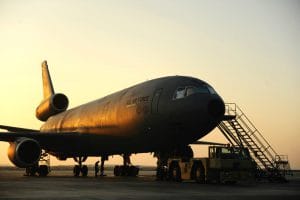

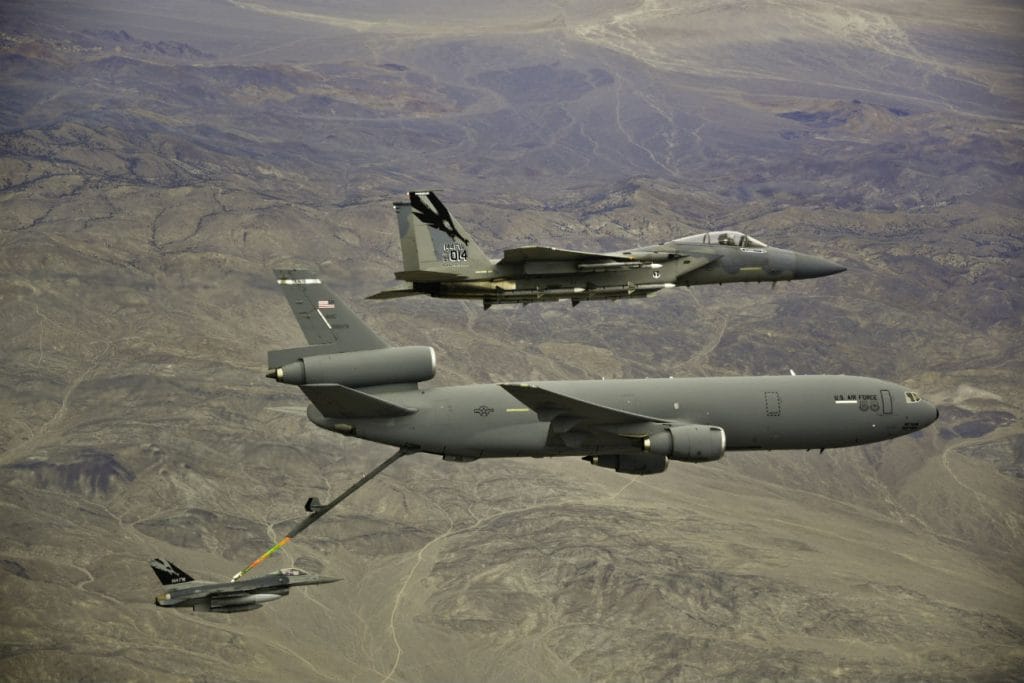
While aerial refueling may date back to the 1920s, it is only in the wake of the Second World War that it became of supreme importance for military forces around the world. The United States Air Force embraced that trend. During the Vietnam war, however, it became apparent that the then current aerial refueling aircraft, the Boeing KC-135 Stratotanker, was increasingly incapable of meeting the rapidly changing requirements of the US’s missions around the world. The threat was changing, as the Soviet Union and its allies were developing their own capabilities, including advanced long-range aerial refueling. With that in mind, they began to look for a replacement. They found it in the McDonnell Douglas KC-10 Extender.
A Heritage of Performance:
The KC-10 Extender was born of an impressive pedigree. It was based on the McDonnell Douglas DC-10, a larger and more robust airframe than then KC-135. It also offered some unique aerodynamic characteristics that made it an ideal candidate upon which to base an aerial refueling aircraft. Aerial refueling is accomplished by having the aircraft in need of fuel fly behind the aircraft doing the fueling. In this position, turbulent wake from the lead aircraft can have disastrous consequences for the aft aircraft - including loss of control that may result in a collision or crash. During initial testing at Edwards Air Force Base in 1972, personnel evaluating the DC-10 found that it had a remarkably stable wake. With that concern out of the way, work began on developing a new aircraft.
From Airliner to Military Workhorse:
Working from a particular variant of the DC-10, the DC-10-30CF, McDonnell Douglas engineers removed the airliner traits and replaced them with features that would meet its new military mission. These included an improved cargo-handling system, advanced military-grade avionics, the removal of most windows on the body of the aircraft, and a much wider cargo door. However, the core systems and airframe retain roughly 88% commonality with the commercial counterpart. This serves an important need: ensuring that the DC-10 can make use of commercial support systems worldwide. Furthermore, this gives the KC-10 Extender operational flexibility and reduces the logistics needed to ensure good maintenance.
Aerial Refueling:
Of course, that mission is refueling US and allied aircraft. The major changes in the KC-10 design were made to support that end. The fuel storage tanks were installed underneath the main deck of the aircraft, where the baggage compartments would have been in the commercial model. In order to transfer fuel from the KC-10 to another aircraft, engineers developed and installed the McDonnell Douglas Advanced Aerial Refueling Boom (AARB). Installed at the rear of the aircraft in line with the centerline, the AARB is operated via a control panel located in the rear of the plane, making for safer and more accurate operation. The refueling boom is also equipped with a hose-and-drogue system. This allows the KC-10 Extender to refuel nearly all US and allied fixed-wing aircraft without altering the configuration or using an adapter.