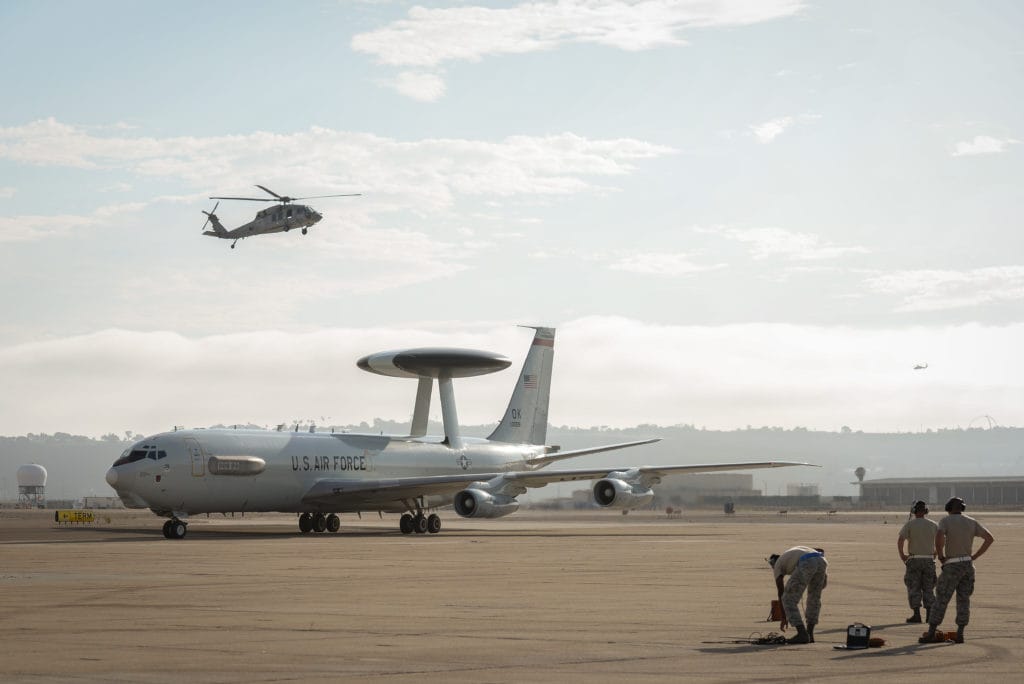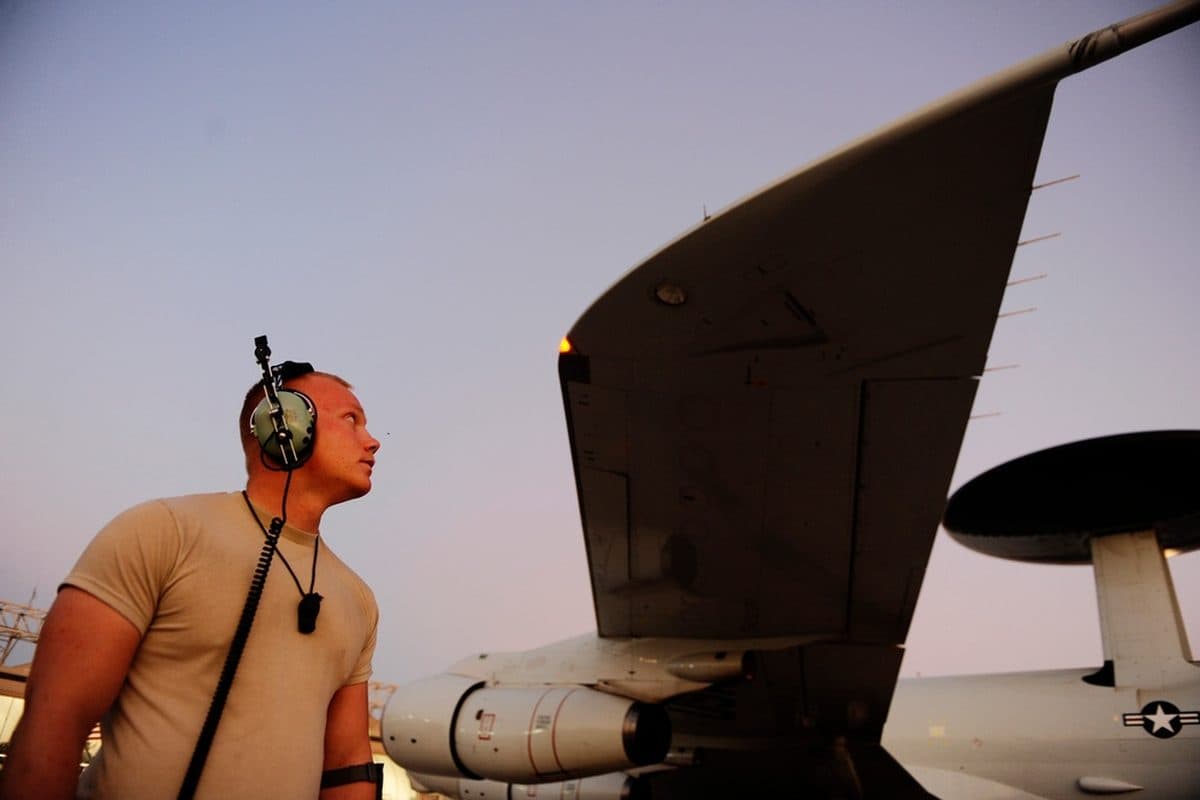

The Boeing E-3 Sentry is far more than just an airborne radar. Nicknamed the “Eye in the Sky” by many pilots, this airborne warning and control system (AWACS) is a combination flying command post and spy plane. With its million-watt Doppler Radar System, AWACS can detect incoming aircraft or missiles from tree-top height all the way up to the high end of the stratosphere, and out to hundreds of miles farther than any ground-based radar system.
AWAC Capabilities:
The sheer range and sensitivity of an AWACS’s AN/APY-2 radar, which is also capable of ignoring ground clutter that confuses most other radars, is a game-changing feature in and of itself. During Desert Storm, most Iraqi warplanes were continuously tracked from the moment they went “wheel’s up” from their bases by E-3’s circling 200+ miles away in Saudi Arabia.
In aerial combat, the advantage always swings to the side with E-3’s. The “Eye in the Sky” provides total situational awareness of friendly and hostile activity, real-time command and control of an area of responsibility, early warning of enemy actions and flexible battle management of theater forces. Almost as important, AWACS crews ease the burden on combat aircraft by coordinating various reconnaissance, weapons control, battle management and communications functions.
 In other words, once a threat is identified, the AWACS’s fully integrated command and control battle management (C2BM) system and “God’s eye” view of the battlespace are the ultimate force multipliers. While the enemy aircraft are blind to what their targets are doing, the E-3 Sentry is busy rerouting friendly forces to intercept them. With the added benefit that defensive fighters do not need to actively scan with their own radar, E-3s make these fighters nearly invisible to the enemy until they open fire.