
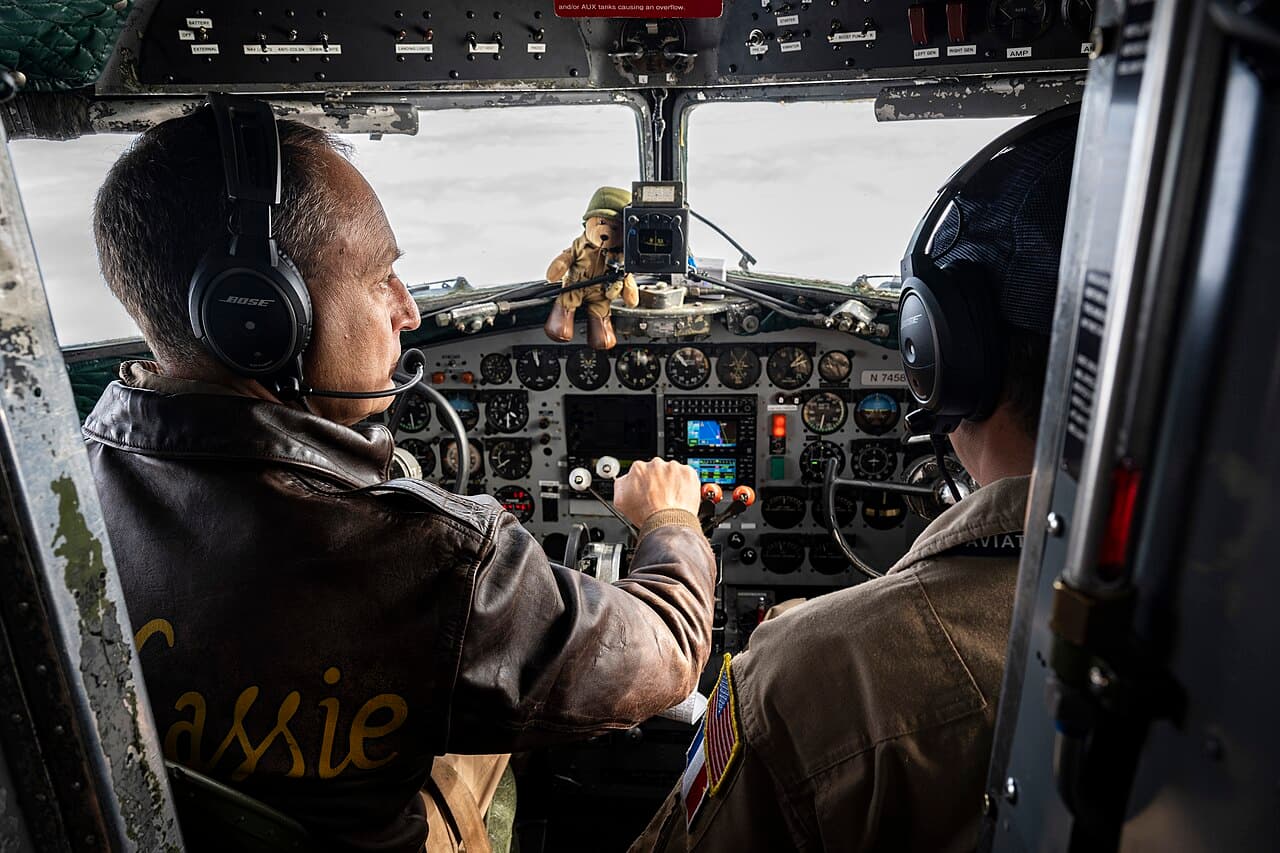
Douglas C-47A Skytrain
Douglas Aircraft Company
How does the C-47A stack up?
CompareOverview
The Douglas C-47 Skytrain, known to the British as the "Dakota" and beloved by aircrews worldwide as the "Gooney Bird", was the most important transport aircraft of World War II and arguably the most important aircraft of the war, period. While fighters and bombers won headlines, it was the C-47 that made the Allied war machine work. Every major Allied airborne operation, every sustained air supply effort, every theater of the war depended on this military version of the Douglas DC-3 airliner.
General Dwight Eisenhower named the C-47 as one of the four most important weapons of the war, alongside the bazooka, the jeep, and the atomic bomb. The aircraft carried paratroopers to Normandy, hauled supplies over the "Hump" from India to China, evacuated wounded from the front lines, towed gliders, and served as an airborne command post. No other single aircraft type was as universally present or as indispensable to Allied operations.
The C-47 could carry 28 fully equipped paratroopers, or 6,000 pounds of cargo, or a combination of both. It could operate from unimproved dirt strips, survive harsh conditions from Arctic cold to tropical heat, and be maintained by ground crews with basic tools. Over 10,000 were built during the war, and the design continued in military service for decades, with some still flying commercially in the 21st century.
Performance Profile
Max Speed
224 mph
at 10,000 ft
Range
1,600 miles
normal
Service Ceiling
26,400 ft
Rate of Climb
930 ft/min
Armament
0 guns
Crew
4
Engine
Pratt & Whitney R-1830-92 Twin Wasp
1200 hp radial
Development History
The C-47 was the military adaptation of the Douglas DC-3, one of the most successful commercial aircraft designs in aviation history. The DC-3, which first flew on December 17, 1935 (the 32nd anniversary of the Wright Brothers' first flight), revolutionized commercial air travel by making passenger flights economically viable for the first time. By 1939, DC-3s carried 90% of the world's airline traffic.
The Army Air Corps recognized the DC-3's military potential early and ordered a small number of C-39 and C-41 transport versions. When war production began in earnest, Douglas designed the C-47, a dedicated military transport incorporating a reinforced cargo floor, a large cargo door on the port side, folding bench seats along the fuselage walls, a tow hook for gliders, and hardpoints for astrodome navigation equipment. The C-47A, the most-produced variant, featured a 24-volt electrical system (versus the 12-volt system in earlier C-47s) for compatibility with standard military equipment.
Douglas produced C-47s at plants in Long Beach, California, and Oklahoma City. The US Navy operated the aircraft as the R4D. The Soviet Union manufactured a licensed copy as the Lisunov Li-2, producing over 4,900 at factories in Tashkent. The Japanese also produced an unlicensed copy as the Showa L2D "Tabby." In total, the DC-3/C-47 family and its derivatives numbered over 16,000 aircraft, making it one of the most-produced transport designs in history.
The C-47's Pratt & Whitney R-1830 Twin Wasp engines were reliable, fuel-efficient, and easy to maintain, qualities that mattered more than raw performance in the transport role. The aircraft's semi-monocoque aluminum construction was lightweight but durable, and the low wing loading allowed operations from short, unprepared airstrips that other transports could not use.
Combat History
The C-47's war began in the Pacific, where early examples helped evacuate personnel from the Philippines and Dutch East Indies in early 1942. But it was in the airborne operations that the C-47 earned its greatest fame. On the night of July 9-10, 1943, C-47s carried the 82nd Airborne Division to Sicily in Operation Husky, the first major Allied airborne operation. Despite scattered drops and friendly fire incidents, the operation demonstrated the potential of airborne warfare.
On D-Day, June 5-6, 1944, over 800 C-47s of IX Troop Carrier Command delivered the 82nd and 101st Airborne Divisions to Normandy in the largest airborne operation yet attempted. The C-47 crews flew through intense anti-aircraft fire, maintaining formation despite losses, to drop paratroopers behind the invasion beaches. Many C-47s returned the next day towing Waco CG-4A gliders loaded with reinforcements and heavy equipment. The Normandy operation was repeated on an even larger scale in September 1944 during Operation Market Garden, the ill-fated attempt to seize bridges across the Rhine.
In the CBI theater, C-47s flew the most dangerous transport route of the war: the "Hump" over the Himalayas from India to China. Flying at altitudes up to 20,000 feet over some of the most inhospitable terrain on Earth, Air Transport Command C-47 crews hauled the fuel, ammunition, and supplies that kept China in the war. Over 600 aircraft were lost on the Hump route, most to weather and terrain rather than enemy action.
C-47s also served as medevac aircraft, carrying wounded soldiers from forward airstrips to hospitals in the rear. During the Burma campaign, the siege of Bastogne, and countless other operations, C-47s delivered supplies to cut-off garrisons by airdrop. In the final months of the European war, C-47s participated in the massive Operation Varsity Rhine crossing airborne operation in March 1945. No Allied operation of any scale could have been conducted without the Gooney Bird.
Variants
| Designation | Key Differences | Produced |
|---|---|---|
| C-47 | Initial military version, 12-volt electrical, R-1830-92 engines | 965 |
| C-47A | 24-volt electrical system, most-produced variant, standard wartime transport | 5,254 |
| C-47B | High-altitude engines (R-1830-90C) with two-speed superchargers for Hump operations | 3,364 |
| R4D (Navy) | Naval designation for various C-47 variants, used by Navy and Marines | 568 |
| C-53 Skytrooper | Paratroop variant with side-facing seats, glider tow hook, no cargo door | 380 |
| Li-2 (Soviet) | Soviet licensed-production variant built by Lisunov, Shvetsov M-62IR engines | 4,937 |
Strengths & Weaknesses
+Strengths
- Unsurpassed reliability and maintainability; could operate from any airfield in any conditions
- Versatile enough to serve as cargo hauler, paratroop transport, glider tug, medevac, and command post
- Economical to operate and simple to maintain, requiring no specialized ground equipment
- Excellent short-field performance from unimproved strips
- Docile handling qualities made it accessible to pilots of widely varying experience levels
-Weaknesses
- Completely unarmed and vulnerable to fighter attack and anti-aircraft fire
- Slow cruising speed of 160 mph made it an easy target in hostile airspace
- Limited payload of 6,000 pounds could not accommodate heavy vehicles or artillery
- Unpressurized cabin limited comfortable operations to below 10,000 feet; high-altitude Hump operations were dangerous
Pilot Voices
“The C-47 could do anything. It hauled our supplies, dropped our paratroopers, carried our wounded, and it did it all without complaining.”
“The DC-3 is the only airplane that can make money and lose money at the same time. She can haul anything, anywhere, and bring you back.”
Did You Know?
General Eisenhower called the C-47 one of the four most critical weapons that won the war, alongside the bazooka, the jeep, and the atomic bomb.
Over 800 C-47s participated in the D-Day airborne operations on June 5-6, 1944, delivering the 82nd and 101st Airborne Divisions to Normandy.
The "Hump" airlift from India to China over the Himalayas cost over 600 aircraft, mostly C-47s, making it the most dangerous sustained air transport operation in history.
Some DC-3/C-47 airframes are still flying commercially in the 21st century, nearly 90 years after the type's first flight, a testament to the soundness of the design.