
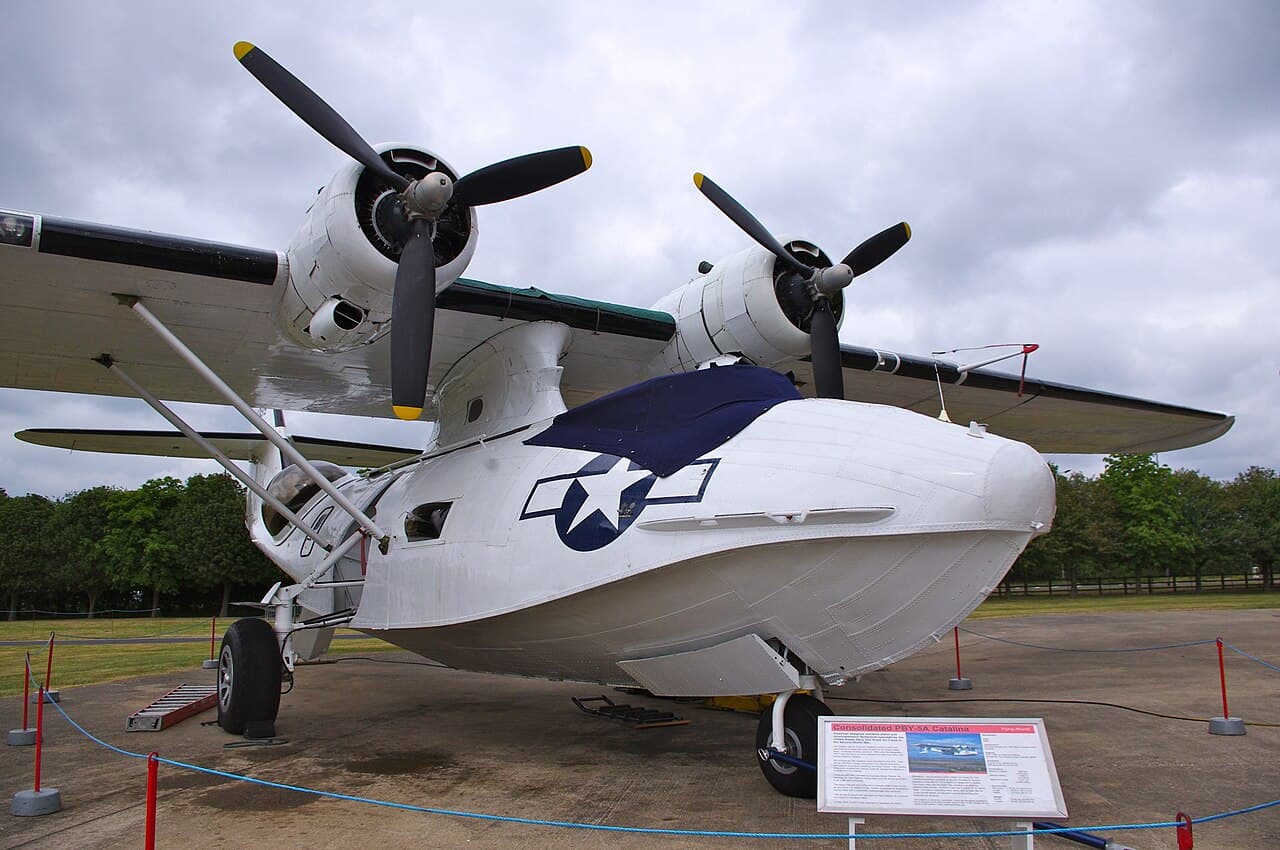
Consolidated PBY-5A Catalina
Consolidated Aircraft
How does the PBY-5A stack up?
CompareOverview
The Consolidated PBY Catalina was the most widely used maritime patrol aircraft of World War II, serving with virtually every Allied navy and air force that operated over water. Slow, ungainly, and vulnerable to fighters, the "Cat" compensated with extraordinary range, endurance, and the ability to land on open ocean to rescue downed aircrews. No other aircraft saved more lives during the war.
The PBY-5A was the amphibious variant, equipped with retractable tricycle landing gear that allowed it to operate from both water and conventional runways. This versatility made it invaluable in the Pacific, where it could stage from remote island lagoons or established bases with equal ease. Catalinas flew marathon patrols of 15 to 20 hours, covering hundreds of thousands of square miles of ocean in search of enemy ships and submarines.
The Catalina's greatest contribution to the war came in the reconnaissance and anti-submarine roles. A PBY crew spotted the Japanese fleet approaching Midway on June 3, 1942, providing the intelligence that enabled the decisive American ambush. In the Atlantic, Catalinas hunted U-boats across the vast ocean, using radar to find surfaced submarines at night. And throughout the Pacific, "Dumbo" rescue Catalinas plucked hundreds of downed aircrews from the sea, often under fire.
Performance Profile
Max Speed
196 mph
at 7,000 ft
Range
2,520 miles
normal
Service Ceiling
18,100 ft
Rate of Climb
620 ft/min
Armament
5 guns
2x .50 BMG, 3x .30 cal
Crew
9
Engine
Pratt & Whitney R-1830-92 Twin Wasp
1200 hp radial
Development History
The PBY traced its origins to a 1933 US Navy competition for a long-range patrol flying boat. Isaac "Mac" Laddon at Consolidated Aircraft designed the Model 28, which featured a parasol wing mounted above the fuselage on a central pylon, with the two engines mounted on the wing's leading edge. The retractable wingtip floats, which folded up to form the wingtips in flight, were an innovative feature that reduced drag compared to fixed floats.
The XP3Y-1 prototype first flew on March 28, 1935, and demonstrated outstanding range and endurance. The Navy ordered 60 aircraft as the PBY-1 in June 1935, the largest peacetime order for naval aircraft since 1918. The PBY-2 through PBY-4 incorporated progressive improvements in engines, armament, and equipment. The PBY-5, introduced in 1940, featured R-1830-92 engines with 1,200 hp, redesigned vertical tail, and improved armament.
The PBY-5A amphibious variant, which added retractable tricycle landing gear, was a game-changer. The ability to operate from both water and land gave commanders far more flexibility in basing and operations. Canadian Vickers built the aircraft as the Canso, and Boeing Canada produced it as well. The Naval Aircraft Factory in Philadelphia built the PBN-1 Nomad, an improved version with a taller tail, modified hull, and increased fuel capacity.
The USAAF operated the PBY-5A as the OA-10 Catalina in the air-sea rescue role, and these "Dumbo" aircraft became some of the most beloved planes in the service. Painted black for night operations, "Black Cat" Catalinas conducted nocturnal attacks on Japanese shipping in the Pacific, using radar to find targets and delivering bombs and torpedoes from low altitude with devastating effect.
Combat History
The PBY's most famous single contribution to the war came on June 3, 1942, when Ensign Jewell "Jack" Reid, flying a PBY-5 from Midway, spotted the Japanese invasion force approaching from the southwest and broadcast the report "Many planes heading Midway." The following day, PBY crews located the Japanese carrier strike force, enabling the SBD Dauntless attacks that sank four carriers and won the Battle of Midway. That night, four PBY-5As made a torpedo attack on the invasion fleet, scoring a hit on a tanker, one of the few successful night torpedo attacks by aircraft in the Pacific war.
In the Atlantic, PBY Catalinas and RAF-operated Catalinas played a critical role in the anti-submarine campaign. RAF Catalinas of No. 209 Squadron located the German battleship Bismarck on May 26, 1941, after it had evaded the Royal Navy, enabling the fleet to close in and sink the warship. Throughout the Battle of the Atlantic, Catalinas patrolled the mid-ocean gap, hunting U-boats with radar, depth charges, and acoustic homing torpedoes.
The "Black Cat" squadrons of the Pacific were among the most innovative and daring units of the war. Painted matte black and operating at night, PBY-5A crews used radar to locate Japanese shipping and barge traffic in the Solomon Islands, New Guinea, and the Philippines. Flying at treetop height, they delivered bombs and depth charges against targets illuminated only by their radar returns. Black Cat operations disrupted Japanese resupply efforts and contributed to the isolation of bypassed garrisons.
"Dumbo" rescue operations were the PBY's most humanitarian mission. Catalina crews landed in open ocean, often in rough seas and under enemy fire, to rescue downed aircrews. During the Marianas campaign alone, PBY crews rescued over 100 aircrews. The courage of Dumbo pilots, who landed their fragile flying boats in shark-infested waters within sight of enemy-held islands, was legendary among the aircrews they saved.
Variants
| Designation | Key Differences | Produced |
|---|---|---|
| PBY-1/2/3/4 | Progressive early variants with improved engines and equipment, pure flying boat configuration | 356 |
| PBY-5 | R-1830-92 engines, redesigned tail, improved armament, major production variant | 1,024 |
| PBY-5A | Amphibious version with retractable tricycle gear, most versatile variant | 803 |
| PBY-6A | Taller vertical tail, radar scanner above cockpit, increased fuel, final US production variant | 175 |
| Canso/Canso A (Canadian) | Canadian Vickers and Boeing Canada-built variants, served with RCAF and others | 731 |
| PBN-1 Nomad | Naval Aircraft Factory-built with modified hull, taller tail, increased fuel, improved bow turret | 156 |
Strengths & Weaknesses
+Strengths
- Extraordinary range and endurance of 20+ hours allowed patrol of vast ocean areas
- Amphibious capability (PBY-5A) permitted operations from water or land bases
- Ability to land on open ocean for air-sea rescue, saving hundreds of downed aircrews
- Reliable and easy to maintain in remote locations with minimal ground support
- Effective radar platform for anti-submarine warfare and nighttime search missions
-Weaknesses
- Extremely slow at under 200 mph, making it highly vulnerable to fighter attack
- Light defensive armament offered minimal protection against enemy aircraft
- Poor climb rate and low service ceiling limited ability to evade threats
- Hull construction was fragile and could be damaged by rough sea landings
Pilot Voices
“We called it the Catalina, but it was really a magic carpet. It could go anywhere, land on anything wet, and stay up there until you ran out of coffee.”
“When you were in the water and you heard the sound of those Twin Wasps, you knew you were going home. The Cat was the most beautiful airplane ever made.”
Did You Know?
A PBY Catalina crew made the critical sighting of the Japanese fleet approaching Midway on June 3, 1942, providing the intelligence that enabled the most decisive naval battle of the Pacific war.
An RAF Catalina of No. 209 Squadron located the German battleship Bismarck on May 26, 1941, after it had shaken off the Royal Navy, enabling the fleet to close in and sink the famous warship.
"Black Cat" PBY squadrons painted their aircraft matte black and conducted night raids on Japanese shipping using radar, pioneering tactics that would influence night maritime operations for decades.
PBY "Dumbo" rescue crews saved hundreds of downed aircrews during the Pacific war, often landing in open ocean under enemy fire, missions that earned them the undying gratitude of fighter and bomber crews.