
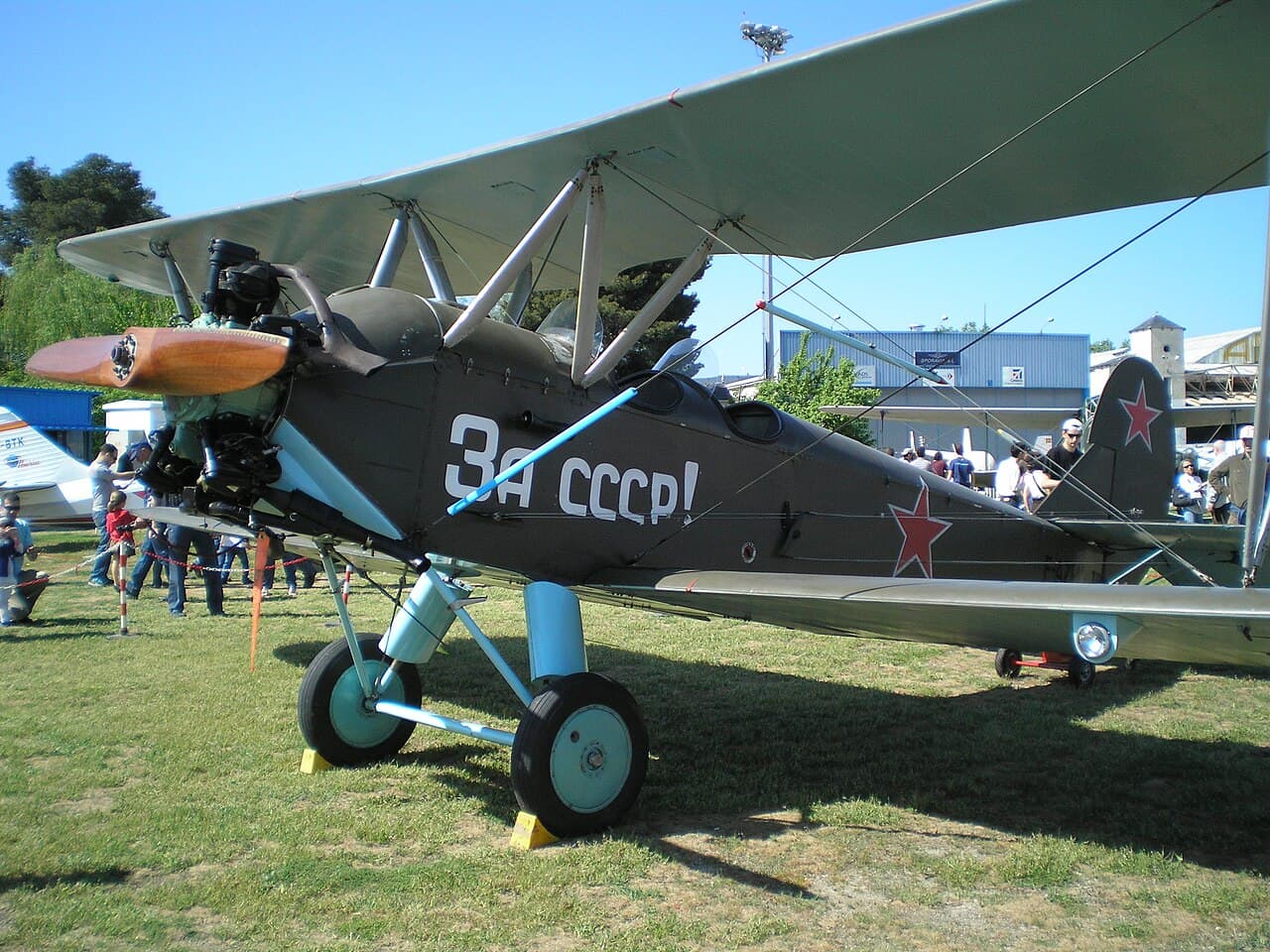
Polikarpov Po-2
Polikarpov
How does the Po-2 stack up?
CompareOverview
The Polikarpov Po-2 was the most improbable combat aircraft of World War II, a fabric-covered biplane trainer from 1928 that became one of the most effective night harassment bombers of the conflict. Designed by Nikolai Polikarpov as a simple, forgiving training aircraft (originally designated U-2), the Po-2 was pressed into combat service out of desperation in 1941 and proved so surprisingly effective in the night bombing role that it remained in active service until the end of the war and beyond.
Its greatest fame came through the all-female 588th Night Bomber Regiment, the legendary "Night Witches", who flew thousands of missions in Po-2s against German positions on the Eastern Front. These women pilots would cut their engines and glide silently over enemy positions, releasing their small bomb loads with devastating psychological effect before the sputtering radial engine restarted and carried them back to safety. The Germans nicknamed them "Nachthexen" (Night Witches) and dreaded the sound of the Po-2's engine in the darkness.
With approximately 33,000 built over a production run spanning from 1928 to 1953, the Po-2 was the second-most-produced aircraft in history after the Il-2 Shturmovik. It served in roles ranging from primary trainer to crop duster, ambulance to liaison, and night bomber to propaganda leaflet distributor. The Po-2 holds the unique distinction of being credited with shooting down a jet aircraft, a USAF Lockheed F-94 Starfire, during the Korean War, making it the only biplane to destroy a jet in combat.
Performance Profile
Max Speed
94 mph
Range
329 miles
normal
Service Ceiling
9,843 ft
Rate of Climb
545 ft/min
Armament
1 guns
1x 7.62mm ShKAS
Crew
2
Engine
Shvetsov M-11D
125 hp radial
Development History
Nikolai Polikarpov designed the U-2 (redesignated Po-2 after his death in 1944) in 1927 as an answer to the Soviet Union's urgent need for a simple, rugged, easy-to-fly primary trainer. The Soviet aviation program was expanding rapidly, and the country needed an aircraft that could be built by semi-skilled workers from readily available materials and flown by students with minimal experience. Polikarpov's solution was a conventional biplane of wooden construction with fabric covering, powered by the domestically produced M-11 radial engine of just 100 horsepower.
The U-2 first flew on January 7, 1928, and was immediately recognized as an outstanding training aircraft. Its docile handling qualities, low stalling speed of barely 40 mph, and ability to operate from any reasonably flat surface made it ideal for the Soviet Union's vast training program. The aircraft was so forgiving that it was virtually impossible to spin accidentally, and even deliberate spins were easy to recover from. Production began in 1928 and never really stopped, over the next 25 years, factories across the Soviet Union turned out U-2/Po-2s in enormous quantities.
When the German invasion struck in June 1941, the massive pilot training infrastructure was disrupted and thousands of trainers became available for repurposing. In a remarkable improvisation, ground crews fitted bomb racks to the lower wings and added simple bombsights. The aircraft's extremely low speed, which was a severe liability in daylight, proved to be an unexpected advantage at night: the Po-2 flew so slowly that it fell below the stall speed of German fighters, making interception extraordinarily difficult. Anti-aircraft guns designed to track aircraft moving at 200-400 mph could not depress or traverse fast enough to engage a target moving at 60 mph at treetop height.
Throughout the war, the Po-2 was continuously adapted for its night-bombing role. Exhaust flame dampeners were fitted to reduce the aircraft's visual signature. Navigation instruments were added for night flying. Bomb release mechanisms were improved. Some aircraft received a rear-seat machine gun for defense. But the fundamental design remained unchanged from 1928, a tribute to the soundness of Polikarpov's original concept and the remarkable adaptability of a simple, well-designed airframe.
Combat History
The Po-2's combat career began in the desperate autumn of 1941, when every available aircraft was thrown into the fight against the German advance on Moscow. Initially, Po-2 night-bombing missions were crude affairs, pilots navigating by railroad tracks and rivers, dropping small bombs on any lights they could see. But as tactics evolved, the night harassment campaign became devastatingly effective at disrupting German sleep, morale, and rear-area operations.
The most famous Po-2 unit was the 588th Night Bomber Regiment, formed in October 1941 by Major Marina Raskova as part of three all-female aviation regiments. The regiment was staffed entirely by women, pilots, navigators, ground crew, and commanders. They flew their first combat missions in June 1942 and would go on to fly over 23,000 sorties by war's end, dropping approximately 3,000 tons of bombs and 26,000 incendiary shells. The regiment never lost a pilot to desertion, and 23 of its members were awarded the Hero of the Soviet Union, the country's highest honor.
The Night Witches developed tactics that maximized the Po-2's surprising advantages. Flying in groups of three, the first two aircraft would approach the target with engines running, drawing searchlight and anti-aircraft fire. The third aircraft would then cut its engine and glide silently over the target, releasing its bombs before the defenders could react. The pilots would often make multiple runs per night, returning to their forward airstrip to rearm and refuel before flying again, sometimes completing eight or more sorties between dusk and dawn.
German troops grew to hate and fear the nightly Po-2 raids out of all proportion to the physical damage inflicted. The psychological effect of constant nocturnal harassment, the inability to sleep, the uncertainty about when the next bomb would fall, the humiliation of being attacked by an aircraft that looked like it belonged in a museum, was immense. The Luftwaffe specifically assigned night-fighter units to counter the Po-2 threat, but the biplane's slow speed, tiny radar signature, and ability to operate from any field made it nearly impossible to intercept systematically. The Po-2 continued to fly night missions through the fall of Berlin, and its Korean War service demonstrated that its effectiveness was not limited to the Eastern Front.
Variants
| Designation | Key Differences | Produced |
|---|---|---|
| U-2 (original) | Standard two-seat primary trainer with M-11 engine (100 hp). Dual controls in tandem open cockpits. The most-produced variant, forming the basis of Soviet pilot training for two decades. | - |
| U-2VS / Po-2VS | Night bomber conversion with underwing bomb racks (up to 551 lbs), simple bombsight, exhaust flame dampeners, and navigation instruments. Some aircraft fitted with rear-seat 7.62mm ShKAS machine gun. | 10,000 |
| U-2LNB | Purpose-built night bomber variant with improved bomb racks, enhanced navigation equipment, landing light for night operations, and provision for RS-82 rockets on underwing rails. | - |
| Po-2S | Ambulance/medevac variant with enclosed pod on the lower wing capable of carrying a single stretcher patient. Used extensively for battlefield casualty evacuation. | - |
| Po-2GN | Propaganda variant equipped with loudspeaker system for broadcasting messages to enemy troops. Also used for psychological warfare operations and surrender broadcasts. | - |
Strengths & Weaknesses
+Strengths
- Extremely low speed made it nearly impossible for modern fighters and radar-directed AA guns to track and engage effectively at night
- Could operate from any flat surface, roads, fields, frozen lakes, requiring no prepared airstrip and minimal ground support
- So simple and rugged that it could be maintained and repaired by ground crews with minimal training and basic hand tools
- Virtually silent in engine-off glide, allowing surprise bomb delivery before defenders could react
-Weaknesses
- Virtually defenseless in daylight, any fighter could easily destroy a Po-2, and even ground fire from rifles posed a serious threat
- Minimal bomb load of 551 lbs limited the physical damage each sortie could inflict, requiring large numbers of missions for significant effect
- Fabric-covered wooden construction was extremely vulnerable to fire, a single incendiary round could ignite the entire aircraft
- Open cockpit exposed crew to extreme cold during winter night operations, sometimes causing frostbite despite heavy clothing
Pilot Voices
“We were called Night Witches. We cut the engines and glided in, you could hear only the wind. The Germans said it sounded like broomsticks. That is why they called us witches.”
“Almost every time we had to fly through a wall of fire. The plane was made of plywood, so it would burn like a torch. We had no parachutes. If we were hit, we burned with the plane.”
“The Germans placed a bounty on our heads. Any pilot who shot down a Night Witch was to receive an Iron Cross. We considered it an honor.”
Did You Know?
The all-female 588th Night Bomber Regiment, the "Night Witches", flew over 23,000 combat sorties in Po-2s, with some pilots completing over 1,000 individual missions. Twenty-three members were awarded the Hero of the Soviet Union.
A Po-2 is credited with the only confirmed biplane-versus-jet kill in history: during the Korean War, a USAF F-94 Starfire night fighter stalled and crashed while trying to slow down enough to engage a Po-2, which was officially credited with the "kill."
The Po-2 flew so slowly, about 94 mph at maximum, that it could not be engaged by most German fighters, whose stall speeds were higher than the Po-2's top speed. Fw 190 pilots specifically complained that they could not fly slowly enough to get a firing solution.
Night Witches pilots sometimes made up to 18 bombing runs in a single night, spending barely minutes on the ground between sorties to rearm. Navigator Nadezhda Popova flew 852 missions during the war.