
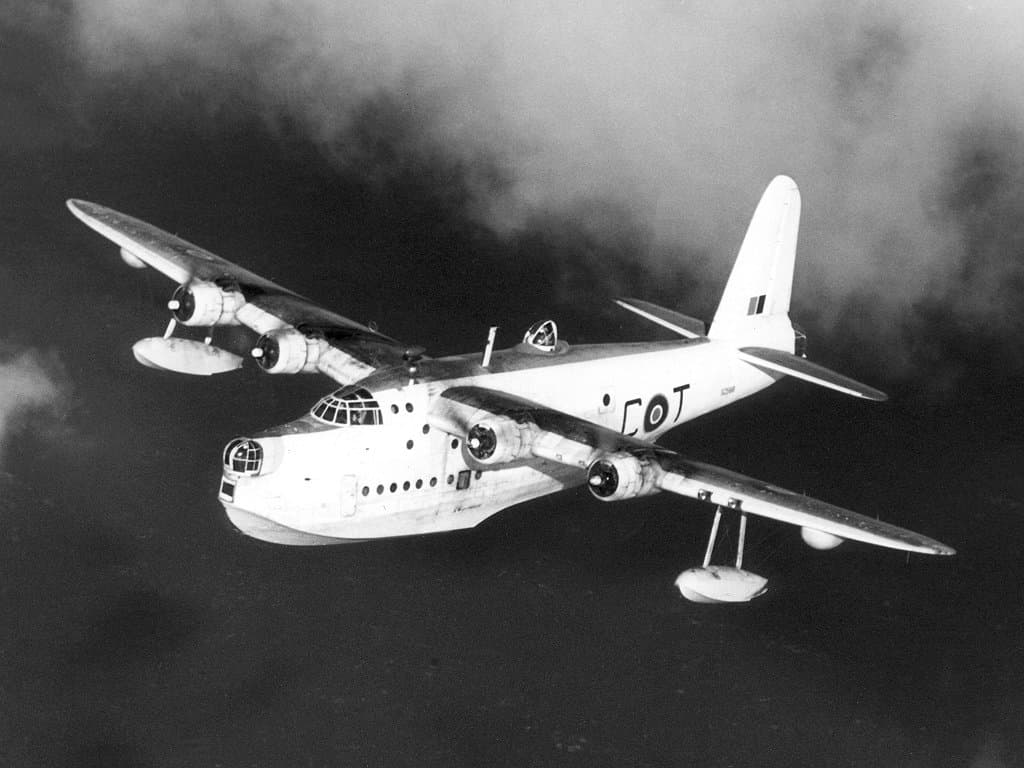
Short Sunderland Mk III
Short Brothers
How does the Sunderland Mk III stack up?
CompareOverview
The Short Sunderland was the finest flying boat of the Second World War, a massive four-engine patrol bomber that kept watch over the Atlantic, hunted U-boats, and could fight off attacking fighters with such ferocity that the Luftwaffe nicknamed it the "Fliegendes Stachelschwein", the Flying Porcupine. The Mk III was the definitive wartime variant, incorporating lessons from the first years of the Battle of the Atlantic.
With a range of nearly 3,000 miles and endurance of up to 13 hours, the Sunderland could patrol vast stretches of ocean that land-based aircraft could not reach. Operating from bases in Britain, Iceland, West Africa, and the Far East, Sunderlands provided continuous coverage over the mid-Atlantic "gap" that U-boats had exploited so effectively in the early years of the war.
The Sunderland was more than a patrol aircraft, it was a self-contained combat platform. Its two-deck hull housed crew rest areas, a galley, and a workshop, allowing crews to maintain their effectiveness over marathon missions. Armed with up to fourteen machine guns and carrying depth charges, bombs, and later rockets, the Sunderland was both a hunter and a fighter.
Performance Profile
Max Speed
213 mph
at 5,000 ft
Range
2,980 miles
normal
Service Ceiling
17,900 ft
Rate of Climb
840 ft/min
Armament
14 guns
8x .303 Browning, 2x .50 Browning, 4x .303 Vickers GO
Crew
11
Engine
Bristol Pegasus XVIII
1065 hp radial
Development History
The Sunderland was derived from the civilian Short Empire flying boat, which had pioneered long-distance Imperial Airways routes across the British Empire in the 1930s. Arthur Gouge at Short Brothers adapted the Empire boat's hull and wing design to military requirements, adding powered gun turrets, a bomb bay in the hull, and military equipment.
The prototype first flew on October 16, 1937, and the Mk I entered service with No. 230 Squadron in June 1938, making the Sunderland one of the few prewar RAF types to serve from the first day of war to the last. The Mk I was powered by Bristol Pegasus XXII engines producing 1,010 hp each.
The Mk II introduced Pegasus XVIII engines with two-speed superchargers and a dorsal turret with twin .303 guns, but only 43 were built before the definitive Mk III entered production. The Mk III featured a revised planing bottom hull with a faired step, which significantly improved hydrodynamic performance during takeoff and landing. This seemingly minor change reduced takeoff distance and improved handling on the water in rough conditions.
The Mk III was the most numerous Sunderland variant, with 461 built by Short Brothers at Rochester and Belfast, plus Blackburn Aircraft at Dumbarton. Later Mk IIIs received ASV Mk III centimetric radar, replacing the earlier metric-wavelength sets that the Germans had learned to detect. The final Mk V variant, with Pratt & Whitney Twin Wasp engines, served into the 1950s.
Combat History
Sunderlands were in combat from the first day of the war, with No. 228 Squadron flying patrols from Pembroke Dock on September 3, 1939. Their primary mission throughout the conflict was anti-submarine patrol over the Atlantic, and Sunderlands sank or shared in the destruction of 26 U-boats during the Battle of the Atlantic.
The Sunderland earned its "Flying Porcupine" nickname on April 3, 1940, when a Mk I of No. 228 Squadron was attacked by six Junkers Ju 88 fighters over Norway. The Sunderland's gunners shot down one Ju 88 and damaged the remaining five so severely that they broke off the attack. This was not an isolated incident, Sunderlands repeatedly fought off fighter attacks throughout the war, their heavy defensive armament making them dangerous opponents.
In the Bay of Biscay, Sunderlands conducted anti-submarine patrols against U-boats transiting to and from their Atlantic hunting grounds. The introduction of ASV radar and depth charges with improved fusing transformed the Sunderland from a deterrent into a killer, and many U-boats were caught and destroyed on the surface during 1943-1944 as the tide of the Battle of the Atlantic turned decisively against Germany.
Sunderlands also served in the Far East, where RAAF and RAF squadrons patrolled the Indian Ocean and supported operations in Burma and Malaya. In the Mediterranean, they hunted Axis submarines and conducted long-range patrols. Perhaps most dramatically, Sunderlands participated in the evacuation of Crete in 1941, carrying soldiers crammed into every available space to escape the German airborne assault.
Variants
| Designation | Key Differences | Produced |
|---|---|---|
| Mk I | Initial production with Bristol Pegasus XXII engines (1,010 hp each); manually operated nose turret; ASV Mk II radar. | 90 |
| Mk II | Pegasus XVIII engines with two-speed superchargers; powered dorsal turret; only limited production. | 43 |
| Mk III | Definitive variant with revised planing hull for improved water handling; ASV Mk III centimetric radar; most-produced variant. | 461 |
| Mk V | Pratt & Whitney R-1830 Twin Wasp engines (1,200 hp each); improved radar and electronics; served postwar until 1959. | 155 |
| Mk IIIA (Seaford) | Proposed larger development with Bristol Hercules engines; became the postwar Short Seaford and eventually the Short Solent civil flying boat. | - |
Strengths & Weaknesses
+Strengths
- Exceptional range and endurance of up to 13 hours enabled mid-ocean patrols no land-based aircraft could match
- Heavy defensive armament of up to 14 guns earned it the "Flying Porcupine" nickname and deterred fighter attacks
- Two-deck hull with crew amenities sustained crew effectiveness during marathon patrols
- Could operate from any sheltered water without runways, providing basing flexibility in remote locations
-Weaknesses
- Very slow maximum speed of 213 mph made it vulnerable when fighters pressed their attacks
- Enormous size made it an easy target for both fighters and anti-aircraft fire
- Complex and time-consuming maintenance required dedicated flying boat bases with marine facilities
- Takeoff and landing on open water was hazardous in rough conditions despite the improved Mk III hull
Pilot Voices
“A thirteen-hour patrol in a Sunderland was exhausting, but the aircraft was magnificent. She was a fortress in the sky, and the U-boats knew it. When a Sunderland arrived overhead, they dived.”
“The Sunderland was like a ship of the air. She had a galley, bunks, a workshop, everything you needed for long patrols. No other aircraft could match that endurance.”
Did You Know?
Luftwaffe pilots nicknamed the Sunderland "Fliegendes Stachelschwein" (Flying Porcupine) because its bristling armament of up to 14 machine guns made it extremely dangerous to attack, and several Ju 88s were shot down attempting to intercept Sunderlands.
During the evacuation of Crete in 1941, a single Sunderland carried 82 evacuees in addition to its crew, crammed into every available space in the two-deck hull, setting an unofficial record for passengers carried by a flying boat.
The Sunderland served continuously from September 1939 to May 1945, one of only a handful of aircraft types to serve operationally on both the first and last days of the European war.