
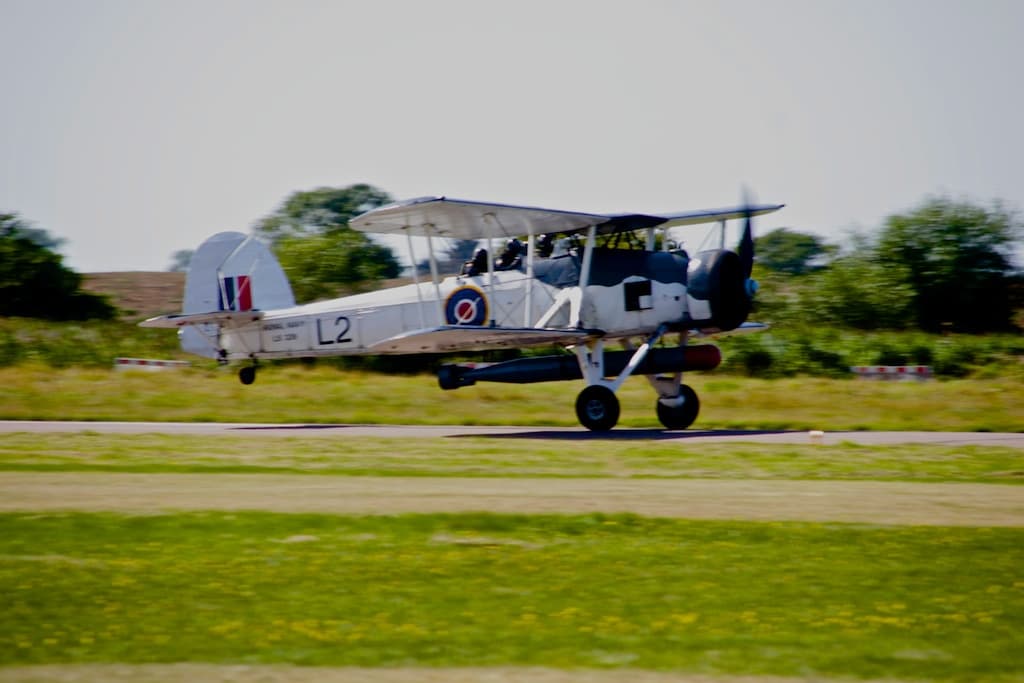
Fairey Swordfish Mk I
Fairey Aviation
How does the Swordfish Mk I stack up?
CompareOverview
The Fairey Swordfish was the most improbable hero of the Second World War, an obsolete fabric-covered biplane that sank more enemy warship tonnage than any other Allied aircraft type. Affectionately nicknamed "Stringbag" by its crews (after the string shopping bags that seemingly held everything), the Swordfish looked like it belonged in the First World War but proved devastatingly effective as a torpedo bomber well into the 1940s.
The Mk I was the original and most famous variant, the one that crippled the Italian fleet at Taranto and sealed the fate of the Bismarck. With a top speed of just 139 mph, slower than many of the ships it attacked, the Swordfish seemed hopelessly outdated. Yet its very obsolescence became an advantage: it could fly so slowly that fighters overshot it, and its biplane agility allowed torpedo approaches at angles that monoplanes could not achieve.
The Swordfish outlasted its intended replacement, the Fairey Albacore, and remained in frontline service from the first day of the war to the last, an achievement unmatched by any other prewar combat aircraft on either side.
Performance Profile
Max Speed
139 mph
at 4,750 ft
Range
546 miles
normal
Service Ceiling
10,700 ft
Rate of Climb
1,220 ft/min
Armament
2 guns
1x .303 Vickers, 1x .303 Lewis/Vickers K
Crew
3
Engine
Bristol Pegasus IIIM.3
690 hp radial
Development History
The Swordfish originated from a 1933 Air Ministry specification for a torpedo-spotter-reconnaissance aircraft for the Fleet Air Arm. Fairey's chief designer Marcel Lobelle created a conventional biplane design with folding wings for carrier stowage, an open cockpit, and fixed undercarriage, thoroughly conventional even by 1930s standards.
The prototype first flew on April 17, 1934, and after modifications to address stability issues discovered in the prototype, production began in 1935. The Swordfish entered service with No. 825 Naval Air Squadron in July 1936 and was immediately recognized as an outstanding torpedo platform, stable and predictable in the demanding low-level approach required for torpedo attacks.
The Mk I was powered by the Bristol Pegasus IIIM.3 radial engine producing 690 hp, modest even for the 1930s. The airframe was all-metal construction with fabric covering, and the three-man crew sat in open cockpits. As a biplane, it had an enormous wing area of 607 square feet, giving it extremely low wing loading and consequently outstanding low-speed handling.
By 1939, the Swordfish was already considered obsolete, and the Fairey Albacore was in development as its replacement. But the Swordfish's simplicity, reliability, and suitability for its primary mission kept it in production long after the supposedly superior Albacore had been retired. Total production across all marks reached 2,391 aircraft.
Combat History
The Swordfish's finest hour came on the night of November 11-12, 1940, when 21 Swordfish from HMS Illustrious attacked the Italian fleet at anchor in Taranto harbor. In two waves flying at just 35 feet, the Swordfish hit three Italian battleships with torpedoes, putting half the Italian battle fleet out of action for months. The attack, for the loss of just two aircraft, shifted the balance of naval power in the Mediterranean overnight and provided the template for Japan's attack on Pearl Harbor thirteen months later.
On May 26, 1941, a Swordfish from HMS Ark Royal scored the torpedo hit on the Bismarck that jammed the German battleship's rudder, enabling the Royal Navy to catch and sink the most powerful warship in the Atlantic. This single torpedo strike, delivered by an aircraft that looked like a relic from 1918, changed the course of the naval war.
The Swordfish's most tragic episode was the Channel Dash on February 12, 1942, when six Swordfish led by Lieutenant Commander Eugene Esmonde attacked the German battlecruisers Scharnhorst and Gneisenau as they dashed through the English Channel. All six aircraft were shot down and only five of the eighteen crew survived. Esmonde was awarded a posthumous Victoria Cross.
From 1943 onward, Mk II and Mk III Swordfish operating from escort carriers played a vital role in the Battle of the Atlantic, hunting U-boats with ASV radar, depth charges, and rockets. The Swordfish's ability to operate from the short flight decks of escort carriers, in weather conditions that grounded faster monoplanes, made it invaluable for convoy protection. The last operational Swordfish flight was on May 28, 1945.
Variants
| Designation | Key Differences | Produced |
|---|---|---|
| Mk I | Original production variant with Bristol Pegasus IIIM.3 engine; open cockpit; could carry torpedo, bombs, or mines. Used at Taranto and against the Bismarck. | 692 |
| Mk II | Strengthened lower wing with metal skinning for rocket rails; Pegasus 30 engine with 750 hp; used primarily for anti-submarine patrol from escort carriers. | 1,080 |
| Mk III | ASV Mk XI centimetric radar in radome between landing gear legs; dedicated anti-submarine variant for escort carrier operations. | 320 |
| Mk IV | Canadian-built variant with enclosed cockpit and additional equipment; limited production. | - |
| Floatplane version | Mk I fitted with twin floats for catapult launch from battleships and cruisers; used for reconnaissance and spotting. | - |
Strengths & Weaknesses
+Strengths
- Superb torpedo delivery platform with stable, predictable low-speed handling
- Extremely low stall speed allowed operation from escort carrier decks too short for monoplanes
- Biplane agility at low altitude made it surprisingly difficult for fighters to engage
- Simple, rugged construction was easy to maintain on carrier decks with minimal facilities
-Weaknesses
- Maximum speed of just 139 mph was slower than many contemporary warships
- Virtually no defensive armament with only two .303 machine guns
- Open cockpit exposed crew to extreme cold during North Atlantic operations
- Completely obsolete design with no ability to evade modern fighters in daylight
Pilot Voices
“The Swordfish could no more evade fighters than a cow could evade a greyhound. Our survival depended on the enemy being somewhere else when we made our attack.”
“She was old and slow, but she was honest. She'd fly in weather that grounded everything else, and she'd put a torpedo exactly where you aimed it.”
Did You Know?
The Swordfish outlived its intended replacement, the Fairey Albacore. The Albacore entered service in 1940 and was retired in 1943, while the "obsolete" Swordfish continued operating until VE Day in 1945.
Japanese naval planners studied the Swordfish attack on Taranto in detail and used it as the model for their attack on Pearl Harbor thirteen months later.
The Swordfish was nicknamed "Stringbag" not because of its struts and wires, but after the old-fashioned string shopping bags that could hold any shape, a reference to the incredible variety of stores (torpedoes, bombs, mines, rockets, radar) the aircraft could carry.