Skip to content
May 2:The Fall of Berlin: Soviet Forces Capture the Nazi Capital81yr ago

50 Most Powerful Tanks Ever Built, Ranked

Charles Bash · · 46 min read
Save
Share:
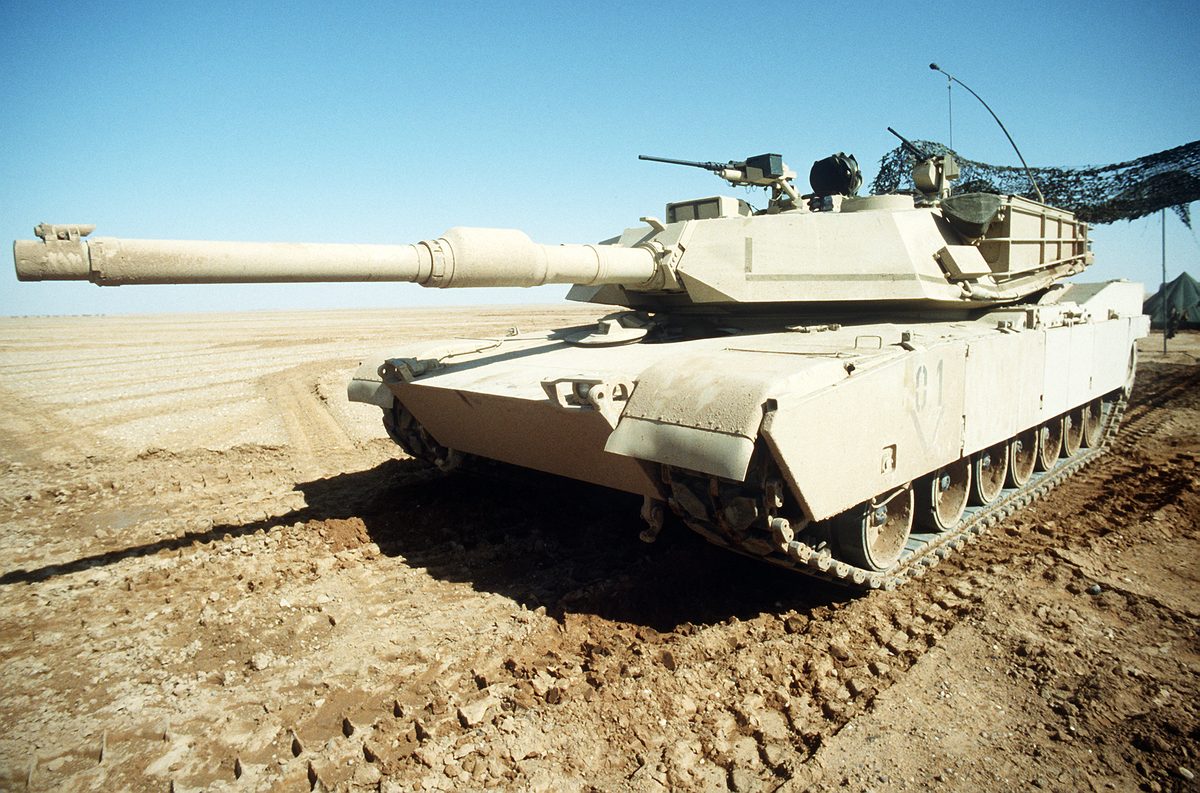
M1 Abrams tank in desert combat
Charles Bash
Charles Bash

Military Culture & Global Defense Writer

Charles Bash covers military culture, global defense forces, and the human side of armed services around the world. His work explores how militaries shape the lives of the men and women who serve in them.

#50: Panzer III: The Blitzkrieg Backbone That Couldn't Keep Up

German Panzer III medium tank advancing across open terrain during World War II

The Panzer III's 50mm KwK 39 cannon could penetrate 78mm of armor at 100 meters, enough to shred early-war Allied tanks but hopelessly outclassed by 1943. Over 5,700 were built between 1939 and 1943, forming the core of Germany's armored divisions during the lightning campaigns across Poland, France, and North Africa.

This was the tank that made blitzkrieg possible. It carried a three-man turret crew, revolutionary for its era, giving German commanders a tactical edge in communication and target acquisition. But as Soviet T-34s and KV-1s appeared on the Eastern Front, the Panzer III's 30-50mm frontal armor that was progressively uparmored throughout the war but could never match the T-34's sloped protection became a critical liability. It was quietly replaced by the Panzer IV and relegated to support roles, a victim of the very arms race it helped ignite in armored warfare.

#49: T-10: The Soviet Heavy That Guarded the Iron Curtain

Soviet T-10 heavy tank on display showing its massive 122mm gun

Weighing 52 tons and armed with a 122mm D-25TA cannon capable of hurling a 25kg shell over 15 kilometers, the T-10 was the last true heavy tank the Soviet Union ever built. Only 1,593 were produced, but each one was designed for a single terrifying purpose: spearheading a breakthrough across the plains of Western Europe.

Entering service in 1954, the T-10 represented the pinnacle of Soviet heavy tank doctrine. Its 120mm of cast armor on the turret front and pike-nose hull design gave it formidable protection for its era. The T-10M variant added infrared night-fighting equipment and a bore evacuator, cutting-edge military technology for the 1950s. It never fired a shot in anger, but NATO planners built entire defense strategies around stopping it. The T-10 remained in Soviet military equipment reserves until 1993, a Cold War relic that outlived the empire that built it.

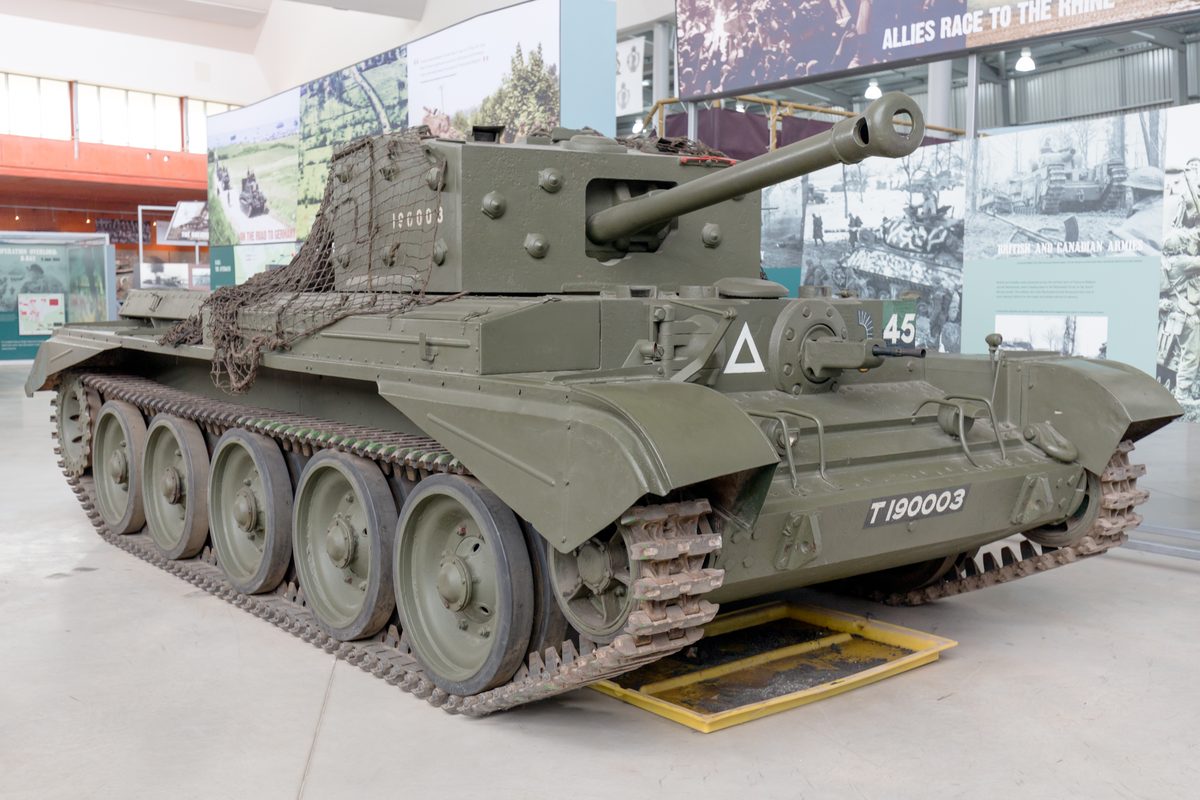
#48: Comet: Britain's Tiger-Killer That Arrived Too Late

British Comet tank with its distinctive 77mm gun advancing through European countryside

The Comet's 77mm HV gun, a modified version of the legendary 17-pounder, could punch through 131mm of armor at 500 meters, giving British tankers their first real chance against Panthers and Tigers from the front. It was the fastest British cruiser tank of the war, hitting 51 km/h on roads.

Arriving in December 1944 with the 11th Armoured Division, the Comet saw just five months of combat but made every one count. During the Rhine crossing in March 1945, Comets led the charge into Germany with a reliability rate that put earlier British tanks to shame. Only 1,200 were built, but the Comet's real legacy was its DNA, it directly evolved into the Centurion, one of the greatest tanks in military history. British crews who had suffered through years of undergunned Cromwells and Churchills finally had a tank that could fight on equal terms.

#47: M3 Lee/Grant: The Ugly Duckling That Held the Line

M3 Lee tank with its distinctive sponson-mounted 75mm gun in North African desert

The M3 packed a 75mm gun in a hull sponson and a 37mm in the turret, an absurd arrangement born from desperation. Yet this ungainly machine was the first Allied tank in North Africa with a gun capable of knocking out German Panzer IIIs and IVs at combat range. Over 6,258 were manufactured in just 18 months.

When the M3 arrived in North Africa with British forces in mid-1942, Rommel's Afrika Korps got an unpleasant surprise. At the Battle of Gazala, Grant variants (the British turret version) scored kills on Panzer IIIs that had been running roughshod over lighter Allied armor. The Soviets received 1,386 M3s through Lend-Lease and used them extensively on the Eastern Front. The tank's tall profile made it vulnerable, crews grimly nicknamed it the "coffin for seven brothers," but it bought the Allies critical time until the M4 Sherman entered production. Sometimes in armored warfare, showing up is half the battle.

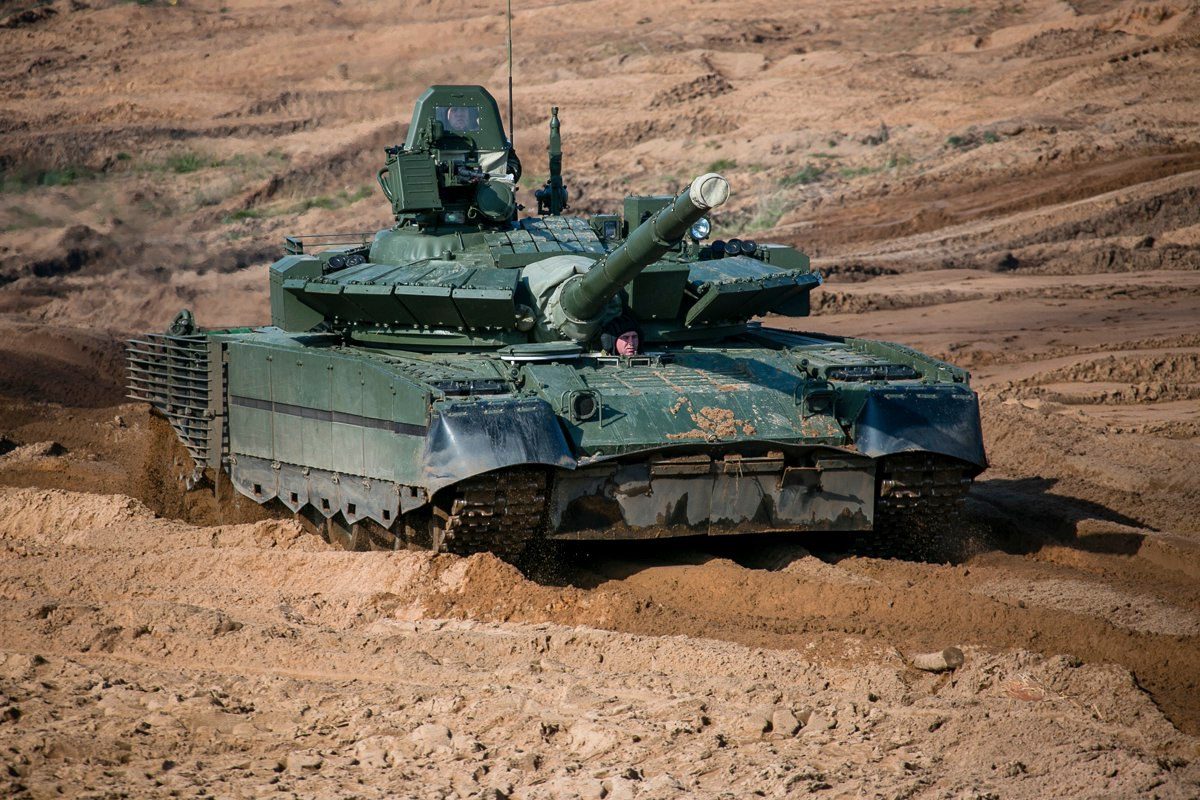
#46: T-90: Russia's Export King With a Laser Trick Up Its Sleeve

Russian T-90 main battle tank firing its 125mm smoothbore gun during live exercises

The T-90's Shtora-1 active protection system can jam incoming laser-guided missiles and automatically deploy smoke grenades, a level of defensive military technology that was cutting-edge when it debuted in 1993. Its 125mm 2A46M smoothbore fires ATGMs through the barrel, giving it an effective engagement range of 5,000 meters.

With over 2,000 built and exported to India, Algeria, Vietnam, and a dozen other nations, the T-90 is the most commercially successful Russian tank since the T-72. India alone operates over 1,000 T-90S Bhishma variants, making it the backbone of their armored divisions. The tank's Kontakt-5 explosive reactive armor provides protection roughly equivalent to 600mm of rolled homogeneous armor against kinetic rounds. In Syria, T-90As shrugged off multiple TOW missile hits on camera, generating viral footage that became Russia's best defense technology advertisement. Its ranking here reflects solid capability limited by the fire control and crew ergonomic compromises inherited from Soviet-era design philosophy.

#45: StuG III: The Ambush Predator With More Kills Than Any Tank

German StuG III assault gun with low-profile silhouette in camouflage during World War II

The StuG III is credited with over 20,000 tank kills during World War II, more than any other armored vehicle on any side. Built on the reliable Panzer III chassis, over 10,600 were produced, making it Germany's most-manufactured armored fighting vehicle of the entire war.

Standing just 2.16 meters tall, over half a meter shorter than a Panzer IV, the StuG III was a nightmare to spot in defensive positions. Its 75mm StuK 40 L/48 gun could penetrate 106mm of armor at 500 meters, more than enough to kill T-34s and Shermans. At the Battle of Kursk, StuG III battalions racked up staggering kill ratios from concealed positions. Technically an assault gun rather than a tank, the StuG III was cheaper and faster to build, which is exactly why Germany produced so many. When military historians study cost-effective armored warfare, the StuG III is exhibit A.

#44: KV-1: The Soviet Fortress That Shocked the Wehrmacht

Soviet KV-1 heavy tank with thick cast armor plowing through muddy terrain on the Eastern Front

In June 1941, a single KV-1 blocked the entire German 6th Panzer Division's advance at Raseiniai for a full day. German 37mm anti-tank guns bounced off its 75mm armor like pebbles. It took an 88mm flak gun firing at point-blank range to finally knock it out, and the crew had to be killed with grenades shoved through the holes.

The KV-1 weighed 45 tons and mounted a 76mm ZIS-5 gun that could destroy any German tank in 1941 at standard combat ranges. Over 4,000 were built, and for the first six months of Operation Barbarossa, German tankers had nothing that could reliably penetrate its armor from the front. The psychological effect was devastating. German after-action reports are filled with near-panic about the "Russian colossus." But the KV-1's 600-horsepower engine was overtaxed, its transmission unreliable, and its turret ring too small for upgrades. By 1943, it was replaced by the IS series, but its early-war invincibility earned it a permanent place in military history.

#43: Tiger II: The Heaviest Predator to Prowl a Battlefield

German Tiger II King Tiger heavy tank with its massive 88mm KwK 43 gun

The Tiger II's 88mm KwK 43 L/71 gun could penetrate 132mm of armor at 2,000 meters. It could kill any Allied tank at ranges where return fire was virtually useless. Its 185mm sloped front hull armor was never confirmed penetrated by any Allied tank gun in direct combat during World War II.

Weighing a staggering 69.8 tons, the King Tiger was the heaviest production tank to see combat in WWII. Only 489 were built due to Germany's collapsing industrial base, and chronic fuel shortages meant many were abandoned rather than destroyed. At the Battle of the Bulge, Tiger IIs of schwere Panzer-Abteilung 501 spearheaded the German offensive, though mechanical breakdowns claimed more King Tigers than enemy fire. The tank consumed 500 liters of fuel per 100 kilometers, a logistics nightmare that perfectly embodied the Third Reich's fatal obsession with wunderwaffen over practical military equipment. Terrifying in theory, crippled by reality.

#42: Altay: Turkey's Bid to Join the Elite Tank Club

Turkish Altay main battle tank during field trials with modular composite armor

The Altay mounts a 120mm Rheinmetall L/55 smoothbore cannon, the same gun family used by the Leopard 2A6, and features a modular composite armor package that can be swapped in the field. Its 1,500-horsepower engine pushes the 65-ton platform to 70 km/h on roads, matching NATO's best.

Turkey's first indigenous main battle tank entered low-rate production in 2023 after over a decade of development. Based on the K2 Black Panther's technology transfer from South Korea, the Altay represents Turkey's ambition to become a major defense technology exporter. The tank features a battlefield management system that networks with other Altay units and Turkish military assets, an autoloader, and hunter-killer capability for the commander. Its ranking reflects impressive specifications on paper tempered by the reality that it has zero combat history. In the competitive world of modern armored warfare, unproven tanks are graded on potential, and the Altay has plenty, if Turkey can scale production beyond limited batches.

#41: Arjun Mk2: India's Homegrown Heavy Hitter

Indian Arjun Mk2 main battle tank during desert trials in Rajasthan

The Arjun Mk2 weighs 68.25 tons, heavier than an M1A2 Abrams, and mounts a 120mm rifled gun that fires LAHAT laser-guided missiles through the barrel, giving it a 5,000-meter engagement range against helicopters and armored vehicles alike. Its Kanchan composite armor has been tested to defeat modern APFSDS rounds.

India's decades-long quest for an indigenous tank finally bore fruit with the Mk2 variant, which addressed 93 deficiencies identified in the original Arjun. The Indian Army ordered 118 Mk2 units after comparative trials in 2010 where it outperformed the T-90S in desert conditions, a politically explosive result given India's massive T-90 investment. The Arjun's 1,400-horsepower turbocharged diesel gives it excellent power-to-weight performance in the Rajasthan Desert, its intended theater. Its ranking reflects genuine capability constrained by limited production numbers and India's ongoing struggle to build a domestic defense technology industrial base. The Arjun proves India can build a world-class tank, now they need to build enough of them.

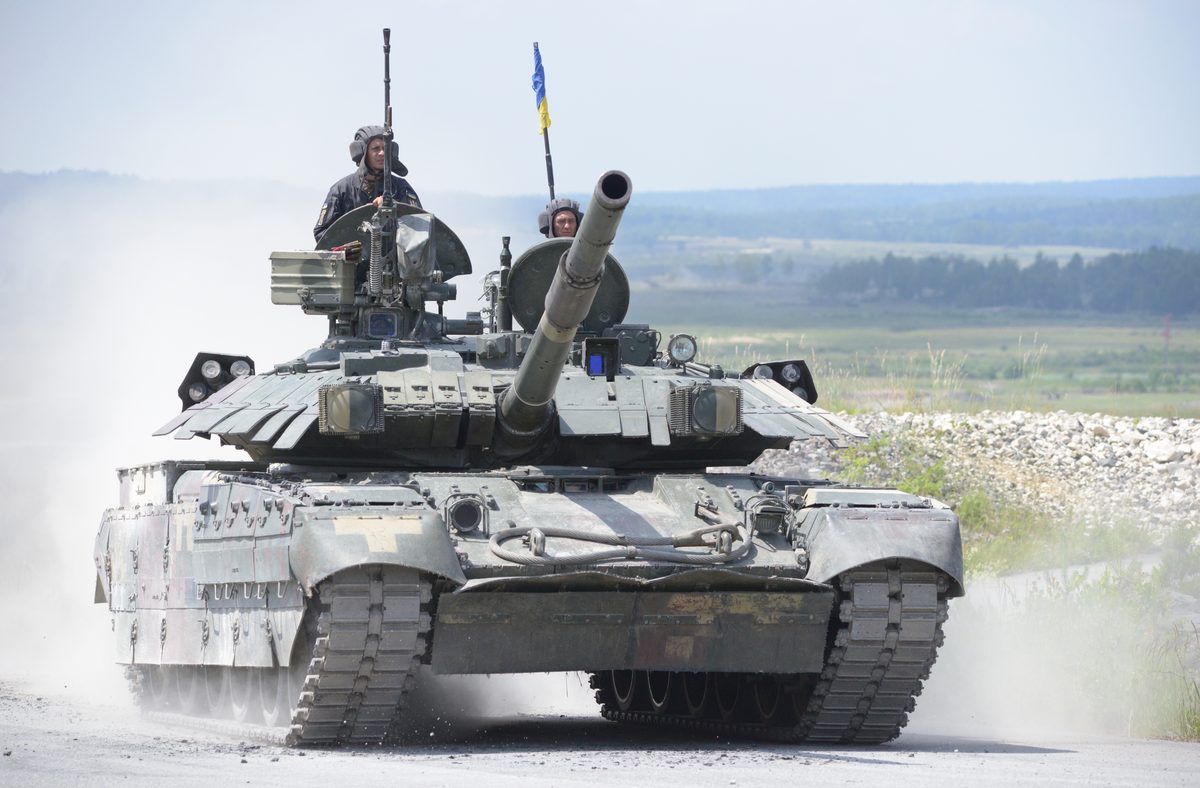
#40: T-84 Oplot-M: Ukraine's Best, Tested by War

Ukrainian T-84 Oplot-M main battle tank with Duplet ERA and distinctive angular turret

The T-84 Oplot-M features Duplet explosive reactive armor that detonates outward in a focused counterburst, neutralizing both kinetic penetrators and shaped-charge warheads, a dual-threat protection system that few tanks in the world can match. Its 6TD-2E engine produces 1,200 horsepower from a uniquely compact two-stroke opposed-piston diesel.

Built at the Malyshev Factory in Kharkiv, the Oplot-M is arguably the most advanced evolution of the Soviet T-80UD lineage. Thailand ordered 49 units in 2011, making it Ukraine's most significant defense technology export. The tank's Varta fire control system integrates thermal imaging, laser rangefinding, and a digital ballistic computer, a generation ahead of the T-72 variants Ukraine inherited from the Soviet era. The ongoing conflict has given Ukrainian engineers brutal real-world feedback on armored warfare, though the Oplot-M itself has seen limited deployment due to small numbers. Its ranking reflects excellent design constrained by a manufacturing base under wartime pressure.

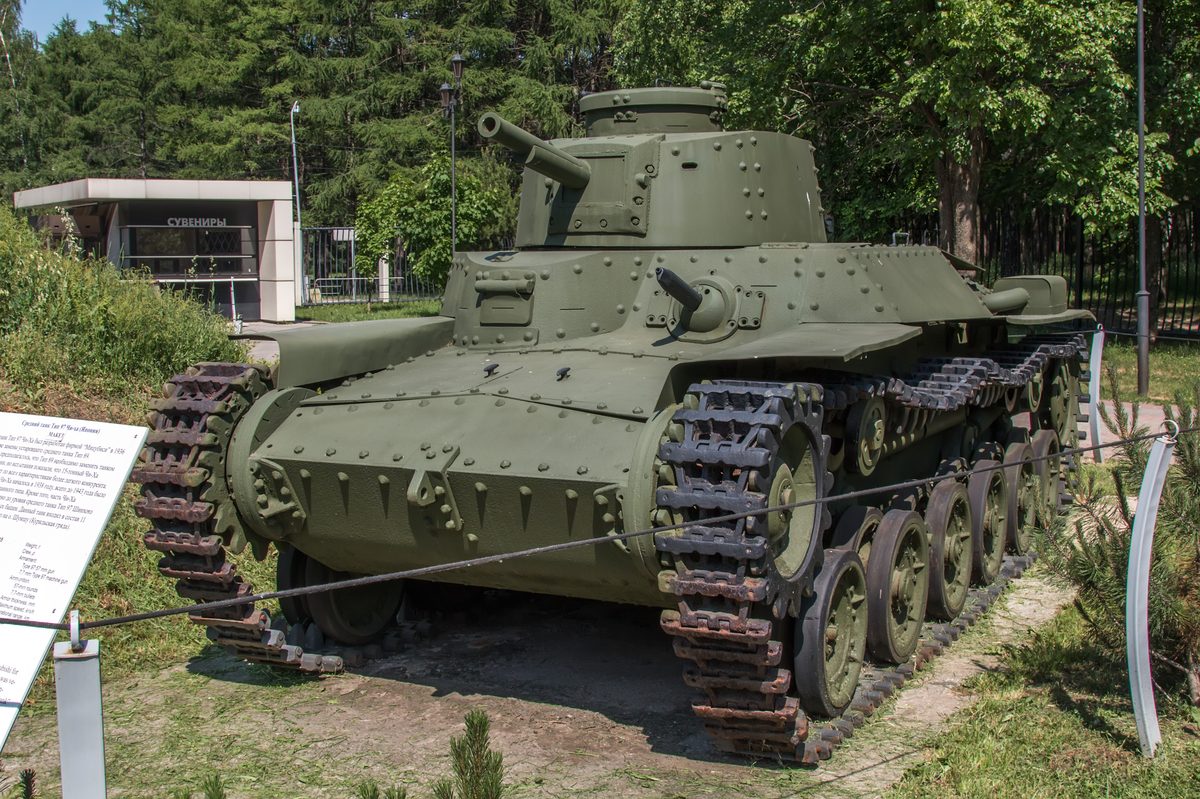
#39: Type 97 Chi-Ha: Japan's Fragile Fist Across the Pacific

Japanese Type 97 Chi-Ha medium tank with rising sun markings in Pacific theater

With just 25mm of frontal armor and a 57mm low-velocity gun, the Type 97 Chi-Ha was outclassed by virtually every medium tank it faced. Yet Japan built 2,123 of them, and they spearheaded the conquest of Malaya, the Philippines, and Burma, campaigns where air superiority and infantry coordination mattered more than raw armor specs.

The Chi-Ha was designed for infantry support in China, where its 57mm gun was adequate against bunkers and light vehicles. When the Pacific War began, it performed well enough against British and American forces that lacked anti-tank weapons in the opening campaigns. But by 1943, encountering M4 Shermans was a death sentence. The Sherman's 75mm gun could penetrate the Chi-Ha at virtually any range, while the Chi-Ha struggled to penetrate the Sherman at all. The improved Shinhoto variant received a 47mm high-velocity gun, but it was too little, too late. The Chi-Ha represents how early military training doctrine and tactical surprise can temporarily overcome inferior military equipment.

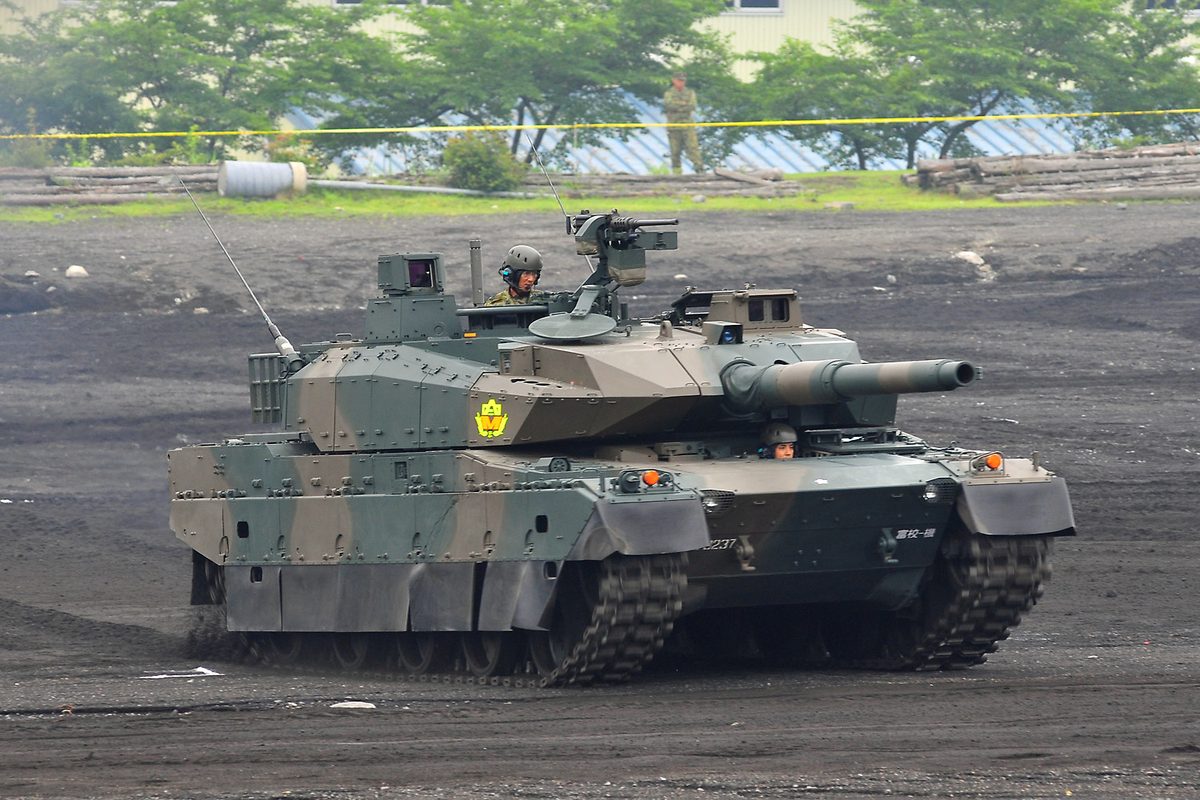
#38: Type 10: Japan's Lightweight Precision Machine

Japanese Type 10 main battle tank with modular armor at speed on a test track

At just 44 tons in base configuration, lighter than every Western main battle tank, the Type 10 was purpose-built for Japan's mountainous terrain and narrow infrastructure. Its Japanese-made 120mm smoothbore gun is paired with a C4I system that networks every vehicle in the formation with real-time targeting data.

Entering service in 2012, the Type 10 represents Japan's philosophy that mobility and information dominance trump raw armor mass. Its continuously variable transmission, borrowed from automotive technology, gives it handling that tankers describe as almost car-like. Modular ceramic composite armor can be added or removed depending on the mission, scaling weight from 44 to 48 tons. The tank's hit-on-the-move accuracy reportedly approaches 90% at standard combat ranges, a testament to Japanese precision engineering. With approximately 100 in service, the Type 10 is optimized for defending the Japanese home islands, where roads, bridges, and tunnels create weight restrictions that would ground an Abrams. In defense technology, sometimes the smartest tank is the lightest one.

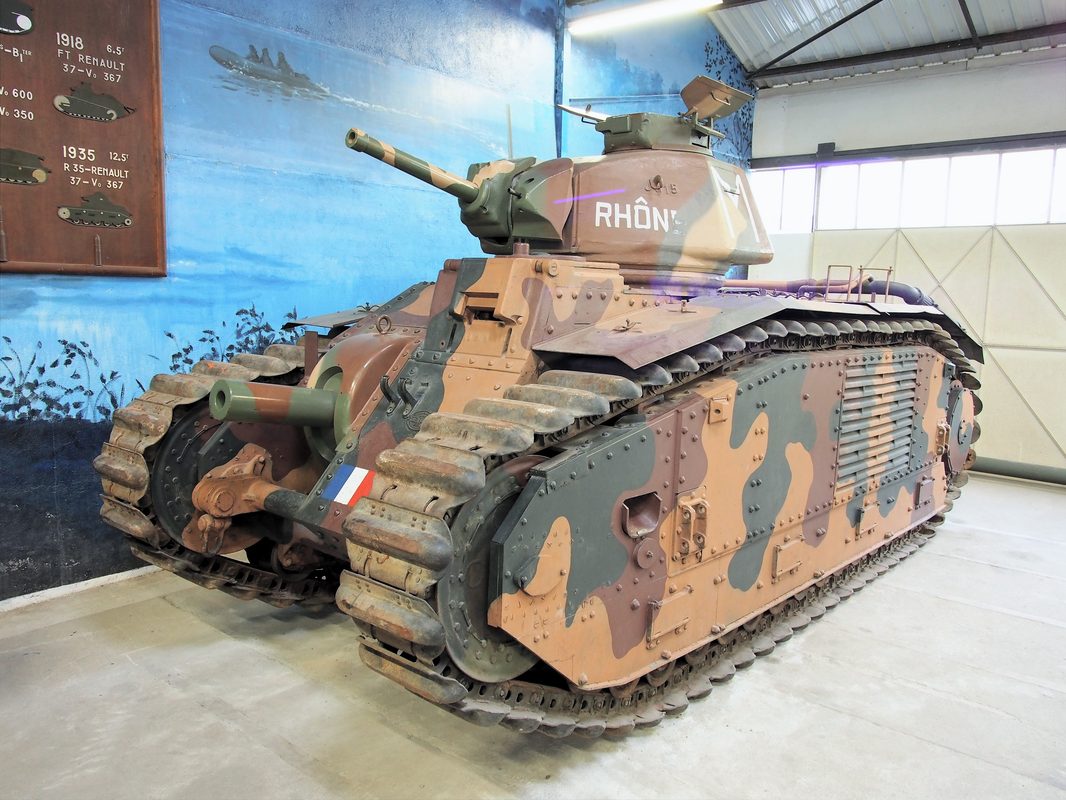
#37: Char B1 bis: France's Rolling Fortress That Terrified the Panzers

French Char B1 bis heavy tank showing its hull-mounted 75mm gun and turret 47mm gun

At the Battle of Stonne in May 1940, a single Char B1 bis named "Eure" destroyed 13 German tanks in a single engagement, taking 140 hits without a penetration. Captain Pierre Billotte drove his tank through the entire German position and back, and the mechanics could not find a single hole in the armor.

The Char B1 bis mounted two guns, a 75mm howitzer in the hull and a 47mm SA 35 in the turret, giving it more firepower than any German tank in 1940. Its 60mm frontal armor was impervious to the standard German 37mm anti-tank gun. France built 369 of them, and in almost every direct engagement, they mauled German armor. So why did France fall? Doctrine. The B1 bis was scattered in small packets across the front instead of concentrated for counterattack. Its 36-liter fuel consumption per 100 kilometers gave it a range of just 180 km, and the one-man turret overwhelmed the commander. The Char B1 bis proves that in armored warfare, the best military equipment in the world loses to superior strategy and tactics every time.

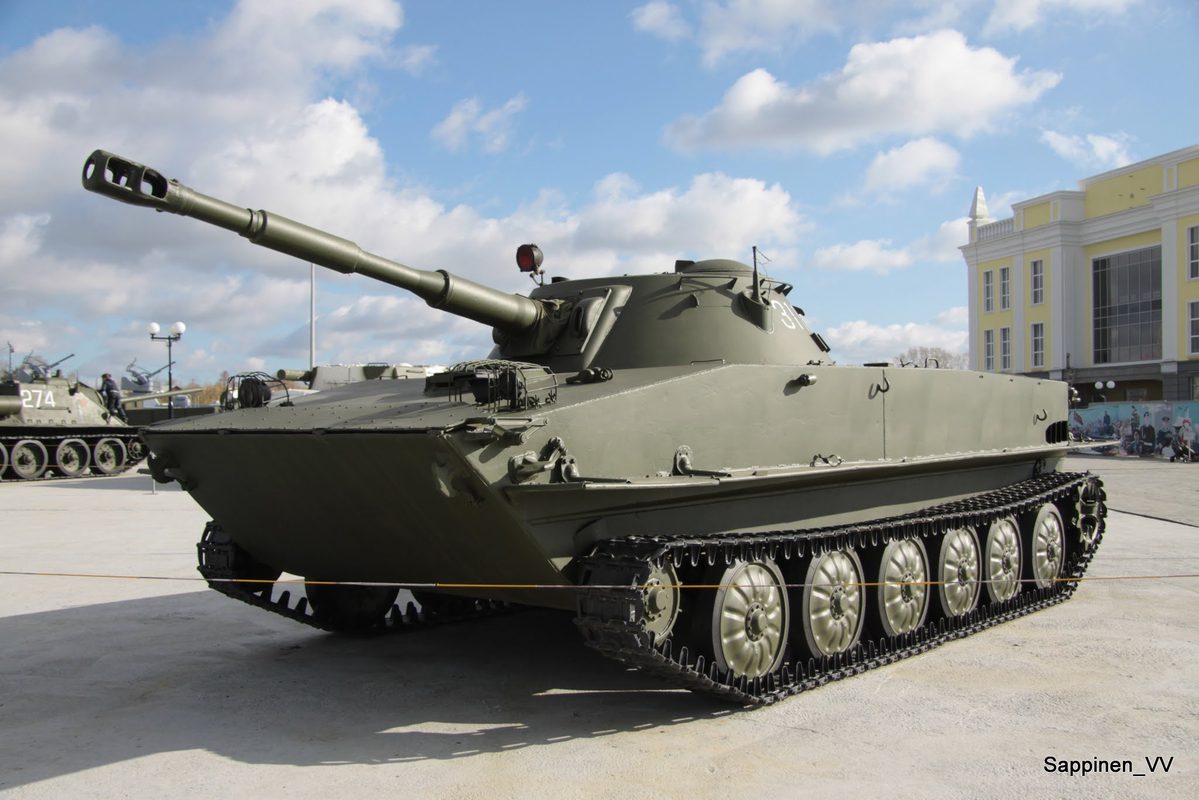
#36: PT-76: The Amphibious Scout That Swam Into History

Soviet PT-76 light amphibious tank swimming across a river with water jets churning

The PT-76 can swim across rivers, lakes, and coastal waters at 10.2 km/h using twin hydrojets, no preparation, no flotation screens, just drive in and go. Its 76mm D-56T gun provided enough firepower to destroy APCs and light vehicles on the far bank before the rest of the force crossed.

Over 12,000 PT-76s were built from 1952 to 1967, serving in more than 25 nations. They saw action in Vietnam, where NVA PT-76s attacked the Special Forces camp at Ben Het in 1969, the first tank-on-tank engagement involving American forces in that war. During the Indo-Pakistani War of 1971, Indian PT-76s crossed the Meghna River into East Pakistan without bridges, a feat no other tank in the Indian inventory could perform. With just 14mm of armor, the PT-76 was never meant to slug it out. It was a reconnaissance platform that could go where no other tank dared, and in military history, the ability to cross a water obstacle unopposed is worth more than inches of armor plate.

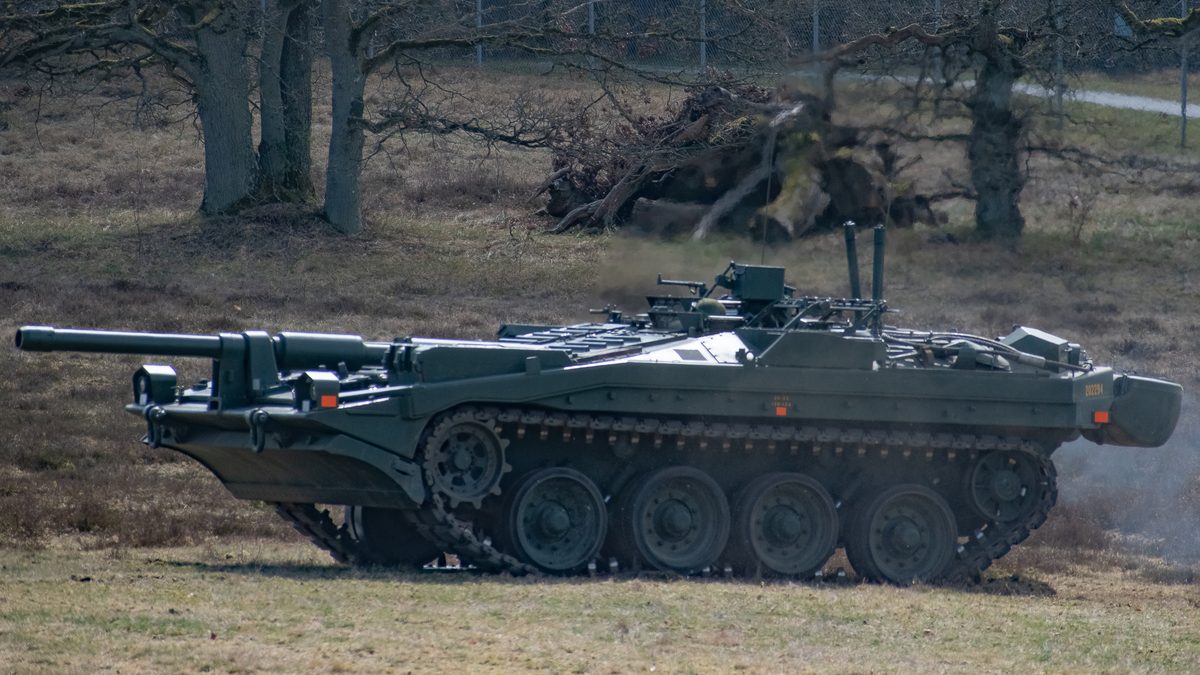
#35: Stridsvagn 103: The Turretless Tank That Broke Every Rule

Swedish Stridsvagn 103 S-tank in hull-down position showing its unique turretless design

The Stridsvagn 103, the S-tank, is the only main battle tank ever fielded without a turret. Its 105mm L74 gun is fixed to the hull, and the entire tank pivots to aim using a revolutionary hydropneumatic suspension that tilts the hull up, down, and sideways. It can present a frontal profile just 1.9 meters high, lower than most APCs.

Sweden designed the S-tank around one scenario: ambushing Soviet armor pouring through Scandinavian forests. In hull-down positions behind berms and rocks, its 40mm frontal armor slope created an effective thickness exceeding 200mm, rounds would simply ricochet. The tank carried a two-man crew plus a rear-facing driver, allowing it to reverse out of firing positions at full speed without turning around. Approximately 290 were built between 1967 and 1971. NATO observers were skeptical of the turretless concept, but Swedish military training exercises consistently showed S-tanks destroying simulated enemy forces at 3:1 ratios from prepared positions. It was retired in 1997, but the S-tank remains the most radical approach to defense technology in tank design history.

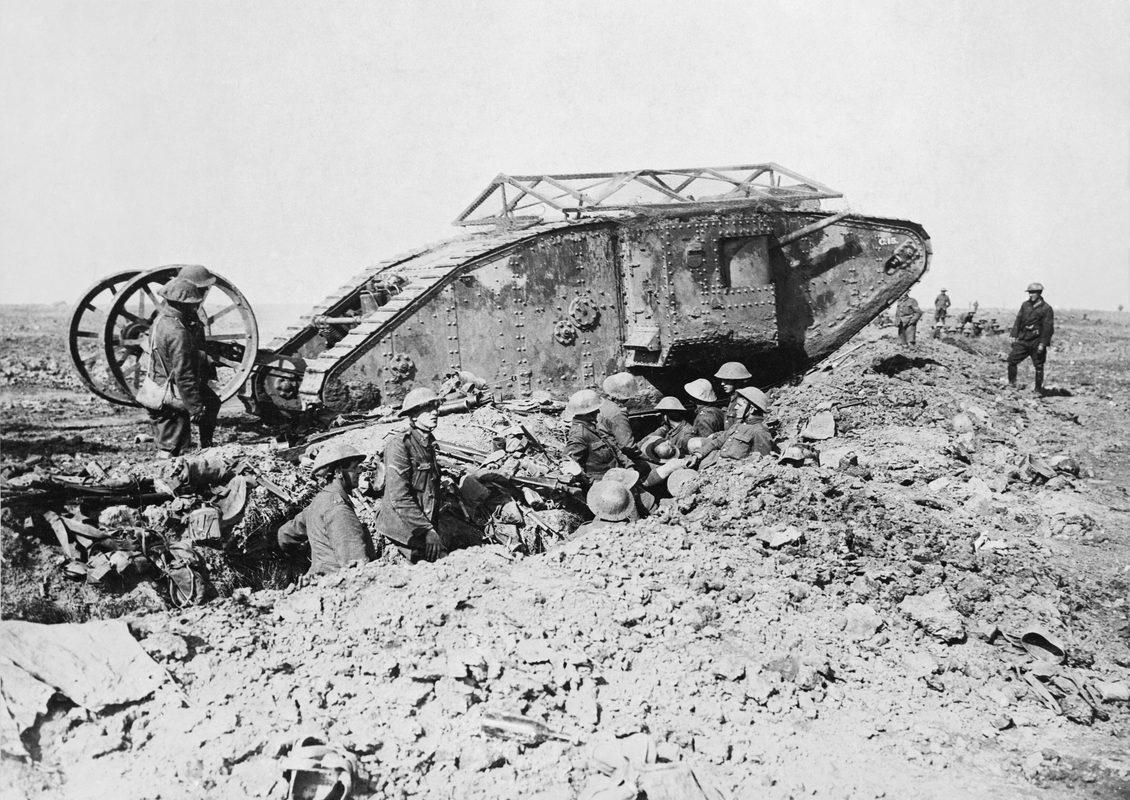
#34: Mark I: The First Tank Ever Built, Straight From a Nightmare

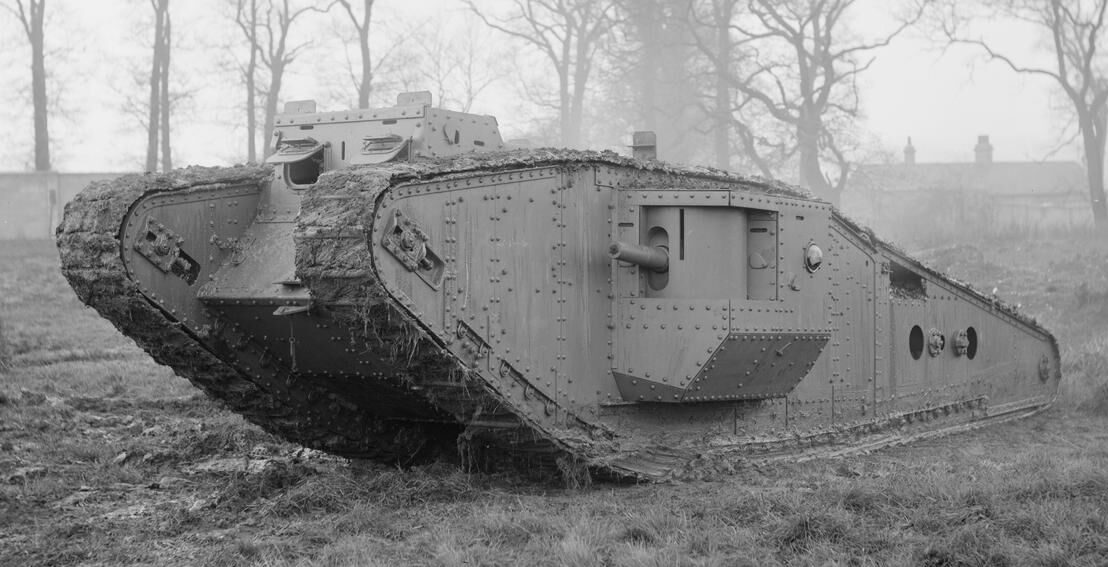
British Mark I tank with rhomboidal shape crossing a trench during World War I

On September 15, 1916, at the Battle of Flers-Courcelette, the Mark I became the first tank to enter combat in human history. German soldiers reportedly fled in panic at the sight of the 28-ton steel rhombus grinding through barbed wire and crawling over trenches that had been impassable for two years.

Only 150 Mark I tanks were built, 75 "males" armed with two 6-pounder guns and 75 "females" carrying machine guns only. The conditions inside were beyond brutal: temperatures exceeded 50°C, carbon monoxide from the engine sickened crews, and the noise was deafening. Top speed was 6 km/h. Of the 49 Mark Is deployed at Flers-Courcelette, only 32 reached the start line, and fewer than a dozen made it to the German trenches. Mechanically unreliable, tactically misunderstood, and rushed into battle, yet the Mark I proved an idea that would reshape military history forever. Every tank on this list exists because someone looked at No Man's Land in 1915 and decided to build a machine that could cross it.

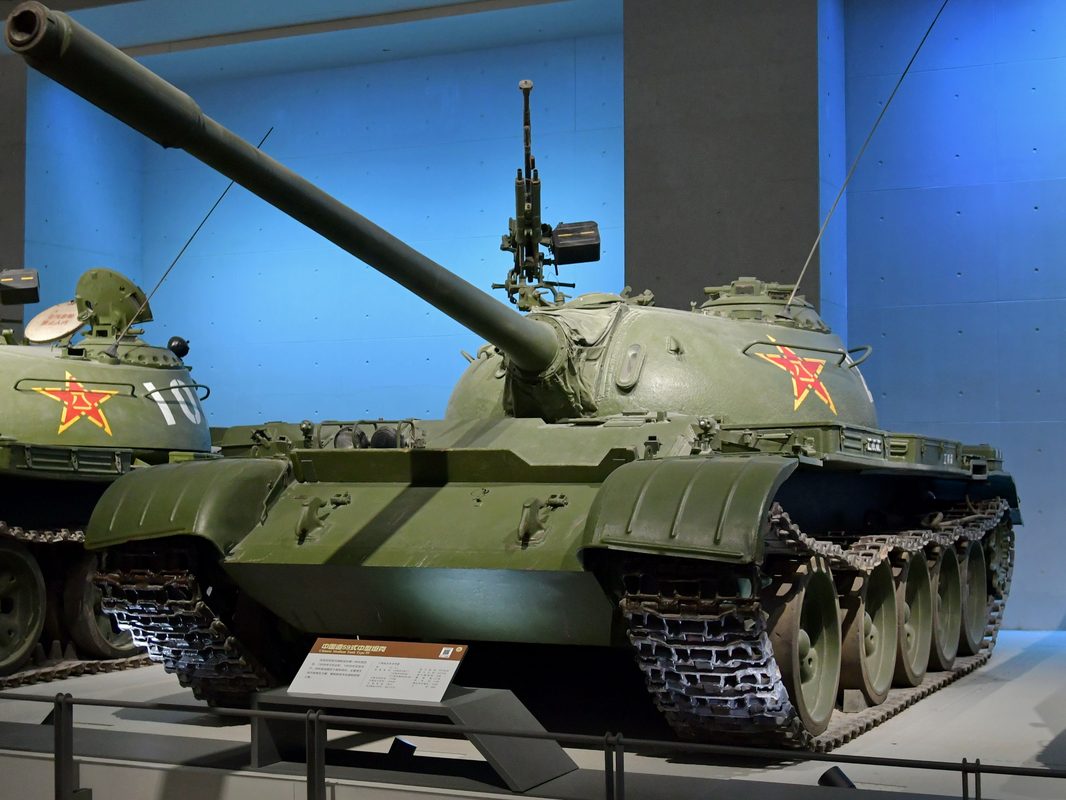
#33: Type 59: China's Million-Man Armor That Conquered Asia

Chinese Type 59 tank column on the move displaying classic Soviet-influenced design

China built over 10,000 Type 59s, more than any other Chinese armored vehicle, and exported thousands more to Pakistan, Bangladesh, North Korea, Iran, Iraq, and at least 15 other nations. At one point, Type 59 variants were in service on every inhabited continent except Australia.

The Type 59 was a licensed copy of the Soviet T-54A, entering production in 1958 at Factory 617 in Baotou. Its 100mm Type 59 rifled gun and 203mm turret armor were adequate for the 1960s, but the tank's real power was in numbers and upgradability. Pakistan's Type 59s fought Indian Centurions in the 1965 war. Iraqi Type 59s battled Iranian Chieftains in the 1980s. The base design proved so adaptable that China kept upgrading it for five decades, the latest Al-Zarrar variant for Pakistan features a 125mm gun, ERA, and thermal sights. The Type 59 is the AK-47 of armored warfare: simple, rugged, endlessly modified, and carried into battle by more armies than any Western defense technology planner ever imagined.

#32: Cromwell: The Fastest British Tank in WWII

British Cromwell cruiser tank at high speed across French countryside during the Normandy breakout

The Cromwell could hit 64 km/h on roads, faster than any other British or American tank in the war and most German ones too. Its 600-horsepower Rolls-Royce Meteor engine (derived from the legendary Merlin that powered the Spitfire) gave it a power-to-weight ratio that made it the ultimate exploitation tank.

Entering combat on D-Day with the 7th Armoured Division (the Desert Rats), the Cromwell excelled in the breakout from Normandy where its speed could finally be unleashed. During Operation Goodwood, Cromwells of the reconnaissance regiments raced ahead to seize bridges and crossroads. The catch: its 75mm gun was a mediocre performer against German heavy armor, and 76mm of frontal armor meant that Panthers could kill it at any range. Over 4,016 were built, and the Cromwell's greatest contribution to military history was proving that a fast tank with a reliable engine could be more valuable than a slow, heavily armored one, a lesson that directly shaped British tank doctrine for decades of armored warfare to come.

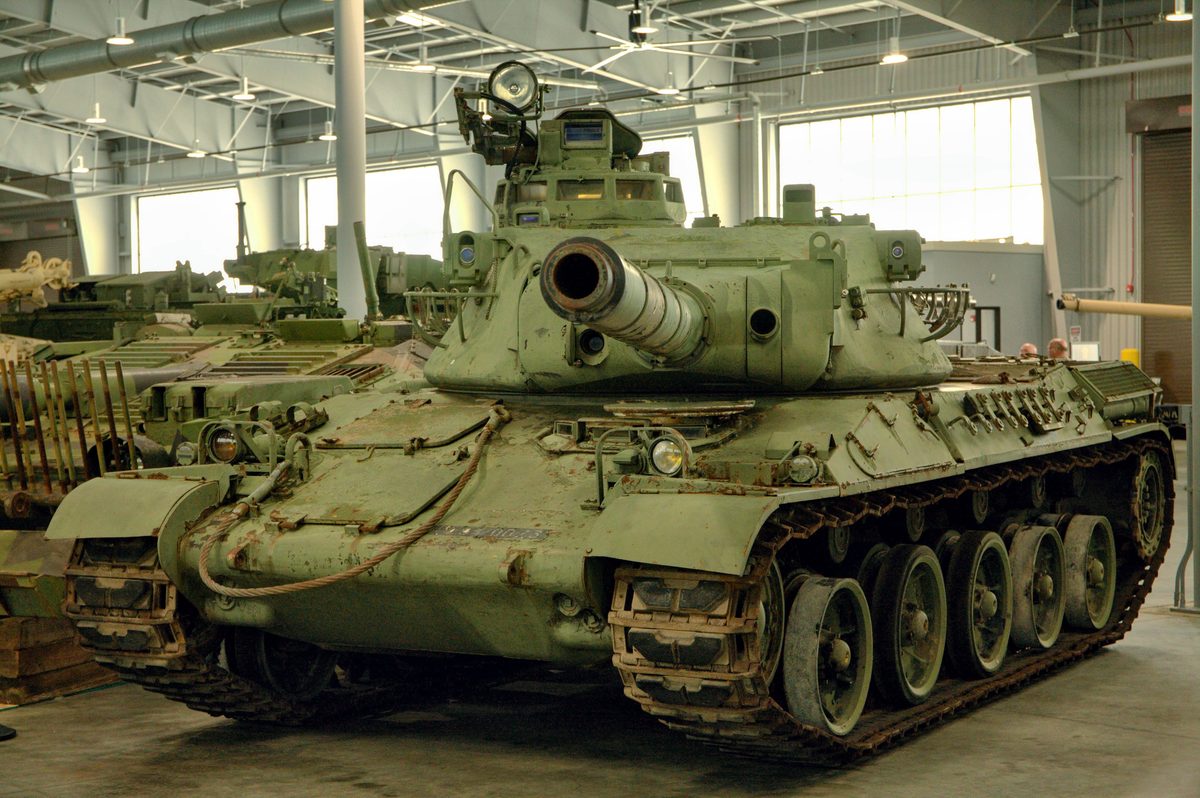
#31. AMX-30: France Goes Its Own Way in Armored Warfare

French AMX-30 main battle tank firing its 105mm gun during NATO exercises

The AMX-30's 105mm F1 gun fired the OBUS G, a unique rotating outer-shell HEAT round that spun on bearings independently of the projectile body, defeating the countermeasure of sloped armor without losing shaped-charge effectiveness. No other nation fielded anything like it during the Cold War.

France deliberately rejected the NATO standardization path in the 1960s, building the AMX-30 around speed and firepower rather than heavy armor. At 36 tons, it was the lightest Western MBT of its generation, with a top speed of 65 km/h. Over 3,500 were built and exported to Saudi Arabia, Spain, Greece, and others. Saudi AMX-30s saw combat in the 1991 Gulf War during the Battle of Khafji, where they engaged Iraqi armor. The AMX-30 also spawned a family of variants (self-propelled guns, air defense systems, and engineering vehicles) making it the backbone of French military equipment for three decades. It was ultimately replaced by the Leclerc, but the AMX-30 proved that an independent French defense technology sector could produce world-class tanks.

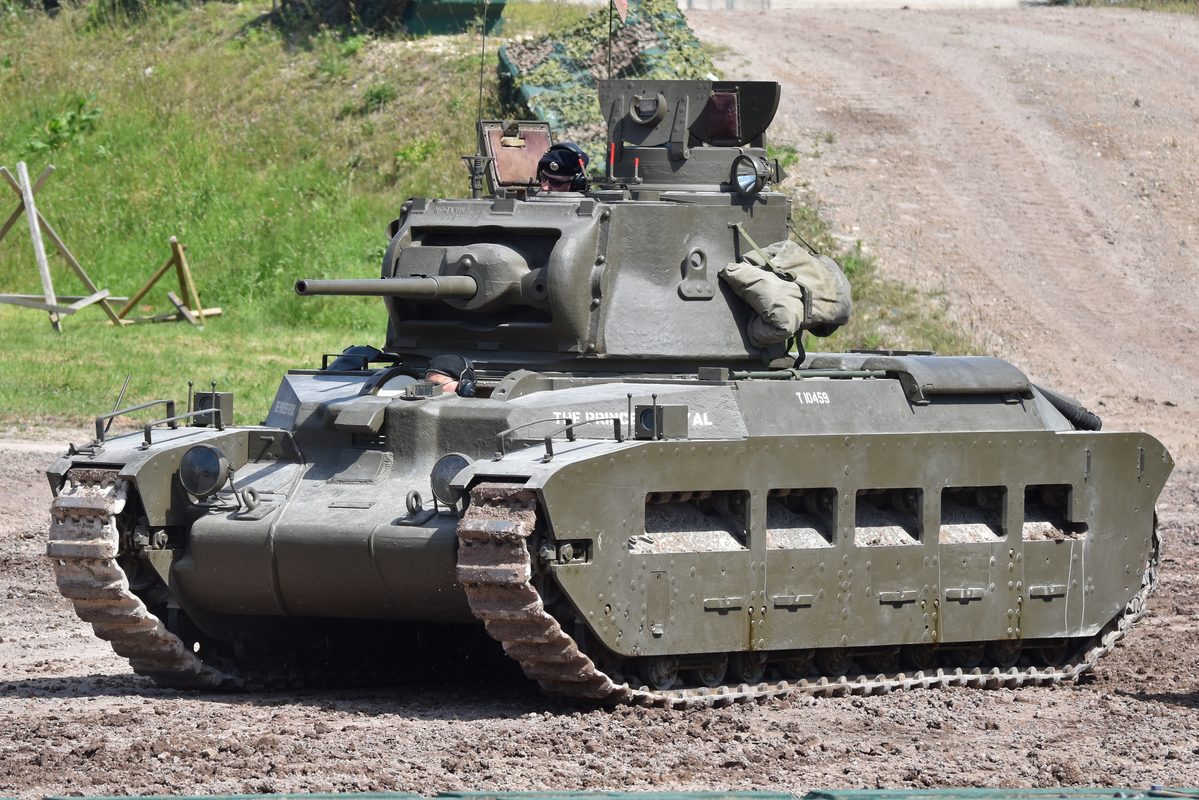
#30: Matilda II: The Queen of the Desert That Stopped Rommel Cold

British Matilda II infantry tank advancing through North African desert sand

At the Battle of Sidi Barrani in December 1940, Matilda IIs of the 7th Royal Tank Regiment shattered the Italian 10th Army, 38,000 Italian soldiers surrendered in three days because they had literally nothing that could penetrate the Matilda's 78mm frontal armor. The standard Italian 47mm anti-tank gun bounced off at every angle.

The Matilda II was the most heavily armored tank in the world when it entered service in 1939. Its 78mm frontal armor outclassed even the German Panzer IV's 30mm. During Operation Compass in North Africa, Matildas advanced through Italian positions with near-total impunity, earning the nickname "Queen of the Desert." Only the German 88mm flak gun, pressed into anti-tank service by desperate commanders, could stop it reliably. Over 2,987 were built, and Australia used them extensively in the Pacific theater with flamethrower modifications. The Matilda's 2-pounder gun was anemic by 1942 standards, and its 26 km/h top speed limited tactical flexibility, but for two critical years it was the most formidable piece of military equipment in the North African desert.

#29: T-80: The Gas Turbine Screamer That Shocked NATO

Russian T-80 main battle tank at high speed with its gas turbine exhaust visible

The T-80 was the first production tank powered by a gas turbine engine, the same type of powerplant used in helicopters. Its 1,250-horsepower GTD-1250 could launch the 46-ton tank from 0 to 70 km/h in under 20 seconds, and in the subarctic conditions it was designed for, the turbine started instantly in temperatures that would freeze a diesel solid.

Entering Soviet service in 1976, the T-80 was the USSR's most expensive tank, three times the cost of a T-72. NATO designated it the most dangerous Soviet tank of the Cold War. Over 5,400 were built across multiple variants, and South Korean tankers who tested captured T-80Us after a 1997 deal with Russia reported being impressed by its speed and gun stabilization. The dark chapter came in Grozny in 1995, where T-80BVs were catastrophically mauled in urban combat. Russia lost an estimated 20 T-80s in the first Chechen War, leading to a doctrinal overhaul in Russian armored warfare. The T-80's combat record is mixed, but its technology was genuinely ahead of its time.

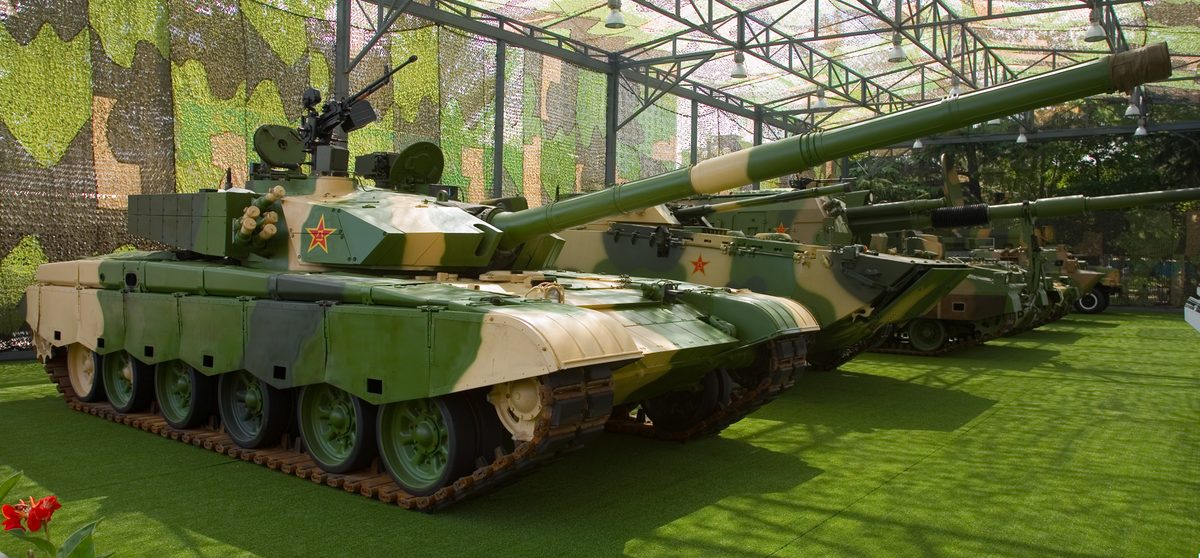
#28: Type 99A: China's Most Dangerous Tank, and the World Is Guessing

Chinese Type 99A main battle tank with arrow-shaped ERA on parade in Beijing

The Type 99A mounts a 125mm ZPT-98 smoothbore gun capable of firing gun-launched ATGMs, composite armor augmented by FY-4 explosive reactive armor, and an active protection system with millimeter-wave radar, a suite of military technology that on paper rivals anything fielded by NATO.

China has been deliberately opaque about the Type 99A's exact capabilities, but open-source analysis estimates its composite armor provides protection equivalent to 700mm+ of RHA against APFSDS rounds. Its 1,500-horsepower turbocharged diesel pushes 58 tons to a reported 80 km/h, if accurate, making it one of the fastest MBTs in the world. Approximately 600-800 are believed to be in PLA service. The Type 99A features a laser warning receiver and what China claims is a laser dazzler capable of blinding optics and possibly damaging the eyes of enemy gunners, a controversial piece of defense technology that would violate international protocols. With zero combat history, the Type 99A's ranking is an educated estimate, but its capabilities demand respect.

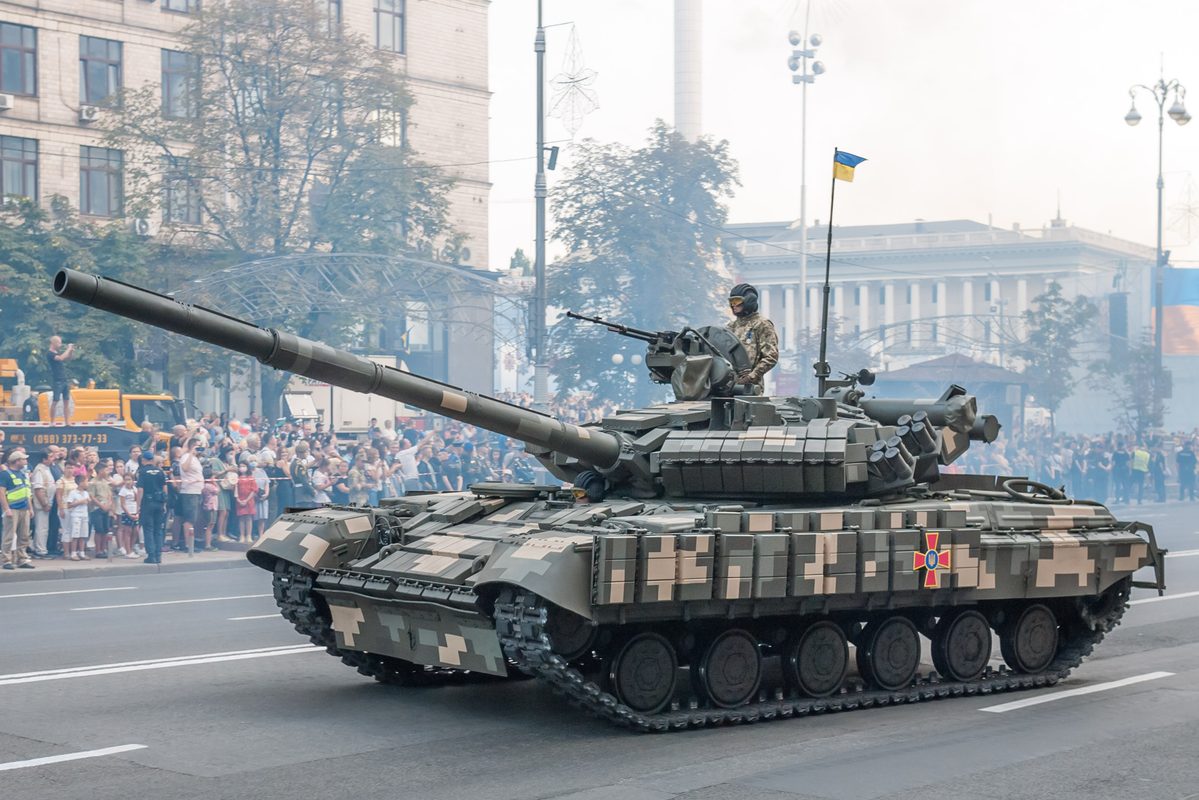
#27: T-64: The Secret Soviet Revolution That Changed Everything

Soviet T-64 tank with composite armor turret in a Ukrainian field

The T-64 was the first production tank in history to feature composite armor, an autoloader, and a smoothbore gun, three technologies that define every modern MBT. When it entered service in 1964, it was so secret that Western intelligence didn't confirm its existence for nearly a decade.

Designed at the Kharkiv Morozov bureau, the T-64 was the Soviet Union's most revolutionary tank. Its 6-round-per-minute autoloader eliminated the human loader, keeping the crew to three and the turret compact. The "Combination K" composite armor, steel-fiberglass-steel layers, offered superior protection to monolithic steel at less weight. Over 12,500 were built, but the T-64 was reserved exclusively for Soviet forces facing NATO; it was never exported. The tank's 5TDF engine was notoriously temperamental and required specialist maintenance that drove logistics planners to despair. But the T-64's DNA runs through the T-80, T-84, and every modern Ukrainian tank. In military history, it's the granddaddy of modern Eastern Bloc armored warfare technology.

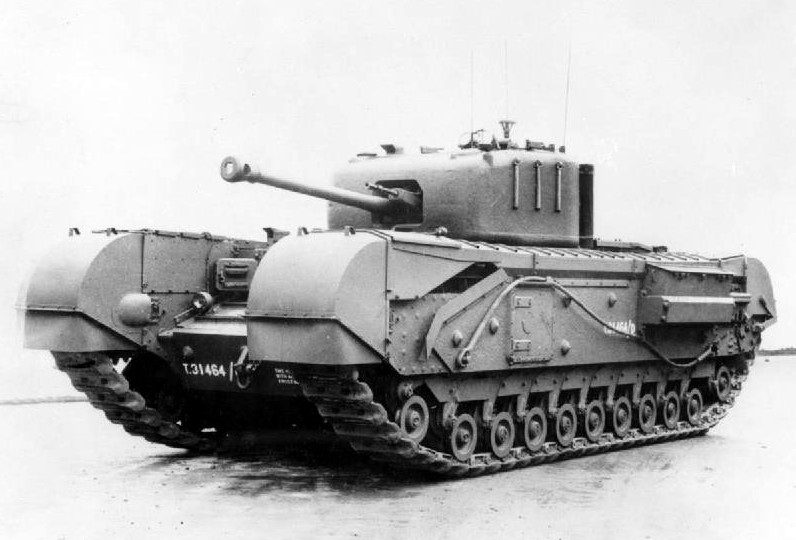
#26: Churchill: The Infantry Tank That Could Climb a Mountain

British Churchill tank climbing steep terrain with infantry following during World War II

The Churchill could climb a 45-degree slope that would stop every other tank in the Allied and Axis arsenals. Its 350mm ground clearance and individually sprung road wheels let it claw over terrain that was supposed to be impassable for armor, and German defensive plans along the Gothic Line in Italy shattered when Churchills appeared on hilltops they'd assumed were tank-proof.

At 40 tons with 152mm of frontal armor, the Churchill was the most heavily armored British tank of the war. Over 5,640 were built across 11 major marks. The Churchill AVRE carried a 290mm Petard mortar that could demolish concrete bunkers with a 40-pound "flying dustbin". It was instrumental on D-Day, clearing beach obstacles that would have cost thousands of infantry lives. Churchills served in North Africa (where early models struggled), Italy, Northwest Europe, and with Soviet Lend-Lease forces. The tank's weakness was its anemic 2-pounder, then 6-pounder, guns, it wasn't until the Mk VII with a 75mm that the Churchill could reliably kill enemy armor. But for crossing impossible terrain and absorbing punishment, nothing in military equipment matched it.

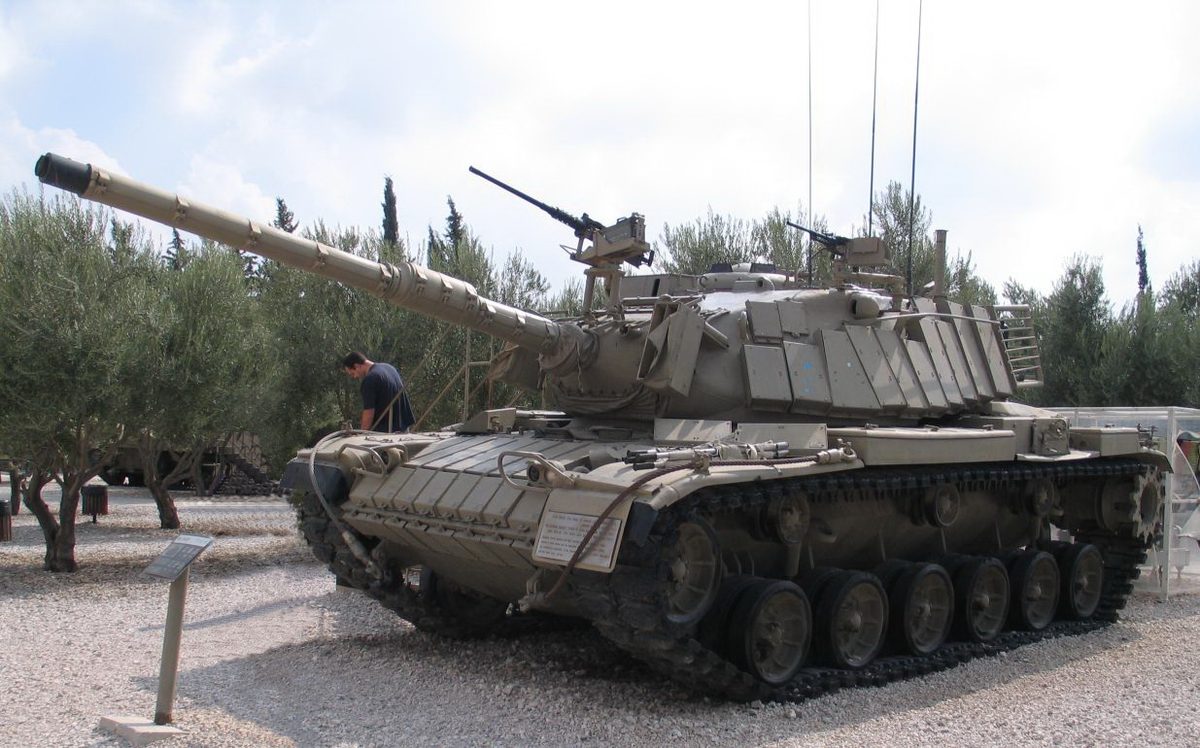
#25: Magach: Israel's Frankenstein Tank Forged in Survival

Israeli Magach tank with Blazer ERA in desert combat during Middle Eastern conflict

The Magach series, Israeli-modified M48 and M60 Pattons, fought in four major wars and racked up one of the highest collective kill counts of any tank family in post-WWII armored warfare. During the 1973 Yom Kippur War, Magach units on the Golan Heights helped hold the line against a Syrian force outnumbering them 9 to 1.

Israel took American-supplied Patton tanks and transformed them into something far more lethal: upgraded engines, Israeli-made fire control systems, Blazer explosive reactive armor (the first ERA system ever used in combat), and eventually the IMI 105mm gun. Over 1,400 Magachs served in the IDF across multiple variants. The Magach 7C, the ultimate version, featured a thermal sleeve, ballistic computer, and ERA coverage that made it nearly unrecognizable from its M60 origins. The Magach perfectly embodies Israel's approach to defense technology: take what you have, make it better through relentless combat-driven iteration, and fight outnumbered until you win. When the Merkava arrived, the Magach finally stepped aside, but it had bought Israel the decades needed to develop its own indigenous military equipment.

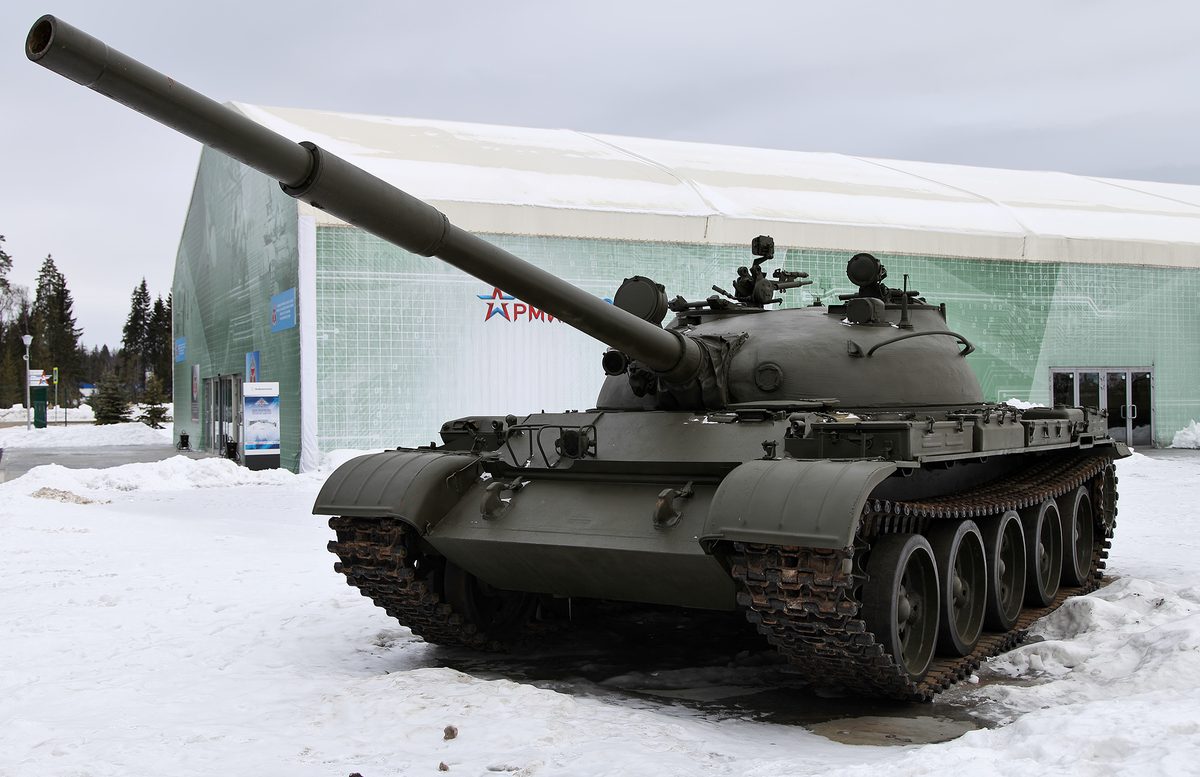
#24: T-62: The First Tank With a Smoothbore Gun

Soviet T-62 medium tank with its 115mm smoothbore gun in desert terrain

The T-62 introduced the 115mm U-5TS smoothbore gun, the first smoothbore tank cannon ever fielded, firing APFSDS (armor-piercing fin-stabilized discarding sabot) rounds at 1,615 m/s. This single innovation established the smoothbore-APFSDS combination that every modern main battle tank on earth now uses.

Entering Soviet service in 1961, the T-62 represented a quantum leap in anti-armor firepower. Its APFSDS round could penetrate 270mm of steel at 1,000 meters, outperforming the rifled guns on contemporary Western tanks. Over 22,700 were built, making it one of the most produced tanks in military history. Syrian T-62s fought Israeli tanks in the 1973 Yom Kippur War with mixed results. The gun was excellent, but the fire control primitive. Egyptian, Iraqi, and Afghan forces all operated T-62s extensively. Its automatic spent-casing ejection system, which popped the hull rear hatch after each shot, was infamously dangerous to nearby infantry. The T-62 may not have been the best tank of its era, but its smoothbore gun technology reshaped armored warfare permanently.

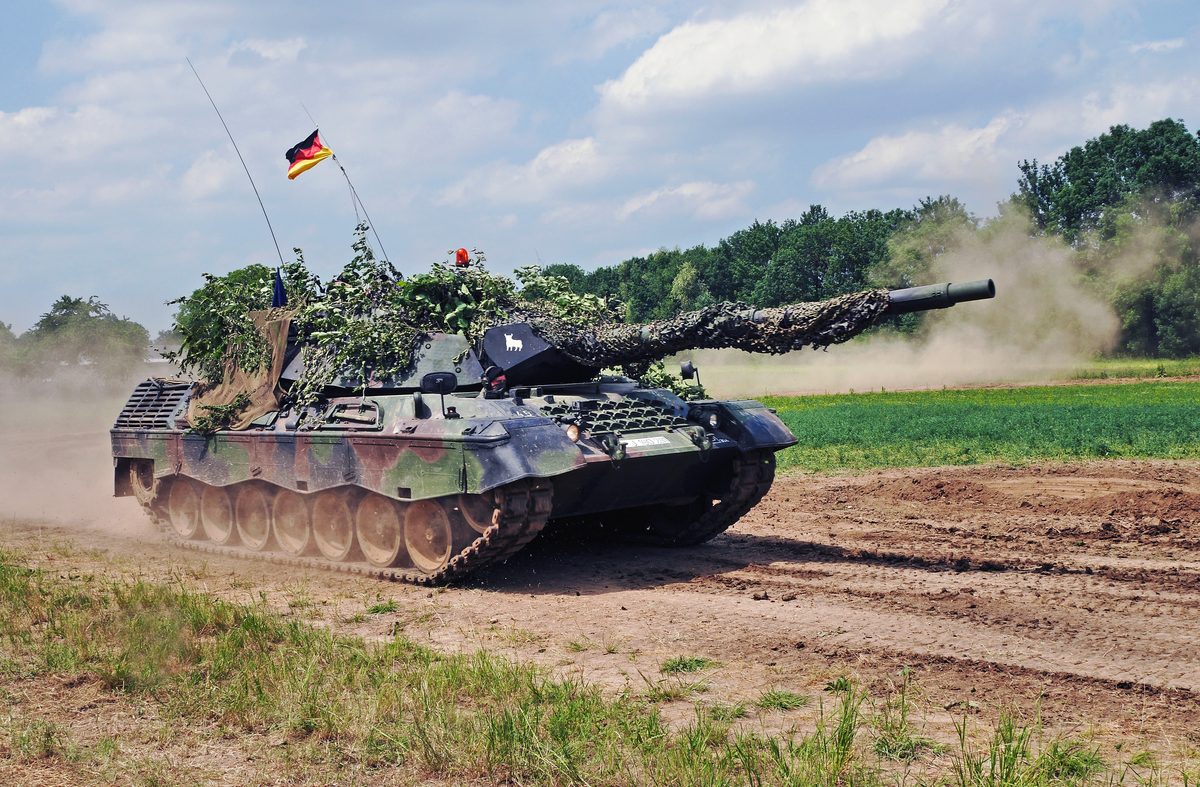
#23: Leopard 1: NATO's Cold War Greyhound

German Leopard 1 main battle tank at speed during NATO Cold War exercises

The Leopard 1 was built around one ruthless calculation: in a nuclear battlefield, no armor could survive a direct hit, so forget protection and maximize firepower and speed. Its 830-horsepower MTU diesel could push 42.2 tons to 65 km/h, making it the fastest NATO tank of the 1960s.

West Germany's first post-war tank entered service in 1965, and 6,485 were eventually built for 13 nations, the most successful European tank export program of the Cold War. Its Royal Ordnance L7A3 105mm gun was NATO-standard and devastatingly accurate, with a fire control system that was considered the best in the world when introduced. Canada, Australia, Denmark, and Norway all deployed Leopard 1s operationally well into the 2000s. Canadian Leopard 1C2s saw combat in Afghanistan in 2006, proving the design still had teeth four decades after production. Belgium, Brazil, and Chile still operate variants today. The Leopard 1 defined the philosophy that mobility equals survivability, a doctrine that its successor, the Leopard 2, would perfect into the ultimate expression of modern defense technology.

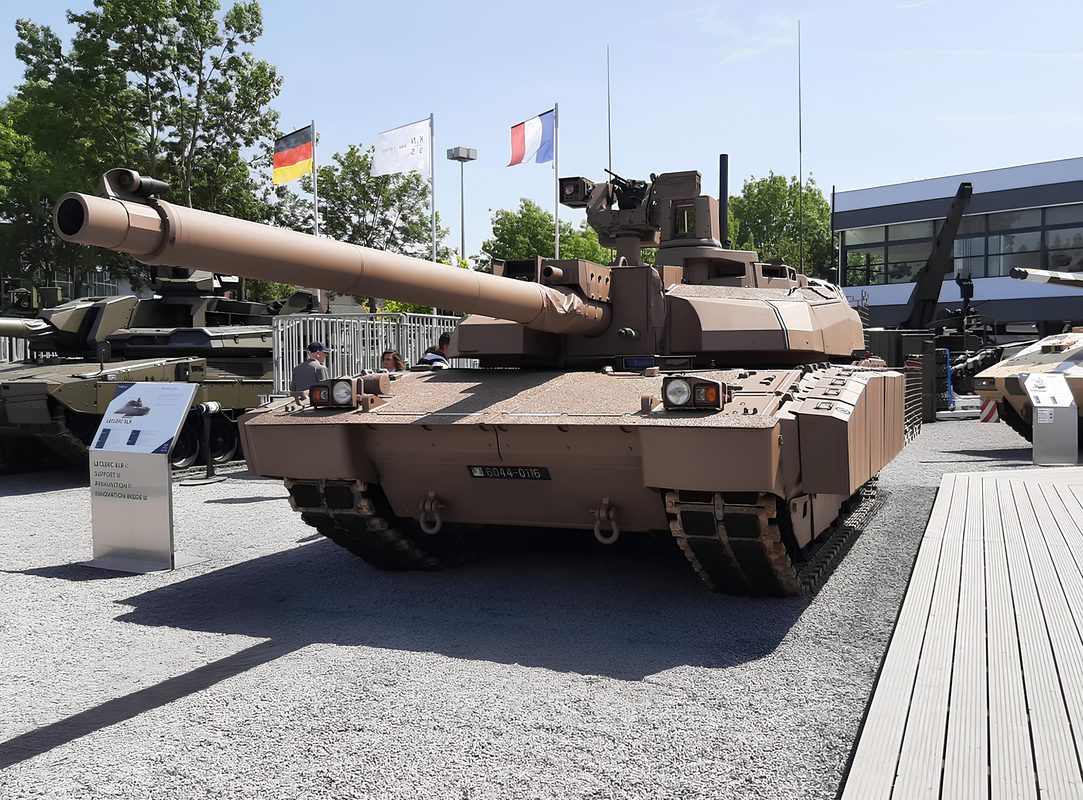
#22: Leclerc: The French Thoroughbred That Outran the Gulf War

French Leclerc main battle tank at high speed with dust trail in desert terrain

The Leclerc can fire its 120mm CN120-26 smoothbore gun while moving at 50 km/h and hit a target at 2,000 meters with first-round accuracy exceeding 95%. Its autoloader delivers a sustained rate of fire of 12 rounds per minute, double the rate of manually loaded Western tanks.

At 57 tons, the Leclerc is the lightest Western MBT with full NBC protection, composite armor, and a 120mm gun. Its 1,500-horsepower SACM V8 hyperbar diesel uses a turbine-assisted supercharging system unique in tank design, achieving a power-to-weight ratio of 26.3 hp/ton. France built 862 units, and the UAE purchased 388, the Emirati Leclercs saw combat in Yemen starting in 2015, marking the type's first engagement. The Leclerc features FINDERS, one of the first fully digitized fire control systems, with automatic target tracking that can lock onto moving vehicles at 4,000 meters. Designed from the ground up as a three-man crew tank with autoloader, the Leclerc represents France's commitment to independent defense technology, expensive, but genuinely world-class military equipment.

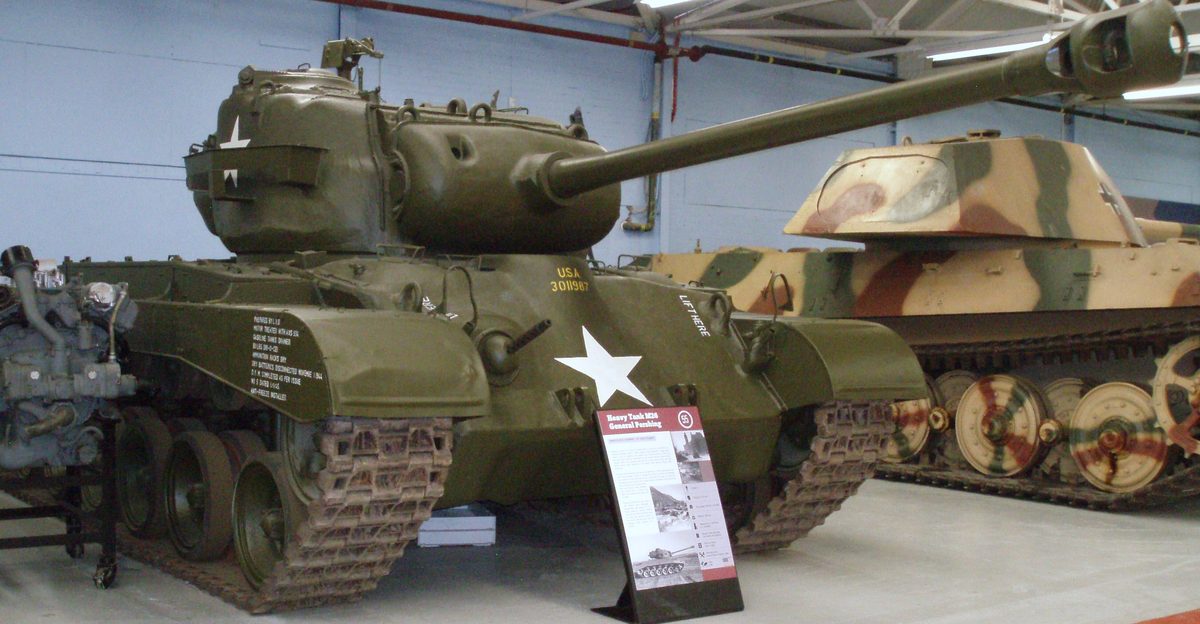
#21: M26 Pershing: America's Answer to the Tiger, One Year Late

American M26 Pershing heavy tank advancing through a destroyed German town in 1945

The M26 Pershing's 90mm M3 gun could penetrate 120mm of armor at 1,000 meters, finally giving American tankers a weapon that could kill Panthers and Tigers from the front. In February 1945, a Pershing from the 3rd Armored Division famously dueled a Tiger I in Cologne, destroying it with a flanking shot captured on film by a combat cameraman.

The Pershing was America's first heavy tank, and its development was plagued by bureaucratic infighting. Army Ground Forces chief General Lesley McNair opposed heavy tanks, insisting that tank destroyers should handle enemy armor. His doctrine cost American tankers their lives in undergunned Shermans for two years. Only 2,212 Pershings were built, and just 310 reached Europe before V-E Day. In Korea, Pershings proved decisive, at the Battle of the Naktong Bulge in 1950, M26s destroyed North Korean T-34/85s in the first tank-on-tank engagements of the war. The Pershing's lineage runs directly through the M46, M47, and M48 Patton series, making it the ancestor of America's entire Cold War armored warfare program.

#20: T-72: The Most Battled Tank on the Planet

T-72 main battle tank firing its 125mm gun with muzzle flash during live-fire exercise

Over 25,000 T-72s have been built since 1971, more than every Western main battle tank combined during the same period. The T-72 has seen combat in more conflicts than any other Cold War tank: Lebanon, Iraq, Syria, Chechnya, Georgia, Libya, Ukraine, and at least a dozen more.

The T-72's 125mm 2A46 smoothbore gun fires a 7.1 kg APFSDS penetrator at 1,700 m/s, and its carousel autoloader maintains a rate of fire of 6-8 rounds per minute regardless of crew fatigue. The original design was intentionally simplified compared to the T-64, cheaper to build, easier to maintain, and operable by conscript crews with minimal military training. This made it the Soviet Union's export king. The T-72's reputation took a devastating hit in the 1991 Gulf War, where Iraqi monkey-model T-72Ms were annihilated by M1A1 Abrams, but these were massively downgraded export versions without composite armor or modern ammunition. Upgraded T-72B3 variants fighting today are a fundamentally different beast. Love it or hate it, the T-72 has shaped more real-world armored warfare than any tank since the Sherman.

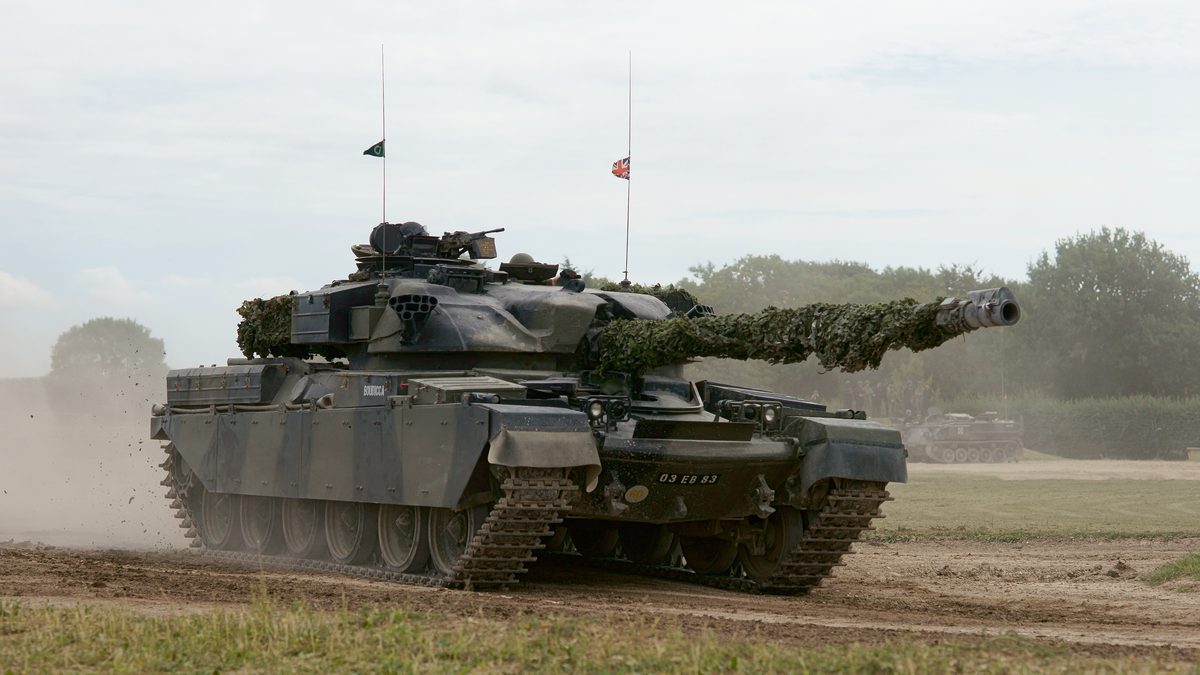
#19: Chieftain: The Cold War Sniper With Impenetrable Armor

British Chieftain main battle tank in hull-down position on NATO exercise in Germany

The Chieftain's 120mm L11A5 rifled gun was the most powerful tank cannon in NATO from 1966 to 1979, its APDS round could penetrate over 300mm of steel at 2,000 meters, and its HESH round could scab lethal fragments off the interior of any Soviet tank's armor.

Britain designed the Chieftain around the hull-down doctrine: get behind a ridge with only the turret exposed and destroy the enemy at maximum range. Its turret featured 390mm of cast steel armor, the thickest on any NATO tank of its era. The driver's semi-reclined position kept the hull profile remarkably low. Over 2,265 were built, with Iran (now operating them as the "Mobarez") and Jordan as major export customers. Iranian Chieftains fought Iraqi T-62s in brutal engagements during the Iran-Iraq War, proving the design's lethality in actual armored warfare. The Chieftain's Achilles' heel was its Leyland L60 multi-fuel engine, underpowered and unreliable, it gave the 56-ton tank a disappointing top speed of 48 km/h. But in its intended role as a hull-down defensive sniper, the Chieftain was the most formidable piece of military equipment in Western Europe.

#18: Mark IV: The WWI Tank That Won the First Great Tank Battle

British Mark IV tank crossing a trench with fascine bundle during the Battle of Cambrai

On November 20, 1917, 476 Mark IV tanks attacked the Hindenburg Line at Cambrai and advanced 8 kilometers in 12 hours, more ground than months of infantry assaults had achieved on the Western Front. It was the first mass tank attack in military history, and it proved that armored warfare could break the deadliest stalemate the world had ever known.

The Mark IV corrected the Mark I's most dangerous flaws: fuel was stored in an external armored tank instead of inside the crew compartment, and the sponson-mounted 6-pounder guns could be pushed inward for rail transport. Over 1,220 were built, more than all other WWI tank types combined. At the Second Battle of Villers-Bretonneux in April 1918, Mark IVs engaged German A7V tanks in the first tank-versus-tank combat in history. British "male" Mark IVs destroyed two A7Vs, establishing armor-on-armor combat as the future of warfare. The Mark IV's legacy in military history is straightforward: it proved the concept that the Mark I had merely introduced, turning the tank from an experiment into a doctrine.

#17: M60 Patton: Three Decades of American Armored Muscle

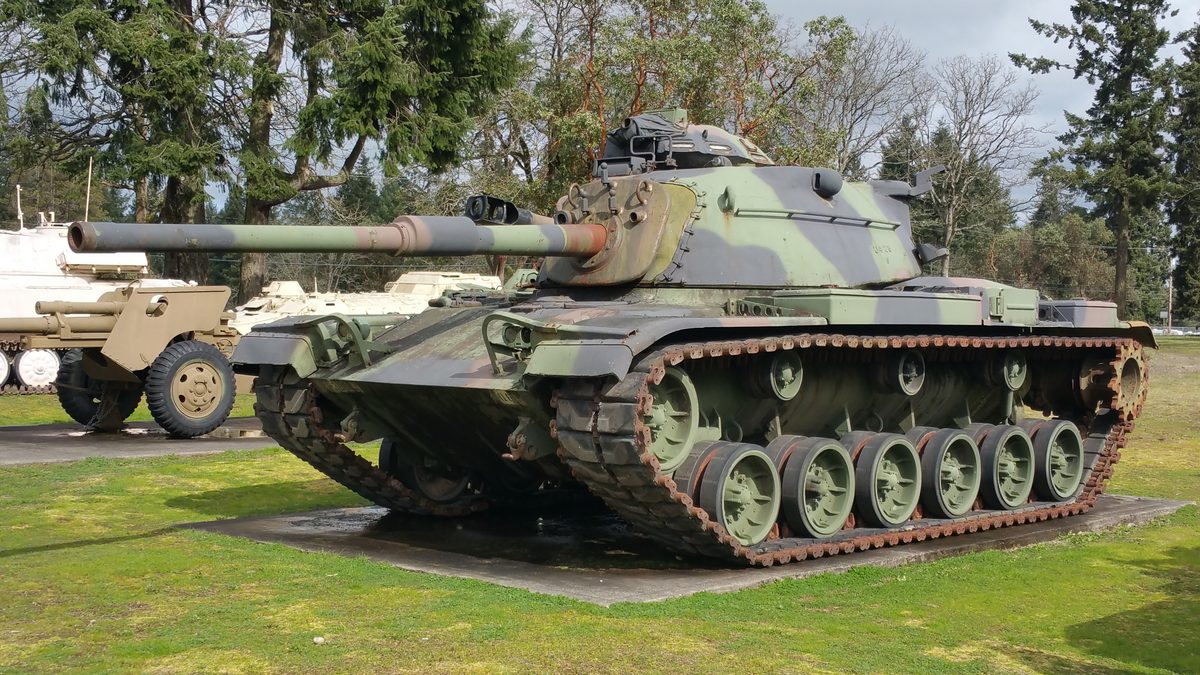
American M60 Patton main battle tank in desert camouflage during Operation Desert Storm

The M60 served as America's main battle tank for an unbroken 27 years, from 1960 until the M1 Abrams fully replaced it in 1987, the longest frontline tenure of any American tank since World War II. Over 15,000 were built, and 20 nations still operate M60 variants today.

Armed with the proven 105mm M68 rifled gun (a licensed L7) and protected by up to 254mm of cast steel armor, the M60 was the definitive Western tank of the 1960s and 1970s. The M60A3 TTS variant introduced a thermal imaging sight that gave American and allied tankers the ability to fight effectively at night, revolutionary military technology for its time. During Operation Desert Storm, USMC M60A1s with ERA fought Iraqi armor in the battle for Kuwait City. Israeli M60 Magachs dominated Middle Eastern battlefields for decades. Turkey still operates over 750 M60T Sabra variants, upgraded by Israel with modern fire control and armor. The M60's durability and upgrade potential make it one of the most commercially successful pieces of defense technology ever produced.

#16: M48 Patton: The Cold War Workhorse That Fought Everywhere

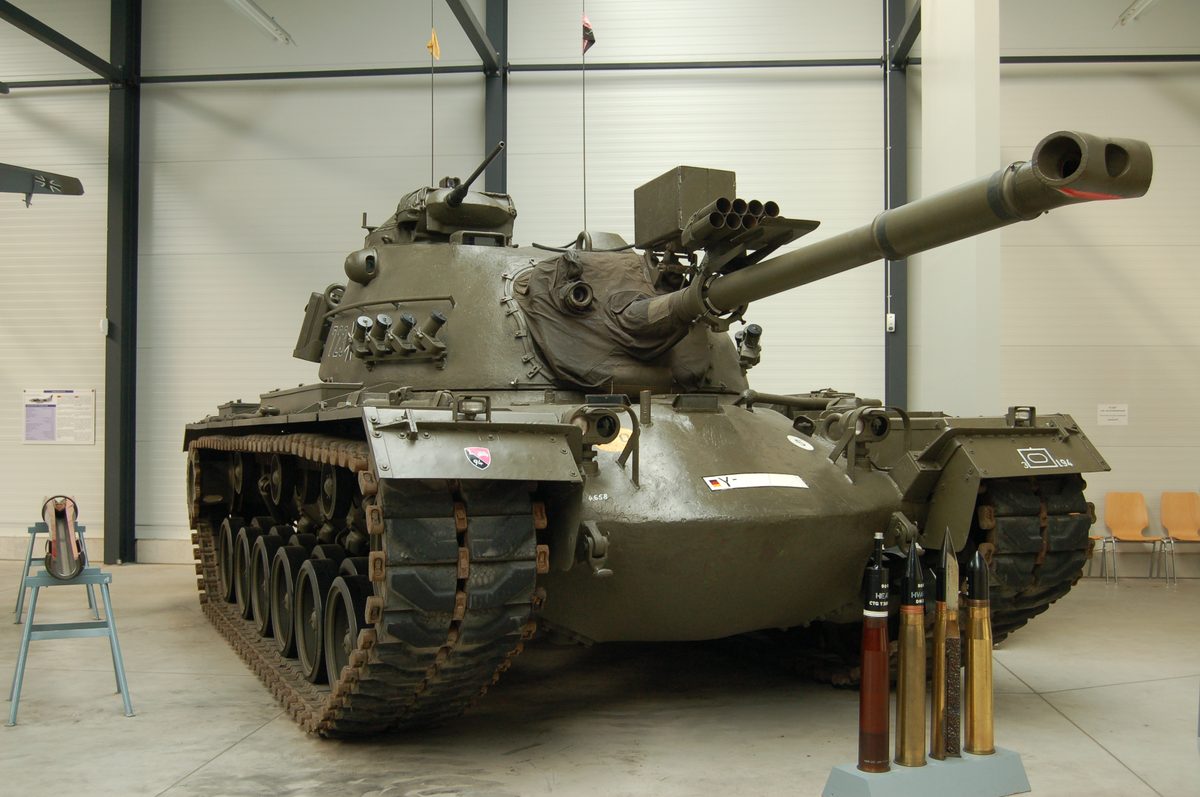
American M48 Patton tank on patrol during the Vietnam War with jungle in the background

The M48 Patton saw combat on four continents across five decades, from the streets of Saigon to the Golan Heights to the deserts of Pakistan. Over 11,700 were built, and at its peak, 19 nations fielded M48s simultaneously, making it the most widely deployed American tank of the Cold War.

In Vietnam, M48A3s proved that heavy armor still mattered in a counterinsurgency, their 90mm guns obliterated bunkers, and their 120mm frontal armor shrugged off RPG-2 hits. During the 1965 Indo-Pakistani War, Pakistani M48s clashed with Indian Centurions in some of the largest tank battles since WWII at Chawinda and Asal Uttar. The M48's most famous hour came on the Golan Heights in 1973, where Israeli M48 Magachs helped blunt the Syrian offensive despite being massively outnumbered. The tank's combat record in military history is staggering in its breadth, no American tank has fought in more diverse conditions. South Korea, Greece, Turkey, and Taiwan continue to operate upgraded M48 variants, a testament to a design that just refuses to quit as frontline military equipment.

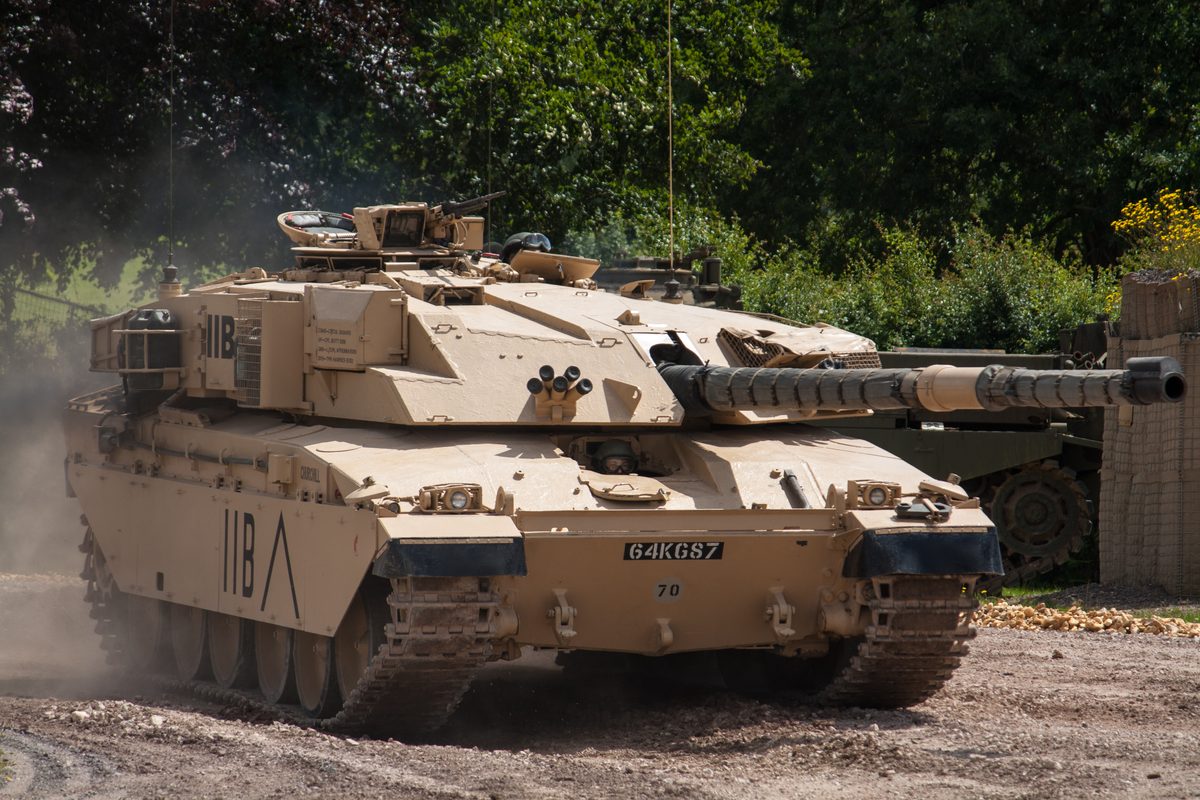
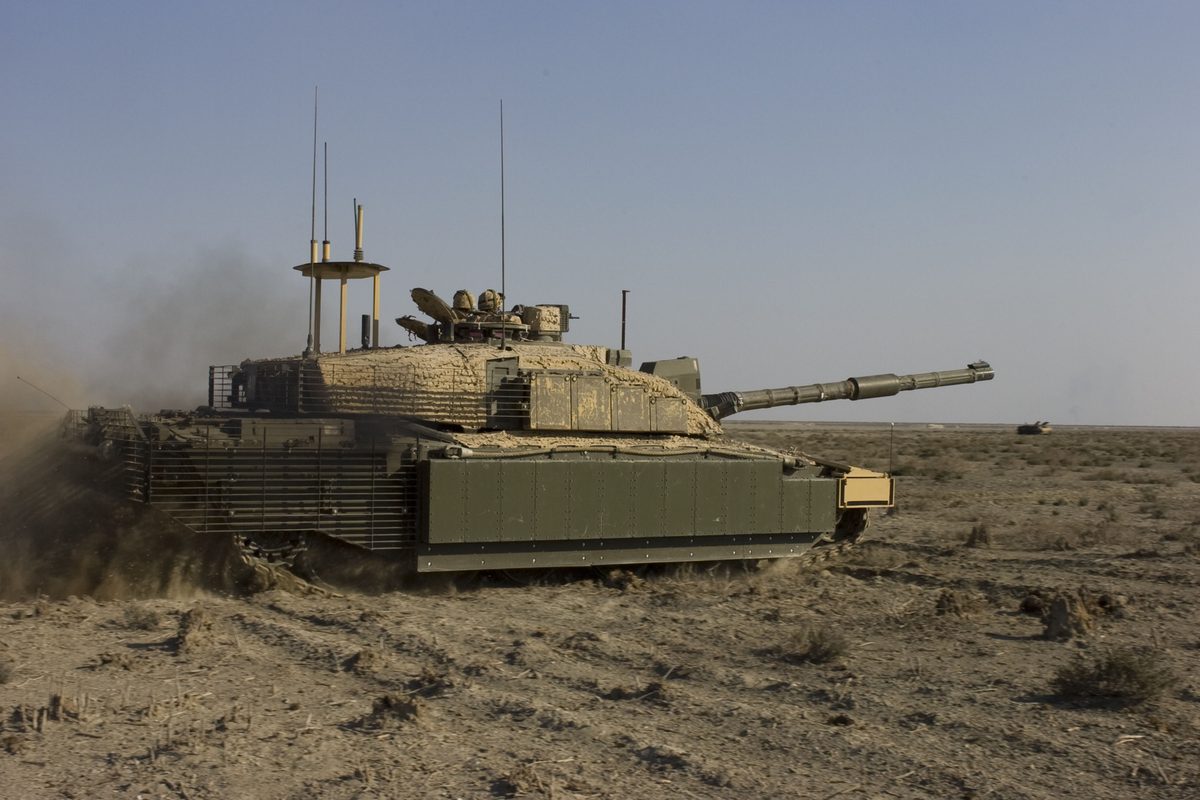
#15: Challenger 1: Undefeated in the Desert Storm Gauntlet

British Challenger 1 main battle tank advancing through Iraqi desert during Operation Desert Storm

During Operation Desert Storm, Challenger 1s of the Royal Scots Dragoon Guards destroyed over 300 Iraqi armored vehicles in 97 hours of continuous combat without losing a single tank to enemy fire. One Challenger 1 scored a confirmed kill on an Iraqi tank at 5,100 meters, the longest tank-on-tank kill in history at the time.

The Challenger 1's Chobham composite armor was a closely guarded British secret, and in the Gulf War, it proved its worth spectacularly. Iraqi T-55s and Type 69s couldn't penetrate it at any range. The 120mm L11A5 rifled gun, the same lineage as the Chieftain, fired APDS and HESH rounds with devastating accuracy. Only 420 were built for Britain and Jordan, but the Challenger 1's 100% crew survival rate in the Gulf War made it one of the most successful combat debuts in military history. The tank's fire control system was criticized as outdated compared to the Abrams' and Leopard 2's digital systems, and its powerpack reliability was middling. But in the metric that matters most, keeping crews alive while destroying the enemy, the Challenger 1 was flawless combat military equipment.

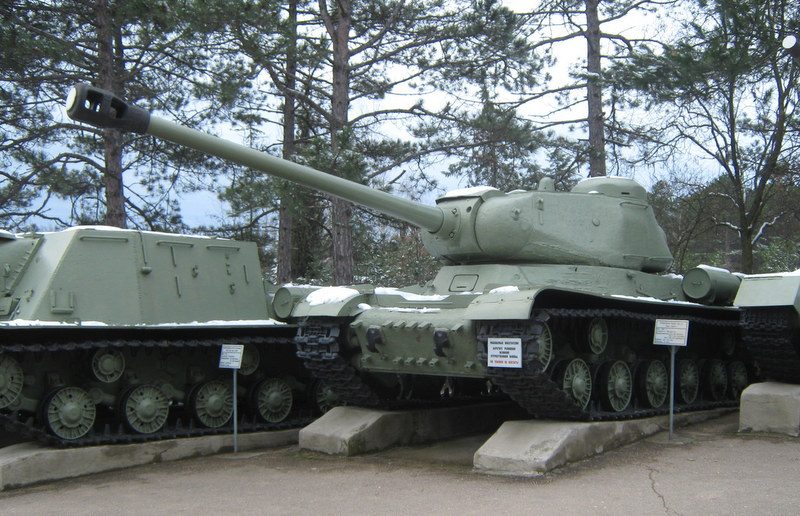
#14: IS-2: Stalin's Hammer That Cracked Berlin Open

Soviet IS-2 heavy tank advancing through rubble-strewn streets during the Battle of Berlin 1945

The IS-2's 122mm D-25T gun fired a 25-kilogram shell that could punch through 160mm of armor at 500 meters, or demolish a multi-story building with a single HE round. German soldiers called it the "animal killer" because it was specifically designed to destroy Tigers and Panthers.

Named after Joseph Stalin himself, the IS-2 entered production in late 1943 as the Soviet answer to German heavy armor. Its 120mm glacis armor, sloped at 60 degrees, gave it effective protection exceeding 200mm, roughly equivalent to a Tiger I's front. Over 3,854 were built by war's end. During the Battle of Berlin, IS-2 regiments blasted through barricades and fortified buildings as direct-fire assault guns, their 122mm HE shells collapsing entire floors. The tank's critical weakness was its rate of fire, the two-piece 122mm ammunition took a skilled loader 20-30 seconds to ram home, compared to the Tiger's 8-second reload. In armored warfare, that gap could be fatal. But the IS-2 wasn't designed for prolonged duels; it was designed to deliver one devastating blow. In the rubble of military history's most brutal urban battle, that was enough.

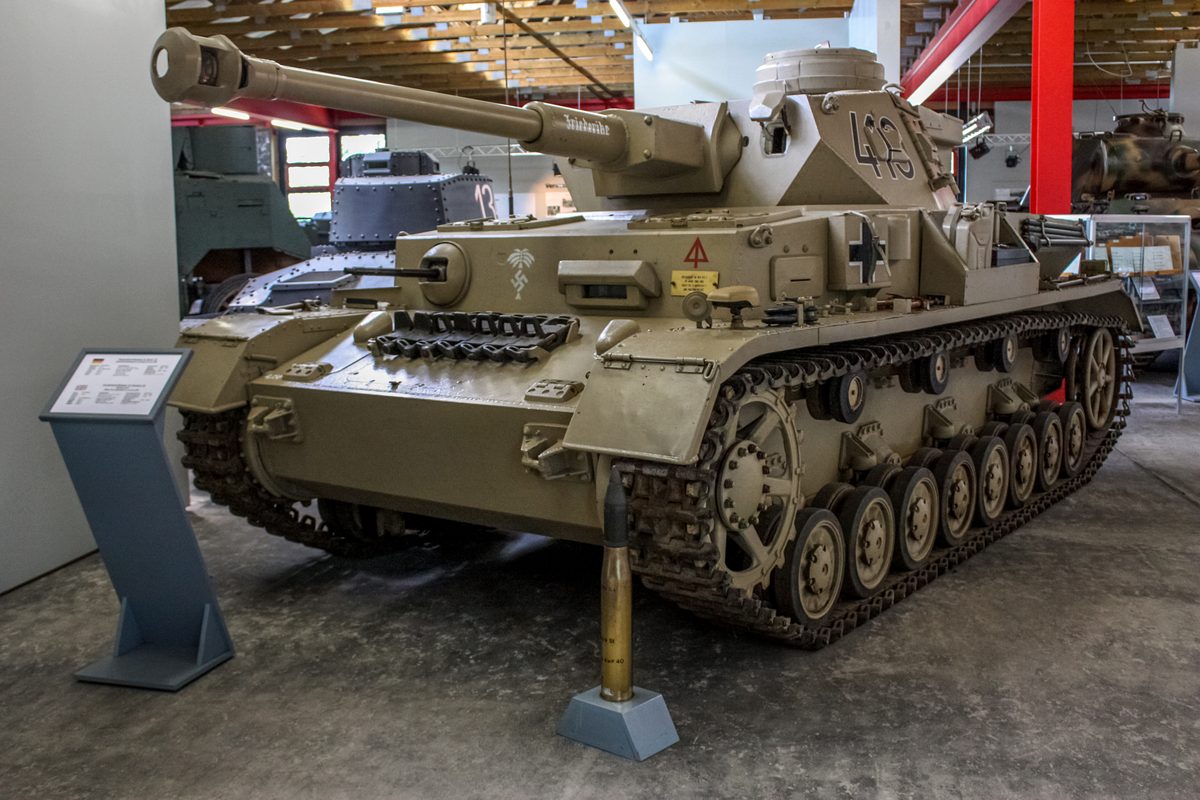
#13: Panzer IV: Germany's Only Tank That Lasted the Whole War

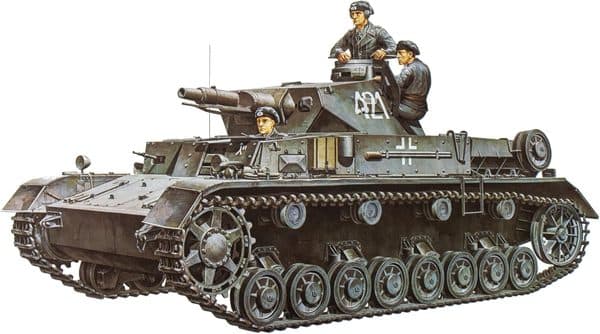
German Panzer IV Ausf H with side skirts advancing on the Eastern Front

The Panzer IV is the only German tank that served from the first day of World War II to the last, from Poland in September 1939 to Berlin in May 1945. Over 8,500 were built, making it Germany's most-produced tank (excluding the StuG III assault gun), and it served on every front where the Wehrmacht fought.

Originally designed as an infantry support tank with a short-barreled 75mm gun, the Panzer IV was continuously upgraded to meet escalating threats. The Ausf F2 variant received the long-barreled 75mm KwK 40 L/43 in 1942, transforming it into a genuine tank-killer capable of penetrating a T-34 at 1,500 meters. By the Ausf J, it had 80mm of frontal armor plus Schurzen side skirts against shaped charges. The Panzer IV was reliable, maintainable, and adaptable, everything the Tiger was not. German crews trusted it because it started every morning, ran all day, and could be repaired in the field. In a war that consumed military equipment at an industrial pace, the Panzer IV's greatest virtue was simply that it kept showing up.

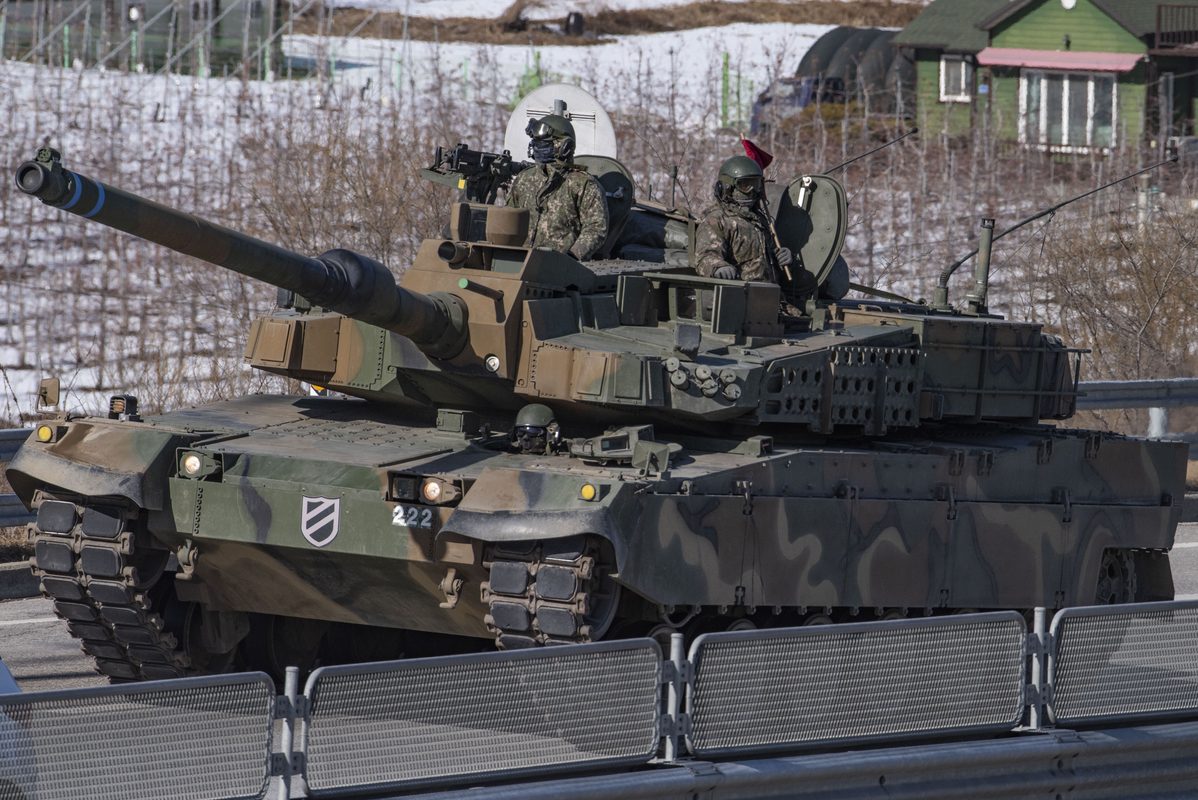
#12: K2 Black Panther: The World's Most Expensive, and Maybe Best, MBT

South Korean K2 Black Panther main battle tank at speed with advanced composite armor visible

The K2 Black Panther costs approximately $8.5 million per unit, the most expensive main battle tank in production. For that price, you get a 120mm L/55 Rheinmetall smoothbore with an autoloader, composite armor with NERA elements, an active protection system, and a hydropneumatic suspension that lets the tank "kneel" to increase gun depression to -10 degrees or "stand" to crest obstacles.

South Korea designed the K2 for one scenario: stopping a North Korean armored blitz through the mountains and valleys of the Korean Peninsula. Its 1,500-horsepower engine pushes 55 tons to 70 km/h, and the in-arm suspension unit allows the tank to navigate terrain that would ground conventional suspension systems. The fire control system features automatic target detection and tracking, with a hunter-killer system that allows the commander and gunner to engage separate targets simultaneously. Poland ordered 1,000 K2 variants in 2022, Europe's largest tank purchase in decades, validating the Black Panther as premier defense technology. With around 260 in South Korean service, the K2 represents what happens when a nation builds military equipment with no budget ceiling and an existential threat next door.

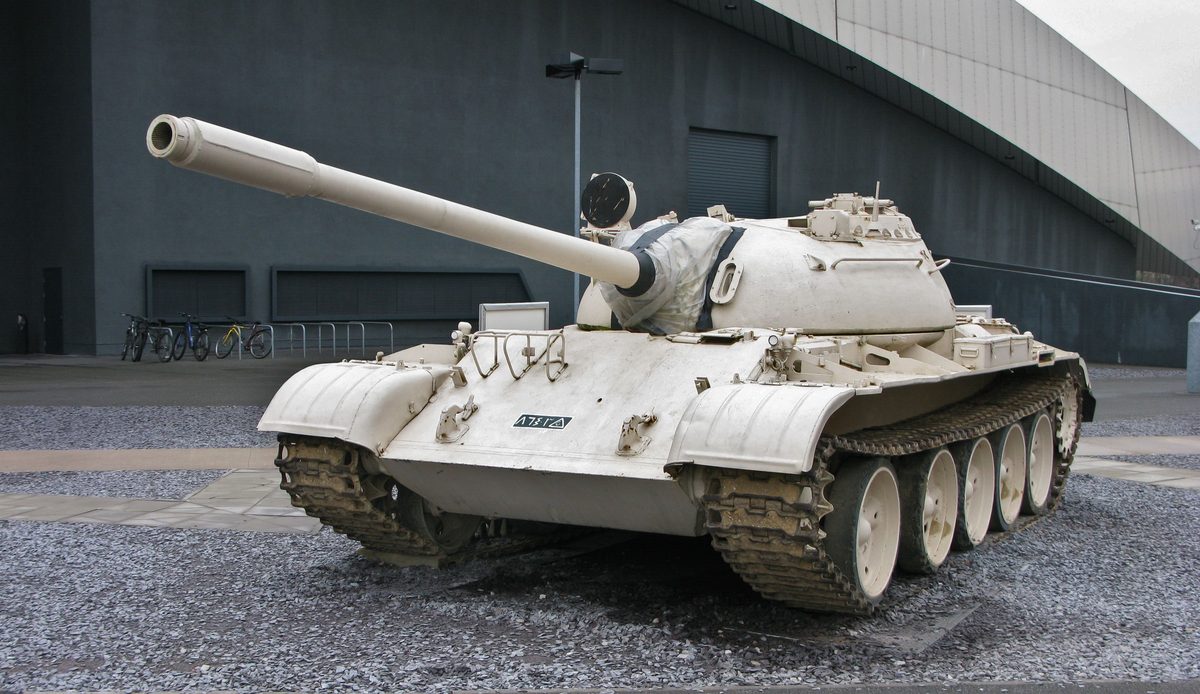
#11: T-54/T-55: The Most Produced Tank in Human History

T-55 tanks in column formation during a Cold War era military exercise

Between the Soviet Union, China, Czechoslovakia, Poland, and Romania, over 100,000 T-54/T-55 tanks were produced, more than all other tank designs in history combined. At the Cold War's peak, more than 50 nations fielded T-54/T-55 variants on every continent except Antarctica.

The T-54/T-55's 100mm D-10T rifled gun could penetrate 185mm of armor at 1,000 meters, and the tank's hemispherical turret, a masterpiece of Soviet foundry work, offered excellent ballistic protection from 200mm of cast armor. The T-55 added NBC protection, a rotating turret floor, and increased ammo stowage. These tanks fought in the Six-Day War, the Yom Kippur War, Vietnam, Angola, Ethiopia, Iran-Iraq, both Gulf Wars, and virtually every Cold War proxy conflict. Many are still in service today, Vietnam, Cuba, and several African nations continue to operate upgraded T-55s. The T-54/T-55 family is to armored warfare what the AK-47 is to infantry combat: not the most sophisticated, but the most prolific, the most combat-tested, and the most consequential piece of military equipment ever built in its category.

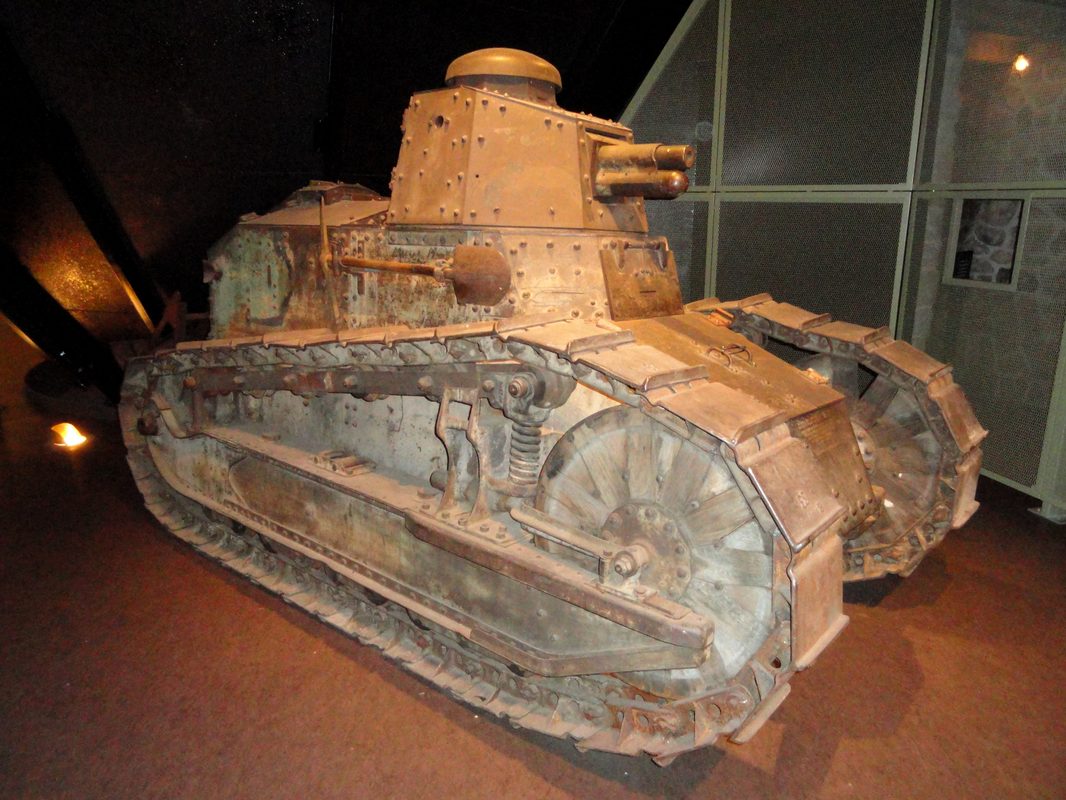
#10: Renault FT: The Revolutionary Design That Defined Every Tank After It

French Renault FT light tank with rotating turret from World War I era

The Renault FT was the first tank with a fully rotating turret mounted on top of the hull with the engine in the rear, a layout so logical that every single tank built in the century since has copied it. Before the FT, tanks were boxes with guns sticking out the sides. After it, tanks were what we recognize today.

Weighing just 6.5 tons and operated by a two-man crew, the FT was designed by Louis Renault after French military strategist Colonel Jean-Baptiste Estienne envisioned swarms of cheap, light tanks overwhelming enemy positions. Over 3,700 were built by the Armistice, more than all British and German tanks combined. On July 18, 1918, during the Battle of Soissons, 480 Renault FTs spearheaded the counterattack that turned the tide on the Western Front. American forces used FTs under the command of a young Lieutenant Colonel named George S. Patton. The FT served in the armies of France, the United States, Poland, Finland, China, and a dozen others well into WWII. Its place in military history isn't about firepower or armor, it's about architectural genius that defined armored warfare for the next hundred years.

#9: Challenger 2: Britain's Unkillable Fortress

British Challenger 2 main battle tank in desert camouflage during combat operations

Only one Challenger 2 has ever been destroyed by enemy fire, and that was a friendly-fire incident by another Challenger 2 in 2003. In every engagement against enemy forces in Iraq, the Challenger 2 maintained a perfect 100% crew survival rate. One Challenger 2 survived 14 RPG hits and a Milan anti-tank missile strike in Basra, and was back in action six hours later. Another reportedly took as many as 70 RPG strikes without a single penetration.

The Challenger 2's second-generation Dorchester composite armor is among the most closely guarded secrets in British defense technology. Its 120mm L30A1 rifled gun, the last rifled tank gun on a NATO MBT, fires CHARM 3 depleted uranium APFSDS with devastating effect. Only 447 were built for Britain and Oman, making it an exclusive but formidable machine. The tank's thermal imaging and commander's panoramic sight give it genuine day-and-night hunter-killer capability. Critics point to its manual loading (slower than autoloader-equipped rivals) and aging fire control, but the ongoing Challenger 3 upgrade with a Rheinmetall 120mm smoothbore will address these gaps. In terms of crew protection, the single most important metric in military equipment, the Challenger 2 has the best combat-proven record of any tank in the world.

#8: M4 Sherman: The Tank That Won World War II Through Sheer Numbers
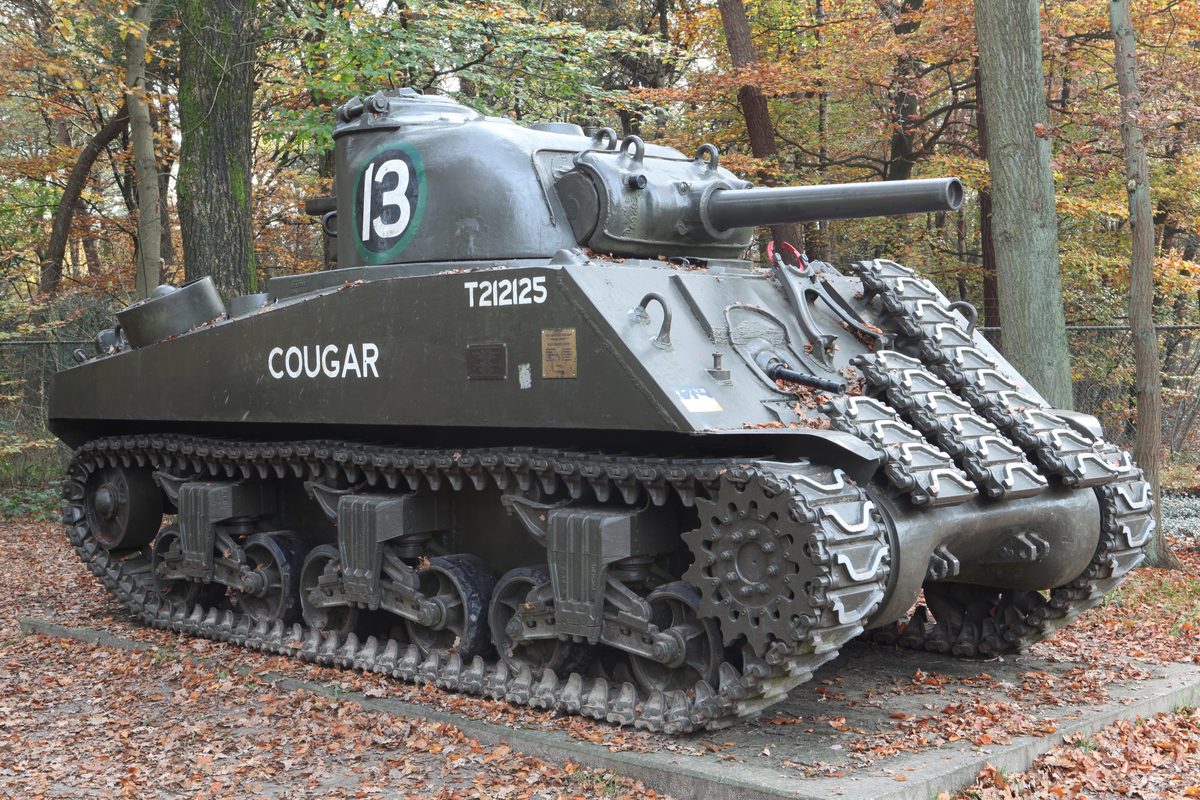
American M4 Sherman tank advancing through a French village with infantry support in 1944

The United States built 49,324 M4 Shermans, more than Germany produced of all tank types combined during the entire war. When American industry hit peak output in 1943, a new Sherman rolled off the assembly line every 6.5 minutes. Germany's total Panther production wouldn't match a single month of Sherman output.

The Sherman wasn't the best tank on any battlefield it fought on, its 75mm gun struggled against Panthers, and its armor couldn't stop an 88mm round. American tankers called it the "Ronson" because it lit up on the first hit. But the M4 won the war through industrial supremacy, mechanical reliability, and adaptability. The 76mm-armed M4A3E8 "Easy Eight" could kill Panthers at combat range. The Sherman DD swam ashore on D-Day. The Sherman Crab flailed mines. The Sherman Jumbo packed 100mm of frontal armor. It fought in Europe, the Pacific, North Africa, Korea, Vietnam, and the 1967 Six-Day War. More nations used the Sherman than any other WWII tank. In armored warfare, the lesson of the Sherman is brutal but true: quantity has a quality all its own, and reliable military equipment that shows up wins wars.

#7: Merkava Mk4: The Tank Built Around One Obsession, Crew Survival
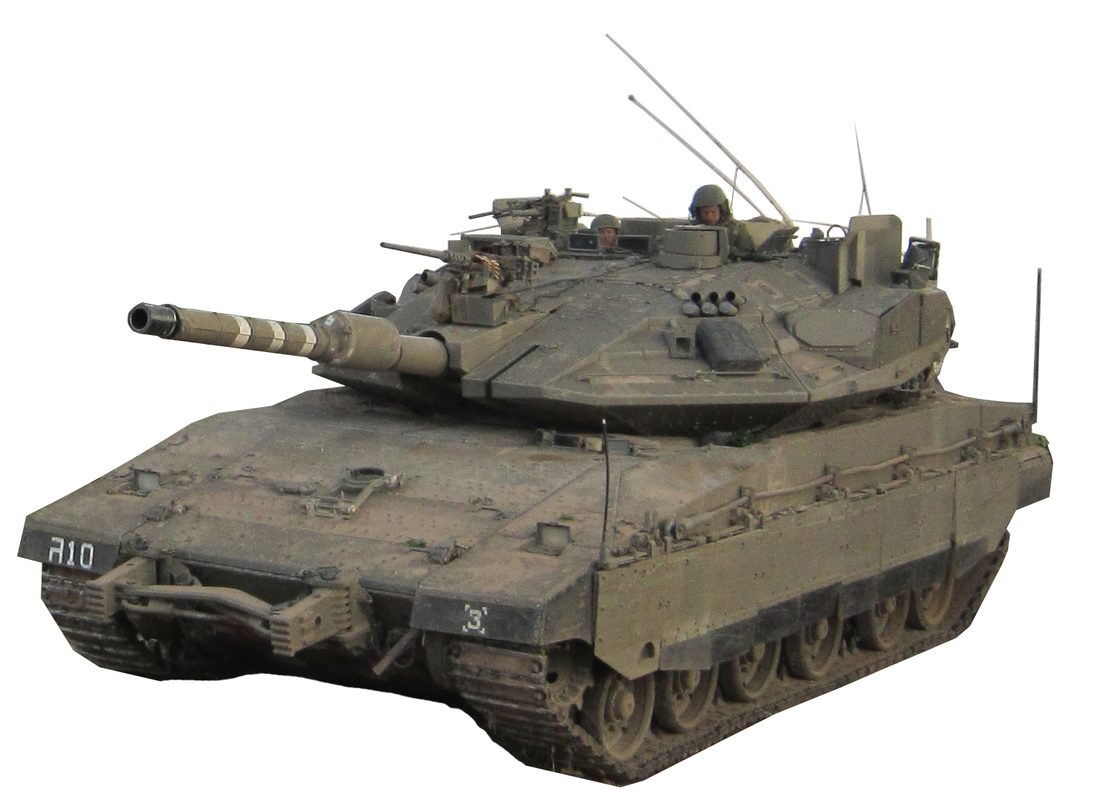
Israeli Merkava Mk4 main battle tank with Trophy active protection system in combat position

The Merkava Mk4 is the first main battle tank fielded with an operationally proven hard-kill active protection system, the Trophy (Windbreaker), which has intercepted incoming RPGs and ATGMs in live combat since 2011 with a reported success rate exceeding 90%. No Merkava Mk4 equipped with Trophy has been destroyed by an anti-tank missile.

Israel's Merkava ("Chariot") puts the engine in the front. A radical departure that gives the crew an extra layer of protection and opens the rear for a small troop compartment or additional ammunition. The Mk4's 120mm MG253 smoothbore is paired with a digital fire control system that can engage moving targets, low-flying helicopters, and even incoming missiles. Its modular armor can be replaced in the field without factory support. Over 660 Mk4s serve in the IDF, and the tank has been continuously refined through real combat experience in Lebanon and Gaza. The Merkava was designed by General Israel Tal, who lost friends in tanks during the 1948 War of Independence and swore to build a machine that brought its crews home alive. Every design decision (front engine, rear escape hatch, Trophy APS) serves that singular philosophy. In defense technology, no tank better embodies the principle that people matter more than machines.

#6: Tiger I: The Fearsome Legend That Terrorized Allied Tankers
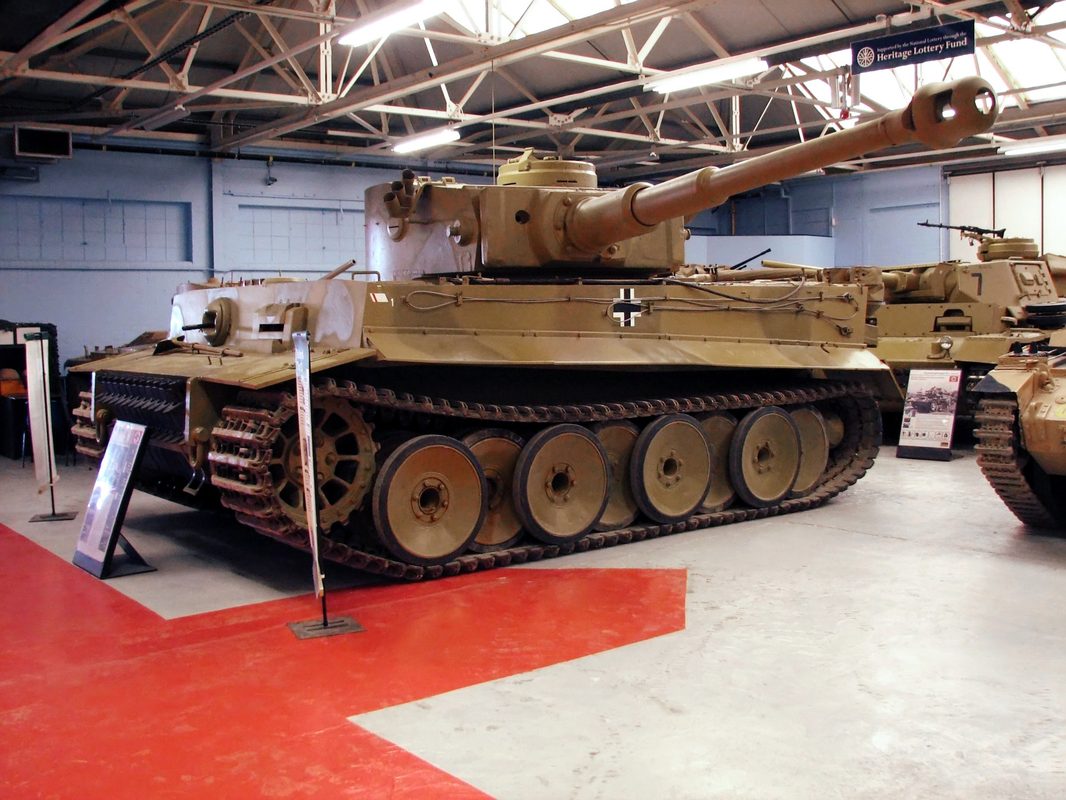
German Tiger I heavy tank with its iconic flat-sided turret and 88mm gun in combat during WWII

SS-Hauptsturmführer Michael Wittmann's Tiger I destroyed 138 tanks and 132 guns during his career, and in a single engagement at Villers-Bocage on June 13, 1944, his Tiger destroyed 14 tanks, 15 personnel carriers, and 2 anti-tank guns in 15 minutes, single-handedly halting the British 7th Armoured Division's advance.

The Tiger I's legendary 88mm KwK 36 L/56 gun could penetrate 120mm of armor at 1,000 meters. It could kill a Sherman at 2,000 meters before the Sherman's 75mm could even scratch its 100mm frontal plate. Only 1,347 were built between 1942 and 1944, but the Tiger's psychological impact far exceeded its numbers. Allied intelligence reported "Tiger fright" among tank crews who assumed every German tank was a Tiger. Each Tiger cost 250,000 Reichsmarks, twice the price of a Panther and four times a Panzer IV. It consumed 540 liters of fuel per 100 kilometers, its interleaved road wheels were a maintenance nightmare in mud and ice, and it broke down constantly. But when a Tiger appeared on the battlefield, everything stopped. In military history, no tank has ever generated more terror per unit than the Tiger I.

#5: Panther: The Best Medium Tank of World War II
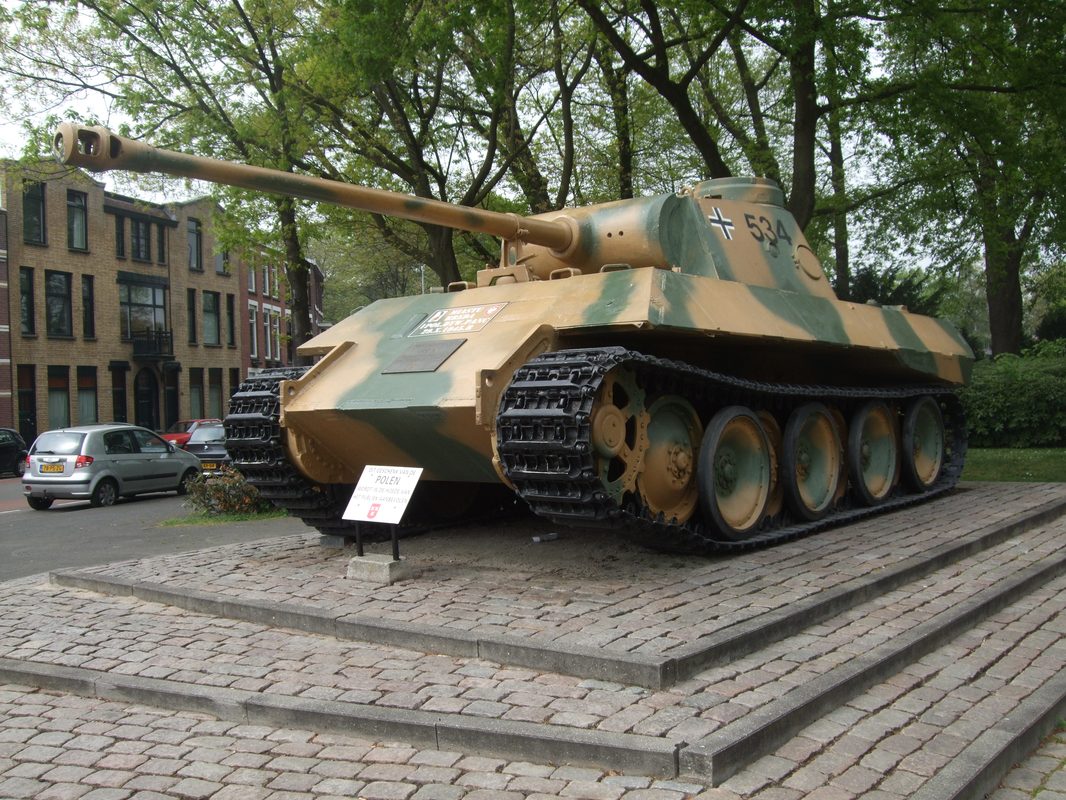
German Panther medium tank with sloped armor advancing through European terrain during WWII

The Panther's 75mm KwK 42 L/70 gun could penetrate 124mm of armor at 1,000 meters, it outperformed the Tiger I's 88mm at long range despite being a smaller caliber. Its 80mm glacis, sloped at 55 degrees, provided an effective armor thickness of 140mm, making it virtually impervious to the Sherman's 75mm and the T-34's 76mm from the front.

Designed as a direct response to the T-34's shocking appearance on the Eastern Front, the Panther combined sloped armor, a high-velocity gun, wide tracks for low ground pressure, and a reliable suspension into a 45-ton package that many historians consider the best tank design of WWII. Over 6,000 were built from January 1943 to April 1945. At Kursk, Panthers of the Grossdeutschland Division engaged T-34s at ranges exceeding 2 kilometers. Post-war, the French Army operated captured Panthers (as the "Char Panther") until 1949, and both the Soviets and Americans extensively tested them. Early Panthers at Kursk suffered catastrophic mechanical failures, transmissions and final drives gave out at alarming rates. But by 1944, these issues were largely resolved. The Panther set the template for what a modern main battle tank should be, firepower, protection, and mobility in balance. Every post-war MBT carries its DNA in the philosophy of armored warfare.

#4: Centurion: The Universal Tank That Fought for 50 Years
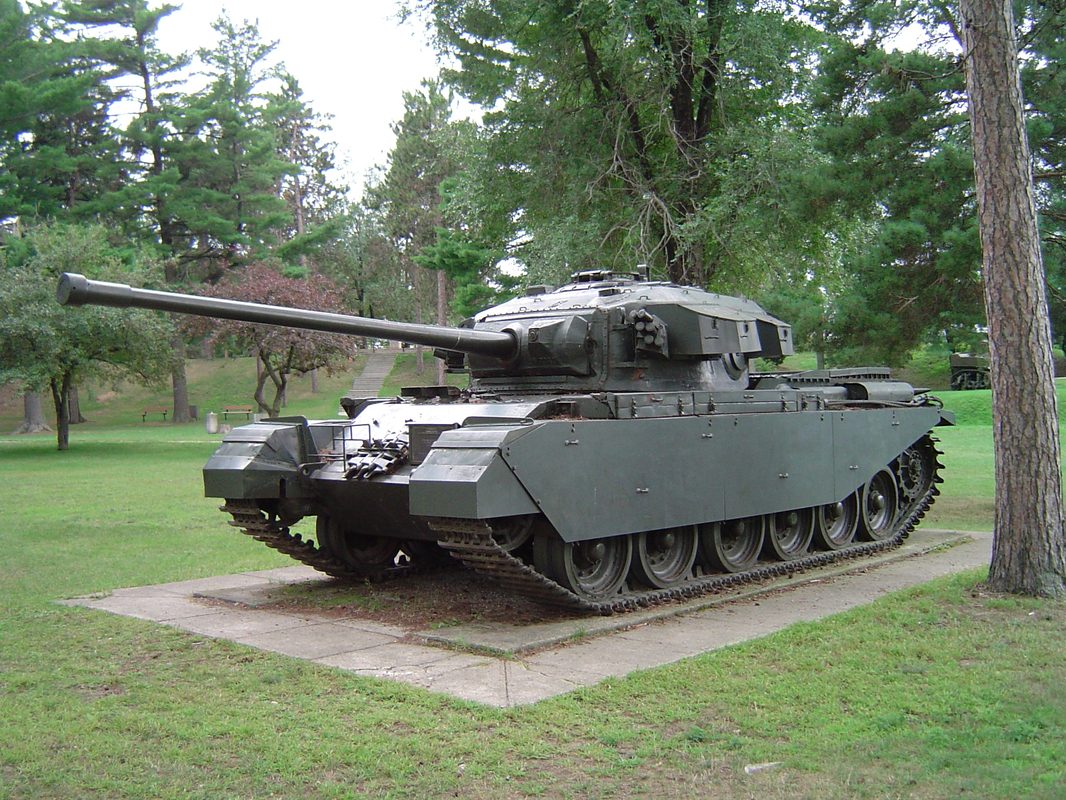
British Centurion tank in combat during the Korean War with infantry support

The Centurion saw combat in Korea, Vietnam, the Indo-Pakistani Wars, the Six-Day War, the Yom Kippur War, South African border conflicts, and Operation Desert Storm, a combat record spanning 50 years across five continents. No other tank in military history has fought in more wars or served more nations.

Entering service in 1945 (just too late for WWII), the Centurion was originally armed with a 76mm gun but was progressively upgraded to the legendary 105mm L7, the most successful tank gun of the Cold War, later adopted by the M60, Leopard 1, and early M1 Abrams. Over 4,423 were built across 13 marks. In the 1967 Six-Day War, Israeli Centurions (Sho't) destroyed dozens of Syrian and Jordanian tanks in the Golan Heights and the West Bank. In Vietnam, Australian Centurions proved that heavy armor was relevant even in jungle warfare, with crews crediting the tank's thick armor with saving their lives against mines and RPGs. The Centurion's adaptability was unmatched, it served as a bridge-layer, a beach recovery vehicle, an AVRE, and an armored personnel carrier. In the pantheon of armored warfare, the Centurion is the ultimate proof that a good basic design with room for upgrades outlasts any wonder weapon. Israel still uses Centurion-based engineering vehicles today, 80 years after the first one rolled off the line.

#3: Leopard 2: The Gold Standard of Modern Armored Warfare
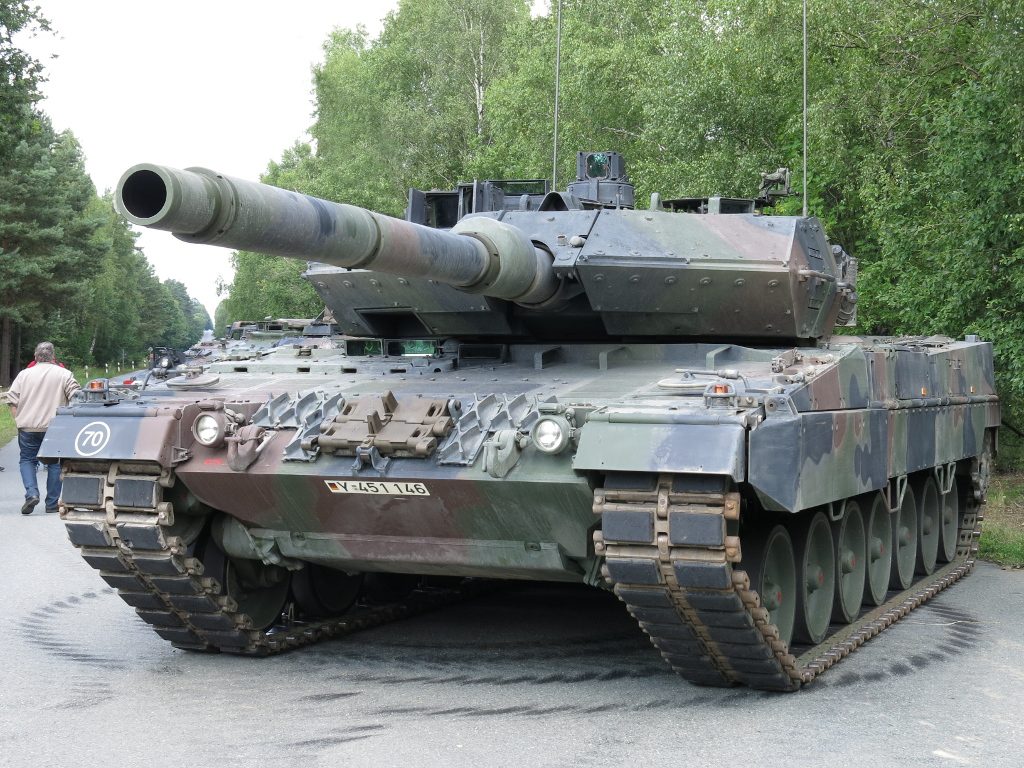
German Leopard 2A7 main battle tank advancing at speed during NATO exercises

The Leopard 2 has been adopted by 19 nations, more than any other Western main battle tank in production. From the frozen forests of Finland to the deserts of Qatar, the Leopard 2 family serves as the armored backbone of NATO's European defense. Over 3,600 have been built, with orders still flowing for the latest 2A7+ variant.

Rheinmetall's 120mm L/55 smoothbore gun on the 2A6 and later variants fires DM53 APFSDS rounds capable of penetrating over 700mm of RHA at 2,000 meters, enough to defeat any tank currently in service. The third-generation composite armor on the 2A7 incorporates NERA elements that provide protection equivalent to over 900mm of RHA against shaped charges. Its 1,500-horsepower MTU MB 873 diesel engine gives the 62.3-ton 2A7 a top speed of 72 km/h with legendary reliability, German tank crews report the Leopard 2's powerpack as the most maintenance-friendly in NATO. Canadian Leopard 2A6Ms saw combat in Afghanistan, and the type has been deployed to the Baltics as part of NATO's Enhanced Forward Presence. The Leopard 2 represents the pinnacle of conventional defense technology: perfectly balanced firepower, protection, and mobility, backed by an upgrade path that will keep it relevant through the 2040s. It's the tank other tanks are measured against.

#2: T-34: The Tank That Broke the Wehrmacht's Back
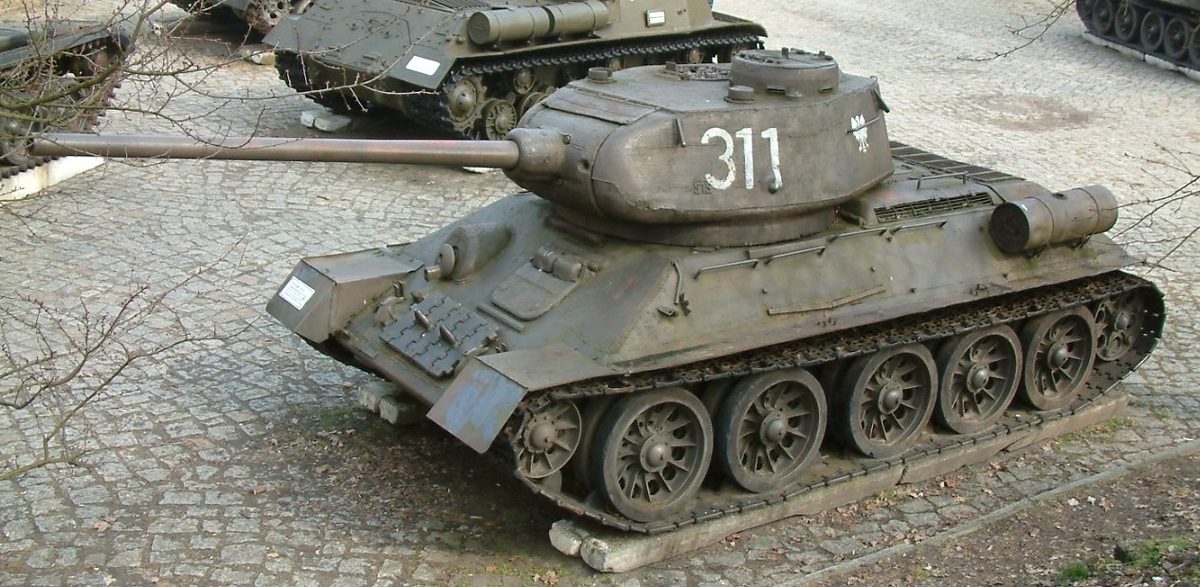
Soviet T-34/85 tanks advancing in mass formation during the Eastern Front offensive

When the T-34 first appeared on the Eastern Front in June 1941, panicked German crews reported that their standard 37mm anti-tank guns were "absolutely useless" against it. General Paul Ludwig Ewald von Kleist called it "the finest tank in the world." The Wehrmacht had nothing that could reliably stop it, and the shock triggered an emergency German tank development program that produced the Panther.

The T-34 combined sloped 45mm armor (equivalent to 90mm effective), a powerful 76mm F-34 gun, a 500-horsepower V-2 diesel engine, and wide Christie suspension tracks into a package that redefined what a medium tank could be. Over 84,000 T-34s were built in all variants, the second-most-produced tank in history behind the T-54/T-55 family. The T-34/85, with its 85mm ZIS-S-53 gun, could engage Tigers and Panthers at medium range and win. At the Battle of Kursk, over 6,000 Soviet tanks, primarily T-34s, clashed with German armor in the largest tank battle in military history. The T-34 was crude inside, ergonomically awful, and the four-man crew was jammed into a space designed for three. But it could be built by untrained workers in factories that had been relocated by rail to the Ural Mountains while under German bombardment. The T-34 didn't just fight in armored warfare, it proved that industrial capacity and design simplicity could defeat engineering excellence. It changed military history forever.

#1: M1 Abrams: The Undisputed King of the Modern Battlefield
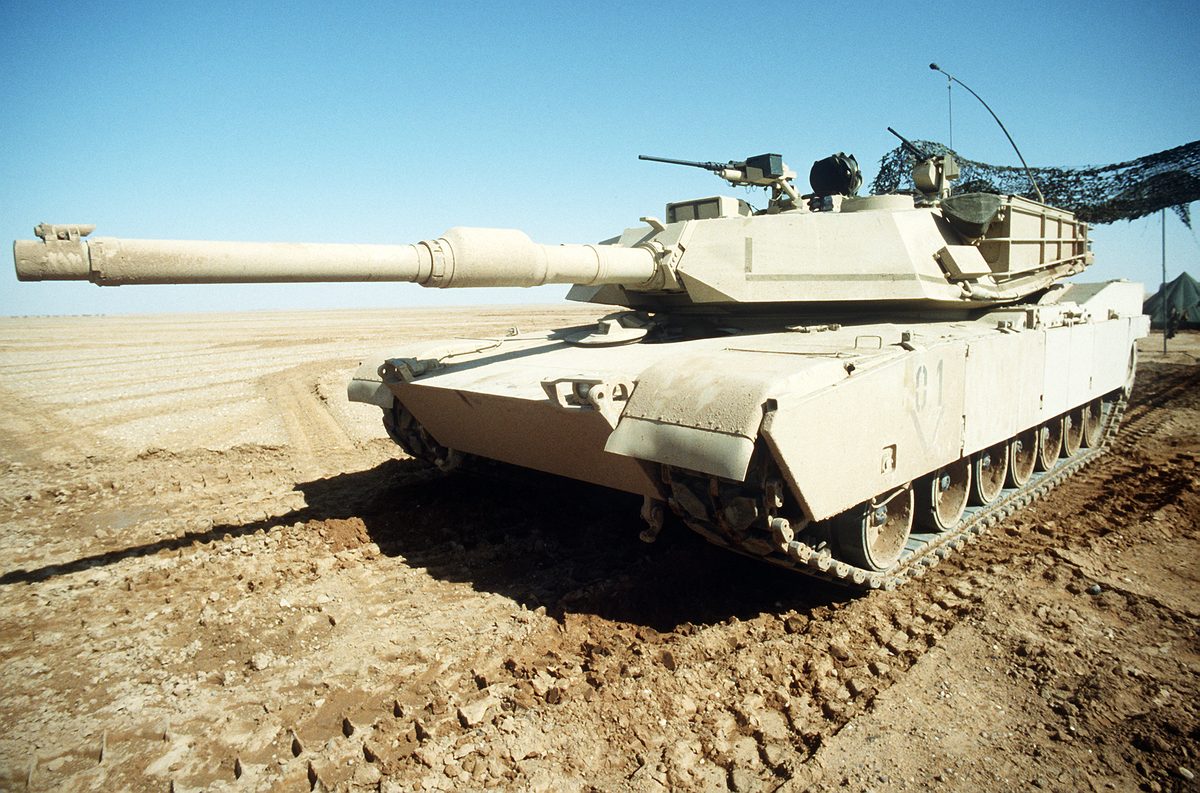
M1A2 Abrams main battle tank firing its 120mm gun during live-fire exercise with American flag

In the 1991 Gulf War, M1A1 Abrams destroyed over 2,000 Iraqi tanks while losing zero, not a single one, to enemy tank fire. At the Battle of 73 Easting, nine Abrams of the 2nd Armored Cavalry Regiment destroyed 28 Iraqi tanks in 23 minutes in a sandstorm, engaging at ranges the Iraqis couldn't even see. The kill ratio was functionally infinite.

The M1 Abrams has dominated every battlefield it has entered since 1991. Its 120mm M256 smoothbore (licensed Rheinmetall L/44) fires M829A4 depleted uranium APFSDS rounds that can penetrate any armored vehicle on earth. The depleted uranium mesh-reinforced composite armor on the M1A2 SEPv3 provides protection estimated at over 900mm RHA equivalent against kinetic rounds, and the exact composition remains classified. Its 1,500-horsepower Honeywell AGT1500 gas turbine can launch 73.6 tons from zero to 72 km/h, and the tank can sustain 60+ km/h cross-country. Over 10,300 Abrams have been built for the U.S., Egypt, Saudi Arabia, Australia, Poland, and others. The M1A2 SEPv3 features the CROWS remote weapon station, next-generation thermal sights, datalink integration with joint forces, and Trophy APS on latest deliveries. The Abrams isn't just a tank, it's a 73-ton networked weapons platform that represents the apex of American defense technology and the most combat-proven main battle tank in modern military history. Nothing else comes close.

Share this article

Share:

Recommended

Ace of The Skies: Can You Identify These Military Aircraft Throughout The Years?
Test Yourself

Ace of The Skies: Can You Identify These Military Aircraft Throughout The Years?

Can you identify these aircraft?

Take the Quiz

On This Day in Military History

January 3

Battle of Princeton (1777)

George Washington's Continental Army defeated British forces at Princeton, New Jersey, just ten days after the stunning victory at Trenton. Washington personally led a charge that rallied his wavering troops, and the twin victories at Trenton and Princeton rescued the American Revolution from collapse, revived patriot morale, and convinced France that the Americans were worth backing.
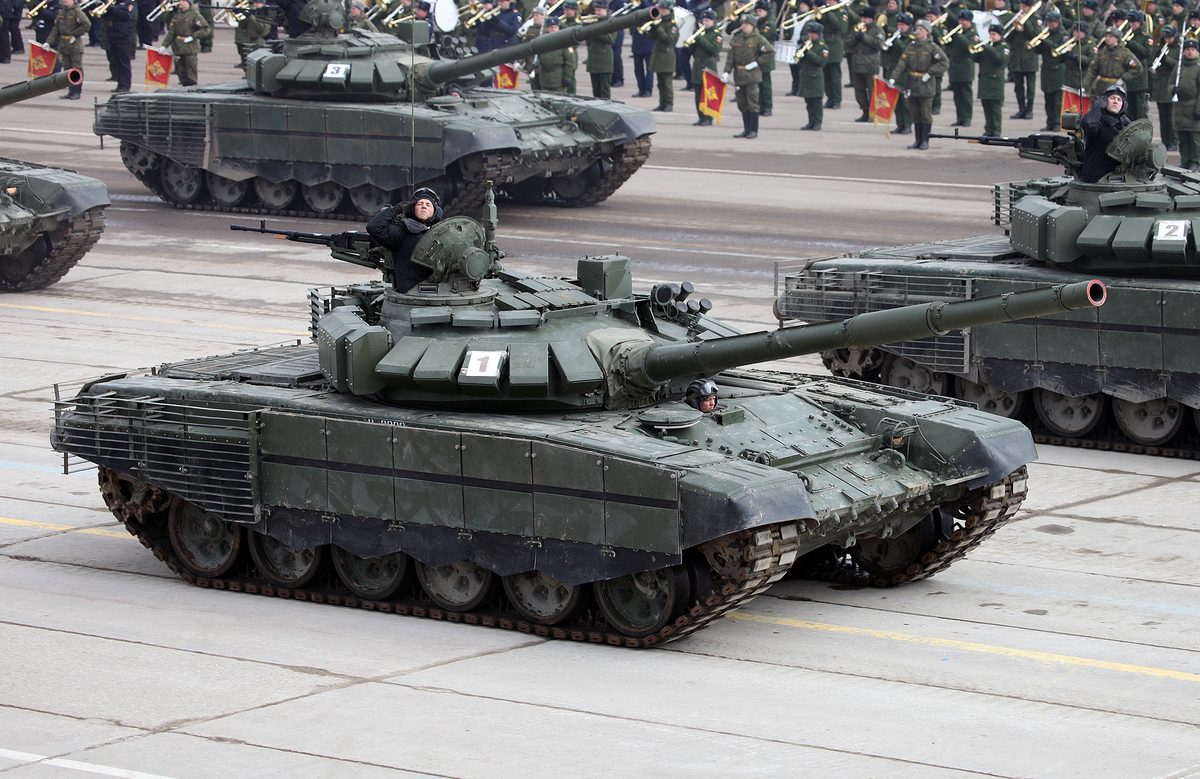
2020, U.S. Drone Strike Kills Qasem Soleimani

1951, Chinese Forces Launch New Year's Offensive in Korea

1431, Trial of Joan of Arc Begins at Rouen

See all 10 events on January 3

Get Military News & History in Your Inbox

Join thousands of readers receiving our weekly digest of military technology, history, and analysis.

Test Your Knowledge