Skip to content
May 5:Battle of Puebla: Cinco de Mayo164yr ago

60 Military Vehicles You Won't Believe Exist

Charles Bash · · 56 min read
Save
Share:
Kugelpanzer ball tank at Kubinka Tank Museum
Charles Bash
Charles Bash

Military Culture & Global Defense Writer

Charles Bash covers military culture, global defense forces, and the human side of armed services around the world. His work explores how militaries shape the lives of the men and women who serve in them.

Kugelpanzer: The Rolling Steel Ball Nobody Can Explain

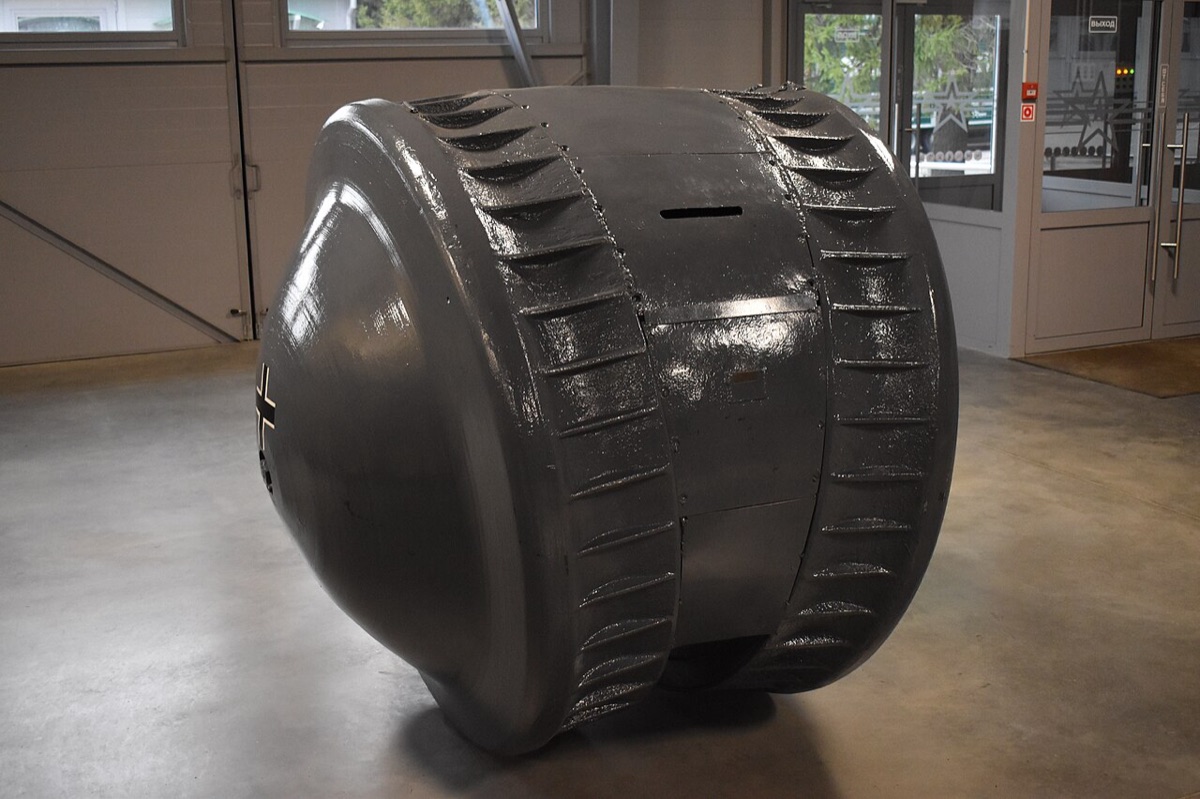
Kugelpanzer spherical tank at Kubinka Tank Museum in Russia

Sitting quietly in Russia's Kubinka Tank Museum is a vehicle so bizarre that military historians still argue about its purpose. The Kugelpanzer, literally "ball tank," is a single-seat, spherical armored vehicle believed to have been developed by Nazi Germany and captured by the Soviets during World War II. Its spherical hull rolls on a central drum with two small stabilizer wheels, and it carries armor just 5mm thick, enough to stop small-arms fire but nothing heavier.

The mystery deepens because almost zero documentation survives. Some researchers believe it was an armored observation post meant to roll into forward positions. Others speculate it was designed for cable-laying or reconnaissance. Japan may have been involved in its development, as the sole surviving example was reportedly captured from the Japanese. The Soviets classified it upon capture and never publicly discussed it. Whatever its intended mission, the Kugelpanzer remains one of the most enigmatic armored vehicles ever built, a steel ball with a story that died with its creators.

Tsar Tank: Russia's 27-Foot Tricycle of Doom

Historical illustration of the Tsar Tank with its massive front wheels

In 1914, Russian engineer Nikolai Lebedenko convinced Tsar Nicholas II to fund an armored vehicle with front wheels standing 27 feet tall, taller than a two-story building. The Lebedenko Tank, better known as the Tsar Tank, looked less like a war machine and more like an enormous metal tricycle. Two massive spoked front wheels were supposed to roll over any obstacle, while a smaller rear roller steered the contraption. It mounted multiple machine gun positions and was powered by two captured Maybach aircraft engines.

When the prototype rolled out for testing near Moscow in August 1915, the concept immediately collapsed, literally. While the front wheels could indeed crush trees, the tiny rear wheel promptly sank into soft ground and stuck. The entire 60-ton vehicle became immobilized and no amount of engine power could free it. The Tsar Tank sat abandoned in the forest for years, slowly rusting, until it was finally scrapped in 1923. It remains one of history's most ambitious, and most spectacularly failed, attempts to reinvent armored warfare from scratch.

Vespa 150 TAP: The Scooter With a Recoilless Rifle

Vespa 150 TAP military scooter with mounted M20 recoilless rifle at a museum

In the 1950s, the French military looked at a Vespa motor scooter and thought: "What if we strapped a 75mm recoilless rifle to it?" The result was the Vespa 150 TAP, designed for French paratroopers who needed lightweight anti-armor capability after dropping into hostile territory. The M20 recoilless rifle was mounted on a reinforced frame, and the entire package (scooter, gun, ammunition) could be parachute-dropped from transport aircraft.

Approximately 800 units were produced and saw actual service with French Airborne forces, including during the Algerian War. The scooter wasn't meant to fire while riding, paratroopers would dismount, set up the rifle on a tripod, and use the Vespa for rapid repositioning between shots. At just 250 pounds fully loaded, it gave lightly equipped airborne troops a genuine anti-vehicle weapon they could move across rough terrain far faster than on foot. It looks absurd in photographs, but the concept was surprisingly practical for its era.

Antonov A-40: The Soviet Flying Tank That Actually Flew

Diagram of the Antonov A-40 flying tank with biplane wings and tail assembly attached to a T-60 light tank

Soviet designer Oleg Antonov decided in 1942 that the best way to deliver tanks to the battlefield was to strap enormous biplane wings and a tail assembly onto a T-60 light tank and tow it into the air behind a bomber. The Antonov A-40, also known as the "Krylya Tanka" (Tank Wings), was designed to glide down to a landing zone, detach its wings, and immediately roll into combat, the ultimate airborne armored assault.

Incredibly, a prototype actually flew during a test in September 1942. A Tupolev TB-3 bomber towed the winged tank aloft, and the A-40 reportedly glided successfully before landing. However, the towing aircraft struggled badly with the aerodynamic drag, the TB-3's engines overheated and the pilot had to release the tank earlier than planned. The A-40 landed safely, shed its wings, and drove back to base under its own power. Despite this qualified success, the project was cancelled because no Soviet bomber was powerful enough to tow the apparatus reliably. The dream of flying tanks died, but not before the Soviets proved it was technically possible.

Bob Semple Tank: New Zealand's DIY Armored Tractor

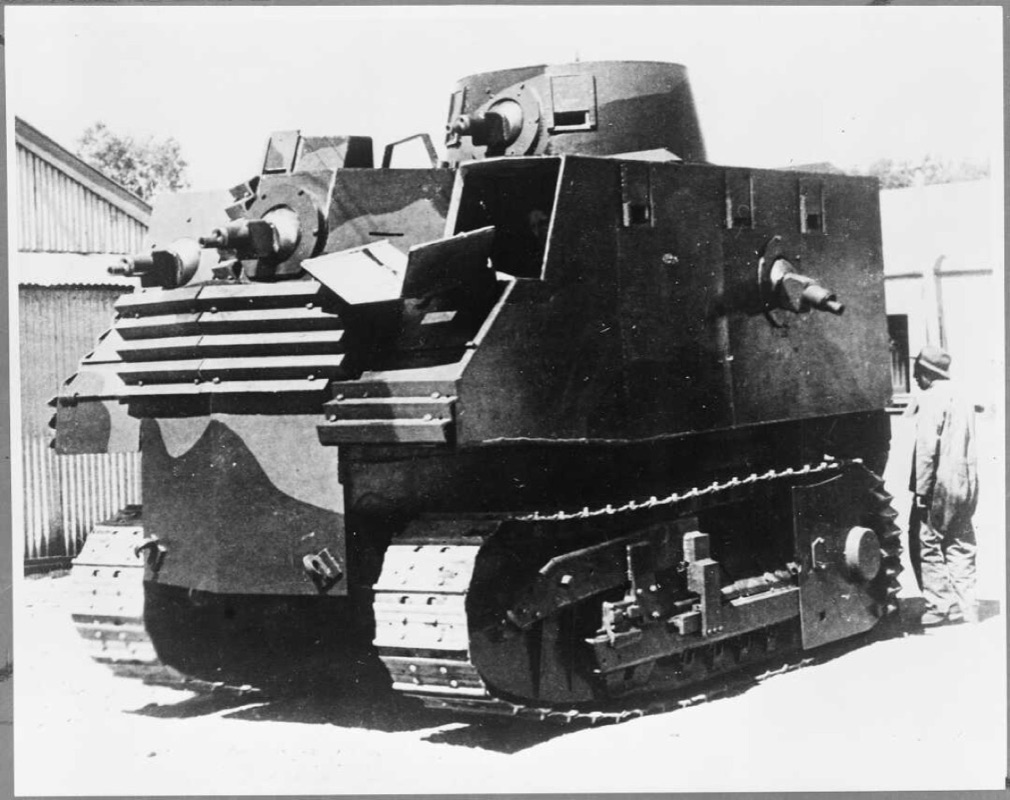
Bob Semple Tank built on a Caterpillar tractor chassis in New Zealand during World War II

When Japan threatened the Pacific in 1940, New Zealand had zero tanks and no way to import any. Public Works Minister Bob Semple took matters into his own hands, ordering his engineers to build armored vehicles from whatever was available. The result was corrugated iron armor bolted onto Caterpillar D8 tractor chassis, armed with six Bren light machine guns. The "Bob Semple Tank" was born, and it was terrible in almost every measurable way.

The vehicle weighed about 25 tons but could barely manage walking speed. The corrugated manganese steel armor would have been penetrated by heavy machine gun fire. Crew members operating the side and rear guns had to lie on mattresses placed over the engine, enduring heat, fumes, and vibrations that made accurate shooting essentially impossible. Only three were built before the program was mercifully cancelled. Yet the Bob Semple Tank earned an unlikely legacy: it proved that a country with nothing but determination and farm equipment would at least try to defend itself, and that spirit, if not the vehicle, deserves respect.

Progvev-T: The Tank With a Jet Engine for a Turret

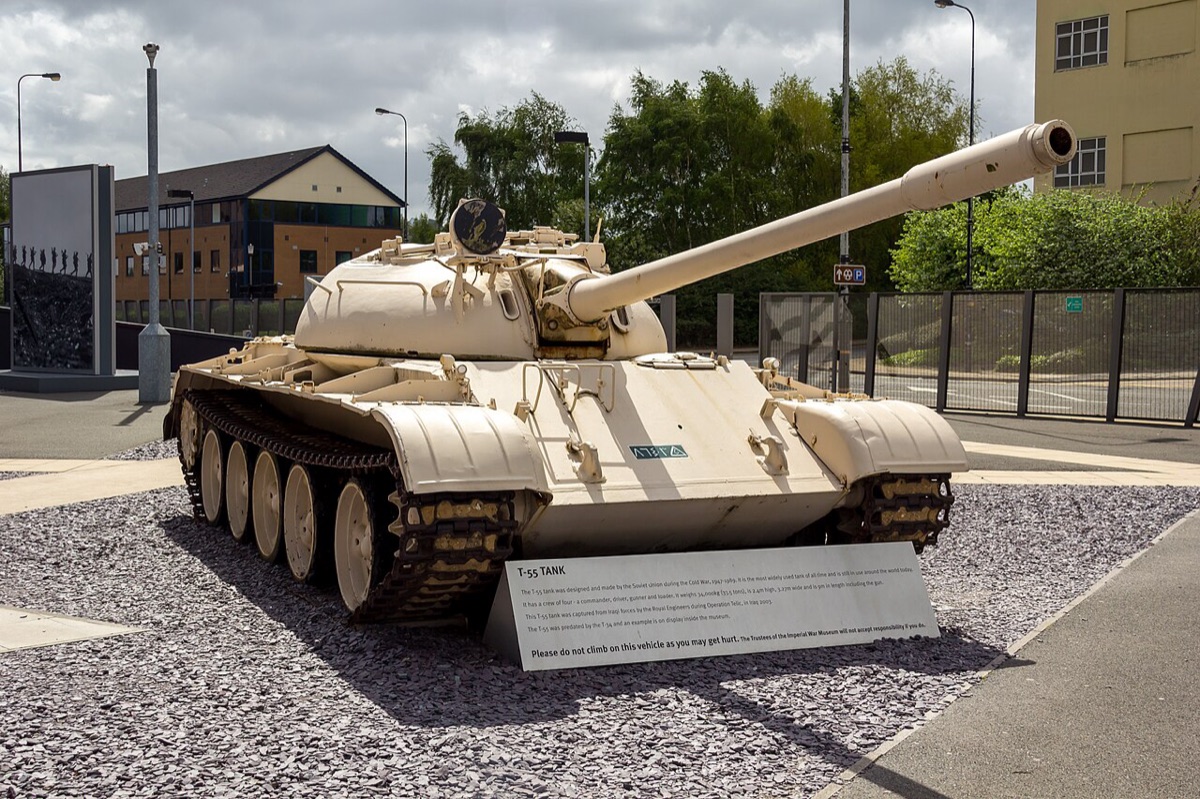
Soviet T-55 tank chassis, the base used for the Progvev-T mine clearing vehicle

The Soviet Union looked at a T-54 tank hull and a surplus MiG-15 jet engine and thought: "Why not combine them?" The Progvev-T (short for "protivogazodinamicheskiy tral," gas-dynamic trawl) replaced the tank's turret with an operational jet engine pointed forward. The concept was to use the engine's superheated exhaust blast to detonate or disable landmines at a safe distance ahead of the vehicle. Turn on the jet, roll forward, and let thermal energy do the mine-clearing work.

Testing in the 1970s showed the concept partially worked. The jet blast could indeed trigger pressure-detonated mines within a narrow strip. But the drawbacks were catastrophic for a military vehicle. The roaring jet engine announced the Progvev-T's presence from miles away, making any element of surprise impossible. Fuel consumption was astronomical, limiting operational range to a few kilometers. The exhaust blast kicked up enormous dust clouds that blinded the crew. And the clearance strip was too narrow for practical use. The project was shelved, but the Progvev-T earned its place in history as the most dramatically over-engineered mine-clearing solution ever attempted.

Panzer VIII Maus: The 188-Ton Monster That Could Barely Move

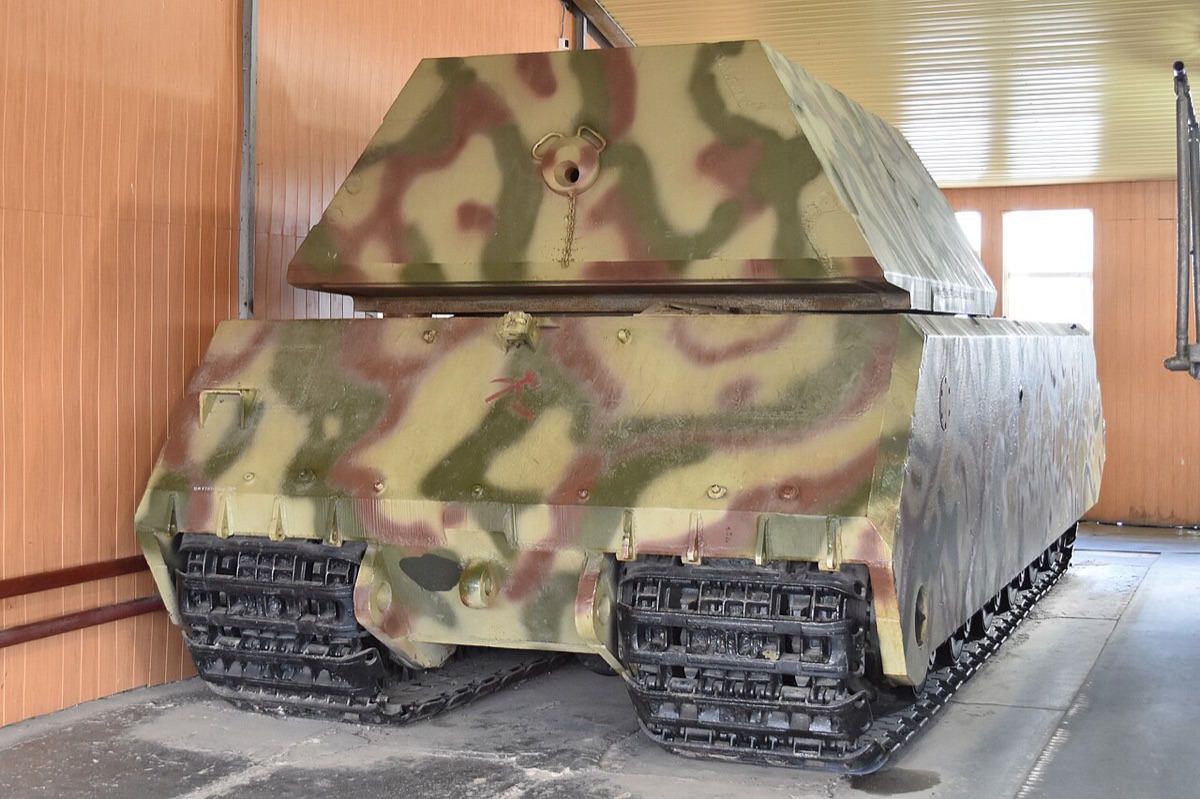
Panzer VIII Maus super-heavy tank at Kubinka Tank Museum in Russia

The Maus wasn't just the heaviest tank ever built, at 188 metric tons, it weighed more than three modern M1 Abrams tanks combined. Designed under Ferdinand Porsche's supervision for Nazi Germany, this behemoth carried a 128mm main gun backed by a coaxial 75mm cannon, all wrapped in armor up to 240mm thick. It was designed to be virtually invulnerable to any Allied weapon in existence and to smash through fortified defensive lines by sheer mass.

Only two prototypes were completed before the war ended. The Maus could theoretically cross rivers by driving along the bottom using a snorkel system. It was too heavy for any bridge in Europe. Its 1,200-horsepower Daimler-Benz engine could push it to a maximum speed of just 13 km/h on roads, and fuel consumption was so extreme that the Maus had an operational range of roughly 60 kilometers. It was too heavy to use roads without destroying them, too slow to maneuver tactically, and too thirsty to deploy far from a fuel depot. The Soviets captured both prototypes and assembled one complete vehicle for testing, which now sits in the Kubinka Tank Museum, a monument to what happens when "bigger" becomes the only design goal.

Landkreuzer P.1000 Ratte: The 1,000-Ton Tank That Never Left the Drawing Board

Size comparison illustration showing the massive scale of the Landkreuzer P.1000 Ratte concept

If the Maus was absurdly large, the Landkreuzer P.1000 Ratte was pure engineering insanity. Proposed in 1942 by Krupp director Edward Grotte, this 1,000-ton super-heavy tank would have been 35 meters long and 11 meters tall, roughly the size of a naval destroyer placed on treads. Its planned armament included twin 280mm naval guns in a battleship-style turret, plus a 128mm anti-tank gun and multiple anti-aircraft batteries. Armor thickness was to reach 360mm.

Albert Speer, Germany's Minister of Armaments, personally cancelled the project in 1943 after recognizing the obvious: a vehicle this massive would sink into any road or bridge, present an unmissable target to Allied bombers, require its own fuel supply chain, and couldn't be manufactured with wartime resources. The Ratte would have needed submarine diesel engines or aircraft powerplants to move at all. It exists only in blueprints and scale models, but it represents the extreme logical endpoint of the "bigger is better" armored warfare philosophy. The point where a tank becomes too large to be a tank anymore.

Object 279: The Nuclear-Proof Tank With Four Tracks

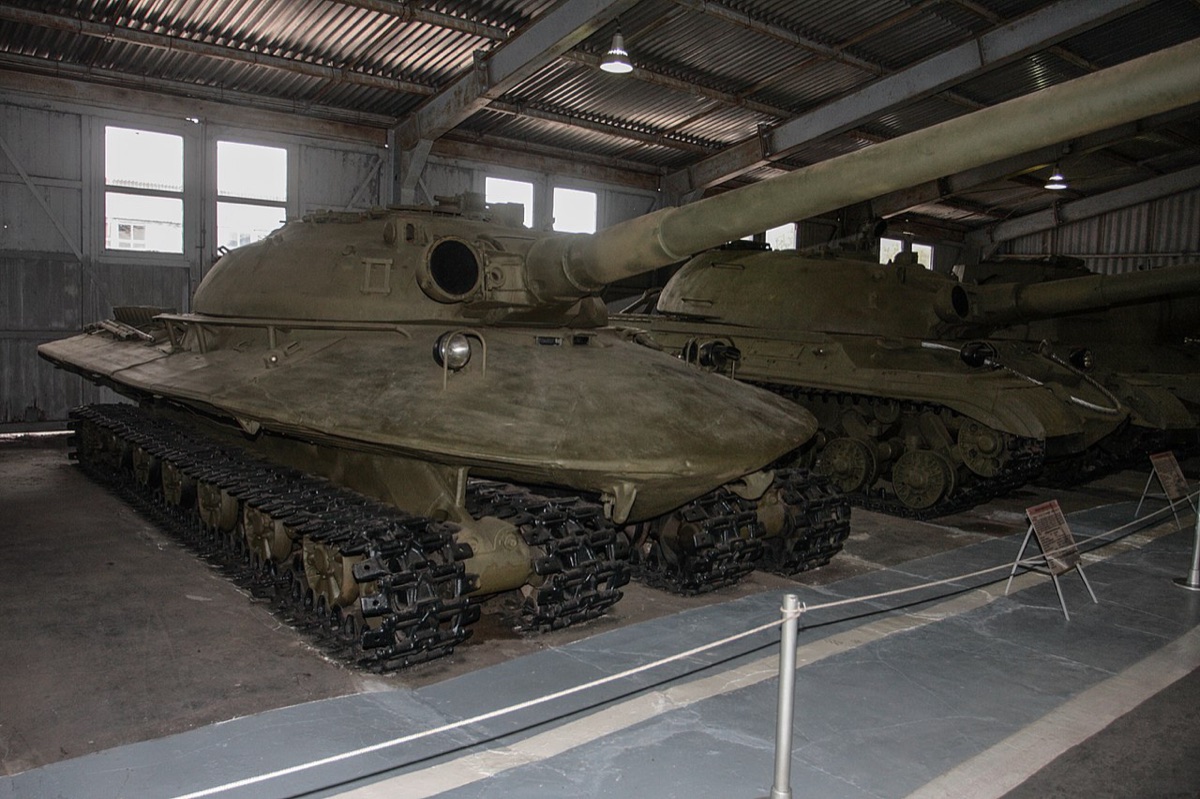
Object 279 experimental heavy tank with distinctive elliptical hull at Kubinka Tank Museum

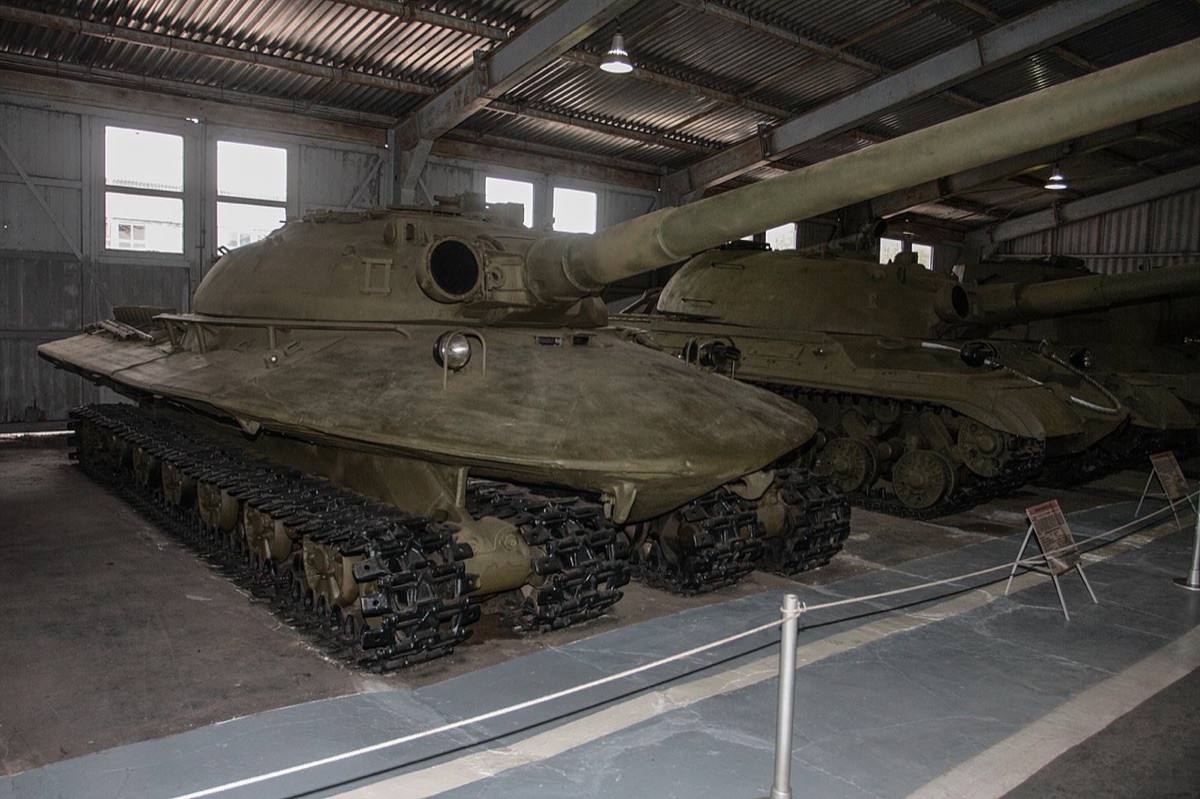
In 1959, Soviet engineers at the Kirov Plant produced what might be the most alien-looking tank ever built. Object 279 featured an elliptical, flying-saucer-shaped hull designed to deflect nuclear blast waves, four sets of tracks for maximum ground pressure distribution, and a 130mm rifled gun that could destroy any NATO tank at extreme range. Its flattened profile and curved armor were specifically engineered to survive on a nuclear battlefield.

The design was genuinely brilliant in several respects. The four-track configuration allowed Object 279 to cross swampy terrain that would trap conventional tanks. The thin, wide hull created excellent shot deflection angles. It weighed 60 tons but distributed that mass so effectively it could traverse soft ground with ease. Only one prototype was built before Nikita Khrushchev cancelled all Soviet heavy tank projects in 1960, declaring that missiles had made heavy tanks obsolete. The sole surviving Object 279 sits in Kubinka, looking exactly like what it was: a vehicle designed to fight World War III.

Schwimmwagen: The Volkswagen That Conquered Rivers

Volkswagen Schwimmwagen Type 166 amphibious military vehicle

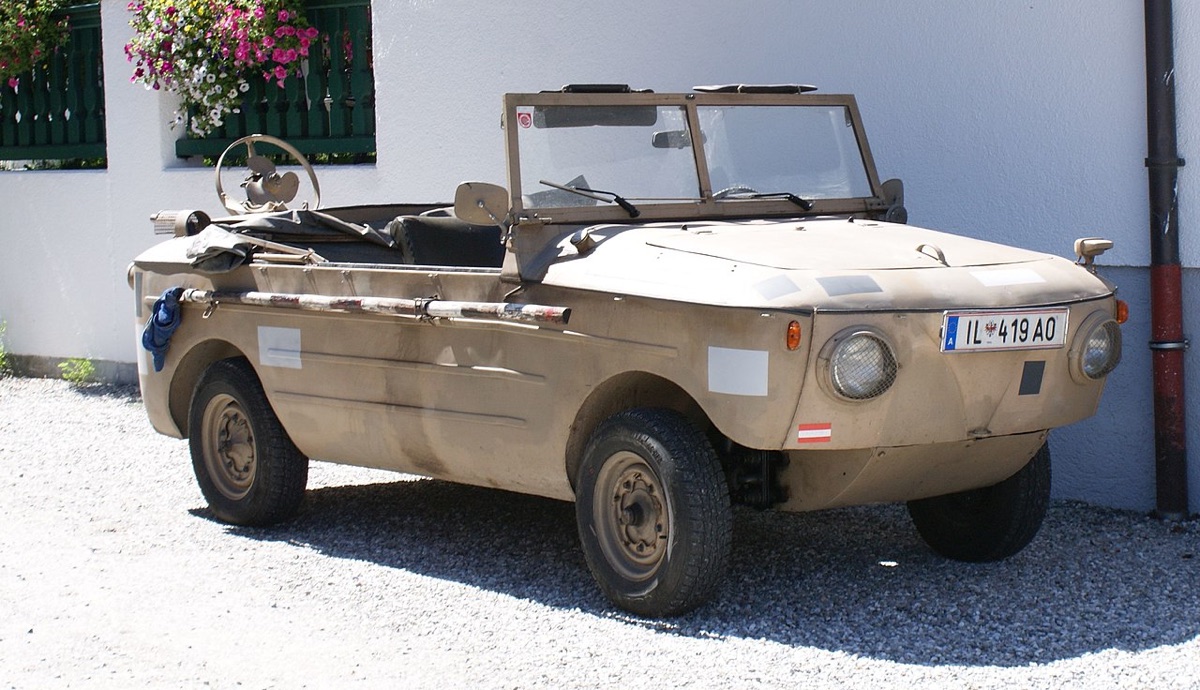
The Schwimmwagen was the most mass-produced amphibious car in history, and it was essentially a Volkswagen Beetle that could swim. Built by Porsche on a modified VW Type 82 Kubelwagen chassis, the Type 166 Schwimmwagen featured a sealed, boat-shaped hull and a rear-mounted propeller that folded down for water operations. Its air-cooled flat-four engine powered all four wheels on land and the propeller in water, making it a true dual-mode vehicle.

Over 15,000 Schwimmwagens were produced between 1942 and 1944, serving on every front where Germany fought. On land, it was a capable off-road vehicle with four-wheel drive. In water, it could cross rivers and lakes at a slow 10 km/h, but far faster and more practical than building a pontoon bridge under fire. The Wehrmacht used them extensively for reconnaissance, messenger duty, and officer transport. Surviving examples now sell for astronomical prices at collector auctions, making the Schwimmwagen both a remarkable piece of wartime engineering and one of the most valuable military vehicles on the vintage market.

Kettenkrad: Half Motorcycle, Half Tank, Fully Bizarre

Kettenkrad half-track motorcycle with front wheel and rear tracked drive system

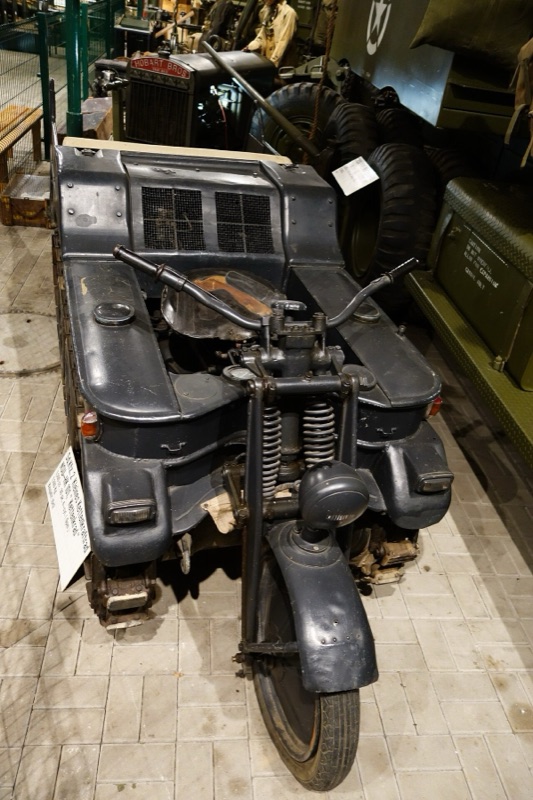
Take a motorcycle's front end, attach it to a miniature tracked vehicle's rear, and you get the Kettenkrad, one of World War II's strangest and most successful hybrid vehicles. The NSU Kettenkraftrad HK 101 combined a motorcycle's handlebar steering with a half-track's go-anywhere capability. Powered by a 1.5-liter Opel Olympia engine, it weighed just 1,560 kg but could tow loads exceeding a ton through mud, snow, and terrain that would stop a standard motorcycle cold.

Originally designed to be air-dropped with paratroopers, the Kettenkrad found its greatest use on the Eastern Front, where it excelled at towing supply trailers and communication cables through the bottomless mud that consumed conventional wheeled vehicles. Over 8,300 were built, and after the war, surviving units were repurposed for forestry work in Germany's dense forests, their narrow profile and tracked mobility made them ideal for hauling logs on trails too narrow for trucks. The Kettenkrad proved that sometimes the most absurd-looking solution is the one that actually works.

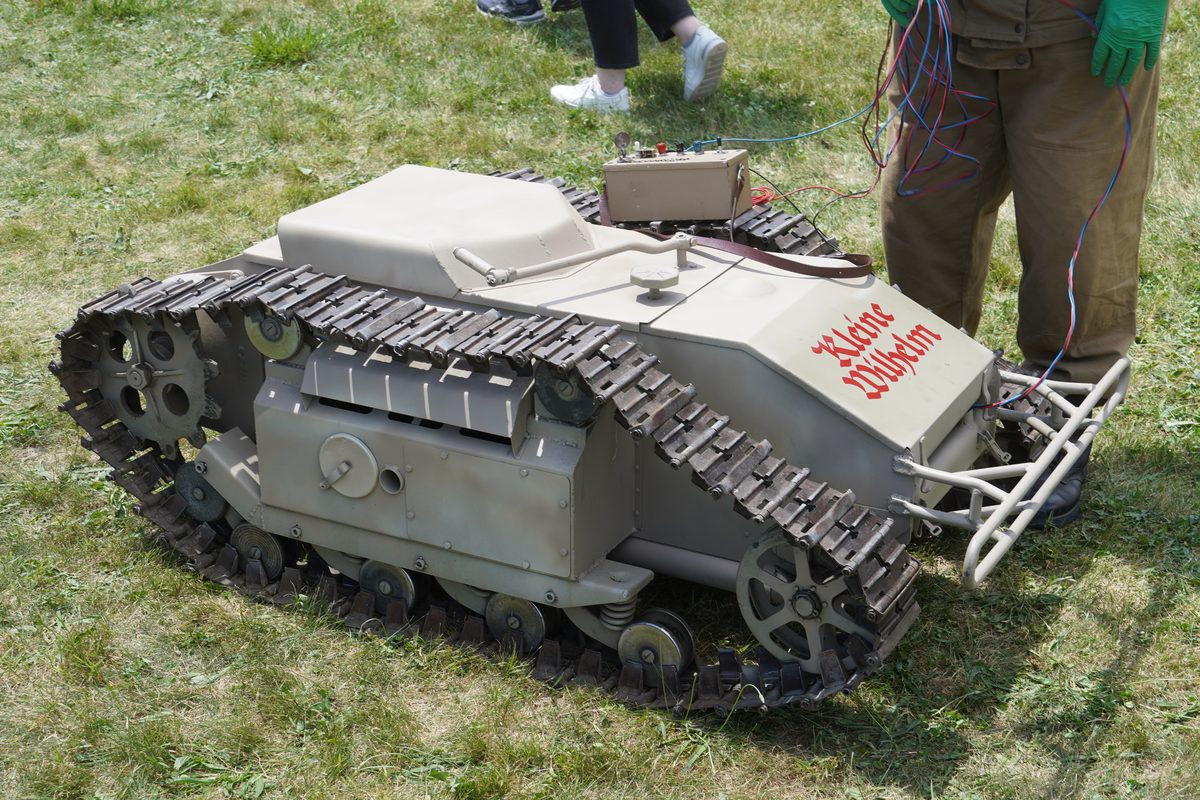
Goliath Tracked Mine: The World's First Kamikaze Robot

German Goliath tracked mine remote-controlled demolition vehicle from World War II

Before modern military drones, there was the Goliath, a small, remote-controlled tracked vehicle carrying 60-100 kg of explosives, guided toward targets by a thin trailing wire. Measuring just 1.5 meters long and 0.6 meters wide, the Goliath was essentially a disposable robot bomb. An operator would steer it toward an enemy bunker, tank, or bridge from a safe distance, then detonate it on arrival. Each use destroyed the Goliath along with its target.

Germany deployed over 7,500 Goliaths between 1942 and 1945. Early versions used electric motors and were expensive at 3,000 Reichsmarks each, roughly the cost of a small car. Later versions switched to cheaper gasoline engines. In practice, the Goliath had significant weaknesses: the trailing control wire could be cut by gunfire, the vehicle was slow enough to be shot at, and it couldn't climb steep obstacles. But the concept was revolutionary, a remotely operated unmanned ground vehicle designed for one-way demolition missions. Modern military robotics engineers consider the Goliath a direct ancestor of today's explosive ordnance disposal robots and loitering munitions.

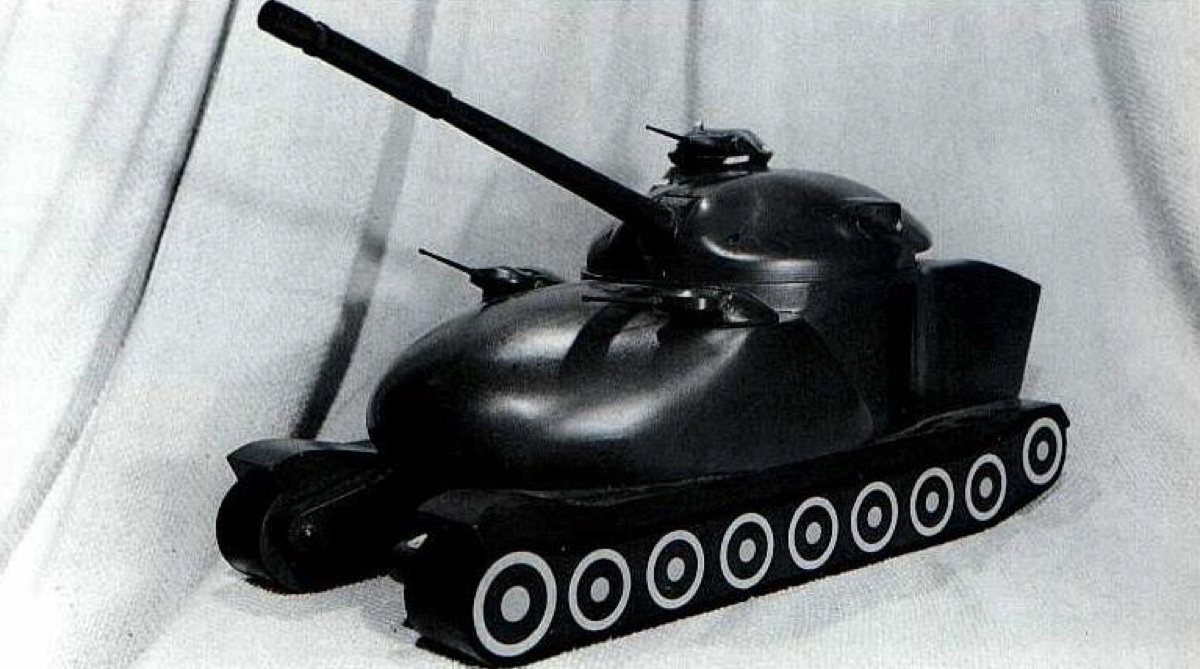
Chrysler TV-8: The Nuclear-Powered Tank Concept

Chrysler TV-8 nuclear-powered tank concept illustration from the 1950s

In 1955, Chrysler presented the U.S. Army with a tank concept so radical it seemed like science fiction. The TV-8 featured a massive, pod-like turret that contained the entire crew, engine, weapons, and ammunition. The chassis was essentially just a set of tracks and a pedestal. The turret was designed to be ejectable and amphibious, capable of floating across rivers independently. Most audaciously, one proposed powerplant option was a small nuclear reactor.

The TV-8's unconventional design was driven by Cold War nuclear survivability concerns. By placing everything inside the turret pod, the vehicle presented a smaller target and could theoretically be more resistant to nuclear blast effects. The rounded turret shape was intended to deflect radiation and shrapnel. Other power options included a gas turbine and a Chrysler V-8 engine. The Army studied the proposal but never funded a prototype, the engineering challenges of a nuclear reactor small enough to fit in a tank turret were insurmountable with 1950s technology. The TV-8 remains a fascinating glimpse into an era when military planners seriously considered atomic-powered everything.

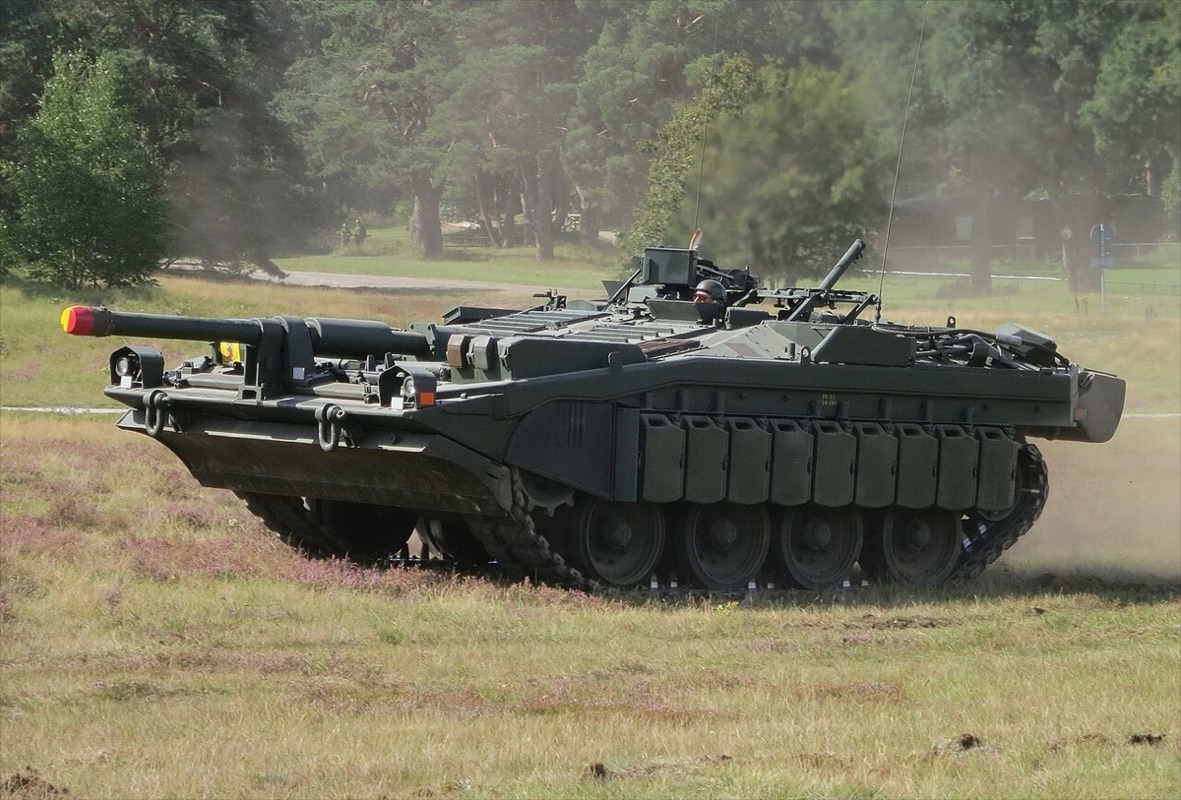
Stridsvagn 103: The Tank With No Turret

Swedish Stridsvagn 103 S-tank with its unique turretless design in field conditions

Sweden's Stridsvagn 103, universally known as the "S-tank," broke every rule of tank design by eliminating the turret entirely. Its 105mm gun was fixed directly into the hull. To aim, the entire tank had to pivot left or right and adjust its hydropneumatic suspension to elevate or depress the barrel. This sounds insane, but the S-tank was specifically designed for Sweden's defensive terrain: position the vehicle behind a ridge, expose only the paper-thin front profile, fire, then reverse out of sight.

The turretless design delivered real tactical advantages. The S-tank's front profile was extraordinarily low, just 1.9 meters from ground to roofline, compared to over 2.7 meters for contemporary NATO tanks. It was the first tank to feature an autoloader, eliminating one crew member and further reducing the vehicle's size. The fixed gun could be aimed with surprising speed and precision using the hydropneumatic system. Sweden operated the S-tank from 1967 to 1997, and comparative trials against turreted tanks consistently showed it held its own in defensive scenarios. It was weird, it was Swedish, and it worked exactly as intended.

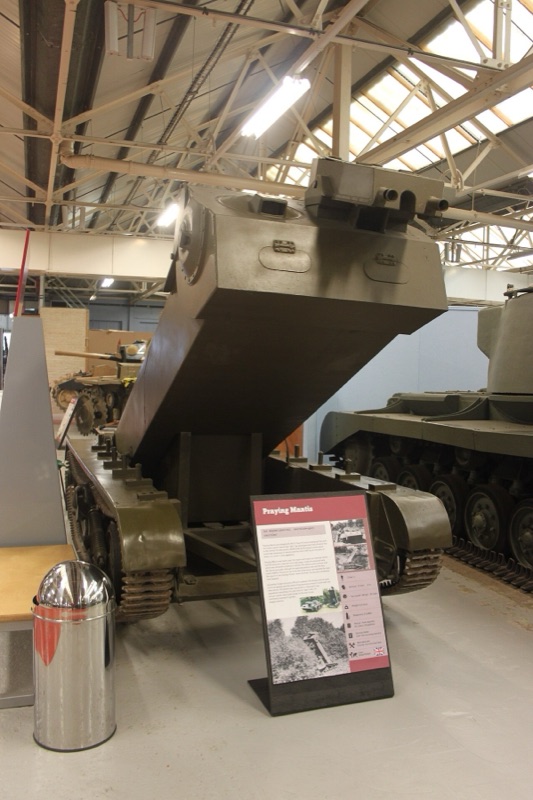
Praying Mantis: Britain's Pop-Up Machine Gun Carrier

Praying Mantis experimental machine gun carrier with elevated fighting compartment

In 1943, a British inventor named Ernest James Tapp proposed a universal carrier variant where the crew compartment could hydraulically elevate to fire over walls, hedgerows, and obstacles. The "Praying Mantis" featured an armored fighting compartment that pivoted upward on a hydraulic arm, allowing the gunner and driver to rise several feet above the vehicle's normal height, fire their weapons, and then retract back behind cover.

The concept addressed a real problem: infantry carriers in Normandy's bocage hedgerow country couldn't fire over the thick earthen banks that lined every road and field. The Praying Mantis could theoretically pop up, spray the area with machine gun fire, and duck back down before the enemy could react. In practice, the elevated position made the crew dangerously exposed, the hydraulic mechanism was unreliable, and the whole system added weight and complexity to an already cramped Universal Carrier. Only a single prototype was built, and it never saw combat. But it earned one of the best names in military vehicle history.

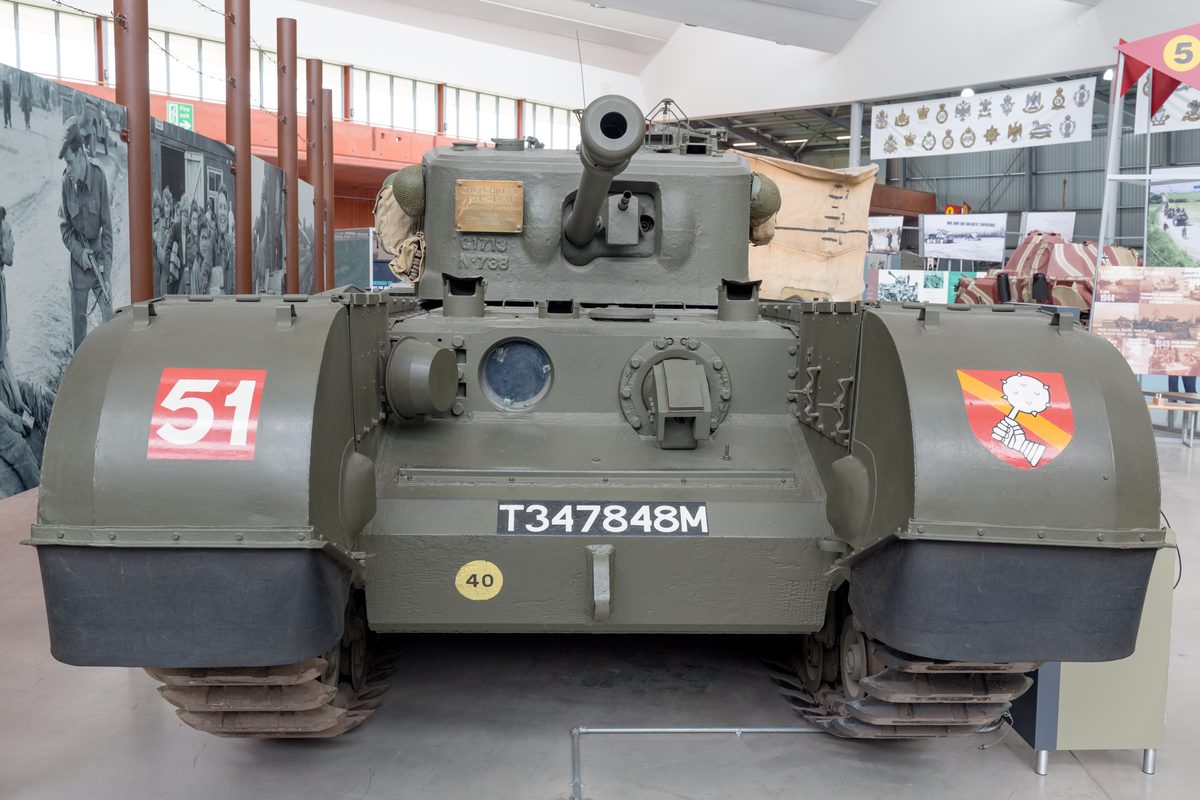
Churchill Crocodile: The Tank That Breathed Fire

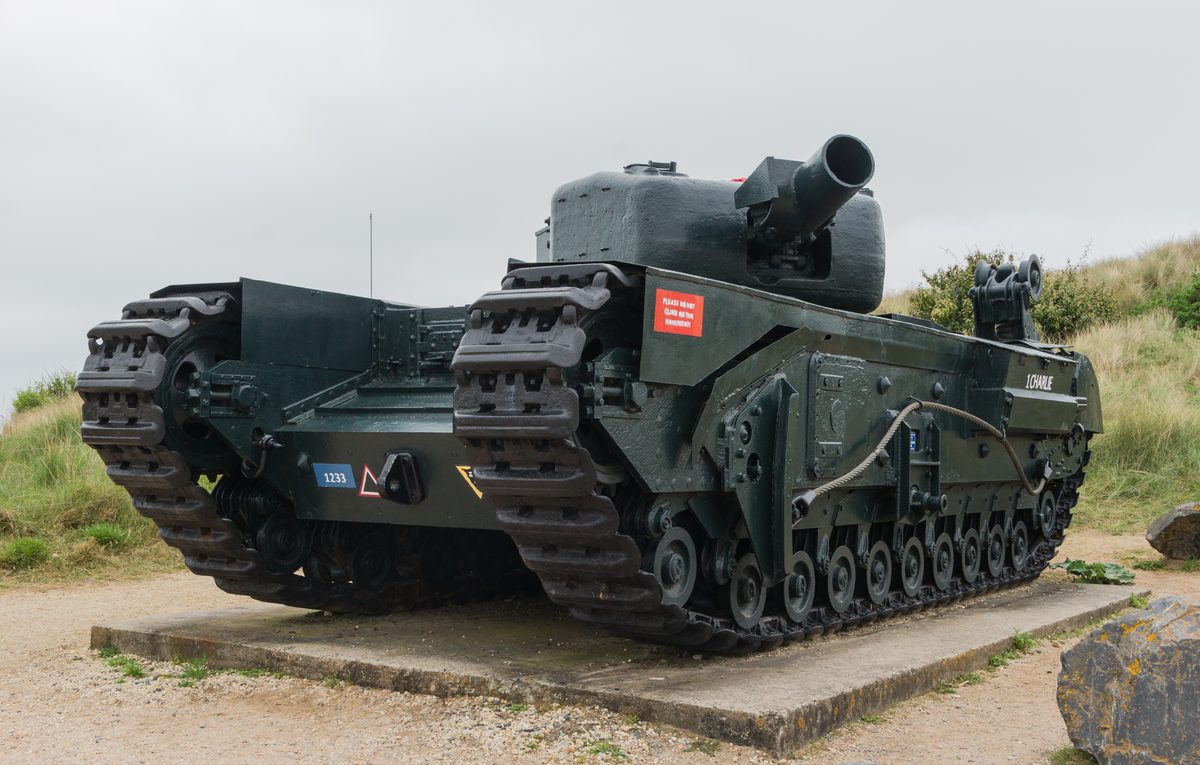
Churchill Crocodile flamethrower tank with armored fuel trailer

The Churchill Crocodile replaced the Churchill tank's hull machine gun with a flamethrower capable of projecting a stream of burning fuel up to 120 meters. An armored trailer towed behind the tank carried 400 gallons of pressurized fuel, enough for approximately 80 one-second bursts of liquid fire. Nitrogen pressure forced the fuel through the projector nozzle, where it was ignited electrically. The result was a weapon that could clear bunkers, trenches, and fortified positions with terrifying efficiency.

The Crocodile saw extensive action from D-Day onward and earned a fearsome reputation. German defenders would frequently surrender the moment they saw a Crocodile approach, preferring captivity to being burned alive. The vehicle's psychological impact often exceeded its physical destruction, entire garrison positions would capitulate after a single demonstration burst. Over 800 Crocodiles were built, and they proved devastating during the clearing of the Siegfried Line and in urban combat. The trailer could be jettisoned if hit, and the Churchill's main 75mm gun remained fully operational, making the Crocodile both a conventional tank and a specialized assault weapon.

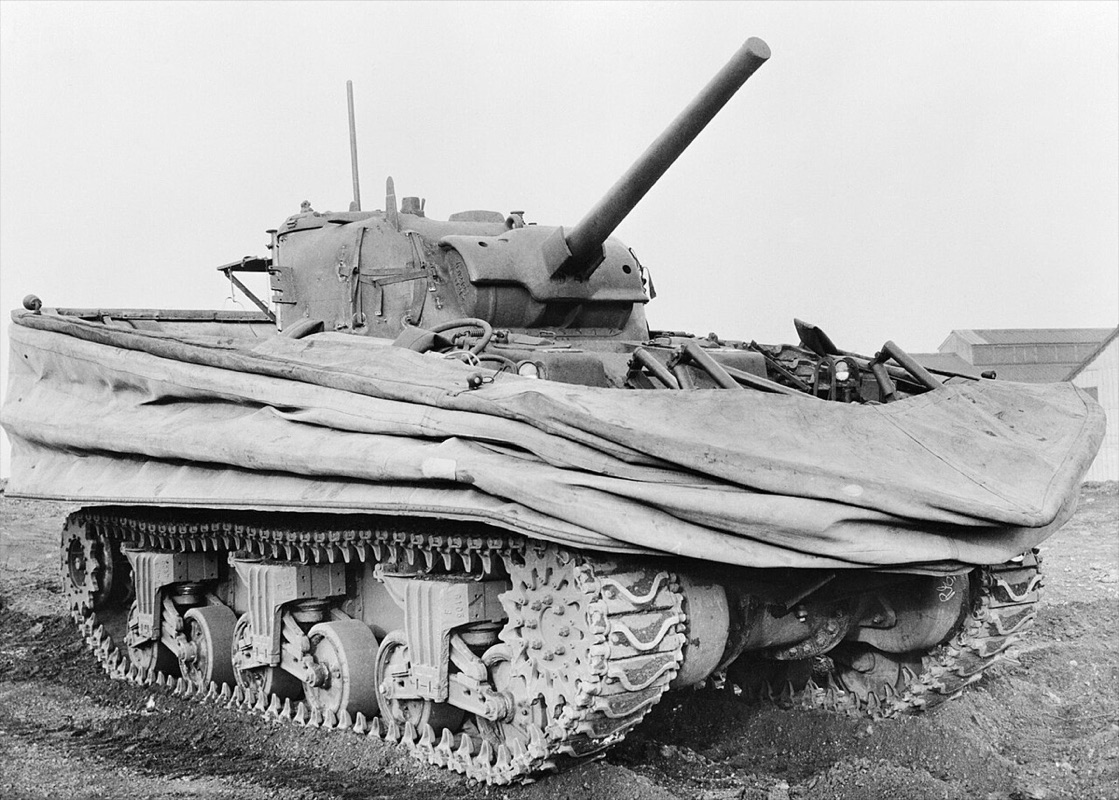
Sherman DD: The Swimming Tank of D-Day

Sherman DD Duplex Drive amphibious tank with collapsible canvas flotation screen

The Sherman DD (Duplex Drive) was a standard M4 Sherman tank fitted with a collapsible canvas flotation screen and twin propellers. When the screen was raised, it displaced enough water to float the 33-ton tank, barely. The tank would launch from a landing craft offshore, swim toward the beach under propeller power at about 4 knots, then drop the canvas screen upon reaching land and fight as a normal tank. The concept was designed to give infantry immediate armored support during amphibious landings.

On D-Day, June 6, 1944, the DD tanks faced their ultimate test, with mixed results. At Omaha Beach, rough seas swamped many DDs launched 5,000 meters offshore; 27 of 29 tanks from one battalion sank, drowning most of their crews in one of D-Day's worst tragedies. At other beaches with calmer water and closer launch points, the DDs performed well, reaching shore ahead of the infantry and providing crucial fire support. The DD tank concept was sound in moderate seas but fatally fragile in rough conditions, a 6-inch canvas freeboard separating a functioning tank from a 33-ton anchor on the ocean floor.

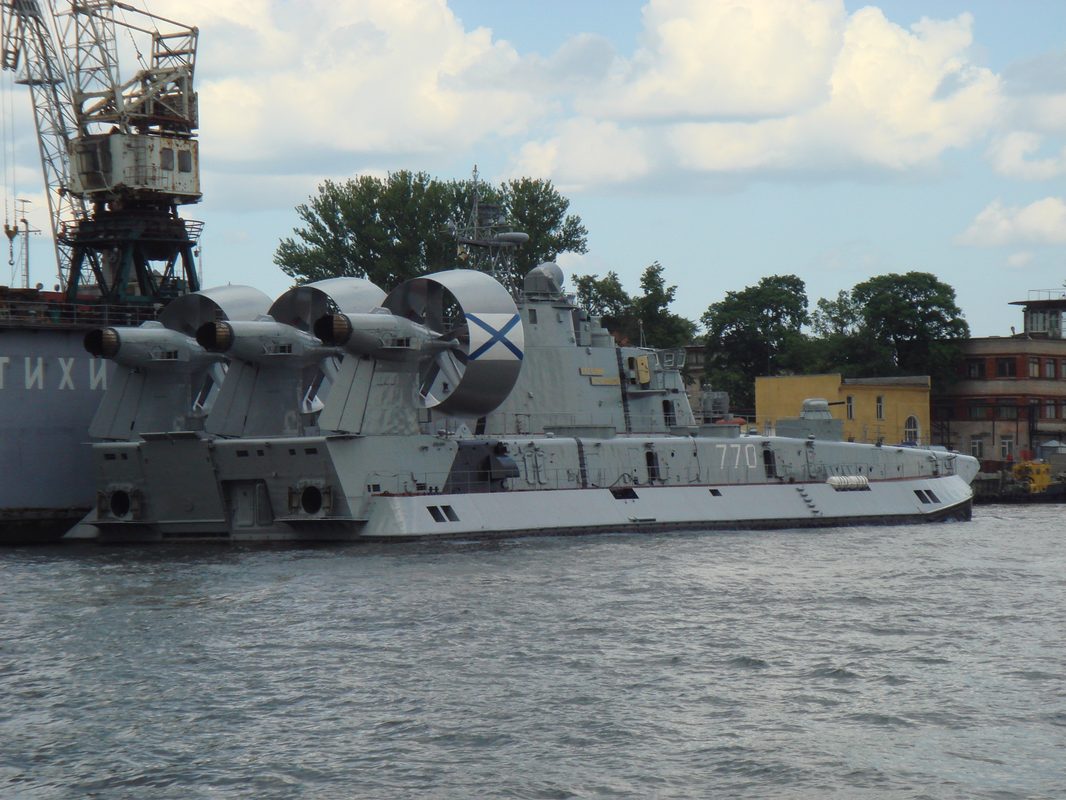
Zubr-Class Hovercraft: The World's Largest Military Hovercraft

Zubr-class air-cushion landing craft, the world's largest military hovercraft

The Zubr-class LCAC (Landing Craft Air Cushion) is the largest military hovercraft ever built, a 57-meter-long, 555-ton beast that can carry three main battle tanks or 500 troops across water, ice, swamp, or flat land at speeds up to 63 knots (117 km/h). Powered by five gas turbine engines producing a combined 50,000 horsepower, the Zubr can cross minefields by hovering above them and reach beaches that conventional landing craft can't approach.

Built by the Soviet Union starting in 1988, the Zubr carries its own armament including two 140mm rocket launchers and multiple air defense guns. Its combat loading capacity of 150 tons means it can deliver an entire armored platoon in a single sortie, and it can do so across 73% of the world's coastlines, compared to just 17% for conventional landing craft. The noise is apocalyptic, the five turbines and three massive lift fans create a wall of sound that announces the Zubr's arrival from miles away. Russia, Ukraine, and Greece have operated various examples, and the design has been exported to China, which has built its own versions for potential operations in the Taiwan Strait.

Caspian Sea Monster: The 550-Ton Ground-Effect Leviathan

KM ekranoplan Caspian Sea Monster ground-effect vehicle skimming over water

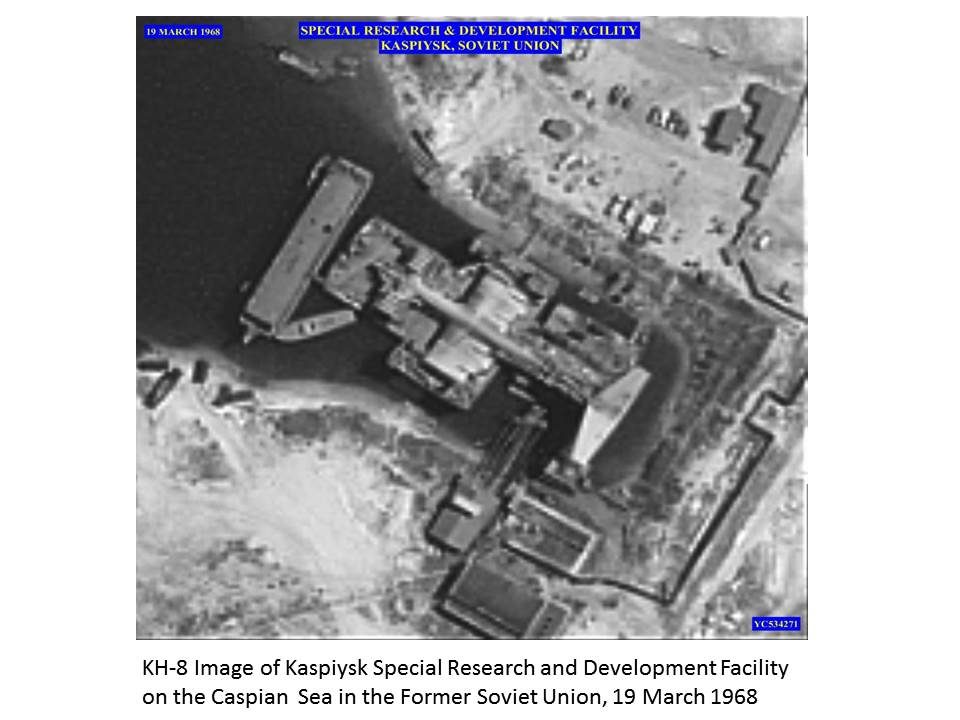
When American spy satellites first photographed this vehicle on the Caspian Sea in the 1960s, CIA analysts couldn't figure out what they were looking at. The KM (Korabl-Maket, or "prototype ship") was a 550-ton ground-effect vehicle (not quite a ship, not quite an aircraft) that skimmed just meters above the water surface at speeds exceeding 400 km/h. American intelligence dubbed it the "Caspian Sea Monster," and the name stuck.

Designed by Soviet engineer Rostislav Alexeyev, the KM exploited ground effect, the cushion of air trapped between a low-flying wing and the surface below, to achieve extraordinary lift efficiency. Its eight nose-mounted turbojet engines provided forward thrust while the massive wing generated lift from the compressed air beneath it. At 92 meters long, the KM was larger than any aircraft then in existence. It operated from 1966 to 1980, when a pilot error caused a crash during takeoff. The Soviets never fully recovered the vehicle, but the technology it proved would lead to armed military variants designed to streak across oceans at jet speed, skimming below radar coverage.

Lun-Class Ekranoplan: The Missile-Armed Sea Skimmer

Lun-class ekranoplan missile carrier beached on the Caspian Sea shore

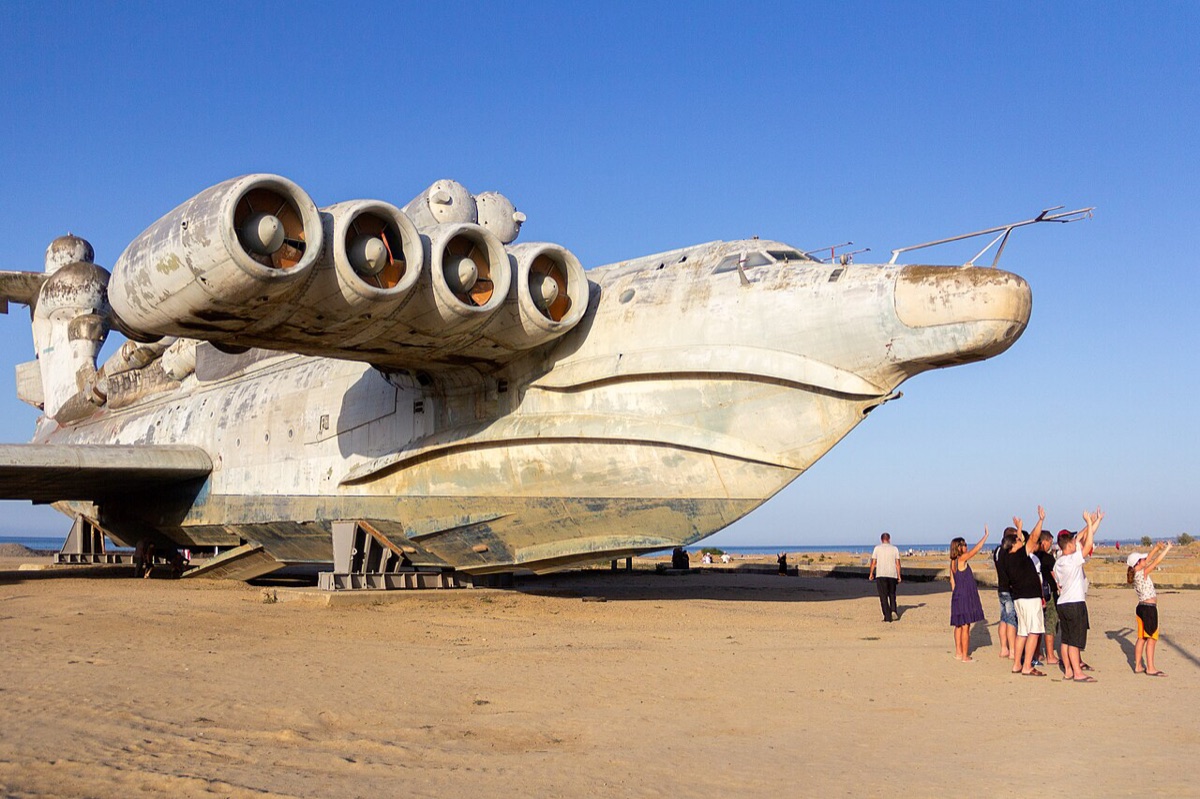
If the Caspian Sea Monster proved the concept, the Lun-class ekranoplan weaponized it. This 380-ton ground-effect vehicle carried six P-270 Moskit (Sunburn) anti-ship cruise missiles mounted in pairs atop the fuselage. Designed to skim across the ocean surface at 500 km/h, too fast for most naval defenses to track and too low for conventional radar to detect, the Lun was conceived as a carrier-killer that would streak toward NATO battle groups at wave-top height and unleash a salvo of supersonic missiles.

Only one Lun was completed in 1987, but its specifications were genuinely terrifying from a naval defense perspective. Flying at 3-5 meters above the waves, it was invisible to ship-based radar until it popped above the horizon at close range. Its eight turbofan engines gave it the speed of a turboprop aircraft but the payload capacity of a small warship. The Soviet Navy classified it as a ship rather than an aircraft, creating bureaucratic confusion that persists to this day. After the Soviet collapse, the sole Lun-class was mothballed and now sits beached on the Caspian coastline in Dagestan, a massive, rusting monument to one of the Cold War's most radical weapons concepts.

A-90 Orlyonok: The Troop Carrier That Flew Over the Ocean

A-90 Orlyonok ekranoplan transport vehicle at a museum display

While the Lun carried missiles, the A-90 Orlyonok was designed to transport troops. This 140-ton ground-effect vehicle could carry 200 fully equipped naval infantry soldiers or two armored personnel carriers across open ocean at 400 km/h, arriving at a hostile beach faster than any ship and with more payload than any helicopter. A bow ramp allowed vehicles to drive directly out upon landing, combining the speed of an aircraft with the logistics capability of a landing craft.

Five Orlyonoks were built and operated by the Soviet Navy's Caspian Flotilla from the early 1980s. Unlike the experimental KM, the Orlyonok was a genuine operational military platform, it participated in exercises and was assigned to a dedicated squadron. Its nose-mounted turboprop could tilt upward for additional lift during takeoff, and once at cruise speed in ground effect, fuel efficiency was far superior to conventional aircraft. The Soviet collapse ended the program, but the Orlyonok proved that ekranoplans could be practical military transports, not just experimental curiosities.

Char 2C: France's Castle-Sized Tank

French Char 2C super-heavy tank, one of the largest tanks ever built

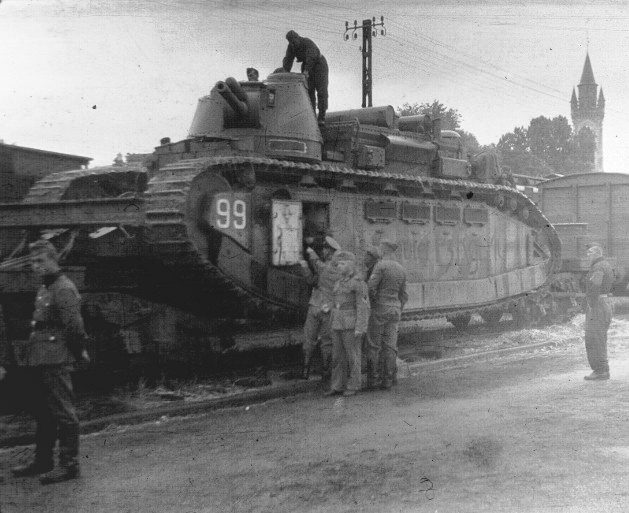
The Char 2C was the largest tank to ever see operational service. Built by France in the early 1920s, this 69-ton colossus stretched 10.3 meters long, stood 4 meters tall, and required a crew of 12 to operate. It mounted a 75mm cannon in the main turret plus a rear machine gun turret, and its 250-horsepower engines could push it to a stately 12 km/h on roads. The armor was up to 45mm thick, impressive for its era but already vulnerable to emerging anti-tank weapons.

Ten Char 2Cs were built and served in the French Army throughout the interwar period, primarily as psychological weapons and propaganda tools. They never saw World War I combat (arriving too late) and were destroyed during the 1940 German invasion, not in battle, but by their own crews when the railcars transporting them were blocked by a demolished tunnel. The Germans reportedly captured one intact and paraded it for propaganda. The Char 2C represented the absolute peak of the "land battleship" concept: a fortress on tracks that was impressive to look at but hopelessly impractical for actual modern warfare.

Karl-Gerat: The Self-Propelled Mortar That Demolished Fortresses

Karl-Gerat 600mm self-propelled mortar, one of the largest artillery pieces ever built

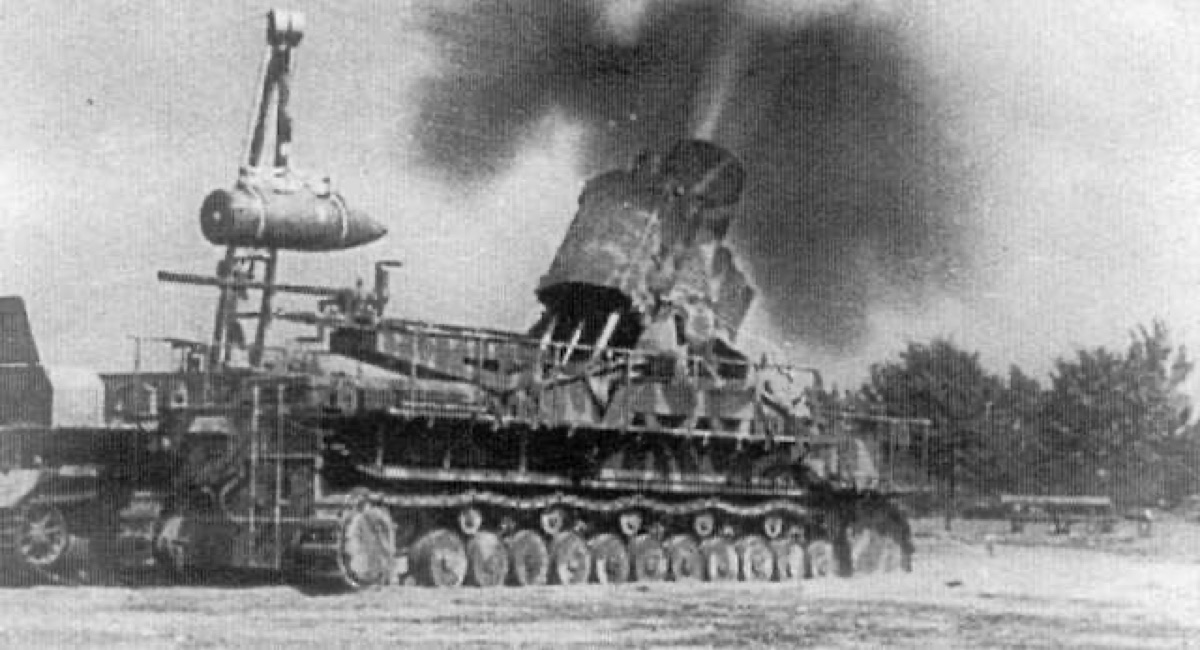
When you need to reduce a fortress to rubble, you call in the Karl-Gerat, a self-propelled mortar with a 600mm barrel that fired concrete-piercing shells weighing 2.17 tons each. Only seven were built, and each received a name: Adam, Eve, Thor, Odin, Loki, Ziu, and Fenrir. These 124-ton vehicles could launch their massive shells up to 6.7 kilometers, with each round capable of penetrating 2.5 meters of reinforced concrete before detonating.

The Karl-Gerats saw combat action at Brest-Litovsk in 1941 and famously at the Siege of Sevastopol in 1942, where they pounded Soviet fortifications alongside the even larger Schwerer Gustav railway gun. They were also deployed during the Warsaw Uprising of 1944, where their shells demolished entire city blocks. Despite their destructive power, the Karl-Gerats were logistical nightmares. Each required a dedicated ammunition carrier (built on a Panzer IV chassis), and the rate of fire was roughly one round every ten minutes. They were instruments of siege warfare in an era that was rapidly moving beyond static fortifications.

T-35: The Five-Turret Soviet Land Battleship

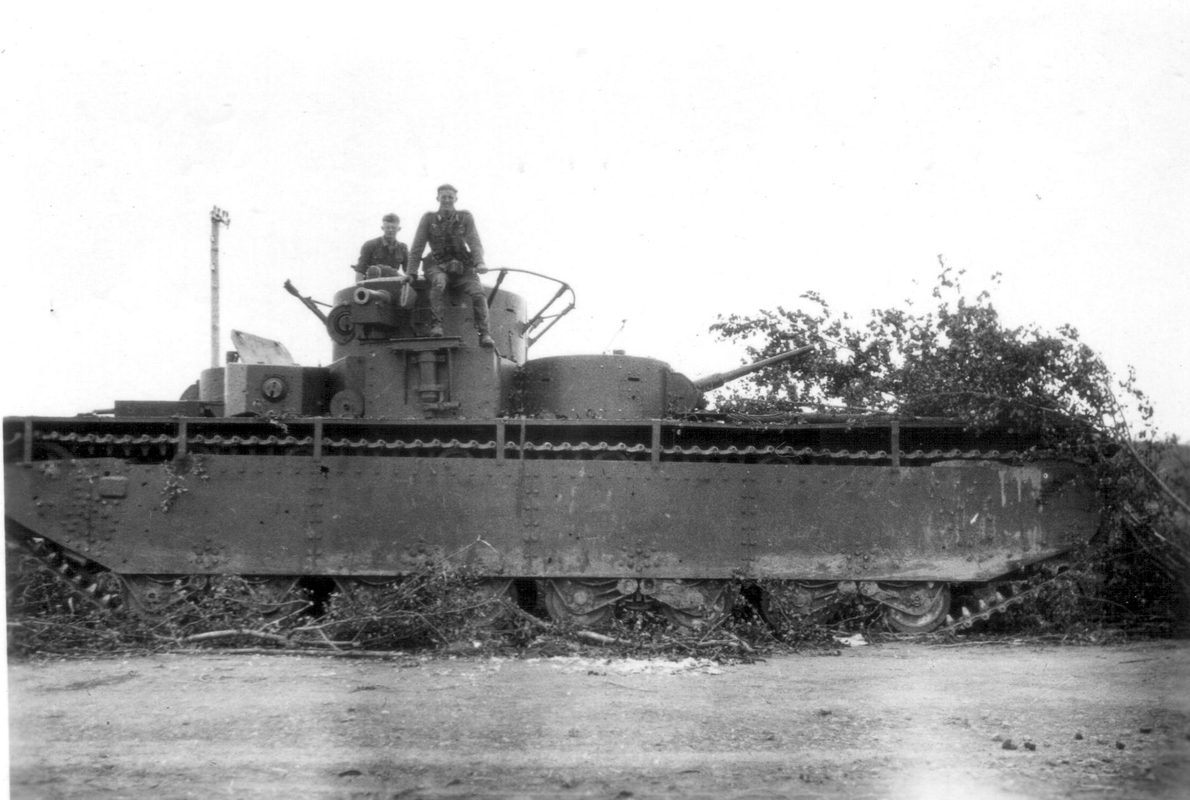
Soviet T-35 heavy tank with its distinctive five turrets

The T-35 took the multi-turret tank concept to its logical extreme: five turrets arranged on a single hull. The main turret mounted a 76.2mm cannon, two secondary turrets carried 45mm guns, and two machine gun turrets rounded out the armament. Weighing 45 tons and stretching 9.7 meters long, the T-35 was the only five-turret tank to enter serial production anywhere in the world. Its silhouette was so distinctive it appeared on Soviet propaganda posters and medals.

Around 61 T-35s were built between 1933 and 1939. On parade, they looked magnificent, a rolling fortress bristling with guns. In combat, they were disasters. The T-35 was mechanically unreliable, breaking down constantly due to the strain its massive weight placed on an overloaded drivetrain. The five turrets couldn't effectively coordinate fire against a single target. The armor, at 30mm maximum, was inadequate by 1941 standards. Most T-35s deployed during Operation Barbarossa were lost not to enemy fire but to mechanical failures, their crews abandoned them on roadsides after breakdowns. Nearly all were destroyed in the first weeks of the war.

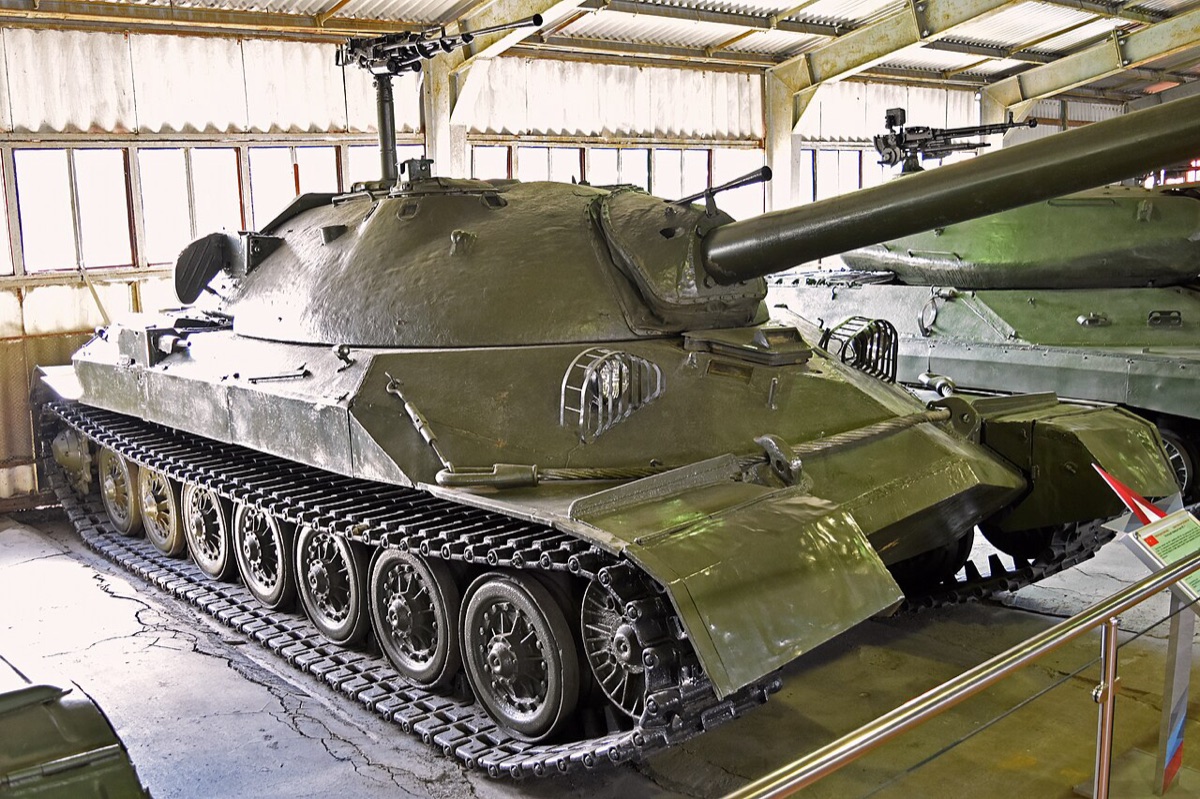
IS-7: The Soviet Super-Tank That Was Too Heavy for Its Own Bridges

IS-7 heavy tank on display at a military museum

The IS-7 was the heaviest tank the Soviet Union ever built, tipping the scales at 68 tons with a 130mm naval gun, an autoloader that could fire 6-8 rounds per minute, and armor up to 300mm thick on a pike-nose hull designed for maximum shot deflection. Its 1,050-horsepower marine diesel engine gave it a respectable top speed of 60 km/h, astonishingly fast for a tank of its mass. On paper, the IS-7 was the most powerful tank in the world when its prototypes rolled out in 1948.

So why did the Soviets build only six? Because the IS-7 couldn't cross most Soviet-built bridges. At 68 tons, it exceeded the weight limit of standard military pontoon bridges and most permanent road bridges in Eastern Europe. The very territory it was supposed to defend. The logistics of supporting such a heavy vehicle were deemed impossible for a mass-production tank. The Soviet military instead chose the lighter IS-8 (T-10) for serial production. The IS-7 was shelved, its revolutionary features (autoloader, pike-nose armor, high-speed diesel) parceled out to influence later tank designs for decades.

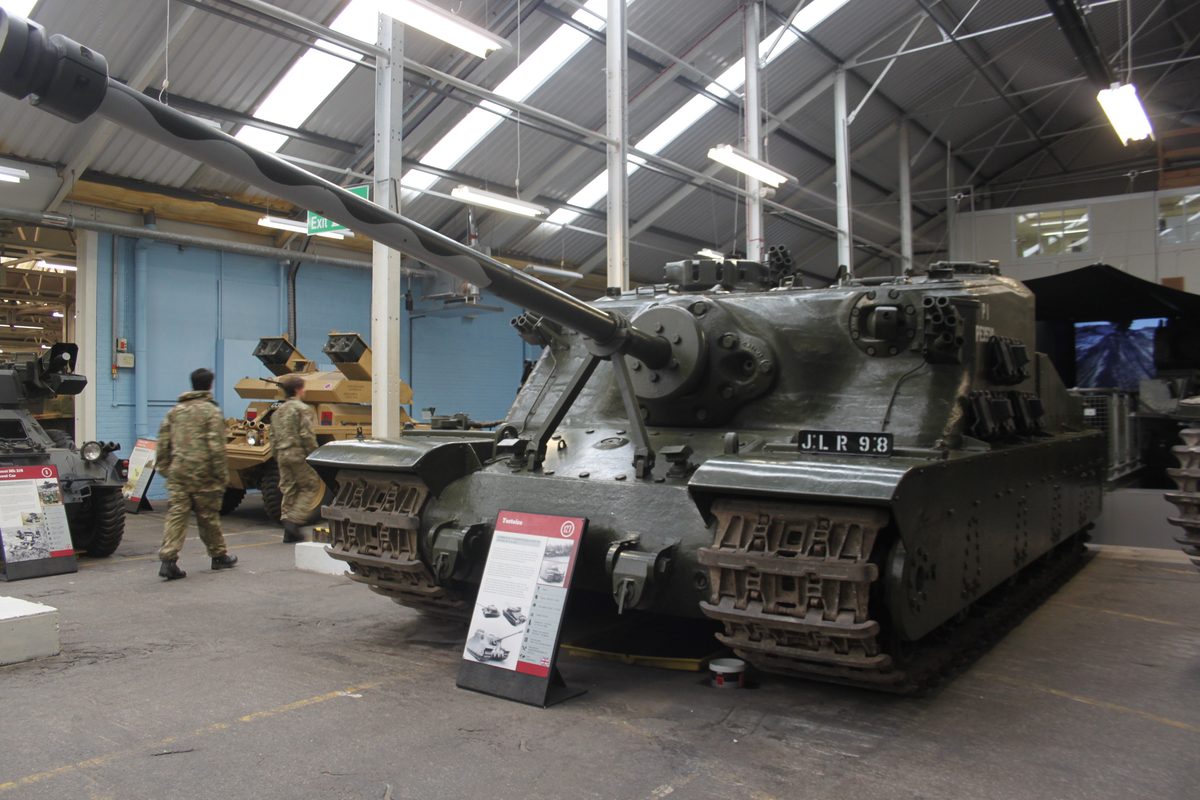
A39 Tortoise: Britain's 79-Ton Bunker on Tracks

A39 Tortoise heavy assault tank at the Tank Museum in Bovington

Designed to breach the Siegfried Line fortifications, the A39 Tortoise was a 79-ton assault gun carrying a 32-pounder (94mm) gun in a fixed superstructure. Its frontal armor reached an incredible 228mm, thicker than any other British armored vehicle of the era. The Tortoise wasn't technically a tank (it had no turret), but rather a heavy assault gun optimized for one mission: rolling up to fortified positions and blasting them apart at point-blank range while shrugging off return fire.

Six prototypes were completed by 1947, too late for the war they were designed to fight. Post-war testing showed the Tortoise's gun could penetrate the frontal armor of every German tank ever built, and its own armor resisted everything the British threw at it during trials. But at 79 tons, it had the same problem as every super-heavy vehicle: no bridge could support it, transportation required special rail flatcars, and its 600-horsepower engine could only manage 12 km/h. One surviving Tortoise resides at the Bovington Tank Museum, a 79-ton reminder that the best armor in the world doesn't help if you can't get to the fight.

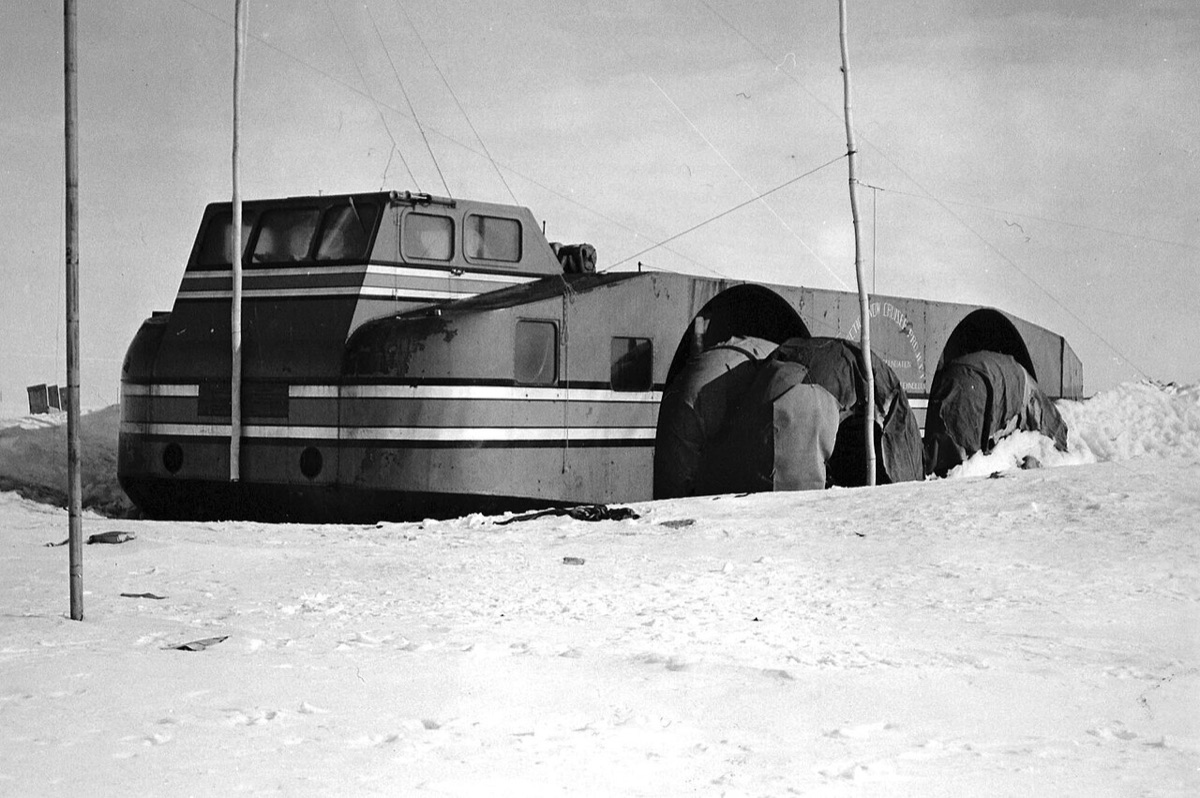
Antarctic Snow Cruiser: America's Failed Polar Land Yacht

The abandoned Antarctic Snow Cruiser partially buried in snow and ice

In 1939, the United States built a 55-foot-long, 37-ton vehicle specifically to explore Antarctica. The Antarctic Snow Cruiser was designed by Dr. Thomas Poulter to serve as a mobile research station: it carried a biplane on its roof, housed a crew of four with sleeping quarters and a galley, and was powered by two diesel-electric engines driving smooth-tired wheels over 10 feet tall. It was supposed to cross Antarctic ice shelves, crevasses, and snow fields with ease.

The Snow Cruiser was a spectacular failure from day one. When it was driven off the ship in Antarctica's Bay of Whales in January 1940, its smooth tires had zero traction on snow. The vehicle could barely move at all, let alone traverse the polar terrain it was built for. Desperate crews tried driving it in reverse (which worked slightly better) and even chaining the tires, but the Snow Cruiser was essentially immobile in the environment it was designed to conquer. It was abandoned and gradually buried by Antarctic snow. Expeditions in 1946 and 1958 found it still intact under the ice. Sometime after 1958, the ice shelf carrying it calved into the sea. The Snow Cruiser is presumably sitting on the ocean floor somewhere in the Ross Sea, a monument to overconfident engineering.

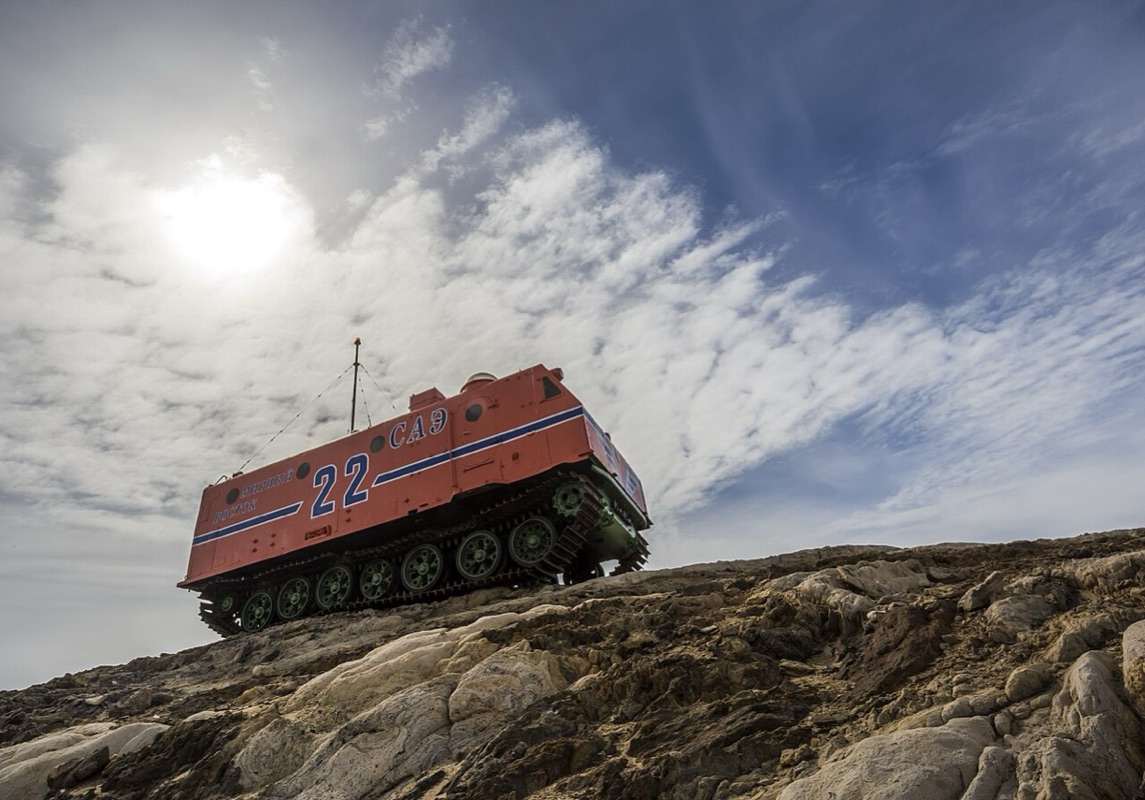
Kharkovchanka: The Soviet Antarctic Fortress on Treads

Soviet Kharkovchanka heavy Antarctic tractor in polar conditions

Where America's Snow Cruiser failed, the Soviet Union's Kharkovchanka succeeded, through the simple expedient of building a vehicle that was heavier, more powerful, and completely indifferent to elegance. Weighing 35 tons with a 520-horsepower V-12 diesel engine, the Kharkovchanka was essentially a heated cabin mounted on the chassis of an AT-T artillery tractor. It could carry up to 12 people and haul sleds of supplies across the Antarctic plateau at temperatures below -60°C.

The Kharkovchanka's insulated cabin maintained habitable temperatures even in the coldest conditions on Earth, and its massive tracked drive system provided reliable traction on snow and ice. Soviet expeditions used Kharkovchanka convoys to reach the Pole of Inaccessibility and other extreme locations in Antarctica during the 1950s and 1960s. Several of these vehicles remain at abandoned Soviet research stations in Antarctica, frozen in place but still structurally intact after decades of exposure. The Kharkovchanka was never glamorous, but it did what the American Snow Cruiser couldn't: actually work in Antarctica.

ZIL-2906: The Screw-Propelled Vehicle That Eats Any Terrain

Screw-propelled amphibious vehicle designed for swamp and snow terrain

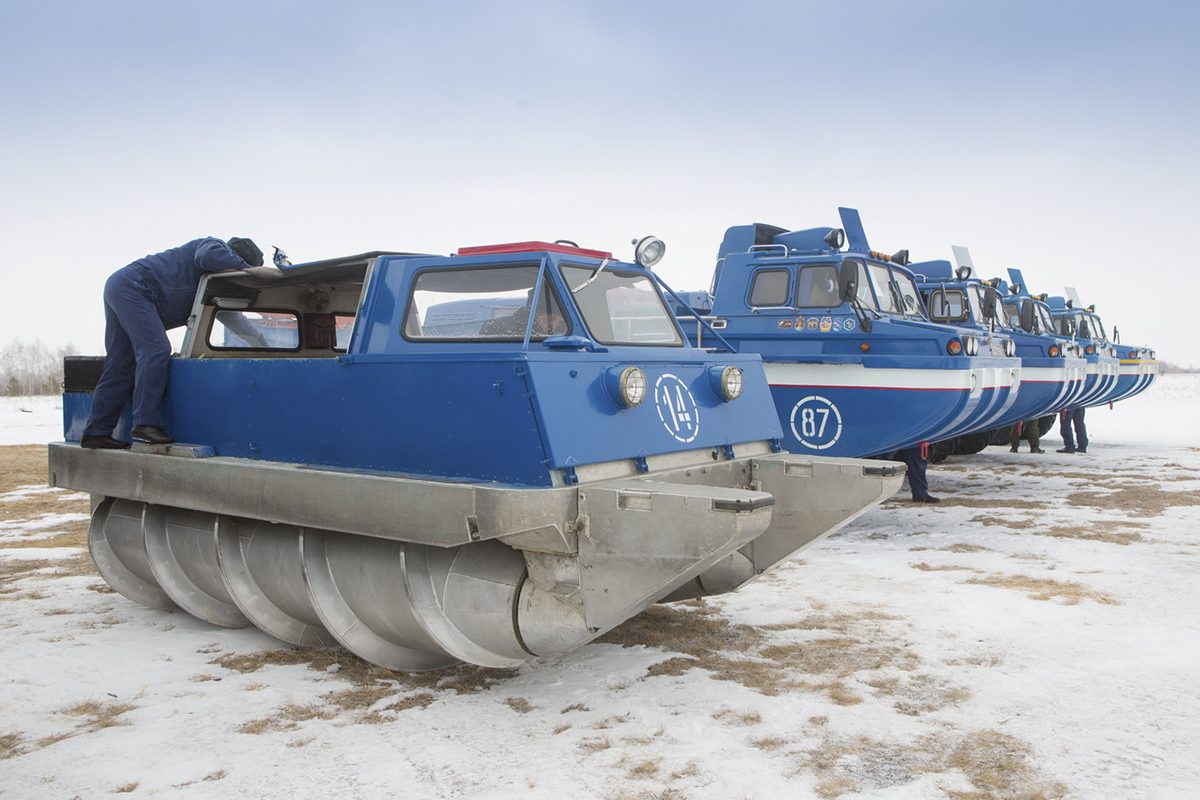
Instead of wheels or tracks, the ZIL-2906 uses two giant counter-rotating Archimedean screws, cylindrical pontoons with helical flanges, to propel itself forward. As the screws rotate, the spiral flanges bite into whatever surface is below: mud, swamp, deep snow, water, or anything else that would stop a conventional vehicle dead. The Soviet Union developed this screw-drive vehicle specifically for recovering cosmonauts from Soyuz capsules that landed in remote Siberian bogs and marshes.

The screw-drive concept works brilliantly in terrain that has no firm surface at all, it excels precisely where wheels spin uselessly and even tracks sink. The ZIL-2906 was part of a multi-vehicle recovery system: a conventional truck would carry the screw vehicle to the edge of passable terrain, then the ZIL-2906 would take over for the final approach across swamp or deep snow. The tradeoff is that screw vehicles are terrible on hard surfaces, they chew up roads and move at walking pace on pavement. But in bottomless Russian swamps, nothing else comes close to their go-anywhere capability.

M1150 Assault Breacher: The Explosive Dozer That Eats Minefields

M1150 Assault Breacher Vehicle clearing obstacles with mine plow and line charges

Built on an M1 Abrams chassis, the M1150 Assault Breacher Vehicle combines a full-width mine plow, two M58 Mine Clearing Line Charges (MICLIC), and a lane-marking system into a single vehicle whose entire purpose is to punch holes through minefields and obstacles. Each MICLIC is a rocket-propelled line of C4 explosive that shoots forward, lands across the minefield, and detonates, clearing a path through anti-personnel and anti-tank mines in a single explosive sequence.

The M1150 saw extensive combat service in Afghanistan and Iraq, where Marines used it to breach through IED-laden routes and Taliban defensive positions. Its Abrams-derived armor protects the two-person crew from mine blasts, small arms, and RPGs. After firing the line charges, the vehicle drives forward with its mine plow lowered, pushing aside any remaining debris and mines. The psychological impact on defenders is considerable, watching two massive explosions clear a 100-meter lane, followed by an armored bulldozer rolling through the gap, tends to discourage resistance. It's the most expensive, most heavily armored road-clearing tool ever built.

M104 Wolverine: The Bridge That Drives Itself to the River

Armoured vehicle-launched bridge deploying a portable bridge across a gap

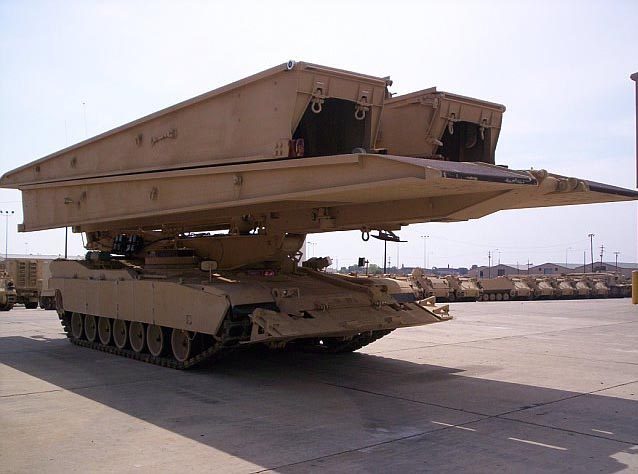
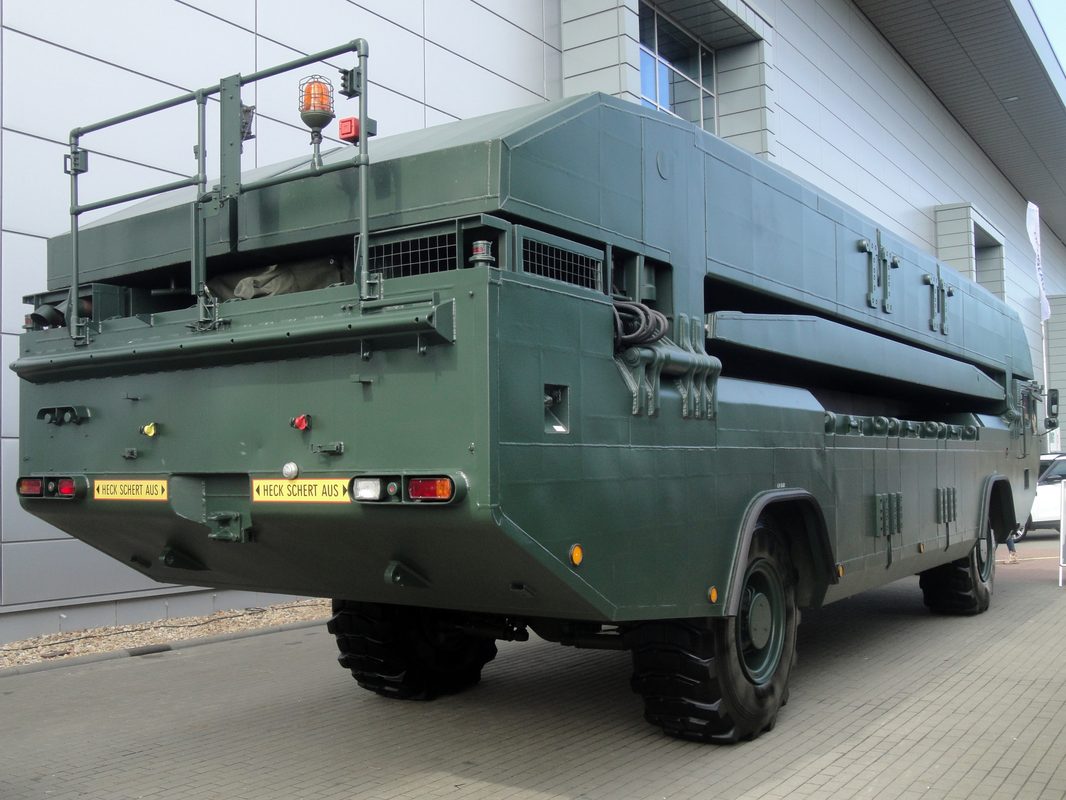
The M104 Wolverine carries a 26-meter folding bridge on top of a modified M1 Abrams chassis. When the vehicle reaches a river or gap, the bridge unfolds hydraulically in under five minutes, no crane, no construction crew, just two operators inside the armored hull. The resulting bridge can support 70 tons of military traffic, meaning main battle tanks can cross immediately. When the last vehicle is across, the Wolverine retrieves its bridge and drives to the next obstacle.

The Wolverine replaced the aging M60-based AVLB (Armored Vehicle Launched Bridge) and represents a quantum leap in military bridging capability. Its bridge is wider, stronger, and faster to deploy than any previous system. The Abrams chassis provides full armor protection for the crew during the bridge-laying operation, critical when working within direct-fire range of the enemy. The entire concept seems impossible until you see it: a 70-ton vehicle drives to the river's edge, mechanically unfolds a full-strength bridge across the gap in minutes, and drives away. It turns a river crossing from a multi-hour engineering operation into a brief pause in an armored advance.

M3 Amphibious Rig: The Vehicle That Becomes a Bridge

M3 Amphibious Rig forming a floating bridge section on a river

The M3 Amphibious Rig is a vehicle that drives to a river on wheels, enters the water, and transforms into a self-propelled ferry or a section of a floating bridge. Built by General Dynamics European Land Systems, the M3 unfolds ramps and pontoon sections from its hull to create a floating platform that can carry a 70-ton main battle tank across a river. Multiple M3s can link together side-by-side to form a continuous ribbon bridge across wide rivers.

The transformation takes just minutes. The M3 drives into the water, its integrated pontoons inflate or unfold, and the vehicle becomes a powered ferry with its own propulsion system. Operators can choose between ferry mode (shuttling vehicles one at a time) or bridge mode (linking multiple rigs into a continuous crossing). Germany, the UK, and several NATO allies operate the M3. During military exercises, a team of M3s can establish a Class 70 bridge across a 100-meter river in approximately 30 minutes. A capability that would have seemed like magic to World War II combat engineers who needed hours and thousands of troops to achieve the same result.

Keiler Mine Flail: The Spinning Chain Nightmare

Keiler mine flail system clearing mines with rotating chains

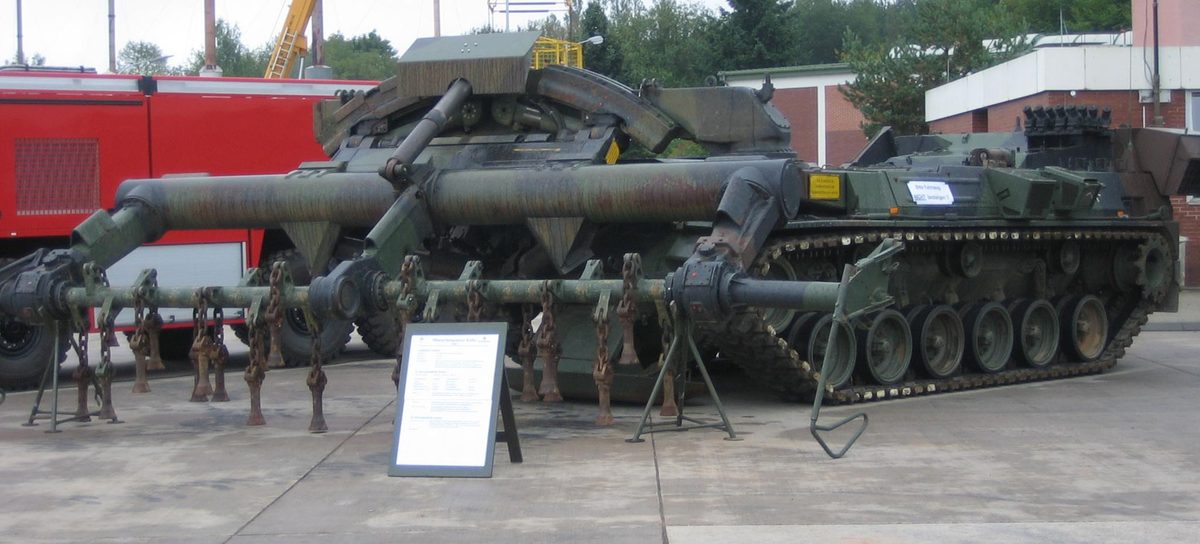
The Keiler is a dedicated mine-flail vehicle that uses a large rotating drum mounted on arms ahead of the vehicle. Heavy chains attached to the drum spin at high speed, pounding the ground ahead of the vehicle with enough force to detonate buried anti-tank and anti-personnel mines. The concept is brutally simple: beat the ground until everything explosive in it goes off, then drive through the cleared lane.

Built by MaK (now Rheinmetall) for the German Bundeswehr, the Keiler can clear a lane 4.4 meters wide through a dense minefield while the operator sits safely behind layers of armored protection. The flail chains are expendable, they break and are replaced as mines detonate, but the vehicle itself is designed to absorb repeated blast effects. Mine-flail technology dates back to World War II (the Matilda Scorpion and Sherman Crab), but the Keiler represents the modern evolution: faster, wider clearance, better crew protection, and integration with GPS lane-marking systems so follow-on forces know exactly where the safe path is.

Churchill Bobbin: The Carpet-Laying Tank of D-Day

Churchill AVRE with bobbin carpet layer attachment for soft beach surfaces

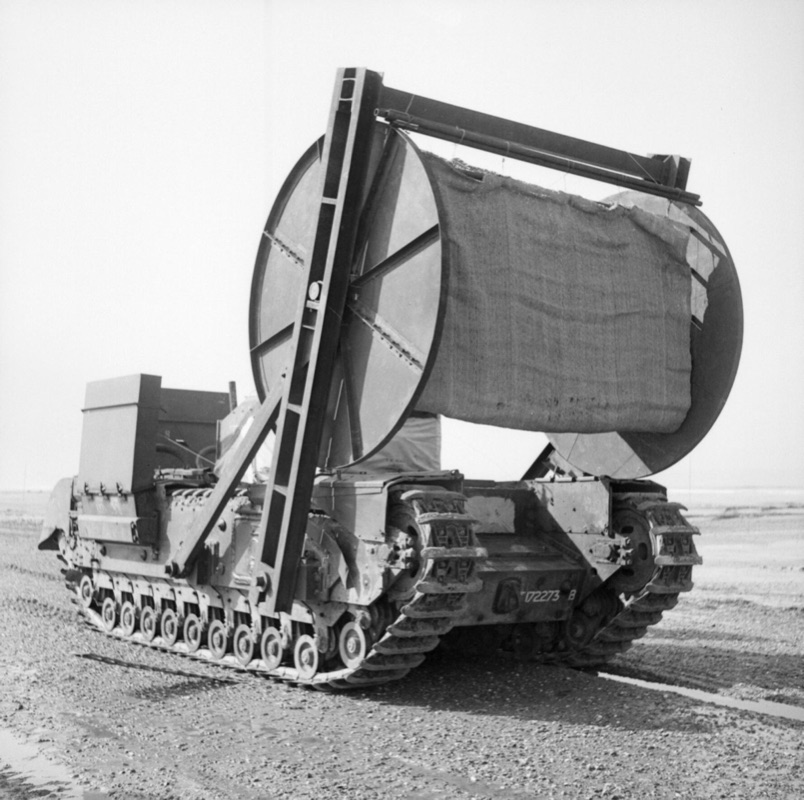
Among the strangest of Hobart's Funnies, the specialized D-Day vehicles designed by Major General Percy Hobart, was the Bobbin. This Churchill AVRE variant carried a large drum of reinforced canvas carpet mounted on the front of the tank. As the Churchill advanced, the carpet unrolled across soft sand, mud, or clay, creating an instant roadway strong enough for wheeled vehicles and subsequent tanks to follow without bogging down.

The Bobbin solved a critical D-Day problem: Normandy's beaches included stretches of soft clay and peat that would trap wheeled vehicles. Without the Bobbin's carpet lanes, supply trucks and ambulances couldn't get off the beach. The carpet was made of hessian-reinforced canvas, approximately 10 feet wide and 200 feet long, just enough to create a temporary road from the waterline to the firm ground beyond the beach. It was one of dozens of specialized Churchill variants that turned the tank into a Swiss army knife of beach assault engineering. Simple, low-tech, and effective, exactly the kind of solution that wins wars.

Sherman Crab: The Mine-Sweeping Flail Tank

Sherman Crab flail tank with chain drum mounted for mine clearing

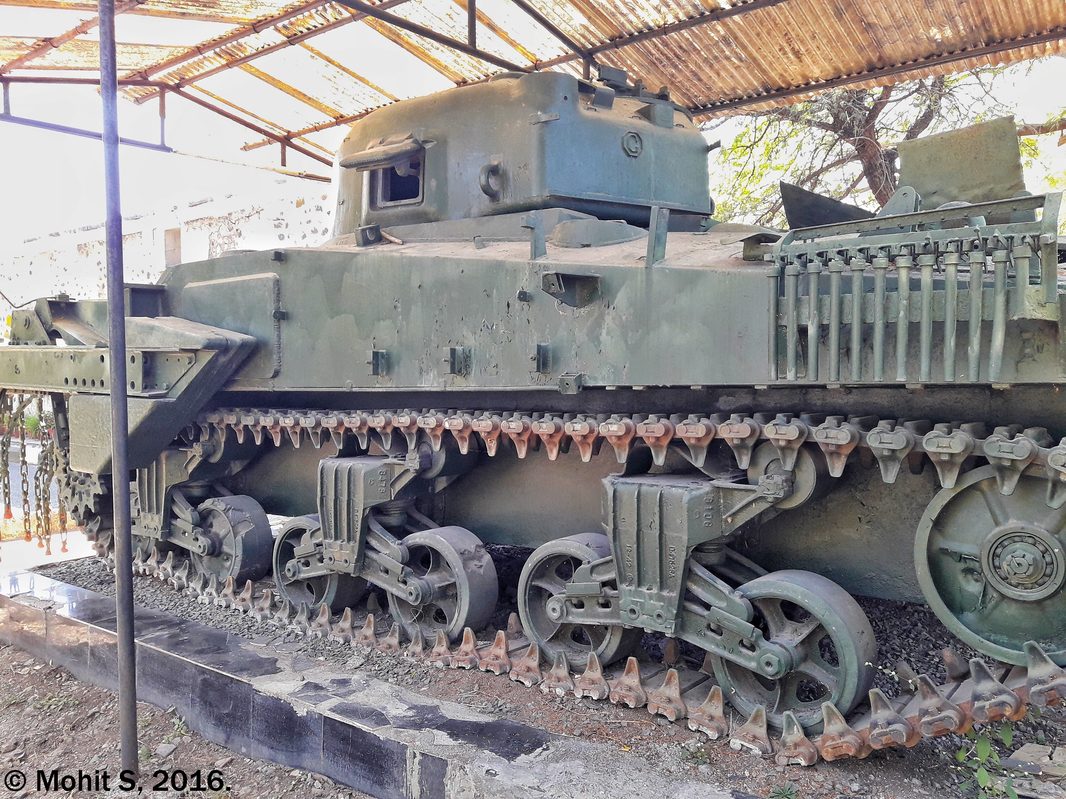
The Sherman Crab mounted a motor-driven drum on arms ahead of the tank, from which hung 43 heavy chains. As the drum spun, the chains beat the ground with enough force to detonate any mines buried in the path. The Sherman behind could then drive safely through the cleared lane. What made the Crab particularly effective was that it retained its 75mm main gun. Unlike most specialized vehicles, it could mine-clear and fight simultaneously.

The Crab was another of Hobart's Funnies, and it proved its worth on D-Day and throughout the Northwest Europe campaign. Teams of three Crabs would advance abreast, clearing overlapping lanes wide enough for following tanks and infantry. The flail produced enormous dust and noise, which had the side effect of suppressing enemy defenders who couldn't see or hear through the chaos. Over 300 Crabs were built, and they remained in service until well after the war. The concept was so successful that flail-based mine clearing remains a standard military technique today. The Keiler mine flail is a direct descendant of the D-Day Crab.

BARV: The Recovery Tank That Wades Into the Surf

Sherman Beach Armoured Recovery Vehicle BARV designed for surf-zone recovery operations

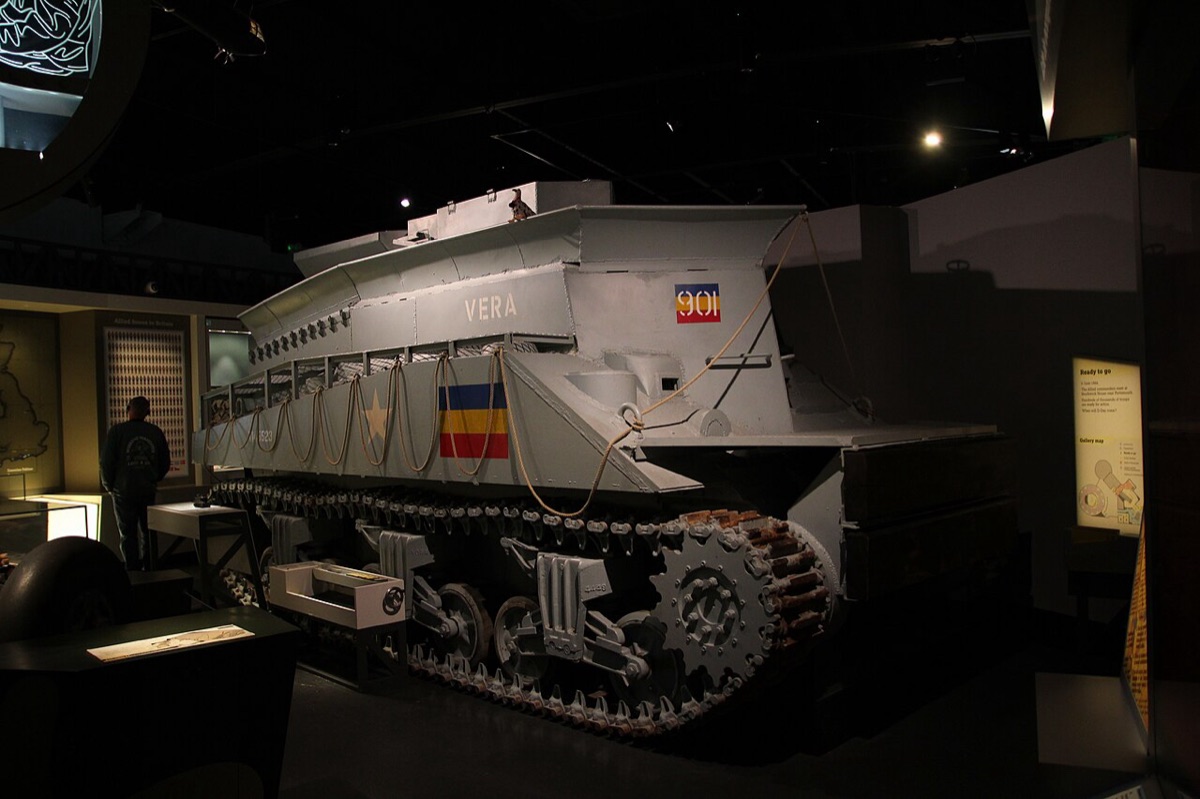
The BARV (Beach Armoured Recovery Vehicle) was designed to solve a problem unique to amphibious landings: vehicles that stall, flood, or break down in the surf zone. Based on a Sherman tank chassis with an extended, boat-shaped superstructure, the BARV could wade into water up to 2.8 meters deep, hook onto disabled vehicles, and drag them clear of the landing zone before they blocked the beach for everyone else. No guns: just a powerful engine, a winch, and the ability to work in conditions that would drown any normal vehicle.

On D-Day and subsequent beach landings, BARVs were essential for keeping traffic flowing. A single drowned truck in the surf zone could block an entire landing lane, preventing tanks, troops, and supplies from reaching the beach. BARVs worked relentlessly in the waves, shoving wrecks aside, towing stalled vehicles to dry ground, and keeping the beach approaches clear. The concept was so valuable that the British military continued developing BARV variants through the Cold War era, with the final version based on the Centurion tank chassis. It's the military's tow truck, unglamorous, essential, and designed to work where no sane vehicle should operate.

Wiesel AWC: The Pocket Tank That Fits Inside a Helicopter

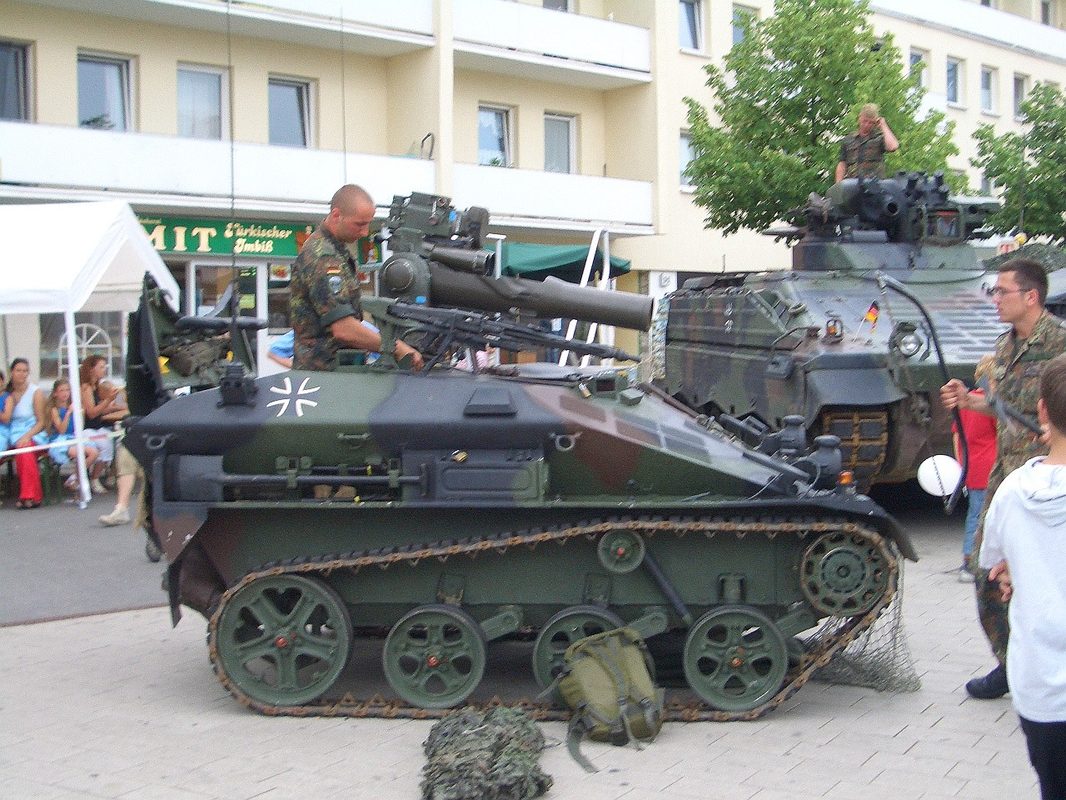
Wiesel Armoured Weapons Carrier, one of the smallest armored fighting vehicles in service

The Wiesel AWC (Armoured Weapons Carrier) is one of the smallest tracked armored vehicles in active military service. Weighing just 2.75 tons and measuring 3.55 meters long, the Wiesel is small enough to be slung under a CH-53 helicopter or loaded inside a C-130 transport aircraft. Despite its toy-like dimensions, it carries either a 20mm autocannon or a TOW anti-tank missile launcher, giving airborne forces genuine anti-armor capability that arrives by air.

Germany's Bundeswehr operates hundreds of Wiesels in various configurations: anti-tank, air defense, reconnaissance, ambulance, and command post. The vehicle is fast (70 km/h on roads), maneuverable, and presents a tiny target on the battlefield. It's designed for the Fallschirmjäger (German paratroopers), light forces that need armored firepower they can't get from a standard tank. The sight of a two-person crew commanding a tracked vehicle roughly the size of a large golf cart, armed with anti-tank missiles, is simultaneously amusing and genuinely threatening. Small doesn't mean harmless.

2S25 Sprut-SD: The Airborne Tank Destroyer

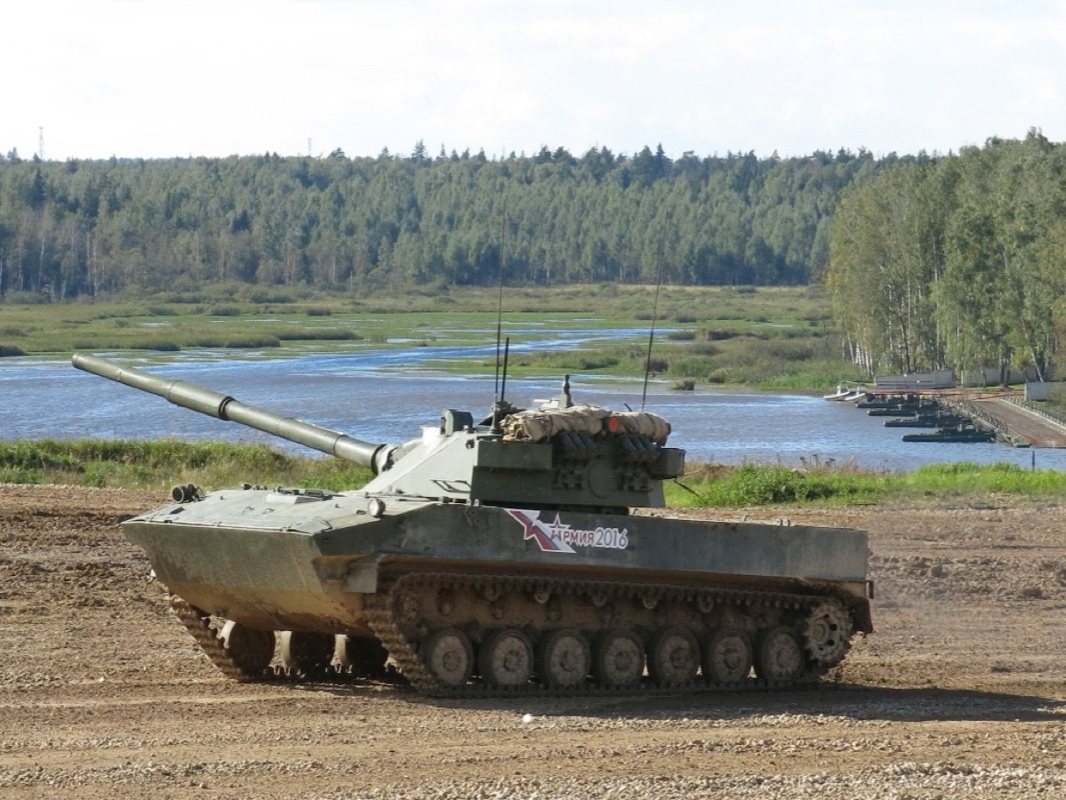
2S25 Sprut-SD self-propelled anti-tank gun for Russian airborne forces

The 2S25 Sprut-SD mounts a full-sized 125mm smoothbore tank gun (the same weapon used on the T-72, T-80, and T-90 main battle tanks) on an 18-ton chassis light enough to be airdropped from an Il-76 transport aircraft. This gives Russian Airborne Forces (VDV) something no other airborne force in the world has: a parachute-deployable vehicle with the main gun firepower of a main battle tank.

The Sprut-SD can fire every type of 125mm ammunition in the Russian inventory, including ATGMs (anti-tank guided missiles) launched through the barrel. It's fully amphibious, swimming across rivers using water jets. The tradeoff for this extraordinary firepower-to-weight ratio is armor, the Sprut-SD's aluminum hull protects against small arms and shell fragments but not much else. It's designed as a tank destroyer and fire support vehicle, not a front-line tank. The concept is uniquely Russian: drop behind enemy lines, ambush tanks with their own caliber weapon, and use speed and surprise to compensate for armor that can't stop a direct hit.

BMD-4M: The IFV That Falls From the Sky

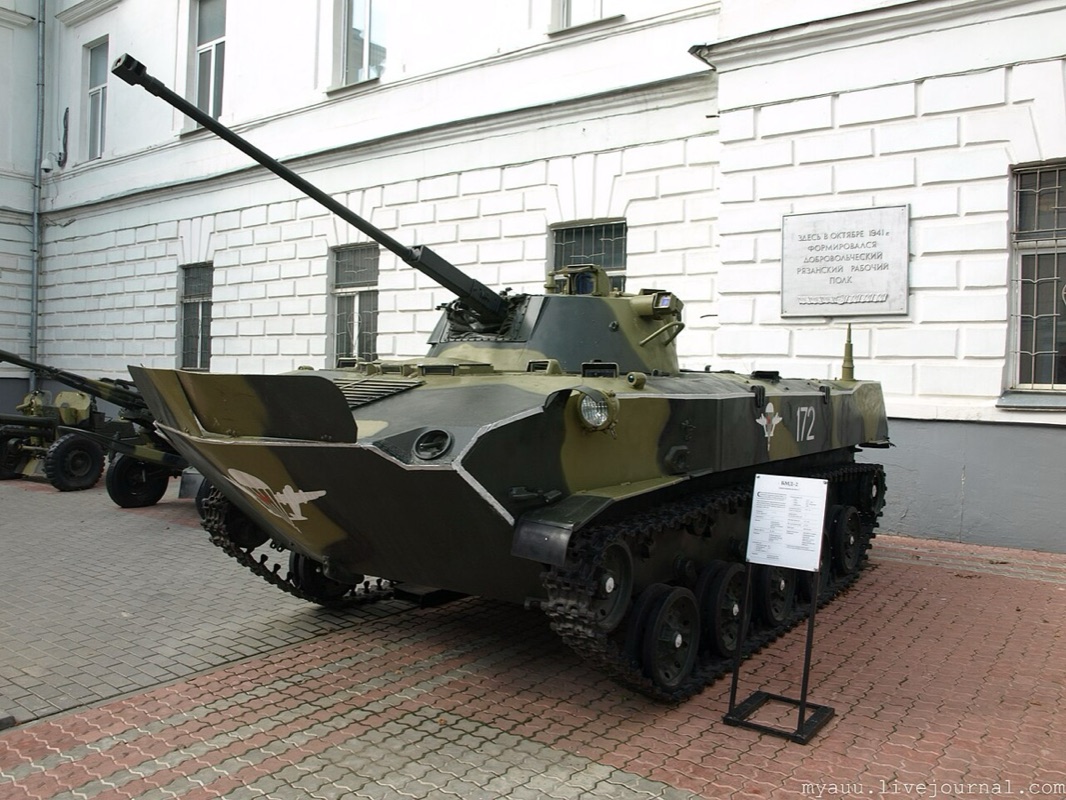
BMD-4M airborne infantry fighting vehicle during Russian military exercises

The BMD-4M is a fully armed infantry fighting vehicle designed to be parachute-dropped from transport aircraft with its crew seated inside during the descent. Read that again: the crew rides inside the vehicle as it falls from an airplane, suspended under parachutes, and lands ready to fight. No other country in the world has developed or fielded a system quite like this.

Armed with a 100mm gun/launcher (capable of firing ATGMs), a 30mm autocannon, and a 7.62mm machine gun, the BMD-4M packs the firepower of a medium armored vehicle into a 13.5-ton package. It carries a crew of three plus five infantry in the rear. The PBS-950 parachute system retro-rockets fire just before landing to cushion the impact. The entire Russian airborne concept revolves around dropping these vehicles en masse behind enemy lines to seize airfields, bridges, and key terrain before conventional forces can react. It's a wild, dangerous way to deliver armored vehicles to the battlefield, and the Russians have been perfecting it for decades.

PL-01: Poland's Stealth Tank Concept

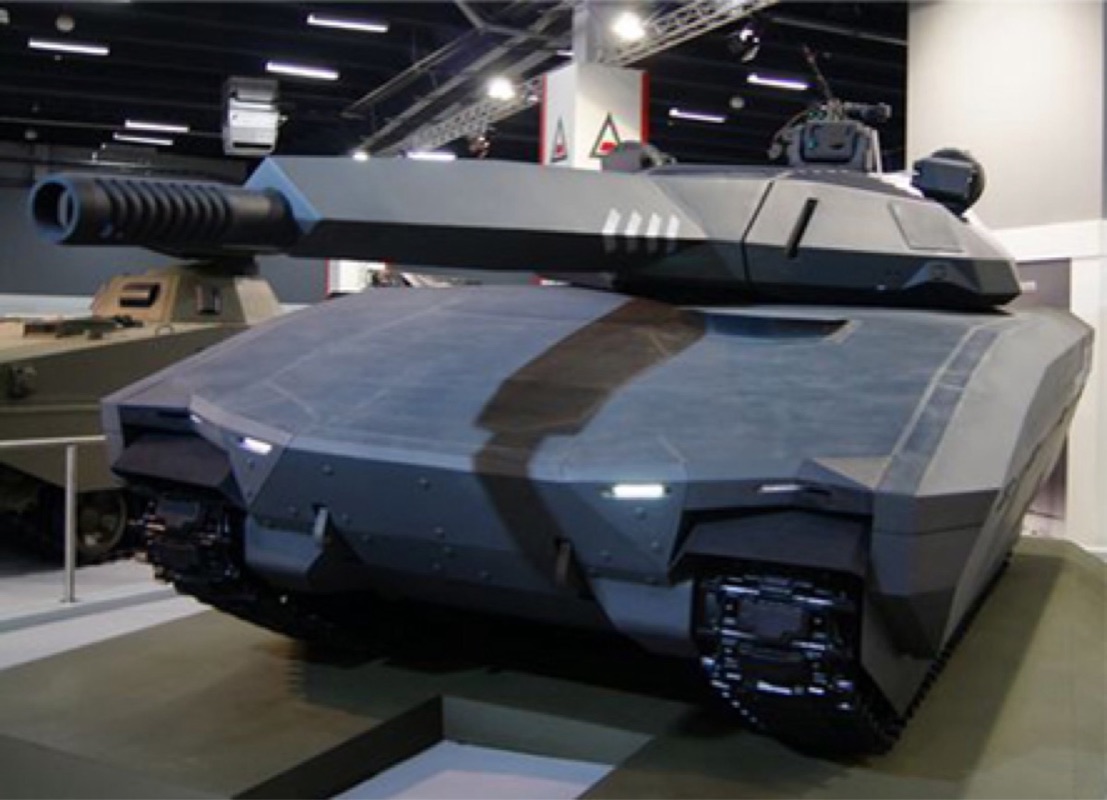
PL-01 stealth tank concept prototype with angular stealth geometry

When Poland's OBRUM defense company unveiled the PL-01 concept at the 2013 MSPO defense exhibition, it looked like a vehicle from a video game. The angular, faceted hull was designed from the ground up for low radar and infrared signature, genuine stealth technology applied to a ground vehicle. The PL-01's exterior panels contained a thermal camouflage system capable of mimicking the infrared signature of the surrounding environment or even disguising the tank as a different type of vehicle entirely.

Based on the Swedish CV90 platform, the PL-01 concept proposed a 35-ton vehicle with an unmanned turret, modular armor, and active protection systems. Its wavy, angular surfaces were designed to scatter radar returns, while the thermal management system would make it nearly invisible to infrared seekers, the primary targeting method for modern anti-tank missiles. Although the PL-01 remained a technology demonstrator and never entered production, its concepts influenced stealth vehicle research worldwide. The idea that a tank could be designed to be invisible to sensors, not just to the naked eye, represented a fundamental shift in armored vehicle design philosophy.

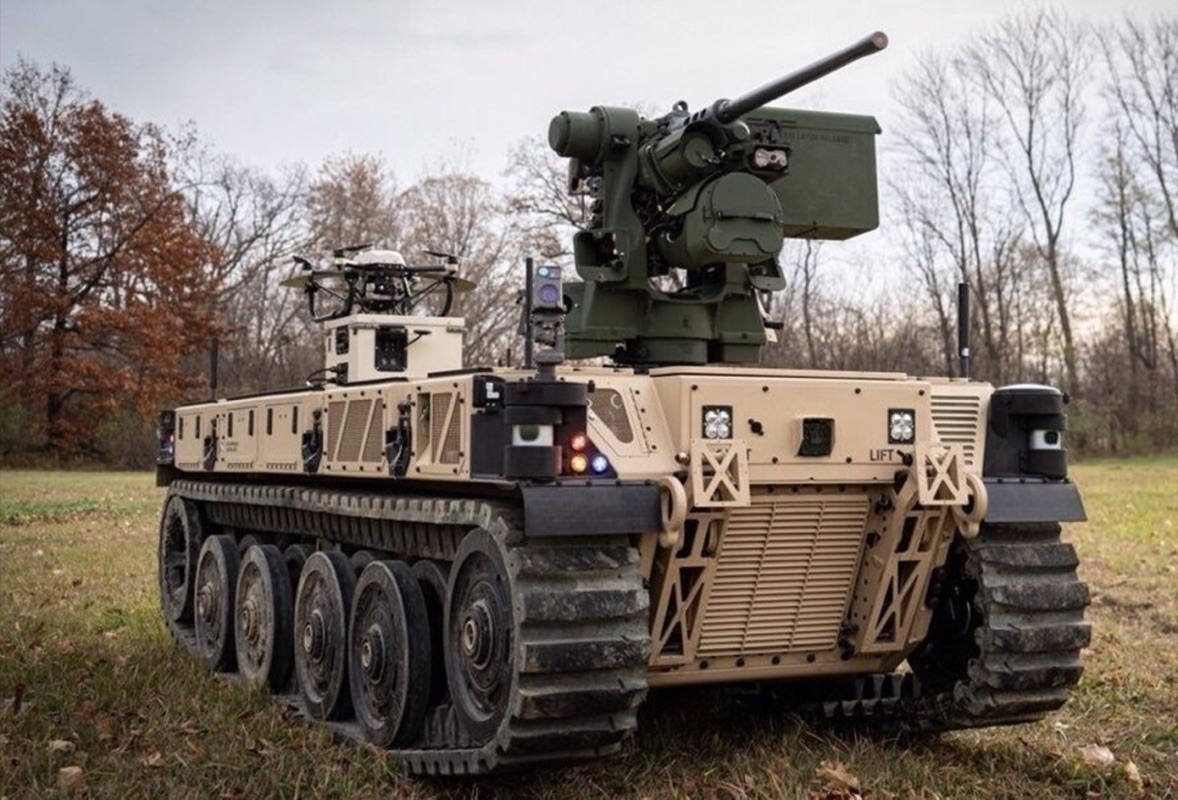
Ripsaw M5: The Robotic Tank Built for Speed

Robotic Combat Vehicle during U.S. Army field testing

The Ripsaw M5, developed by Textron Systems (originally by Howe & Howe Technologies), is an unmanned ground combat vehicle that combines the speed of a sports car with the lethality of an armored fighting vehicle. Weighing around 10 tons, the Ripsaw can exceed 65 km/h on roads, extraordinarily fast for a tracked vehicle, while carrying a variety of weapon stations including 30mm cannons, anti-tank missiles, and electronic warfare payloads. No human crew means no human-rated armor, which saves massive weight.

The U.S. Army selected the Ripsaw as a candidate for its Robotic Combat Vehicle program, which aims to field unmanned combat platforms that operate alongside manned tanks and infantry. The M5 variant includes autonomous navigation, remote weapons operation, and the ability to serve as a forward scout that takes the first contact instead of risking soldiers. The concept of a crewless tank that can be controlled from miles away, absorb hits without casualties, and outrun most threats it can't outfight represents the near-future of armored warfare, and it already exists in prototype form.

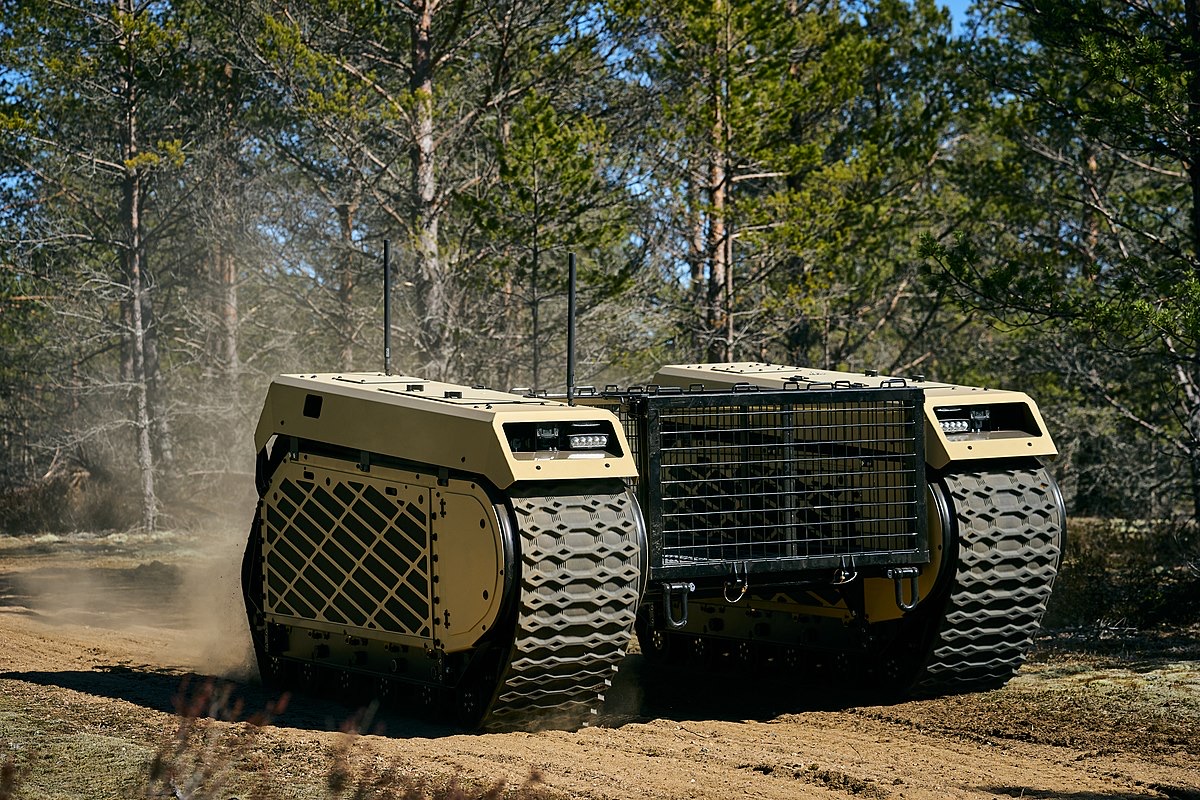
THeMIS: Estonia's Battlefield Pack Mule Robot

THeMIS unmanned ground vehicle by Milrem Robotics

Estonia's Milrem Robotics built the THeMIS (Tracked Hybrid Modular Infantry System) as a modular robotic platform that can be configured for cargo transport, casualty evacuation, route clearance, or armed combat, all depending on which payload module is bolted on top. The base platform weighs about 1,450 kg, runs on a hybrid diesel-electric drivetrain, and can autonomously follow infantry squads through rough terrain while carrying up to 750 kg of supplies.

What makes the THeMIS remarkable is that it's not a concept, it's in active service. Multiple NATO countries have purchased and deployed THeMIS units. In the logistics configuration, it follows troops as a robotic pack mule, carrying ammunition, water, and equipment that would otherwise be on soldiers' backs. In the combat configuration, it mounts a remote weapon station. The THeMIS represents the quiet revolution happening in ground warfare: small, affordable robots that handle the dull, dirty, and dangerous tasks so soldiers don't have to. Estonia, a country of 1.3 million people, has become a leader in military robotics, an asymmetric advantage that multiplies the combat power of its small armed forces.

Type-X: The Robotic Combat Vehicle That Thinks
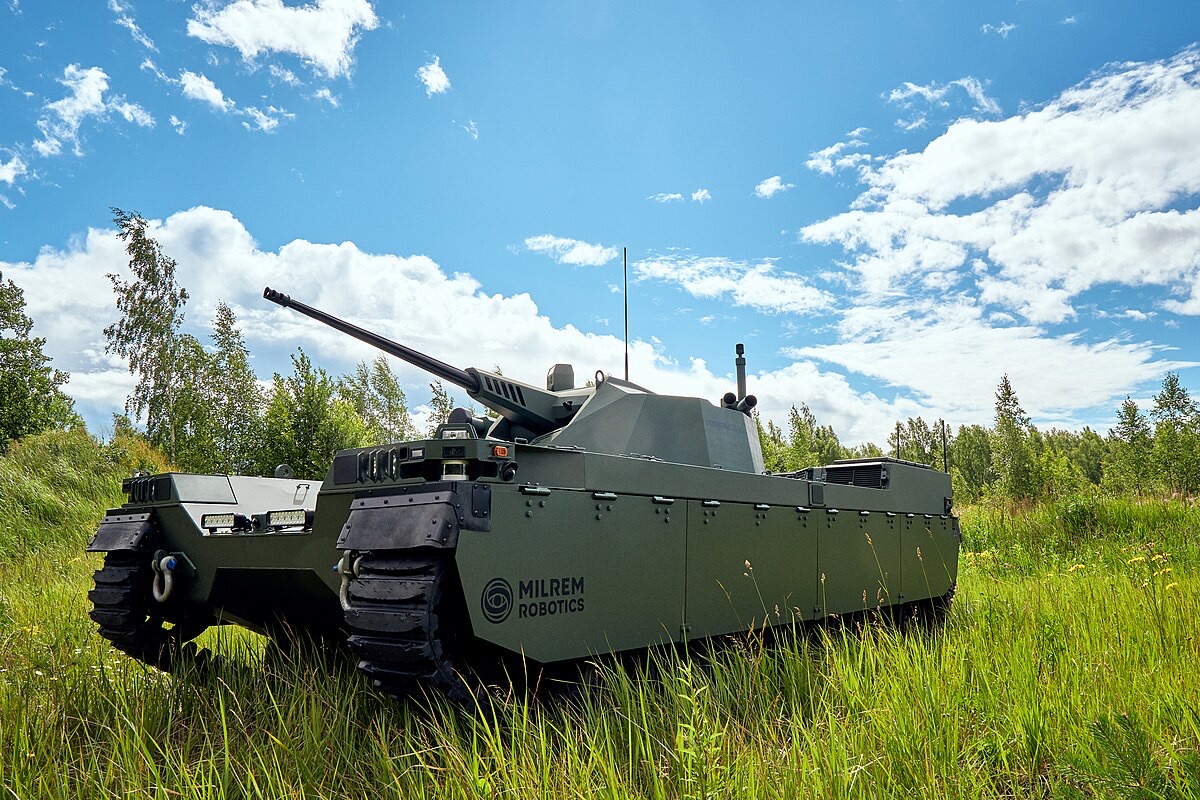
Type-X Robotic Combat Vehicle by Milrem Robotics at a defense exhibition

Also from Milrem Robotics, the Type-X is a full-sized robotic combat vehicle, larger and more heavily armed than the THeMIS. Weighing 12 tons, the Type-X can be equipped with a 25mm or 30mm autocannon turret, anti-tank missiles, or reconnaissance payloads. It's designed to operate in a "wingman" role alongside manned infantry fighting vehicles, advancing into danger zones first to trigger ambushes, draw fire, and provide suppressive fire, all without risking human crews.

The Type-X incorporates artificial intelligence for autonomous navigation, target identification, and convoy operations. It can follow a lead vehicle, maintain formation, and navigate obstacles without human input. When the AI detects a potential threat, it alerts a human operator who makes the engagement decision. This "human-in-the-loop" approach addresses the ethical and legal challenges of armed autonomous systems while still providing the tactical advantages of robotic combat. The Type-X is already being evaluated by several NATO allies, and its combination of meaningful firepower, autonomous capability, and expendable (because crewless) design represents where armored warfare is heading within the next decade.

DARPA RACER: The Off-Road Robot That Teaches Itself
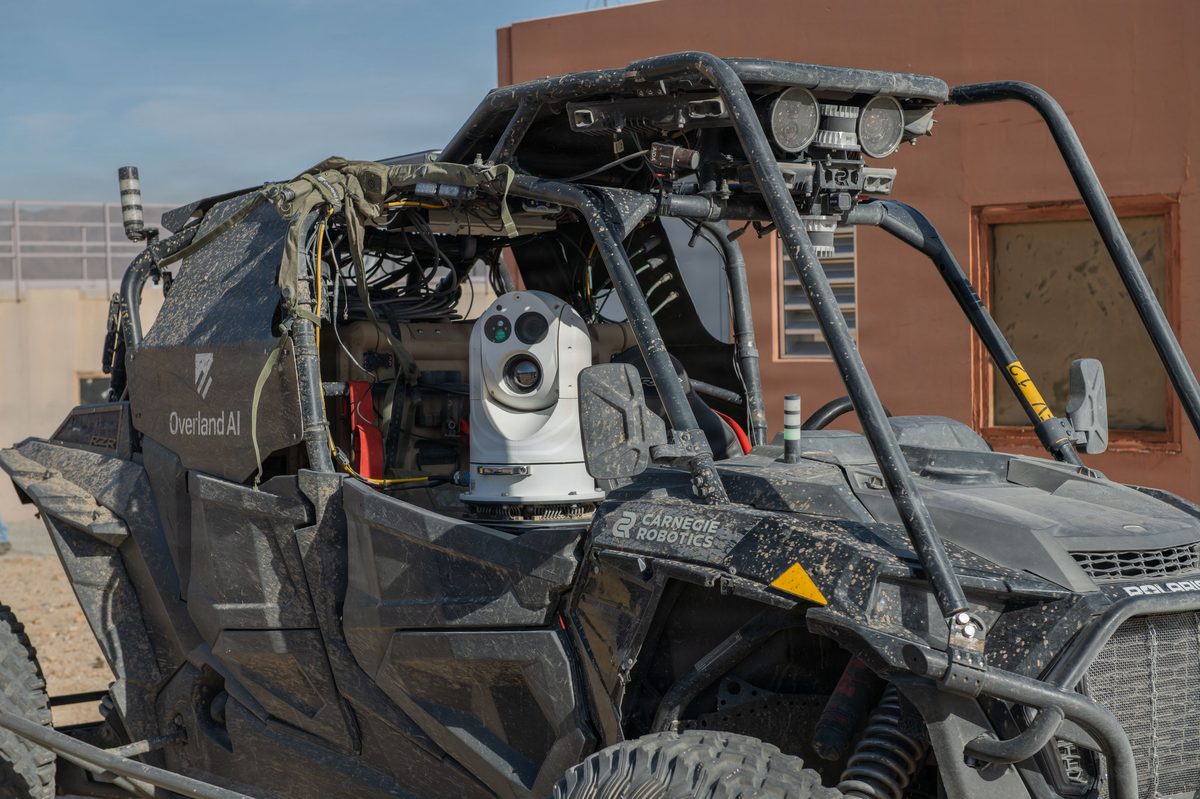
DARPA autonomous military vehicle concept for off-road autonomous navigation

DARPA's RACER (Robotic Autonomy in Complex Environments with Resiliency) program is developing unmanned ground vehicles that can navigate complex off-road terrain at speeds approaching what a skilled human driver would achieve. Unlike previous autonomous vehicles that relied on detailed pre-programmed maps, RACER vehicles use machine learning to adapt to terrain they've never seen before (rocks, ditches, vegetation, mud, and slopes) in real time.

The program represents DARPA's push to solve the hardest problem in military robotics: getting unmanned vehicles to move quickly through unstructured terrain without human intervention. Urban roads have lane markings and traffic rules; cross-country terrain has nothing predictable. RACER vehicles use LiDAR, cameras, and AI to "read" the ground ahead, classify terrain types, and choose optimal paths, all at speeds that would challenge a human driver. The military application is obvious: autonomous supply convoys, robotic scouts, and unmanned combat vehicles that can keep pace with manned forces across any landscape. The technology is still in development, but each test cycle pushes autonomous off-road speed closer to human parity.

LS3 AlphaDog: The Robotic Pack Mule That Follows You Anywhere
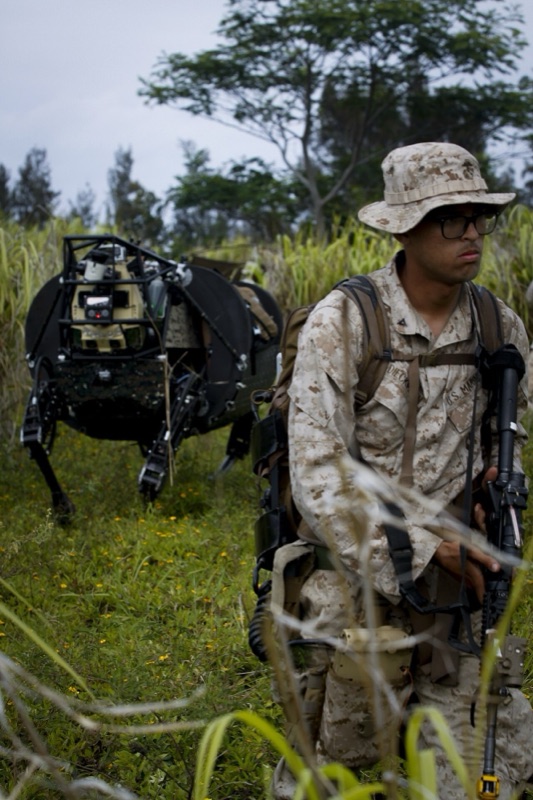
LS3 AlphaDog robotic pack mule during U.S. Marine Corps field trials

Boston Dynamics' LS3 (Legged Squad Support System), nicknamed "AlphaDog," was a four-legged robotic pack animal designed to carry 400 pounds of equipment and follow a squad of Marines across 20 miles of rough terrain in 24 hours. Using dynamic balance algorithms derived from Boston Dynamics' earlier BigDog robot, the LS3 could walk, trot, jog, and even recover from stumbles across terrain that would stop wheeled or tracked robots cold.

DARPA and the U.S. Marine Corps funded the LS3 program, and the robot underwent extensive field testing with Marines at Quantico and during RIMPAC exercises. It could follow a designated leader using computer vision, respond to voice commands, and navigate autonomously using GPS waypoints. The LS3 was technologically impressive but had one fatal flaw for military use: noise. Its gasoline-powered hydraulic system was so loud that Marines in field tests concluded it would compromise squad stealth during patrols. The program was shelved in 2015, but the walking-robot technology it developed flowed directly into Boston Dynamics' later commercial robots. The LS3 proved legged locomotion worked, just not quietly enough for the infantry.

Vityaz DT-30: Russia's Articulated Arctic Monster
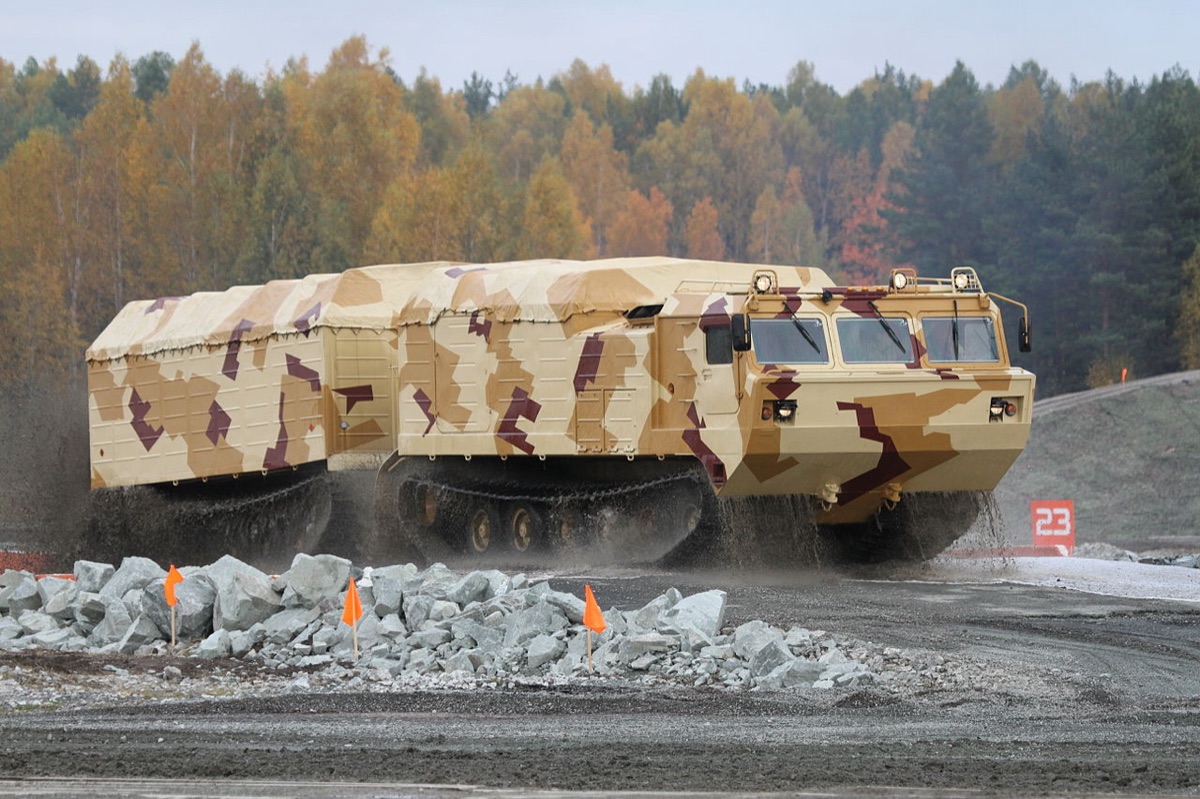
DT-30 Vityaz articulated tracked carrier crossing rough terrain

The DT-30 Vityaz is a two-section articulated tracked carrier that can haul 30 tons of cargo across the most hostile terrain on Earth: Arctic tundra, deep snow, swamps, and rivers. The two sections are connected by a powered articulation joint that allows each unit to pitch, roll, and yaw independently, giving the 30-ton vehicle the ability to snake across terrain that would stop a conventional vehicle in its tracks. It can also swim, crossing rivers and lakes using its tracks for propulsion.

Russia operates the Vityaz extensively in its Arctic military operations, where it's the primary heavy logistics vehicle for moving supplies, equipment, and troops across regions with no roads and no infrastructure. The vehicle's enormous low-pressure tracks distribute its weight so effectively that it exerts less ground pressure than a human footprint, allowing it to traverse thin ice and soft snow that would swallow a normal truck. The articulated design lets it climb gradients and cross ditches that would be impassable for a rigid-frame vehicle. In the Arctic, where Russia is building new military bases and claiming new territory, the Vityaz is as strategically important as any weapons system.

MAZ-7907: The 12-Axle Soviet Missile Carrier
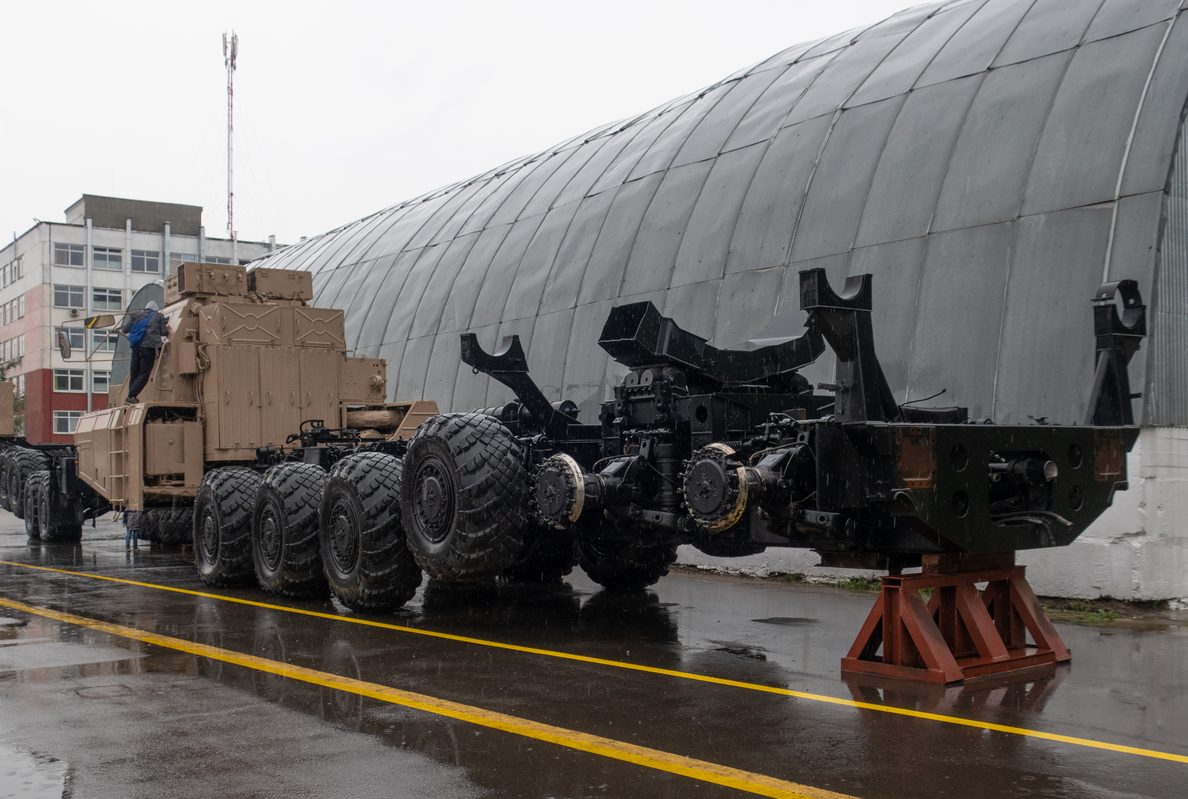
MAZ-7907 twenty-four wheel missile transporter vehicle

The MAZ-7907 was the Soviet Union's attempt to build the ultimate mobile missile launcher. With 12 axles and 24 driven wheels, this behemoth was over 28 meters long and weighed approximately 65 tons empty. It was designed to carry and launch the RT-23 (SS-24 Scalpel) ICBM, a solid-fuel intercontinental ballistic missile with multiple warheads capable of striking targets across the globe. All 24 wheels were steerable, giving this massive vehicle a surprisingly tight turning radius.

Powered by a gas turbine engine producing 1,250 horsepower, the MAZ-7907 could reach 40 km/h on roads, fast for its enormous size. The all-wheel-drive, all-wheel-steer configuration allowed it to traverse unpaved roads and disperse into forests, making it extremely difficult for enemy satellite reconnaissance to track. Only two prototypes were built before the Soviet collapse ended the program. The MAZ-7907 represented the peak of Soviet mobile-missile-launcher engineering, a vehicle so large it needed its own class designation, yet designed to disappear into the Russian wilderness carrying enough nuclear firepower to end civilization.

MZKT-79221: The Topol-M's Road-Going Launch Pad
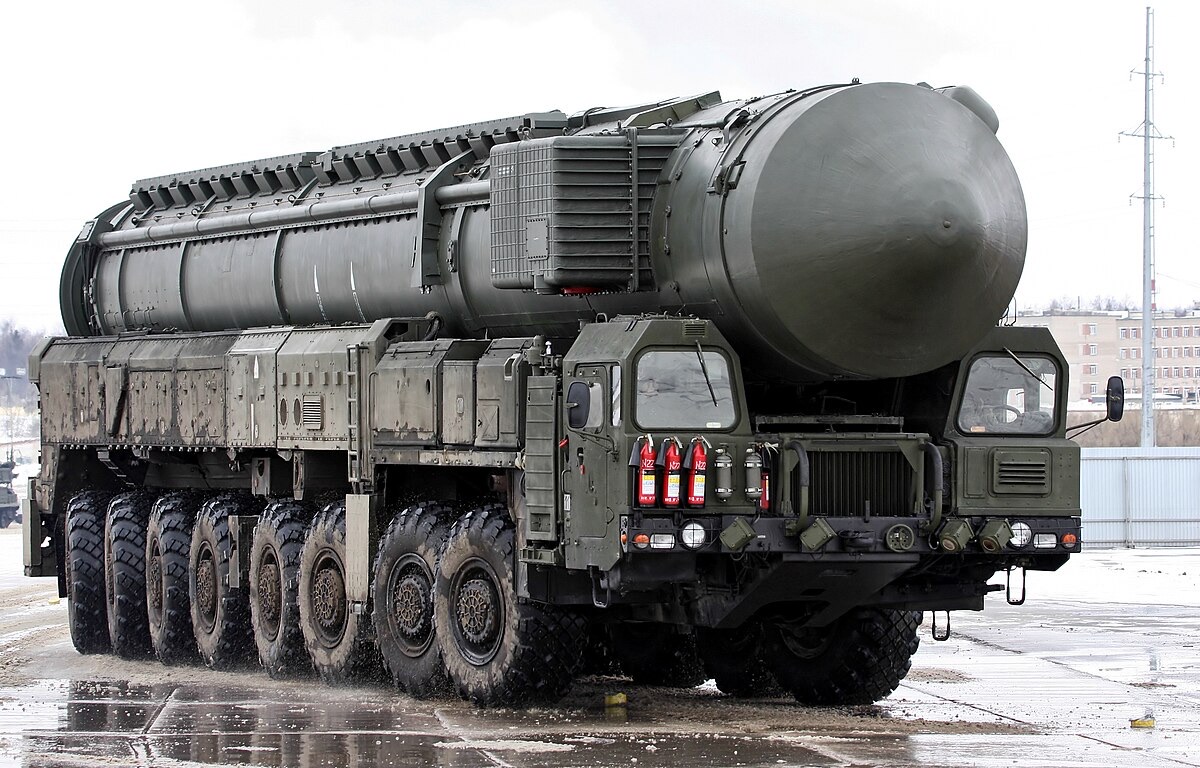
MZKT-79221 Topol-M intercontinental ballistic missile launcher on parade

The MZKT-79221 is the Transporter-Erector-Launcher (TEL) for Russia's Topol-M intercontinental ballistic missile, one of the most important vehicles in Russia's nuclear deterrent. This 8-axle, 16-wheel behemoth carries a single Topol-M ICBM in a sealed launch canister, drives to a pre-surveyed launch point, erects the missile to vertical, and fires it, all without leaving the vehicle. The entire sequence from road march to launch can be completed in minutes.

The Topol-M system's mobility is its key survivability feature. Unlike silo-based missiles with fixed, known locations, a road-mobile ICBM can be anywhere along thousands of kilometers of Russian roads and forest trails. Satellite surveillance can photograph the vehicle, but by the time the image is processed, the TEL has moved to a new location. The MZKT-79221 weighs over 120 tons fully loaded, yet it can operate on unpaved roads and forest tracks. Russia maintains dozens of these vehicles in constant rotation, ensuring that any first-strike attempt against Russian nuclear forces would miss the mobile component entirely.

Bandvagn 206: Sweden's Go-Anywhere Articulated Carrier
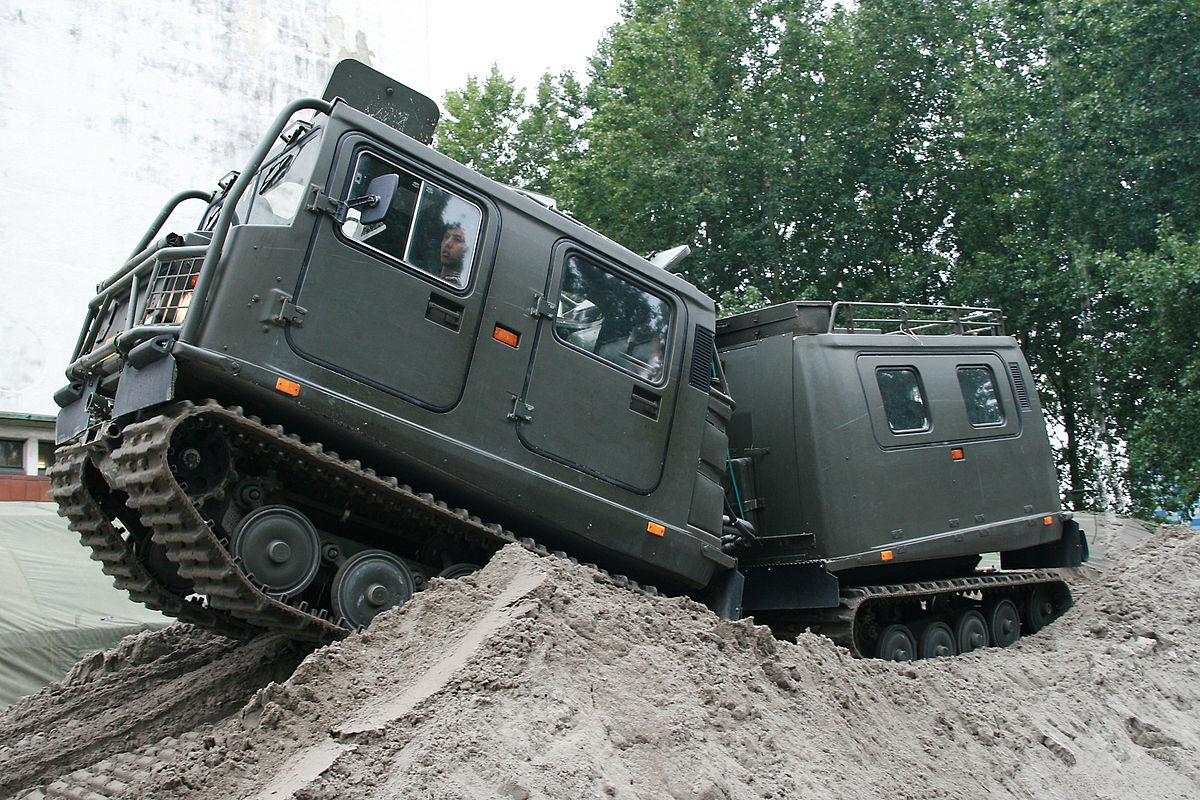
Bandvagn 206 articulated tracked carrier used by multiple NATO armies

The Hagglunds Bandvagn 206 (BV206) is a small, lightweight articulated tracked vehicle that has been adopted by over 40 countries for a simple reason: it goes everywhere. The BV206's two units are connected by a steering joint that allows the vehicle to twist and flex across terrain, deep snow, mountain slopes, arctic ice, swamps, and even moderate water crossings. Its rubber tracks and low ground pressure let it float across surfaces that would swallow heavier vehicles.

Weighing just 4.5 tons, the BV206 can be helicopter-slung, transported inside larger aircraft, or towed by trucks. Its versatility has made it the standard small utility vehicle for Nordic and mountain warfare forces worldwide. British Royal Marines used BV206s extensively in Norway, Afghanistan, and the Falkland Islands. The vehicle has been configured as a troop carrier, ambulance, command post, cargo hauler, and weapons platform. The articulated design gives it a caterpillar-like ability to conform to terrain, climbing slopes and crossing obstacles that would be impassable for rigid vehicles twice its size. Simple, reliable, and supremely versatile.

LCAC: The U.S. Navy's Beach-Storming Hovercraft
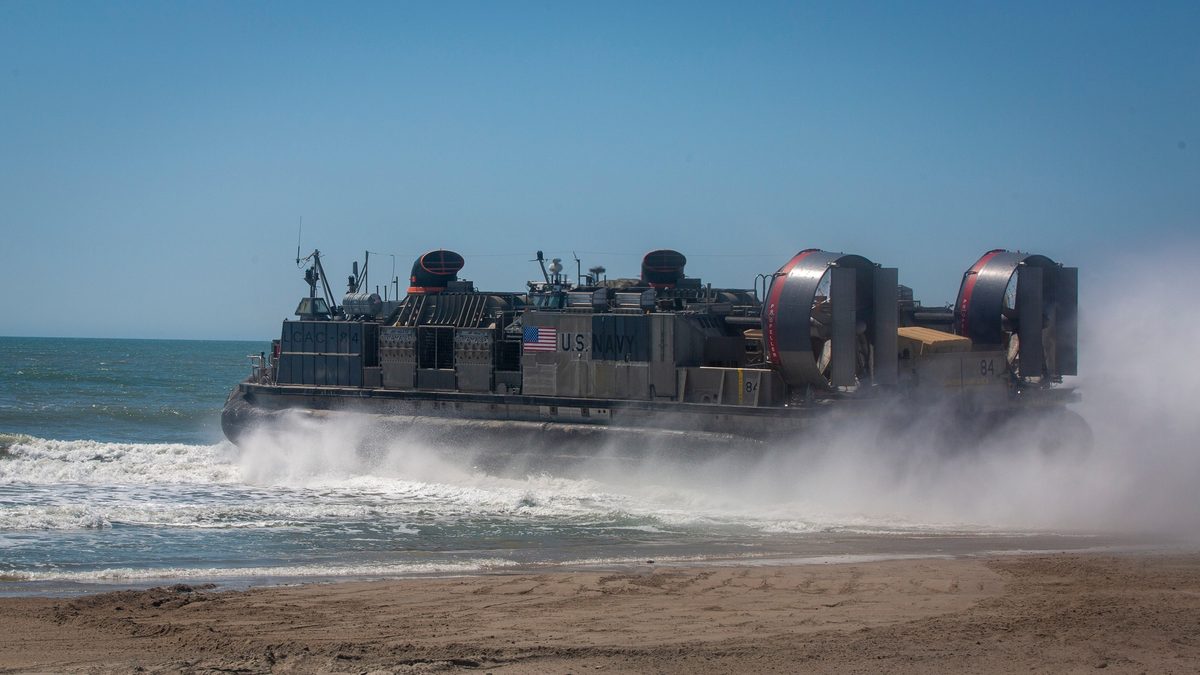
U.S. Navy LCAC Landing Craft Air Cushion hovercraft approaching a beach

The Landing Craft Air Cushion (LCAC) is a high-speed hovercraft used by the U.S. Navy and Marine Corps to transport troops, vehicles, and cargo from ship to shore at speeds exceeding 40 knots. Unlike conventional landing craft that are limited to gently sloping beaches, the LCAC rides on a cushion of air and can come ashore on over 70% of the world's coastlines, including mud flats, marshes, and rocky shores that would strand a traditional boat.

Each LCAC can carry a 60-ton payload, enough for one M1 Abrams tank or several lighter vehicles plus troops. Four gas turbine engines power the lift fans and propellers, creating a vehicle that can transit from a well-deck-equipped ship directly to the beach at highway speeds. The U.S. operates over 80 LCACs, and they've been deployed in every major amphibious operation since the 1991 Gulf War. The LCAC eliminated the most dangerous phase of amphibious warfare (the slow, vulnerable approach to the beach) by replacing it with a high-speed dash across the surf zone that gives defenders far less time to engage. It's being gradually replaced by the even faster Ship-to-Shore Connector (SSC).

Sherp ATV: The Floating Tire Monster From Ukraine
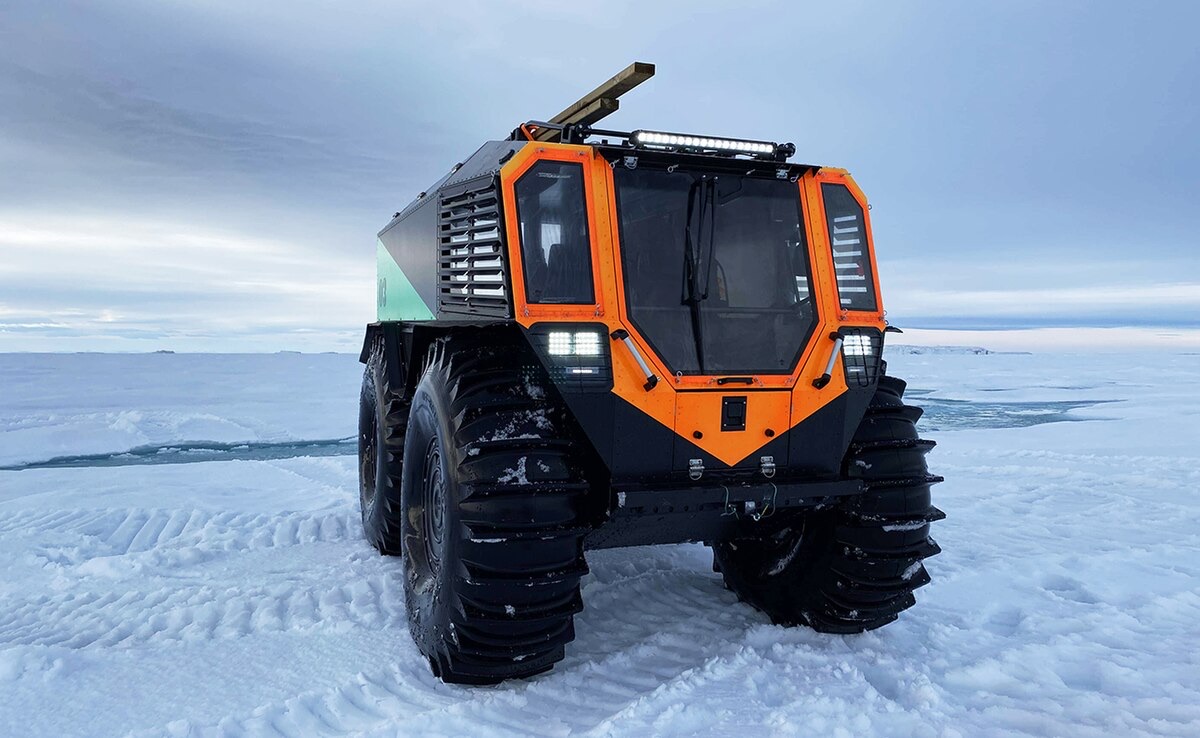
Sherp N 1200 all-terrain vehicle driving through extreme off-road conditions

The Sherp is a Ukrainian-designed all-terrain vehicle that rides on four massive low-pressure tires, each 1.6 meters in diameter. It weighs just 1,300 kg, floats without modification (the tires themselves provide buoyancy), and can climb vertical obstacles up to 70 cm high by using its tire-mounted paddles. With a ground pressure lower than a human footprint, the Sherp can traverse snow, ice, swamp, mud, water, and rocky terrain that would be impassable for conventional off-road vehicles.

The Sherp achieved viral fame through YouTube videos showing it climbing out of lakes, crossing frozen rivers, and driving through terrain that looks impossible. While it started as a civilian product, military applications became obvious: Special Forces insertion, Arctic patrol, border security in roadless regions, and disaster response in flooded areas. Its pneumatic circulation system can transfer air pressure between tires, if one tire loses pressure, the others compensate. The Sherp proves that sometimes the most effective all-terrain vehicle isn't the heaviest, most armored, or most powerful, it's the one that thinks about the terrain differently.

Ripsaw EV2: The Luxury Unmanned Tank
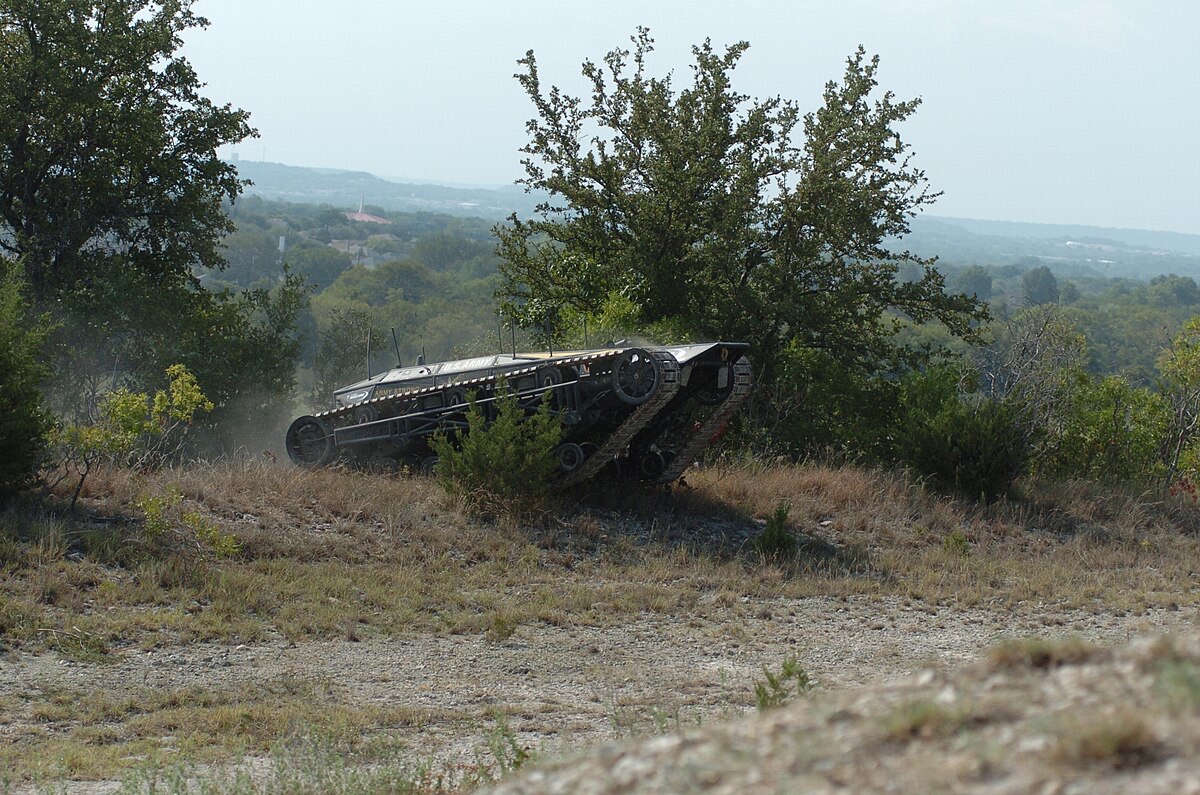
Ripsaw unmanned tracked vehicle during U.S. Army robotics testing

Before the military-focused M5, Howe & Howe Technologies built the Ripsaw EV2, a high-speed unmanned tracked vehicle that combined extreme performance with a surprisingly polished design. The EV2 was a 6.5-ton diesel-powered platform capable of exceeding 95 km/h on flat terrain, making it one of the fastest tracked vehicles ever built. Its compact profile, advanced suspension, and powerful engine made it capable of jumps, high-speed turns, and terrain transitions that looked more like a motorsport vehicle than a military robot.

The Ripsaw EV2 gained public attention when it appeared on TV shows and attracted military interest for its speed and controllability. The U.S. Army used early Ripsaw variants as technology demonstrators for autonomous vehicle concepts, testing remote operation, sensor integration, and unmanned convoy operations. While the EV2 was too lightly protected for direct combat, it proved that unmanned tracked vehicles could achieve performance levels that matched or exceeded manned platforms, a critical proof point for the Army's subsequent Robotic Combat Vehicle programs. The Ripsaw lineage went from garage project to military prototype to potential future of armored warfare.

Object 490 Poplar: The Soviet Super-Tank That Never Was

Soviet experimental heavy tank design concept from the Cold War era

Object 490 "Poplar" was a radical Soviet next-generation tank concept developed at the Kharkov Morozov Machine Building Design Bureau in the late 1980s. The design featured a crew of two positioned in an isolated armored capsule in the hull rear, a fully unmanned turret with a 152mm gun and autoloader, and a revolutionary layout that moved all humans to the most protected part of the vehicle. The concept anticipated by decades the unmanned-turret designs now appearing in modern tanks like Russia's T-14 Armata.

Details of Object 490 only became public after the Soviet collapse, when design documents were declassified. The vehicle was to weigh approximately 30 tons, radically light for its firepower, through the use of advanced composite armor and an extremely compact layout. The 152mm gun would have outranged and outpunched any NATO tank of its era. Active protection systems, composite armor, and an autoloader were all integrated into the design. The project died with the Soviet Union, but its influence is visible in the T-14 Armata's unmanned turret, isolated crew compartment, and emphasis on active protection. The Object 490 was designing the future of tank warfare 30 years before that future arrived.

Churchill AVRE Petard: The Tank That Threw Dustbins

Churchill AVRE with Petard spigot mortar for demolishing fortifications

The Churchill AVRE (Armoured Vehicle Royal Engineers) replaced its main gun with a 290mm Petard spigot mortar, a massive weapon that launched a 40-pound demolition charge nicknamed the "Flying Dustbin." The projectile was designed to blast holes in concrete fortifications, seawalls, and bunkers at close range. At just 80 meters effective range, the AVRE had to drive practically into the enemy's face to use its weapon, but that weapon would demolish a concrete pillbox with a single shot.

The Petard was loaded by the co-driver, who had to open a hatch and slide the round into the mortar from outside the turret. An exposed task that required considerable bravery under fire. Despite this hazard, the Churchill AVRE proved enormously valuable on D-Day and during the subsequent advance into Germany. At the Siegfried Line and in urban combat, AVRE crews would advance under covering fire, close to within mortar range of a bunker, fire a Dustbin through the embrasure, and move on to the next target. The Churchill's thick armor protected it during the dangerous close approach. It was rough, inelegant engineering, but it worked when more sophisticated weapons couldn't.

NASA Crawler-Transporter: The Military-Derived Vehicle That Carries Rockets

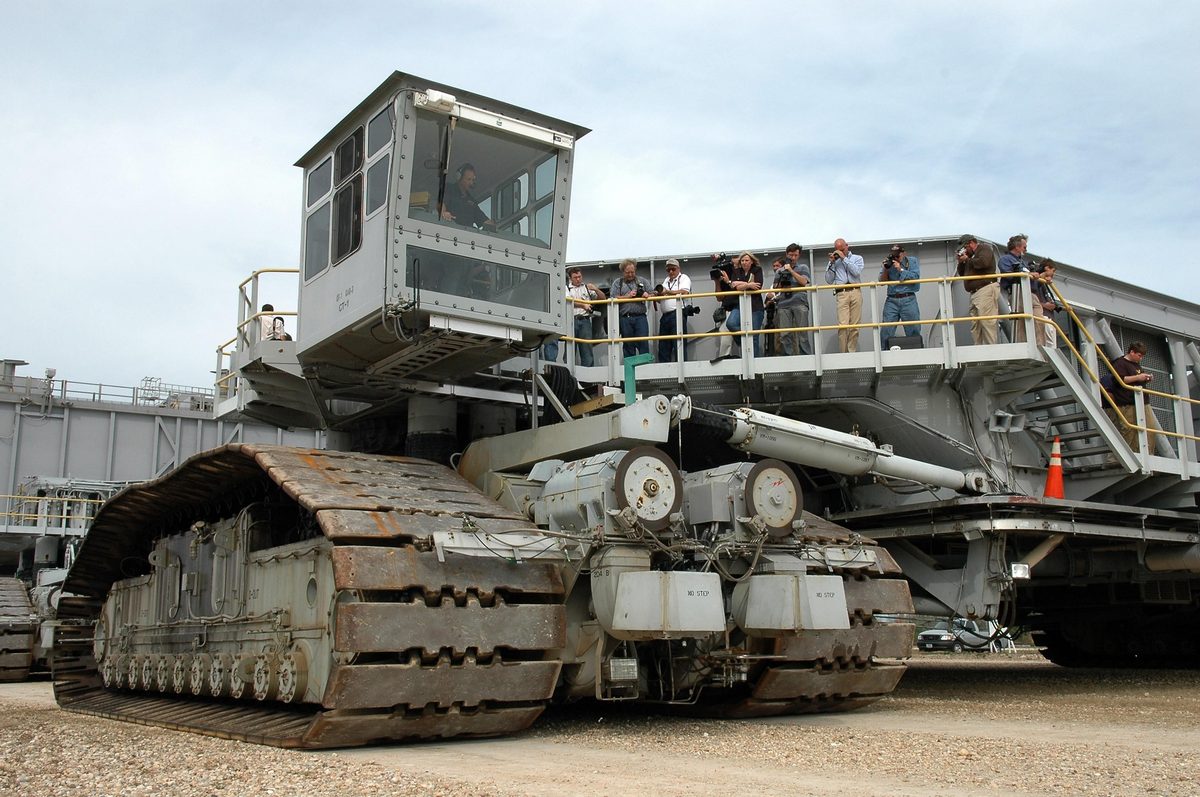
NASA Crawler-Transporter carrying a Space Shuttle to the launch pad at Kennedy Space Center

While not strictly a military vehicle, the NASA Crawler-Transporter deserves inclusion because it was built by the Marion Power Shovel Company using technology from massive strip-mining equipment and military engineering. Weighing 2,721 tons empty, it's the largest self-powered land vehicle ever built. Its job: carry assembled rockets (initially Saturn V, then Space Shuttles, now SLS) from the Vehicle Assembly Building to the launch pad at Kennedy Space Center, a 5.6-kilometer journey that takes about five hours at a maximum speed of 1.6 km/h.

Two Crawler-Transporters were built in 1965 and both remain in service, making them over 60 years old and still operational. Each runs on eight tracked treads, with each tread assembly weighing 57 tons. The vehicle uses a sophisticated leveling system to keep its payload (up to 8,165 tons for SLS) perfectly vertical during the journey up the 5-degree ramp to the launch pad. The Crawler-Transporters have carried every NASA crewed mission vehicle since Apollo 4, logging thousands of trips across Kennedy Space Center's gravel crawlerway. They're the world's most patient vehicles, built for a job that requires absolute precision, infinite reliability, and zero rush.

MAZ-543: The Scud Missile's Ride to the Battlefield

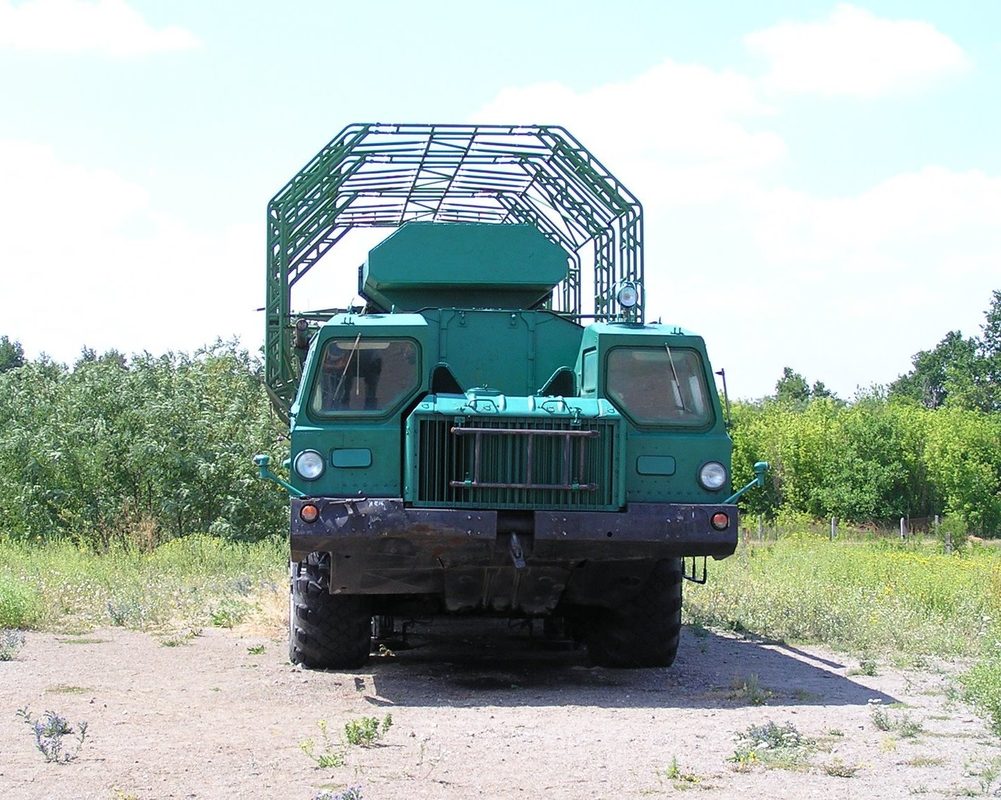
MAZ-543 8x8 vehicle serving as a Scud missile transporter-erector-launcher

The MAZ-543 is an 8x8 special-wheeled chassis that became famous, or infamous, as the Transporter-Erector-Launcher (TEL) for the Scud ballistic missile. This Soviet-designed vehicle can carry a Scud missile to a pre-surveyed launch point, erect it to vertical using an integrated hydraulic crane, and fire it, all within minutes. The MAZ-543's cross-country mobility meant Scud batteries could relocate constantly, making them extremely difficult for enemy air forces to find and destroy.

During the 1991 Gulf War, Coalition aircraft flew thousands of "Scud hunting" sorties over western Iraq, searching for MAZ-543 TELs hiding in the desert. Despite massive air superiority, they destroyed remarkably few. The mobile launchers would fire, relocate to a new position within minutes, and hide under camouflage. The MAZ-543 has been exported worldwide and serves as the launcher for numerous missile systems beyond the Scud, including air defense missiles, cruise missiles, and rocket artillery. It's the original mobile missile platform, a truck that turned ballistic missiles from fixed-site weapons into hunt-and-kill nightmares for any opposing air force.

DT-30 With TOS-1A: The Arctic Carrier Turned Thermobaric Nightmare

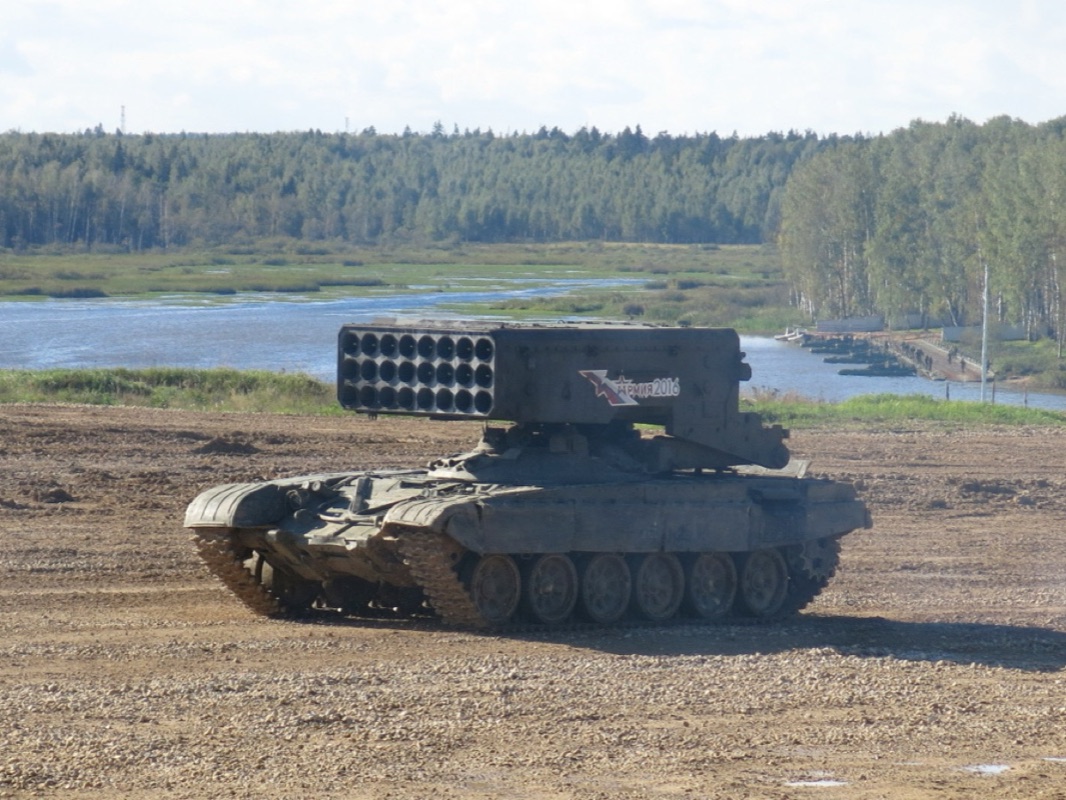
TOS-1A thermobaric multiple rocket launcher system mounted on tank chassis

Russia took the DT-30 Vityaz articulated carrier, already featured on this list as an Arctic logistics vehicle, and mounted a TOS-1A thermobaric rocket launcher on it. The TOS-1A fires 220mm rockets filled with fuel-air explosive warheads that create massive overpressure waves, one of the most devastating conventional weapons in any arsenal. Mounting it on the DT-30 gives this weapon system the ability to operate in Arctic and extreme terrain that would be impassable for the TOS-1A's standard T-72 tank chassis.

The combination is specifically designed for Russia's northern military districts, where permafrost, tundra, and the absence of roads make conventional tracked vehicles impractical for large portions of the year. A TOS-1A salvo can devastate an area the size of several city blocks, and putting that capability on a platform that can reach any point in the Arctic regardless of terrain gives Russia a thermobaric fire support option in regions where most armies can barely maintain supply lines. The DT-30/TOS-1A marriage is a perfect example of Russian military pragmatism: take two existing systems, bolt them together, and create a capability nobody else has.

Fennek: The Whisper-Quiet Reconnaissance Vehicle

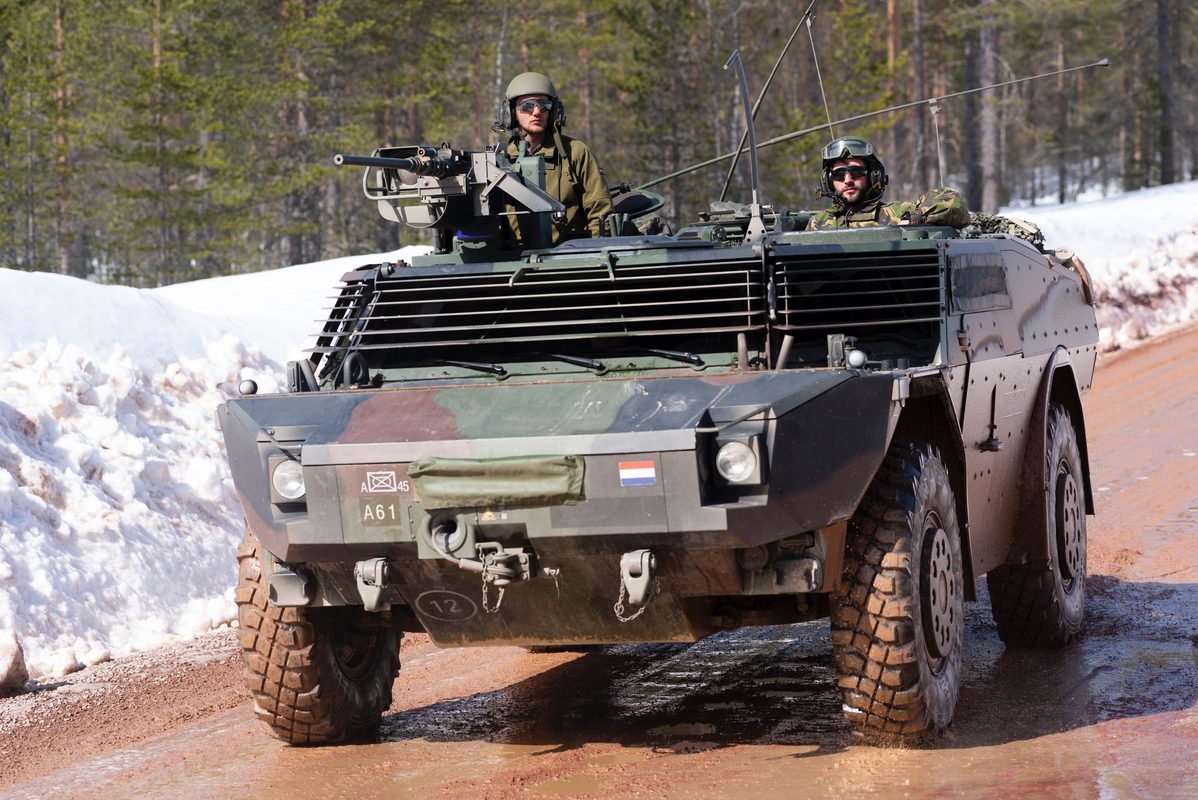
Fennek light armoured reconnaissance vehicle used by German and Dutch forces

The Fennek is a 4x4 light armored reconnaissance vehicle designed by Germany and the Netherlands with one overriding priority: seeing the enemy without being seen. It features a retractable sensor mast that can elevate battlefield surveillance cameras, thermal imagers, and laser rangefinders above the vehicle while the Fennek itself remains hidden behind terrain. The crew never needs to expose the vehicle's body to observe the enemy.

What makes the Fennek special is its emphasis on stealth for a ground vehicle. It has a remarkably low silhouette, reduced infrared and acoustic signatures, and can operate its surveillance systems from a concealed position for extended periods. The vehicle's sensor mast can detect targets at ranges exceeding 10 kilometers, far beyond the distance at which the Fennek itself would be visible. Germany and the Netherlands each operate over 200 Fenneks, and the vehicle has seen combat deployment in Afghanistan. In an era where every vehicle on the battlefield is a potential target for drones, the Fennek's philosophy (look without being seen, know without being known) is more relevant than ever.

Tachanka: A Horse-Drawn Machine Gun Cart That Terrorized Eastern Europe

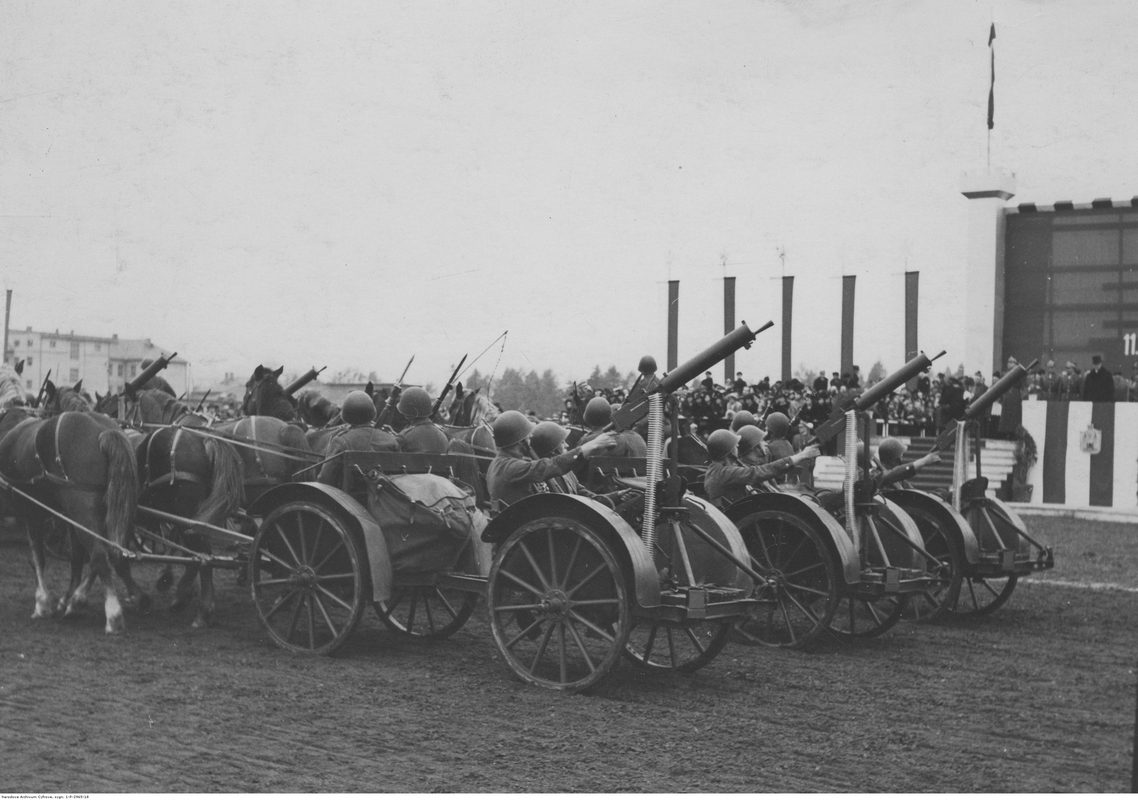
Tachanka horse-drawn machine gun cart with crew in action

Before tanks existed, the fastest way to move a heavy machine gun across a battlefield was to bolt it onto the back of a horse-drawn cart. The Tachanka, a spring-mounted wagon carrying a Maxim machine gun and a crew of two to four, became the signature weapon of the Russian Civil War, where both Red and White armies used them for lightning raids across the vast steppe. The concept was brutally simple: gallop into range, unleash sustained automatic fire, then gallop away before the enemy could respond.

The Tachanka reached its peak during the campaigns of Nestor Makhno's anarchist army in Ukraine, where hundreds of them operated as mobile fire platforms that could keep pace with cavalry charges. They were so effective that the Soviet Red Army formally adopted them as standard equipment, and they remained in service through the early stages of World War II. The Soviets even used them during the defense of Moscow in 1941. A monument to the Tachanka stands in Kakhovka, Ukraine, a testament to the absurd effectiveness of strapping a machine gun to a horse cart and charging into battle.

Uran-9: Russia's Armed Robot Tank

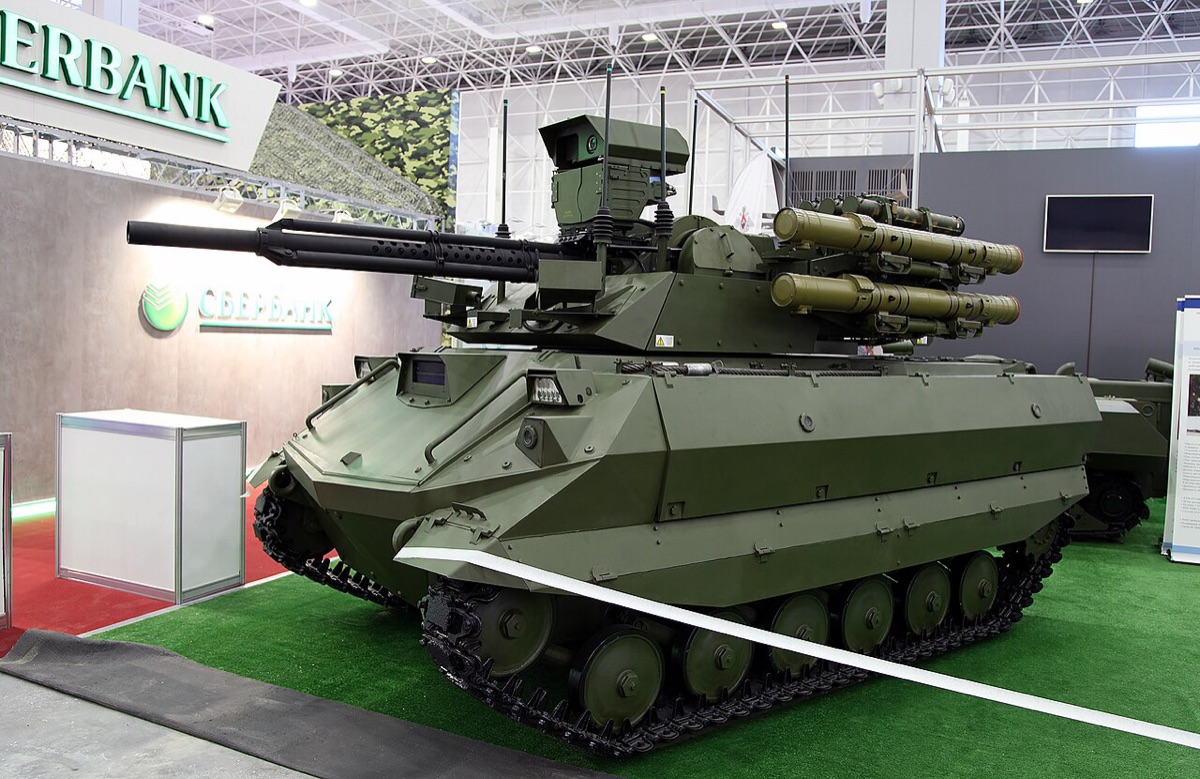
Uran-9 unmanned ground combat vehicle at Russian military exhibition

The Uran-9 is a Russian unmanned ground combat vehicle that packs the firepower of an infantry fighting vehicle into a 12-ton robotic platform. Its armament includes a 30mm 2A72 autocannon, a coaxial 7.62mm machine gun, and four Ataka anti-tank guided missiles, enough firepower to engage everything from infantry to main battle tanks. An operator controls the Uran-9 from a mobile command station up to 3 kilometers away, directing the vehicle and its weapons via encrypted radio link.

Russia deployed the Uran-9 to Syria for combat testing, and the results were reportedly mixed, the robot experienced communication blackouts, fire control malfunctions, and navigation difficulties in urban terrain. But the concept it represents is significant: a ground combat vehicle with no crew to protect, meaning armor can be lighter, the vehicle can be smaller, and losses don't cost human lives. Russia has continued developing the platform, and the Uran-9's combat debut, flaws and all, made it the first armed unmanned ground vehicle to see actual warfare. The age of robotic ground combat has begun, even if the first chapter was rough around the edges.
Share this article

Share:

Recommended

Ace of The Skies: Can You Identify These Military Aircraft Throughout The Years?
Test Yourself

Ace of The Skies: Can You Identify These Military Aircraft Throughout The Years?

Can you identify these aircraft?

Take the Quiz

On This Day in Military History

January 9

U.S. Sixth Army Invades Luzon (1945)

General Douglas MacArthur's Sixth Army, comprising 175,000 troops, stormed the beaches of Lingayen Gulf on Luzon, the Philippines' largest island and the site of Manila. The invasion fulfilled MacArthur's famous promise to return and began the largest land campaign of the Pacific War, a brutal three-month battle that would cost over 190,000 Japanese and 10,000 American lives.

1916, Gallipoli Campaign Ends, Last Allied Troops Evacuate

1861, Star of the West Fired Upon at Fort Sumter

1916, Gallipoli Evacuation Completed, Last Allied Troops Leave the Peninsula

See all 10 events on January 9

Get Military News & History in Your Inbox

Join thousands of readers receiving our weekly digest of military technology, history, and analysis.

Test Your Knowledge