Emergency preparedness is not a hobby. It is a baseline responsibility that most people ignore until the moment they need it. Whether you are building a 72-hour bug-out kit, stocking a vehicle emergency bag, or assembling a home disaster cache, the gear you choose directly determines how well you handle the gap between when things go wrong and when help arrives. That gap can be 72 hours in a hurricane, a full week after an earthquake, or indefinitely in a grid-down scenario.
This guide covers 23 products across complete kits, first aid, fire and shelter, water filtration, tools, and communication. Prices range from $12 water purification tablets to $160 turnkey 72-hour kits. Every product includes honest trade-offs because survival gear that fails when you need it is worse than no gear at all. We prioritized products with strong track records, real-world testing pedigrees, and proven supply chains over flashy newcomers with no field history.
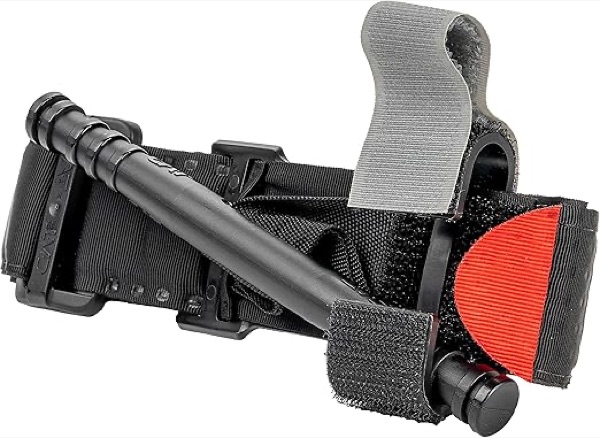
NAR C-A-T Gen 7
~$32


Emergency Zone 2-Person 72-Hour Kit
$160 on Amazon

Emergency Zone's premium offering covers two people for 72 hours with food rations, water pouches, a comprehensive first aid kit, shelter, hygiene items, and a communication plan. Everything is packed into a quality backpack with room to add personal items.
Complete Survival Kits ($48 - $160)
Pre-built survival kits are the fastest way to establish a baseline level of preparedness. The best ones give you a foundation of essentials across food, water, shelter, and first aid that you can customize and supplement over time. The worst ones fill a bag with cheap filler items that look good in marketing photos but fail under stress. These four kits cover a range of budgets, and all include items that actually function when you need them.
1. LUXMOM 142-Piece Emergency Survival Kit
~$48 on Amazon
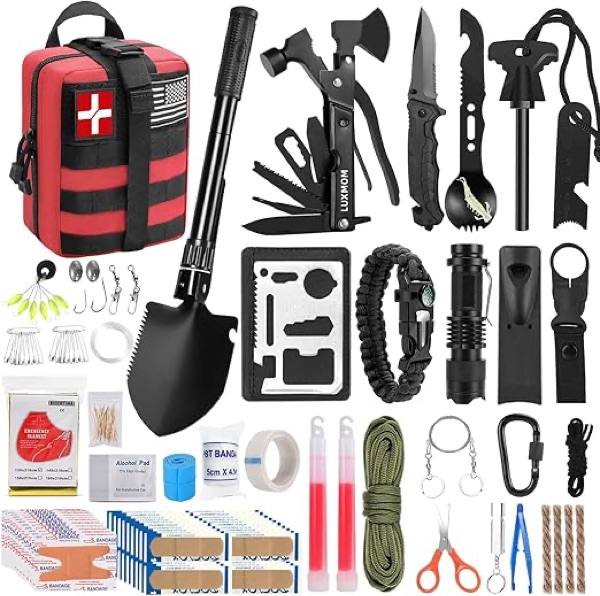
At under $50, the LUXMOM kit crams 142 pieces into a compact MOLLE-compatible pouch. You get a flashlight, fire starter, compass, wire saw, emergency blankets, first aid supplies, and a range of small tools that cover the basics of short-term survival.
Best for: Vehicle glove boxes, starter kits for new preppers, and gift-worthy emergency bags on a tight budget
The LUXMOM kit is one of the better-organized budget options because it uses a structured MOLLE pouch instead of a generic drawstring bag. Individual items are grouped into labeled sub-pouches for first aid, fire, and tools, which matters when you need to find something fast in low light. The flashlight is serviceable for short-term use, and the fire starter rod works well enough to get a flame going with dry tinder. Where this kit falls short is component quality. The compass is a basic button type that lacks the reliability of a proper baseplate compass, and the multi-tool feels flimsy under any real torque. Think of this as a $48 foundation you will gradually upgrade piece by piece rather than a finished product.
2. Ready America 72-Hour Emergency Kit (2-Person)
~$75 on Amazon
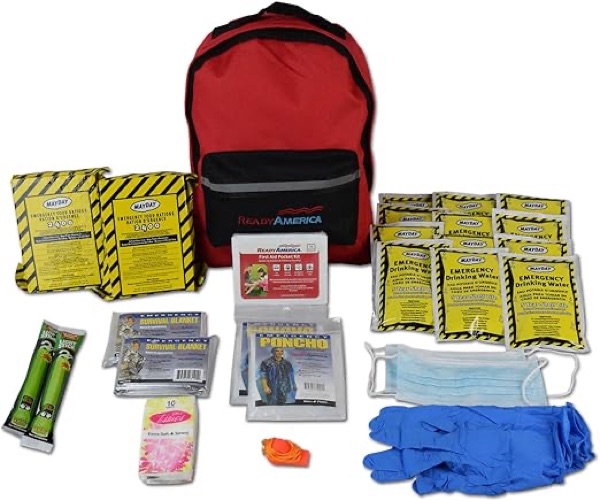
Ready America has been in the emergency preparedness space for over 20 years, and this 2-person 72-hour kit reflects that experience. It includes food bars, water pouches, emergency ponchos, blankets, lightsticks, a first aid kit, and a backpack to carry it all.
Best for: Families building their first home emergency cache, apartment closets, and anyone who wants a grab-and-go bag that requires zero assembly
Ready America built this kit around FEMA's recommended 72-hour supply list, which gives it an institutional credibility that most Amazon survival kits lack. The food bars are Coast Guard-approved, calorie-dense, and have a five-year shelf life without refrigeration. Water pouches are individually sealed and rated for the same shelf duration. The included backpack is lightweight and gets the job done for transport, though it would not survive a multi-day hike. The main limitation is that this kit focuses almost entirely on sustenance and basic comfort. It does not include a fire starter, knife, water filter, or any real tools. You are getting food, water, shelter basics, and first aid, but you will need to add your own tooling layer on top. For pure disaster preparedness at home, that is often fine. For wilderness or bug-out scenarios, supplement heavily.
3. EVERLIT Storm II 72-Hour Survival Kit
~$100 on Amazon
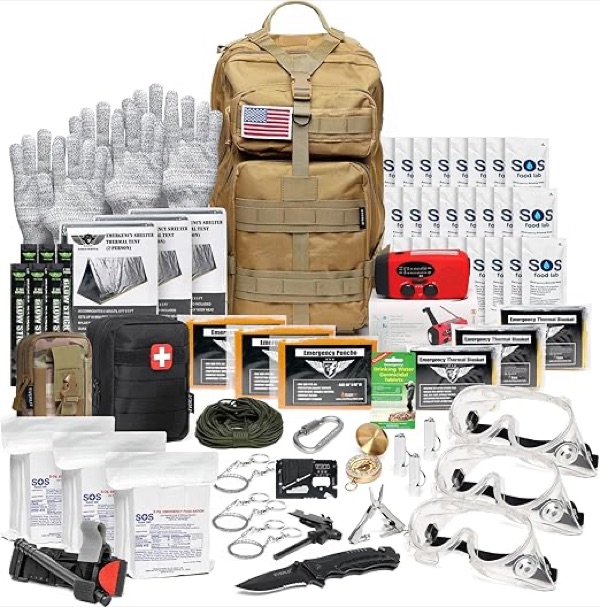
EVERLIT's Storm II is the most complete pre-built survival kit at this price point. It includes a quality tactical backpack, first aid supplies, fire starters, water filtration, an emergency blanket, shelter materials, a fixed-blade knife, and a hand-crank radio, all organized in labeled compartments.
Best for: Anyone who wants a fully functional 72-hour kit without spending hours sourcing individual components
What separates the Storm II from most pre-built kits is that EVERLIT actually included items you would choose yourself. The fixed-blade knife holds an edge well enough for batoning small kindling. The ferro rod produces reliable sparks. The water filter straw removes 99.9% of bacteria and protozoa. The hand-crank radio receives NOAA weather alerts. None of these items are best-in-class individually, but together they form a cohesive system that covers all five survival priorities: shelter, water, fire, food, and signaling. The backpack itself is a step above the generic bags most kits ship in, with padded straps and multiple compartments. Where the Storm II stumbles is food. It does not include calorie-dense rations, so you will need to add your own food bars or MREs. For everything else, this kit is ready to go out of the box.
4. Emergency Zone 2-Person 72-Hour Kit
~$160 on Amazon
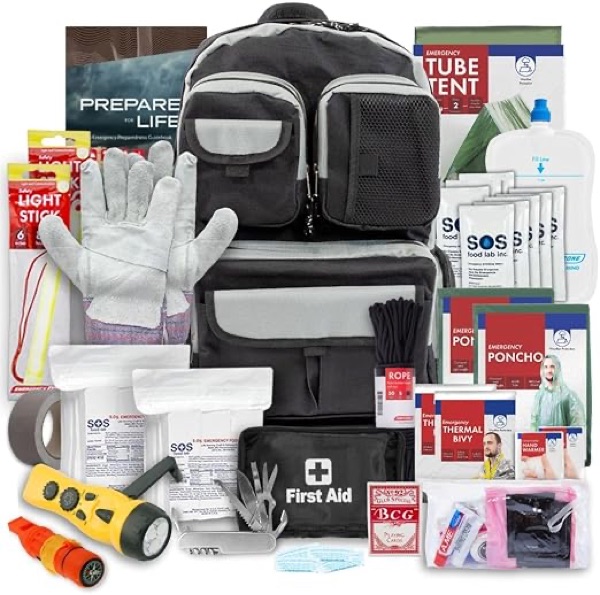
Emergency Zone's premium offering covers two people for 72 hours with food rations, water pouches, a comprehensive first aid kit, shelter, hygiene items, and a communication plan. Everything is packed into a quality backpack with room to add personal items.
Best for: Couples and two-person households who want a turn-key disaster kit that covers food, water, and hygiene for both people
Emergency Zone goes beyond basic survival with this kit by including items most competitors skip: a hygiene kit with toothbrushes and soap, a deck of playing cards for morale during long waits, document bags for protecting insurance papers and IDs, and dust masks. The food rations and water pouches carry a five-year shelf life, and the quantities are correctly calculated for two adults across 72 hours. The first aid component is more thorough than what ships in cheaper kits, with proper bandaging materials and antiseptic supplies. The trade-off at $160 is that you are paying a premium for convenience and completeness over raw capability. The individual tools and survival items are not as capable as what you would select if you built the kit yourself for the same budget. But for someone who wants to open one box and have a fully stocked 72-hour bag for two people, this is the simplest path to real preparedness.
First Aid / IFAK ($15 - $70)
A first aid kit is not optional in any survival loadout. The distinction that matters here is between a basic boo-boo kit for cuts and scrapes and a proper Individual First Aid Kit (IFAK) capable of managing life-threatening hemorrhage. Military IFAKs are built around one principle: stop massive bleeding fast. The products below range from single-purpose trauma items to complete field-ready kits used by military and law enforcement medics.
5. NAR HyFin Vent Chest Seal Twin Pack
~$16 on Amazon
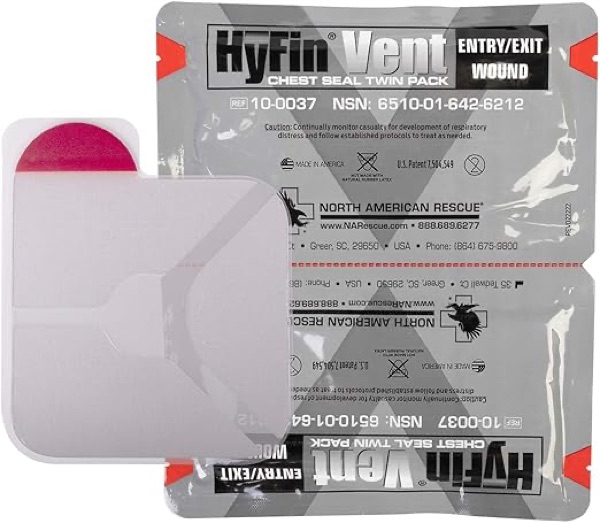
The HyFin Vent is the gold standard for treating open chest wounds in the field. This twin pack provides one seal for the entry wound and one for a potential exit wound, with a three-channel venting design that prevents tension pneumothorax.
Best for: IFAK builds, range bags, and anyone who carries trauma gear alongside a tourniquet
North American Rescue developed the HyFin Vent for military use, and it remains the chest seal recommended by the Committee on Tactical Combat Casualty Care (CoTCCC). Application is straightforward: peel the backing, press onto the wound, and the adhesive grips even through blood and sweat. The three-channel venting system allows air to escape from the chest cavity without letting air back in, which prevents the potentially fatal buildup of pressure known as tension pneumothorax. The limitation is that proper chest seal application requires training. If you buy these for your IFAK, you need to take a tactical medical course like TCCC or Stop the Bleed to learn correct placement and to recognize the signs of a chest injury. Without that training, the seal becomes an expensive adhesive bandage in an emergency.
6. NAR C-A-T Gen 7 Tourniquet
~$32 on Amazon
The Combat Application Tourniquet is the single most important piece of trauma gear you can carry. The Gen 7 update improves the windlass clip, routing strap, and single-hand application. It is the same tourniquet issued to every branch of the U.S. military.
Best for: Every survival kit, range bag, vehicle kit, and IFAK. Period. This is non-negotiable gear.
Severe extremity hemorrhage is the number one cause of preventable death in both combat and civilian trauma. The C-A-T Gen 7 addresses this with a windlass-based design that can be self-applied to an arm or leg with one hand in under 30 seconds, once you have practiced the technique. The Gen 7 improvements over the Gen 6 include a redesigned windlass clip that is less prone to breakage, a beveled routing buckle that reduces friction during tightening, and a more visible time strap for marking application time. One major concern is the counterfeit market. Amazon is flooded with fake C-A-Ts that look identical but use inferior materials that snap under tension. Always verify you are buying from NAR's authorized Amazon storefront or a verified medical supplier. See our counterfeit warning section below for more detail. The other limitation is that tourniquets require practice. Buy a dedicated training tourniquet and rehearse until you can apply it in the dark.
7. EVERLIT Survival First Aid Kit
~$38 on Amazon
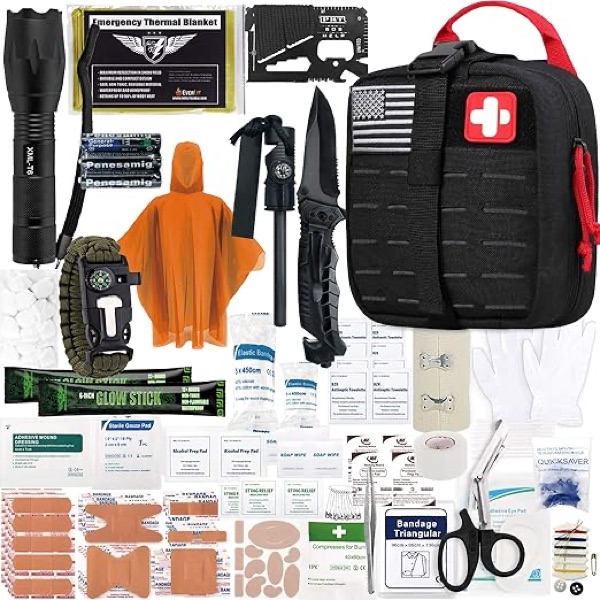
EVERLIT's survival first aid kit bridges the gap between a basic medicine-cabinet kit and a full IFAK. It includes a tourniquet, Israeli bandage, chest seal, trauma shears, and standard first aid supplies in a compact MOLLE-compatible pouch.
Best for: Hikers, campers, and range-goers who want trauma capability without building a full IFAK from scratch
For under $40, the EVERLIT kit gives you a workable trauma kit alongside everyday first aid items. The included tourniquet is a CAT-style windlass design, the Israeli bandage provides wound compression, and the chest seal covers penetrating injuries. Standard items like adhesive bandages, gauze, antiseptic wipes, and medical tape round out the kit for non-life-threatening injuries. The MOLLE pouch attaches to any compatible pack, vest, or belt system. The weakness here is component sourcing. The tourniquet is not a genuine NAR C-A-T, and the chest seal is not a NAR HyFin. These alternatives work, but they have not undergone the same level of military testing and certification. If you plan to rely on this kit for serious trauma response, consider swapping the tourniquet and chest seal for genuine NAR components and keeping the rest of the kit as-is.
8. NAR IPOK (Individual Patrol Officer Kit)
~$65 on Amazon
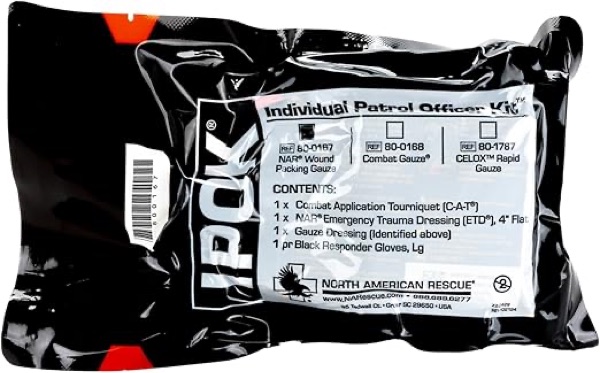
North American Rescue designed the IPOK for law enforcement patrol officers, and it has become one of the most trusted compact trauma kits available. It contains a C-A-T tourniquet, HyFin chest seal, emergency trauma dressing, and compressed gauze in a vacuum-sealed flat pack.
Best for: Anyone who wants a NAR-sourced trauma kit with guaranteed authentic components in a compact, purpose-built package
Every component in the IPOK is genuine NAR, which eliminates the counterfeit risk that plagues Amazon trauma gear listings. The vacuum-sealed flat pack design keeps the kit compact enough to slide into a cargo pocket, plate carrier, or the front pouch of a backpack. Inside you get a C-A-T tourniquet (current generation), a HyFin Vent chest seal, an emergency trauma dressing, and compressed gauze for wound packing. That combination covers the three most common causes of preventable battlefield death: extremity hemorrhage, tension pneumothorax, and junctional bleeding. The trade-off at $65 is that you are paying a premium for NAR's quality assurance and packaging. You could assemble the same components individually for slightly less, but you would lose the vacuum-sealed form factor and the certainty of buying from a single verified source. The kit also lacks everyday first aid items, so pair it with a basic boo-boo kit for non-trauma injuries.
Fire & Shelter ($17 - $22)
Hypothermia kills faster than dehydration or starvation. In a survival scenario, your ability to maintain core body temperature through fire and shelter is often the difference between a manageable situation and a fatal one. These three products address both sides of that equation: reliable fire starting and emergency shelter that traps body heat.
9. Uberleben Zunden Ferro Rod
~$18 on Amazon
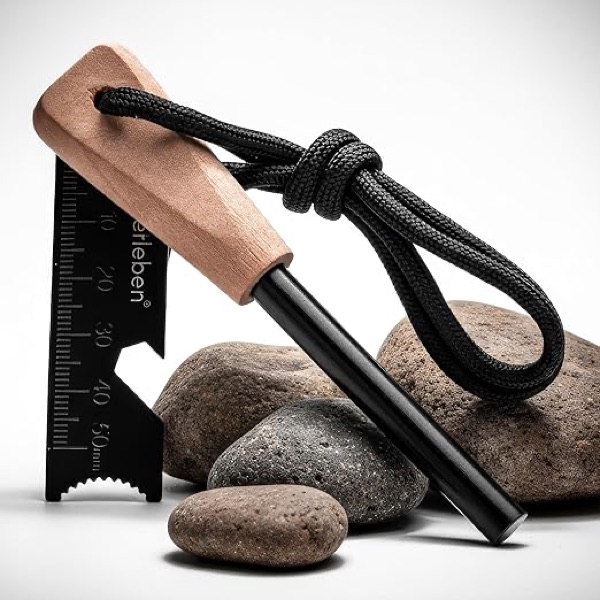
Uberleben's Zunden ferro rod is thicker and longer than most competing fire starters, which translates to more sparks per strike and a longer service life. The hardwood handle provides a solid grip even in wet conditions.
Best for: Primary fire starting in survival kits, camping, and any situation where matches and lighters are unreliable
Ferro rods work when lighters fail. They function in rain, wind, and freezing temperatures, and they do not run out of fuel. The Uberleben Zunden stands out from the dozens of ferro rods on Amazon because of its rod diameter and length. A thicker rod throws a wider shower of sparks, and the extra length gives you more material to work with over years of use. The included striker has a comfortable grip, and the lanyard keeps the two pieces together. One thing to understand about any ferro rod is that it requires proper tinder preparation. You cannot just scrape sparks onto damp leaves and expect a fire. Learn to make feather sticks, carry cotton balls with petroleum jelly, or pack commercial tinder tabs. The rod itself is only as good as the tinder you pair it with, and that skill gap trips up a lot of first-time users who expect it to work like a lighter.
10. S.O.L. Emergency Bivvy
~$20 on Amazon
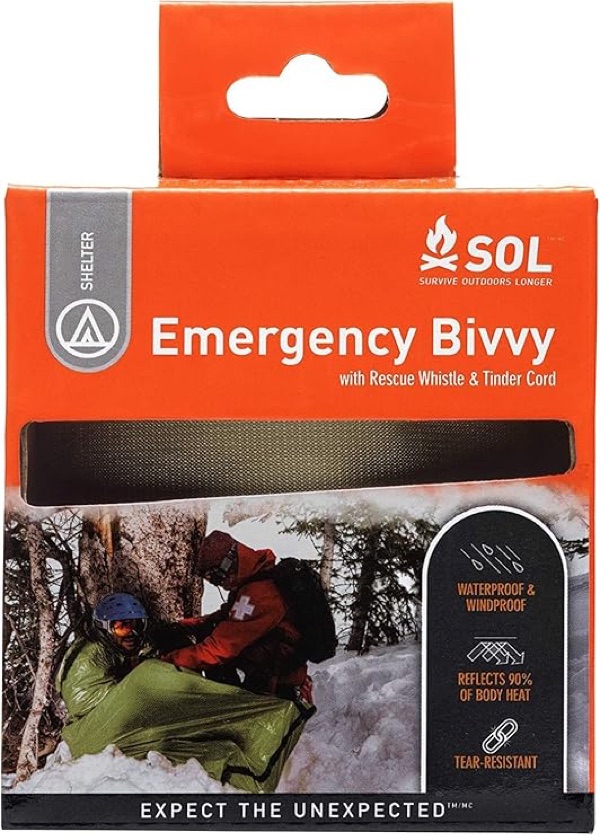
The S.O.L. Emergency Bivvy is a massive upgrade over the classic Mylar space blanket. It is a full sleeping-bag-shaped shelter made from heat-reflective material that retains up to 90% of your body heat while keeping wind and rain out.
Best for: Emergency shelter in survival kits, unexpected overnight situations, and as a backup to primary sleeping systems
Anyone who has tried wrapping themselves in a flat Mylar blanket knows how frustrating they are. They crinkle constantly, slip off your body, and channel wind through every gap. The S.O.L. Bivvy solves all of that by sealing you inside a proper tube shape with a drawstring hood closure. The material reflects radiant heat back toward your body, dramatically slowing heat loss in cold conditions. At under four ounces, it adds almost nothing to your pack weight. The weakness is condensation. Because the material is waterproof and non-breathable, moisture from your body accumulates inside during extended use. After several hours, you will be damp from your own perspiration. This is a survival tool for emergency use, not a replacement for a proper sleeping bag. For a planned overnight, bring real insulation. For an unplanned one, this bivvy can keep you alive.
11. Go Time Gear Life Bivy
~$19 on Amazon
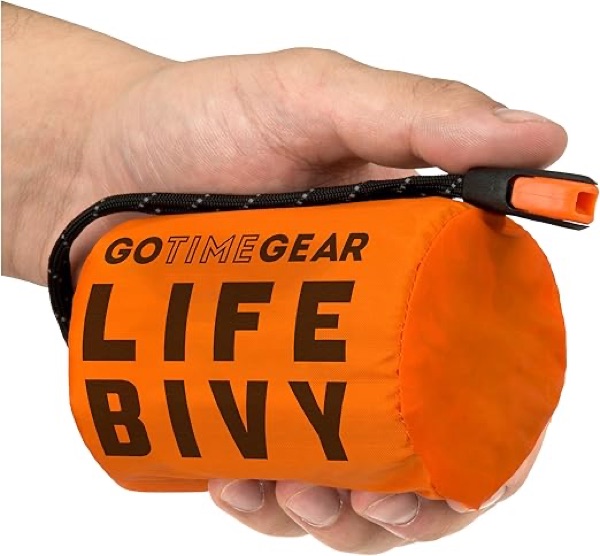
Go Time Gear's Life Bivy packs into a stuff sack the size of your fist and weighs just 4.1 ounces. Like the S.O.L. Bivvy, it uses heat-reflective material in a sleeping bag form, but adds a built-in whistle for signaling.
Best for: Ultralight emergency kits, hikers who refuse to carry extra weight, and as a redundant shelter backup in any pack
Go Time Gear positions the Life Bivy as a competitor to the S.O.L. Bivvy, and the two products are similar in concept. The Life Bivy's distinguishing features are a built-in signaling whistle on the stuff sack and a bright orange interior that doubles as a visual signal if you lay the bivvy open on the ground. The material is slightly thinner than the S.O.L. version, which cuts weight by a fraction of an ounce but reduces durability. In testing, the Life Bivy tears more easily if dragged over rough ground. The same condensation problem applies here: extended use means you will get damp inside. If you are choosing between the two, the S.O.L. is slightly more durable, while the Life Bivy is marginally lighter and includes the whistle. Neither is a bad choice, and at under $20, carrying both as redundant shelter options is reasonable.
Water Filtration & Purification ($12 - $40)
Clean water is your most urgent survival need after immediate physical safety. You can survive weeks without food, but severe dehydration degrades your cognitive and physical performance within hours. These three options cover the spectrum from chemical purification tablets to gravity-fed filtration systems, each suited to different scenarios and budgets.
12. Potable Aqua Water Purification Tablets with PA Plus
~$13 on Amazon
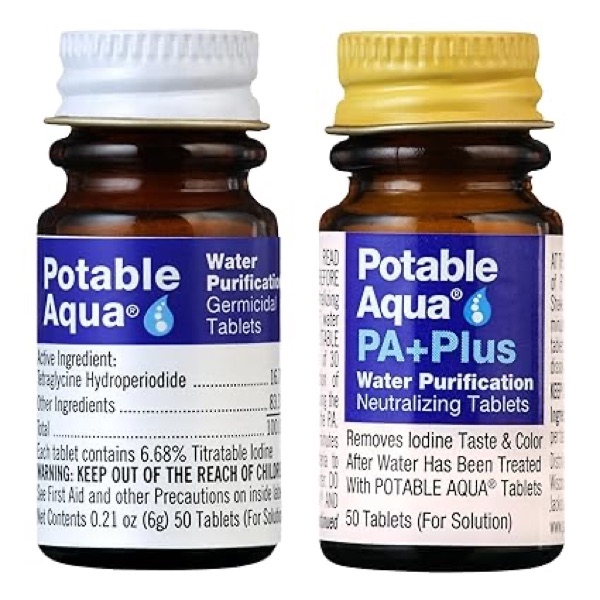
Potable Aqua has been the standard-issue water purification tablet for the U.S. military for decades. The two-bottle system uses iodine tablets to kill pathogens, followed by PA Plus tablets that neutralize the iodine taste and color.
Best for: Backup water purification in any kit, international travel, and situations where carrying a filter is impractical
Chemical purification tablets occupy a unique niche in emergency preparedness because they weigh almost nothing, take up minimal space, and have no moving parts to break. Drop two iodine tablets into a quart of water, wait 30 minutes, then add the PA Plus neutralizer to remove the taste. The result is potable water that eliminates bacteria, viruses, and Giardia cysts. Where tablets fall short compared to filters is that they do not remove sediment, chemicals, or heavy metals. Murky water will be biologically safe after treatment but still cloudy and unpleasant to drink. They also require a 30-minute wait time, which can feel like an eternity when you are dehydrated. Some people experience sensitivity to iodine, and pregnant women should avoid iodine-based purification entirely. For all their limitations, tablets belong in every kit as a zero-weight backup to your primary filtration system.
13. LifeStraw Personal Water Filter
~$18 on Amazon
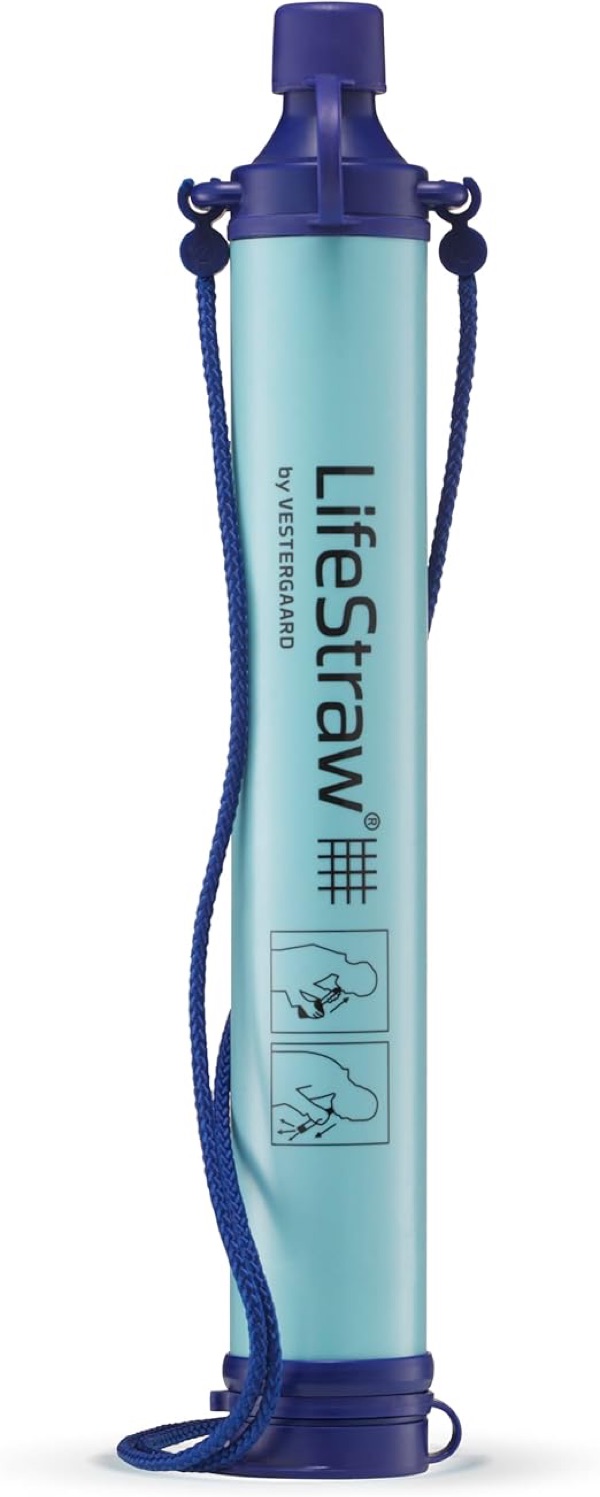
With over 120,000 reviews and a 1,000-gallon capacity, the LifeStraw has become the most recognized personal water filter in the world. It removes 99.999% of bacteria and 99.999% of parasites using hollow fiber membrane technology with no chemicals, batteries, or moving parts.
Best for: Hiking, emergency kits, international travel, and as a lightweight backup filter in any survival loadout
The LifeStraw works by forcing water through a hollow fiber membrane with pores small enough to trap bacteria and protozoa. There are no chemicals to add and no wait time. You dip one end in a water source, suck from the other end, and get clean water immediately. At two ounces, it is essentially weightless in a pack. The limitation that most people discover in the field is that the LifeStraw only works as a straw. You cannot use it to fill a water bottle, hydration bladder, or cooking pot with filtered water (unless you buy the separate bottle adapter). You have to drink directly from the source while crouching over it, which is awkward and limits how much water you can transport. The LifeStraw also does not filter viruses, which matters in regions where waterborne viruses are a concern. For most North American wilderness use, bacteria and protozoa are the primary threats, and the LifeStraw handles those effectively.
14. Sawyer Squeeze Water Filtration System
~$40 on Amazon
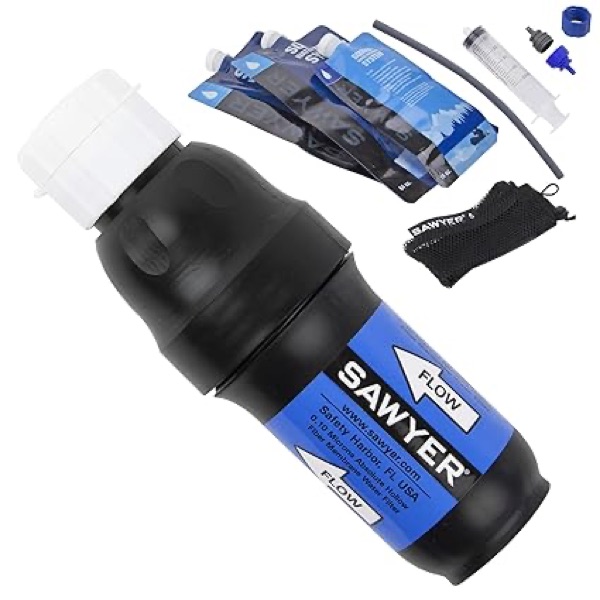
The Sawyer Squeeze is the filter that backpackers, preppers, and humanitarian organizations all converge on. Its 0.1-micron hollow fiber membrane removes 99.99999% of bacteria and 99.9999% of protozoa, and it can be used inline, as a gravity system, or as a squeeze filter.
Best for: Primary water filtration in any survival kit, extended backcountry trips, and multi-person camp use via gravity setup
What makes the Sawyer Squeeze the top recommendation among experienced preppers is its versatility. Screw it onto the included squeeze pouches, attach it inline to a hydration bladder, hang it as a gravity-fed system for camp use, or thread it onto a standard plastic bottle. That flexibility means one filter serves multiple roles across different scenarios. The 0.1-micron membrane is tighter than the LifeStraw's 0.2-micron filter, providing an extra margin of safety. And with a rated capacity of 100,000 gallons (backflushable to maintain flow rate), you will never need to replace the filter element itself. The known weakness is the included squeeze pouches. They develop leaks at the seams after repeated use, especially in cold weather when the plastic becomes brittle. Most experienced users replace them with Evernew or CNOC hydration bladders that use the same thread pattern but are built from more durable materials. Budget an extra $10-15 for aftermarket pouches and consider the Sawyer Squeeze a lifetime filter.
Tools ($20 - $130)
A survival tool needs to do real work. It needs to baton firewood, prepare food, cut cordage, and potentially build shelter. The three tools below cover a range of budgets and philosophies: a robust fixed-blade knife for raw cutting power, a premium survival knife built for hard field use, and a multi-tool that consolidates a dozen functions into one carry.
15. Morakniv Companion Heavy Duty
~$22 on Amazon
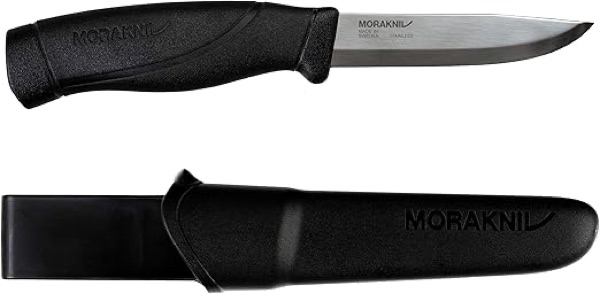
Morakniv has been making knives in Sweden since 1891. The Companion Heavy Duty uses carbon steel with a 3.2mm thick blade spine, giving it enough backbone for light batoning and heavy camp tasks that would snap thinner knives.
Best for: Budget survival kits, car emergency bags, and anyone who needs a capable fixed blade without spending $100+
Dollar for dollar, the Morakniv Companion Heavy Duty may be the best value in fixed-blade knives. The carbon steel blade takes a razor edge with minimal effort and is easy to resharpen in the field with a basic stone. The Scandi grind excels at wood carving and food prep. At 3.2mm thick, the spine handles light batoning, which is the most common heavy-duty task in a survival scenario. The rubber-overmold handle provides a secure grip in wet or cold conditions, and the included plastic sheath snaps securely onto the knife. The trade-off is that carbon steel rusts if you do not maintain it. You will need to dry the blade after use and periodically oil it. The sheath is also basic and lacks a belt loop or MOLLE attachment, though aftermarket leather sheaths are widely available for a few dollars. For a $22 knife that performs above its price class, those are minor compromises.
16. ESEE 4P Fixed Blade
~$115 on Amazon
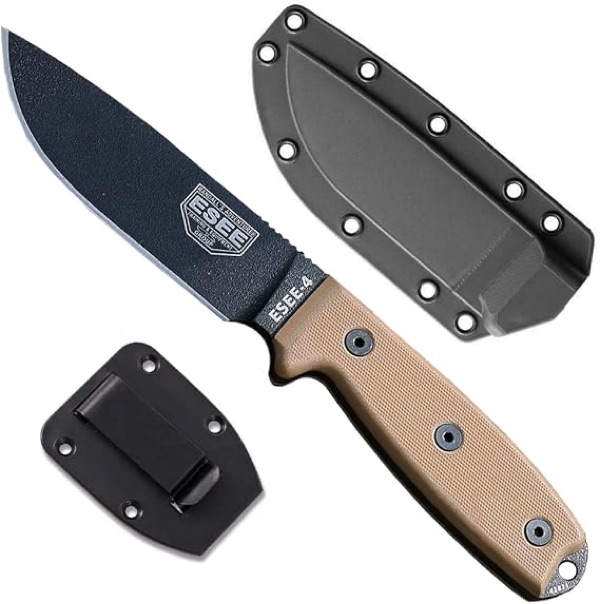
ESEE knives are designed by former military SERE instructors and backed by an unconditional lifetime warranty with no questions asked. The 4P is the company's most popular model, with a 4.5-inch 1095 carbon steel blade designed for hard survival use.
Best for: Primary survival knives for serious kits, wilderness expeditions, and anyone willing to invest in a lifetime tool
ESEE knives come with a warranty that says everything about the company's confidence in its product: if the blade breaks, for any reason, they replace it. No receipt required, no questions asked, no time limit. The 4P uses 1095 high-carbon steel, which is not the hardest or fanciest steel available, but it was chosen deliberately. 1095 is easy to sharpen in the field with a simple stone, holds a working edge through sustained use, and is tough enough to resist chipping during batoning. The full-tang construction means the steel runs the entire length of the handle, providing structural integrity that partial tangs cannot match. ESEE's removable handle scales also let you wrap the tang with paracord for a customized emergency grip. The downside is weight and corrosion. At 8 ounces, the 4P is noticeably heavier than the Morakniv, and 1095 steel requires diligent rust prevention. ESEE applies a powder coating to help, but it wears off with use. Carry oil and wipe the blade down after every use in wet conditions.
17. Leatherman Signal
~$125 on Amazon
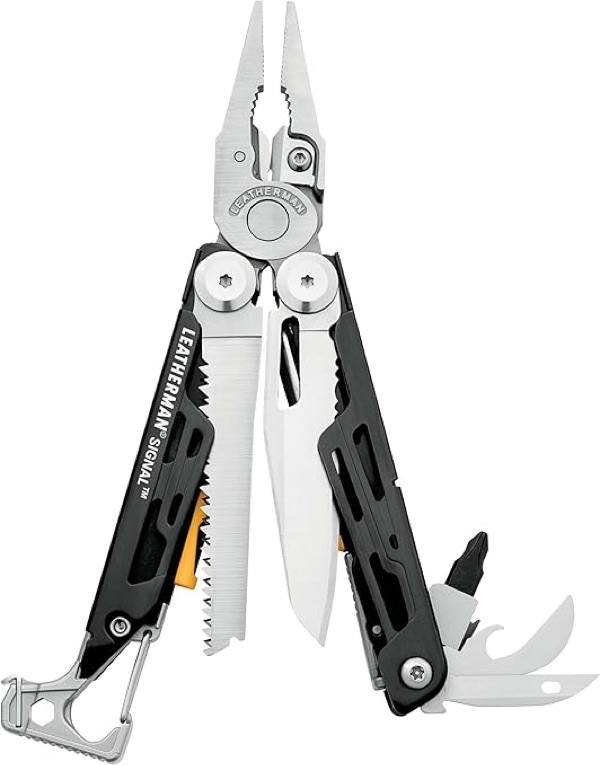
Leatherman built the Signal specifically for outdoor and survival use, setting it apart from their urban-focused multi-tools. It includes 19 tools along with a fire-starting ferro rod, emergency whistle, and diamond-coated sharpener built directly into the frame.
Best for: Survival kits that need multi-tool versatility with built-in fire starting and signaling
Most multi-tools are designed for urban or workshop tasks. The Signal was purpose-built for wilderness survival, which shows in its unique feature set. The removable ferro rod slots into the handle and strikes against the diamond-coated sharpener to throw sparks. The emergency whistle is integrated into the frame and produces a piercing tone that carries over long distances. Standard multi-tool functions include pliers, wire cutters, a saw, a knife blade, a hammer, and various drivers. All tools lock open, which is essential for safety during hard use. The trade-off is that survival-specific features come at the expense of everyday utility tools. The Signal lacks scissors, which the Leatherman Wave includes, and the pliers are not as refined as those on the Surge. The ferro rod is also small and will not produce the same volume of sparks as a dedicated rod like the Uberleben Zunden above. If your kit already has a standalone ferro rod and knife, the Leatherman Wave or Surge might serve you better. If you want one tool that consolidates fire, signal, and cutting into a single carry, the Signal earns its name.
Communication ($30 - $55)
When the grid goes down, your phone becomes an expensive paperweight. Emergency radios provide access to NOAA weather alerts, AM/FM news broadcasts, and in some cases SOS beacon capabilities. The two options below are the most recommended emergency radios on the market, both featuring multiple power sources so they keep working regardless of battery availability.
18. FosPower Emergency Weather Radio
~$35 on Amazon
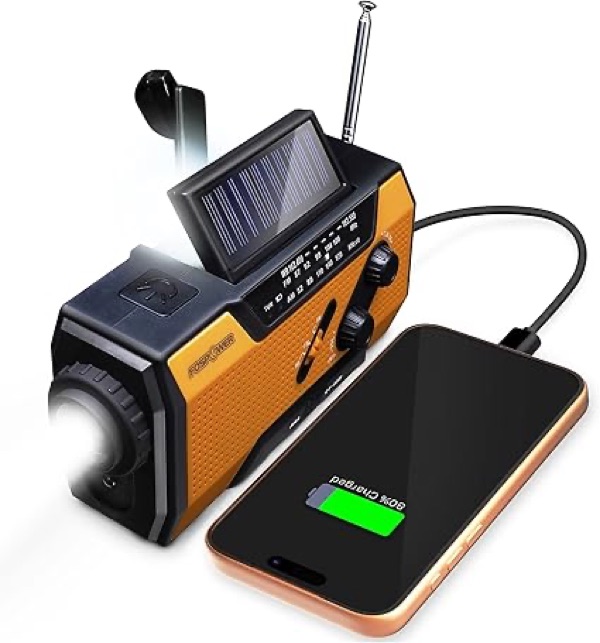
Over 37,000 Amazon reviews and a 4.5-star average have made the FosPower one of the most popular emergency radios sold online. It receives NOAA, AM, and FM stations and charges via hand crank, solar panel, USB, or AAA batteries.
Best for: Home emergency kits, vehicle kits, and budget-conscious preppers who want reliable weather radio access
Four power sources mean this radio will work no matter what. The hand crank generates enough power for basic radio reception after about a minute of cranking, the solar panel trickle-charges in direct sunlight, USB charges the internal battery to full, and AAA batteries serve as a backup. It also doubles as a phone charger in a pinch, though the small internal battery means you will get a partial charge at best. The built-in LED flashlight and SOS beacon add utility without adding weight. Where the FosPower falls short is build quality. The plastic housing feels lightweight and would not survive a hard drop onto concrete. The hand crank mechanism can develop a grinding feel after extended use, and the speaker is tinny at higher volumes. For the price, these trade-offs are expected. Keep it in a protective pouch inside your kit and it will perform its core job reliably for years.
19. Midland ER310 E+READY Emergency Radio
~$50 on Amazon
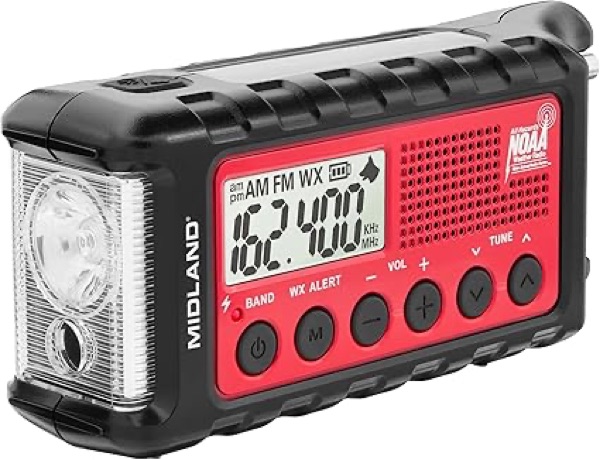
Midland has manufactured two-way radios and weather radios for over 60 years. The ER310 receives all 7 NOAA weather channels with Specific Area Message Encoding (S.A.M.E.) alerts, and it charges via hand crank, solar panel, USB, or 6 AA batteries.
Best for: Anyone who wants the best-in-class emergency radio with location-specific NOAA alerts and a 2,600 mAh battery
The ER310's standout feature is S.A.M.E. (Specific Area Message Encoding), which filters NOAA alerts to only your county. Without S.A.M.E., weather radios broadcast every alert for your entire region, including counties hours away from you. With it, you only hear warnings that affect your specific location. The 2,600 mAh rechargeable battery is significantly larger than what most emergency radios carry, which translates to longer radio runtime between charges and a more useful phone-charging capability. The Cree LED flashlight is bright enough for actual navigation, not just tent use. Build quality is a clear step above the FosPower, with a rubberized housing that handles drops and weather exposure. The trade-off is size and weight. The ER310 is noticeably bulkier than the FosPower and heavier in a pack. For a home kit or vehicle kit where weight does not matter, the ER310 is the better radio. For an ultralight bug-out bag, the FosPower saves ounces.
Bonus Picks
These four products did not fit neatly into the categories above but are worth serious consideration for any survival loadout. A proper compass, a pocket-sized survival kit, a vehicle emergency kit, and an alternative water purification option each fill a specific gap that the main picks leave open.
20. Suunto MC-2 Mirror Compass
~$65 on Amazon
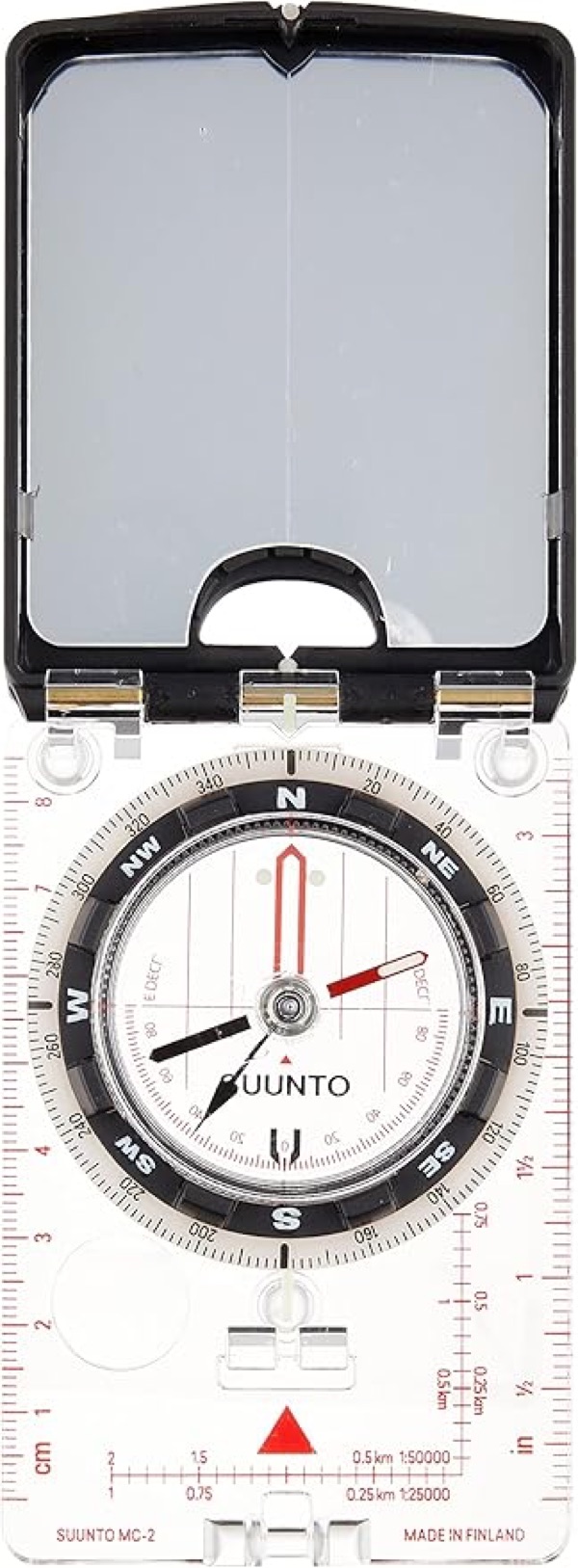
When your GPS dies and your phone is dead, a quality compass becomes your primary navigation tool. The Suunto MC-2 is a professional-grade sighting compass with a mirror lid, declination adjustment, clinometer, and luminous bezel for night navigation.
Best for: Serious survival kits, backcountry navigation, and anyone who wants a compass they can actually navigate with
The MC-2 is not a toy compass or a decorative lensatic. It is a proper navigation instrument used by search-and-rescue teams and backcountry professionals. The mirror lid serves two purposes: it allows precision sighting on distant landmarks for accurate bearings, and it doubles as a signaling mirror in emergencies. Tool-free declination adjustment lets you set the difference between true north and magnetic north for your region, which eliminates a common source of navigation error. The clinometer measures slope angles, useful for avalanche assessment and terrain analysis. The needle settles quickly and reads accurately even in challenging magnetic environments. The weakness is learning curve. A compass this capable requires actual navigation skills to use effectively. If you cannot read a topographic map or plot a bearing, the MC-2's advanced features are wasted. Pair this purchase with a land navigation course, and it becomes one of the most reliable tools in your kit.
21. ESEE Mini Survival Kit (Izula Gear)
~$35 on Amazon
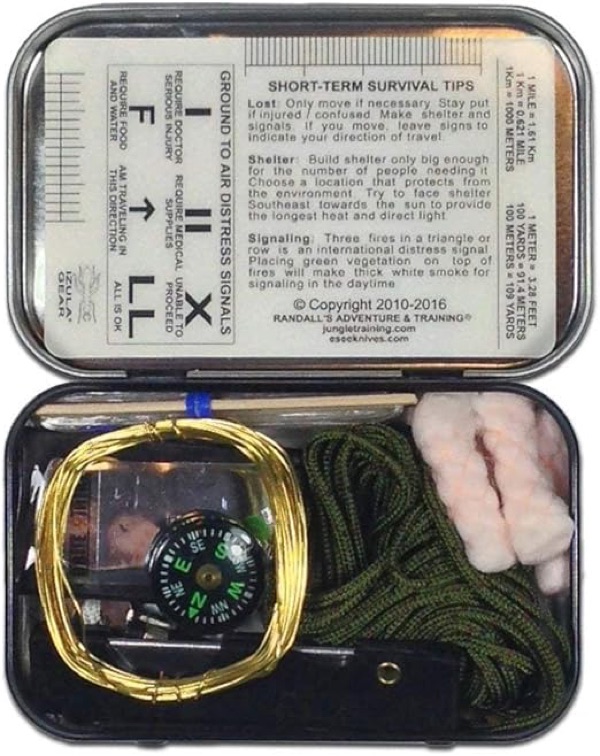
ESEE packed survival essentials into an Altoids-sized tin that slips into a cargo pocket. Inside you get a small ferro rod, fishing kit, signal mirror, snare wire, Kevlar cord, water purification tablets, a compass, and other micro-tools curated by SERE instructors.
Best for: Pocket-sized emergency backup, EDC survival layer, and anyone who wants SERE-designed kit selection in a tiny package
This kit was designed by people who have actually survived in the field, and it shows in the item selection. Every piece serves a direct survival function: fire, water, food procurement, signaling, and navigation. The tin itself can be used as a container for boiling small amounts of water or charring cloth for fire starting. ESEE chose items that maximize capability per gram, which is the right philosophy for a last-ditch pocket kit. The limitation is that every item is miniaturized. The ferro rod is small and harder to grip than a full-sized rod. The compass is a button type that gives general direction but not precision bearings. The fishing kit assumes you have the skill to use it. None of these items are replacements for their full-sized counterparts, but as a backup layer that lives in your pocket when everything else is lost, the ESEE kit is one of the most thoughtfully assembled options available.
22. WEYLAND Outdoor Emergency Survival Kit
~$27 on Amazon
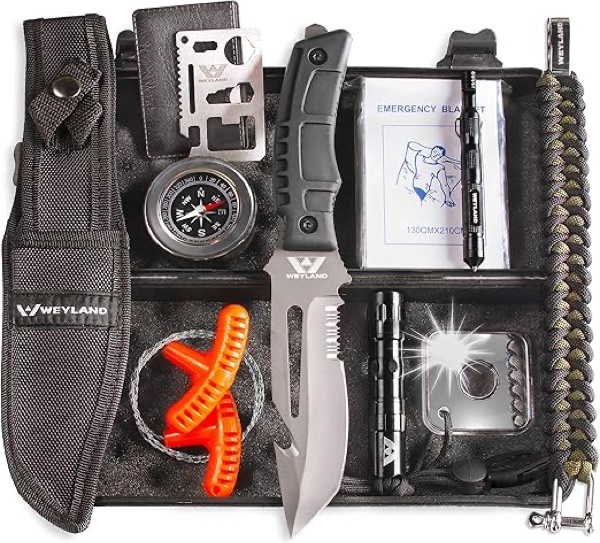
WEYLAND's kit fills a practical niche as a vehicle emergency bag. It includes a flashlight, fire starter, first aid basics, an emergency blanket, whistle, compass, wire saw, and a compact carrying case that fits in a glove box or under a seat.
Best for: Vehicle emergency kits, glovebox preparedness, and supplementing a larger home kit with a portable grab bag
Not every emergency kit needs to be a full 72-hour bug-out bag. The WEYLAND kit targets a different scenario: you are stuck on the side of a highway, lost on a day hike that went wrong, or dealing with a power outage at home. The compact case holds enough basics to manage a short-term emergency, and the price point makes it easy to stock multiples in different vehicles or locations. The included items work for their intended purpose, though none would win a quality comparison against standalone counterparts. The wire saw cuts slowly. The compass points north but lacks precision features. The flashlight runs on disposable batteries. At $27, you get functionality across multiple survival categories in a package that actually stays in your car because it is small enough to forget about until you need it. The weakness is exactly what you would expect: every component is entry-level. This is a stopgap kit, not a primary survival loadout.
23. Potable Aqua Chlorine Dioxide Tablets
~$13 on Amazon
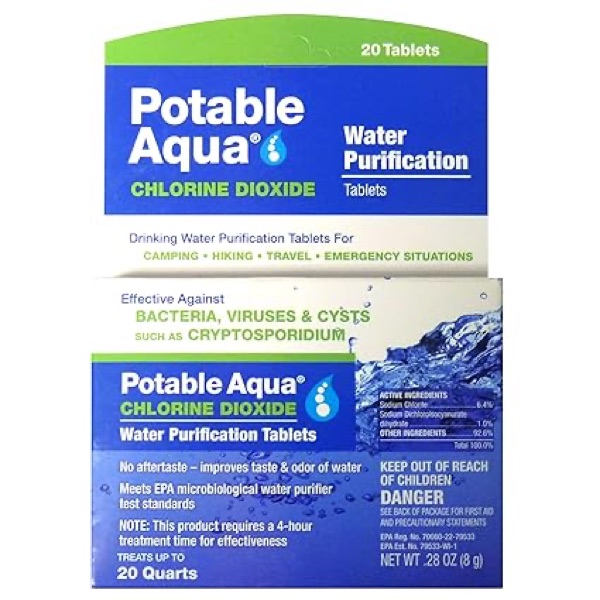
An alternative to iodine-based purification, these chlorine dioxide tablets kill bacteria, viruses, Giardia, and Cryptosporidium without the iodine taste. They are safe for long-term use and suitable for people with iodine sensitivities or thyroid conditions.
Best for: People who cannot use iodine, long-term emergency water treatment, and kits where taste matters
Chlorine dioxide works differently from iodine. It oxidizes pathogens rather than poisoning them, which makes it effective against Cryptosporidium, a parasite that iodine cannot reliably kill. The treated water has minimal taste impact compared to iodine tablets, which matters more than you might think when you are trying to stay hydrated over multiple days. These tablets are also safe for pregnant women and people with thyroid conditions, which eliminates the medical restrictions that come with iodine. The downside is treatment time. Chlorine dioxide tablets require a four-hour wait for full Cryptosporidium kill, compared to 30 minutes for iodine against bacteria. In cold water, that wait time can extend even further. For situations where Crypto is not a concern, the standard Potable Aqua iodine tablets above are faster. Carry both types for maximum flexibility, and default to the ClO2 tablets when time is not critical.
Building Your Emergency Kit by Tier
You do not need to spend $500 on day one. Build your kit in tiers based on budget, starting with the essentials and adding capability over time. Each tier below assumes you already own the items from the previous tier.
Tier 1: Budget Foundation ($100)
Start with the basics that cover the most likely emergencies: a power outage, a natural disaster evacuation, or a vehicle breakdown in a remote area.
- Potable Aqua Tablets with PA Plus ($13) - Backup water purification
- LifeStraw Personal Filter ($18) - Primary water filtration
- Uberleben Zunden Ferro Rod ($18) - Reliable fire starting
- Go Time Gear Life Bivy ($19) - Emergency shelter
- Morakniv Companion Heavy Duty ($22) - Fixed-blade knife
- NAR C-A-T Gen 7 Tourniquet ($32) - Life-saving trauma gear
Total: approximately $122. This covers water, fire, shelter, cutting tools, and the single most important piece of trauma gear. Everything fits in a gallon zip-lock bag except the knife.
Tier 2: Mid-Range Kit ($250)
Add communication, better filtration, and a proper first aid capability on top of the Tier 1 foundation.
- All Tier 1 items ($122)
- NAR HyFin Vent Chest Seal ($16) - Completes your trauma gear
- FosPower Emergency Radio ($35) - NOAA weather alerts and phone charging
- EVERLIT Survival First Aid Kit ($38) - Comprehensive first aid
- Sawyer Squeeze System ($40) - Upgrades your water filtration
Total: approximately $251. You now have a complete communications layer, redundant water filtration, and trauma care capability that covers hemorrhage, chest injuries, and standard first aid.
Tier 3: Premium Preparedness ($500)
Round out the kit with premium tools, professional-grade navigation, and a comprehensive survival tin for pocket carry.
- All Tier 1 and Tier 2 items ($251)
- ESEE Mini Survival Kit ($35) - Pocket-sized backup
- Midland ER310 ($50) - Upgrades to S.A.M.E. weather alerts
- Suunto MC-2 Compass ($65) - Professional navigation
- NAR IPOK ($65) - Military-grade trauma kit
- ESEE 4P Fixed Blade ($115) - Primary survival knife
Total: approximately $581. At this level, you have professional-grade gear across every survival category with built-in redundancy. The Morakniv becomes your backup knife, the LifeStraw backs up the Sawyer Squeeze, and you carry both a FosPower and Midland radio.
Counterfeit Warning: Fake Tourniquets and Medical Gear
This section exists because people could die from counterfeit medical gear, and the problem is worse than most buyers realize.
The NAR C-A-T tourniquet is the most counterfeited piece of tactical medical equipment on the market. Fake C-A-Ts are sold on Amazon, eBay, and dozens of third-party websites at prices that undercut genuine units by $5 to $15. They look nearly identical to the real thing in photos and even in person. The differences only show up when the windlass snaps under tension, the strap fails to hold compression, or the Velcro gives out when a life depends on it.
Here is how to protect yourself:
- Buy from NAR's authorized Amazon storefront or directly from North American Rescue's website. Verify the seller name before adding to cart.
- Check the price. A genuine C-A-T Gen 7 retails for $30 to $35. If you see one for $15 to $20, it is almost certainly counterfeit.
- Inspect the packaging. Genuine C-A-Ts come in sealed packaging with lot numbers and expiration dates. Counterfeits often ship in generic plastic bags.
- Look for the holographic label. Recent genuine C-A-Ts include a holographic authentication label on the packaging.
- Test the windlass. On a genuine C-A-T, the windlass rod is thick, rigid metal. Counterfeits often use thinner material that flexes under load.
The same counterfeit risk applies to chest seals, Israeli bandages, and hemostatic gauze. If a medical product seems unusually cheap, verify the seller's authorization before trusting your life to it.
Frequently Asked Questions
What should be in a basic 72-hour emergency kit?
A 72-hour kit should cover five priorities: water (filter plus purification tablets), food (calorie-dense bars with long shelf life), shelter (emergency bivvy or space blanket), fire (ferro rod plus backup lighter), and first aid (tourniquet, bandages, and basic wound care). Add a flashlight, emergency radio, and a fixed-blade knife, and you have a solid foundation. FEMA recommends one gallon of water per person per day, so for a 72-hour kit you need three gallons or a reliable way to filter and purify water from natural sources.
How often should I replace survival kit supplies?
Check your kit every six months. Replace water purification tablets according to their expiration date, which is typically four to five years from manufacture. Food bars and rations usually have a five-year shelf life. Batteries in flashlights and radios should be swapped annually or replaced with lithium cells that hold charge longer. Medical supplies like tourniquets and chest seals do not expire in the traditional sense, but check for UV degradation, worn elastic, or compromised packaging. Rotate any medications every 12 months.
Is a LifeStraw or Sawyer Squeeze better for survival?
The Sawyer Squeeze is the more capable filter. It has a tighter 0.1-micron membrane versus the LifeStraw's 0.2 microns, a rated capacity of 100,000 gallons versus 1,000, and it works in multiple configurations including inline, gravity-fed, and squeeze. The LifeStraw's advantage is simplicity and weight: it weighs 2 ounces, has no parts to assemble, and works immediately. For a primary survival filter, the Sawyer Squeeze is the better choice. The LifeStraw makes an excellent lightweight backup.
Do I really need a tourniquet in my emergency kit?
Yes. Severe extremity hemorrhage from car accidents, power tool injuries, falls, and natural disasters is the leading cause of preventable death in civilian trauma. A properly applied tourniquet can stop life-threatening bleeding in seconds. The NAR C-A-T Gen 7 can be self-applied with one hand, which matters when you are the person who is injured. Pair it with training from a Stop the Bleed course, which is free and available nationwide.
What is the difference between a survival kit and a bug-out bag?
A survival kit contains the tools and supplies to sustain life in an emergency, typically for 72 hours. A bug-out bag (BOB) is a specific type of survival kit designed for rapid evacuation. It is pre-packed in a backpack and ready to grab at a moment's notice. The contents overlap significantly, but a bug-out bag also includes documents (copies of IDs, insurance papers), cash, a change of clothes, and navigation tools. A survival kit might live in your car trunk or closet in a bin. A bug-out bag lives by the door.
Are pre-built survival kits worth the money?
Pre-built kits like the EVERLIT Storm II provide good value for people who want a quick start without researching individual components. The trade-off is that you pay a convenience premium, and some included items will be lower quality than what you would select yourself. The best approach is to buy a pre-built kit for the foundation, then gradually replace weaker components with better standalone items. A $100 pre-built kit supplemented with $50 in targeted upgrades often outperforms a $200 kit built entirely from scratch by a first-timer.
How do I store an emergency kit long-term?
Store your kit in a cool, dry location away from direct sunlight. Extreme heat degrades food rations, batteries, and medical adhesives. A hall closet, basement shelf, or the trunk of your car all work, but vehicle storage in hot climates accelerates expiration on perishable items. Use a waterproof bag or dry sack for the contents if your storage location is prone to moisture. Label the outside of the kit with the date you last inspected and rotated supplies so you never have to guess when it was last checked.
Can water purification tablets replace a water filter?
Tablets and filters address different threats. Purification tablets kill bacteria, viruses, and most parasites through chemical treatment, but they do not remove sediment, chemicals, or heavy metals. Filters physically remove bacteria and protozoa by forcing water through microscopic pores, but most backpacking filters do not eliminate viruses. The best approach is to carry both. Use the filter as your primary method for clear water sources, and keep tablets as a backup for situations where your filter breaks, clogs, or freezes. In areas where waterborne viruses are a concern, tablets are the more reliable option.
Building a survival kit is not about buying the most expensive gear or filling the biggest backpack. It is about covering the fundamentals, water, fire, shelter, medical, tools, and communication, with reliable products that you have practiced using before you need them. Start with our tier-based build guide above and expand from there.
If you are also looking for a tactical backpack to carry your kit, check out our guide to the best tactical backpacks and EDC gear. And if you are shopping for someone who takes preparedness seriously, our Father's Day gifts for military enthusiasts guide includes several items that complement any survival loadout.