Skip to content
April 23:The Zeebrugge Raid108yr ago

How the C-17 Globemaster Flies an M1 Abrams Across an Ocean and Lands on a Dirt Runway

James Holloway · · 10 min read
Save
Share:
C-17 Globemaster III in flight during a sortie mission showing its massive wingspan and four turbofan engines
James Holloway
James Holloway

Military Logistics & Sustainment Analyst

James Holloway writes about military readiness, logistics, and the practical limits of modern forces. His work focuses on how training, sustainment, and organizational decisions shape what militaries can actually do -- not just what they are designed to do on paper.

A C-17 Globemaster III can carry a 70-ton tank, fly it 2,400 miles, and land on a dirt road. Nothing else can do all three. The aircraft that made this possible was Boeing's answer to a problem the Air Force had struggled with since Vietnam: how do you deliver the heaviest equipment in the American inventory directly to a forward airstrip that no heavy transport was ever designed to reach? The C-17 solved that problem so completely that nothing built since has come close to matching it, and now that the production line is closed, nothing likely will.

The Problem the C-17 Was Built to Solve

Before the C-17, strategic airlift meant a two-step process. The C-5 Galaxy could carry anything, including tanks, helicopters, and bridge sections, but it needed a 6,000-foot paved runway to land. That meant flying cargo to a major airbase, then transferring it to smaller C-130 Hercules aircraft for the last leg to forward strips. The C-130, however, could not carry a main battle tank. The transfer process added days to delivery timelines and required airfield infrastructure that did not always exist in theater.

The Air Force wanted a single aircraft that could carry the C-5's payload and land on the C-130's runways. The requirement seemed contradictory. Heavy payloads demand large wings and powerful engines. Short-field landings demand precise low-speed handling and robust landing gear that can absorb the punishment of unpaved surfaces. Boeing's design team at Long Beach, California, spent the better part of the 1980s proving that both requirements could live in the same airframe.
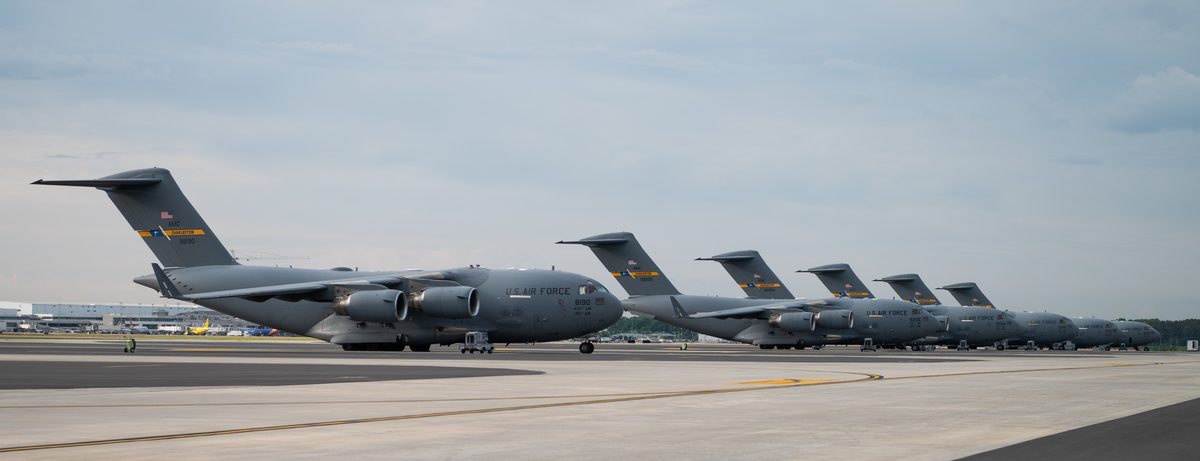
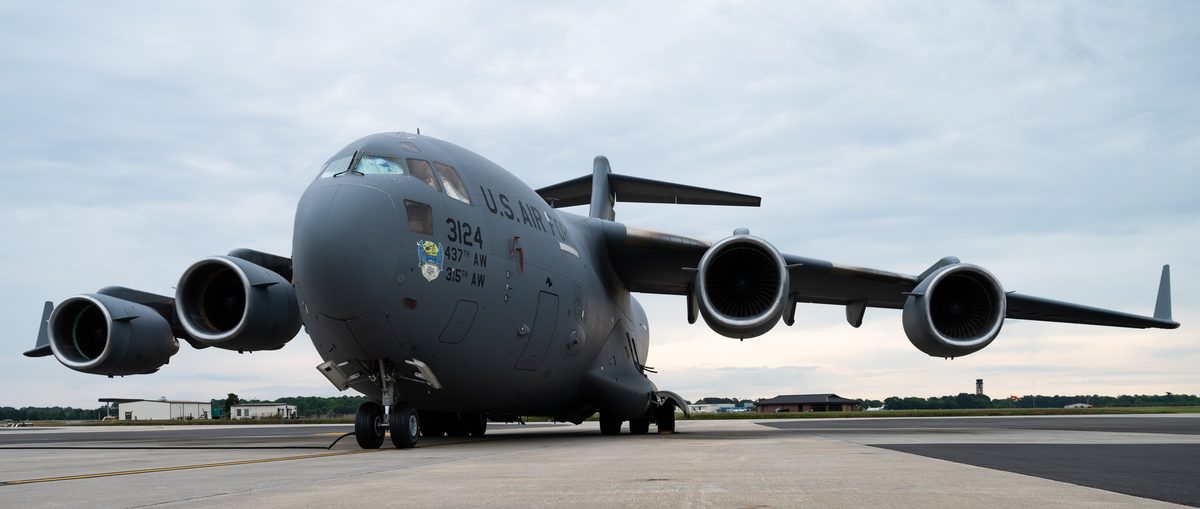
C-17 Globemaster III on the flightline at Joint Base Charleston showing its massive cargo bay and rear loading ramp
A C-17 Globemaster III on the flightline at Joint Base Charleston, South Carolina. The aircraft's massive cargo hold can accommodate a single M1 Abrams tank or three Stryker armored vehicles. (U.S. Air Force photo)

170,900 Pounds of Anything, Anywhere

The C-17's maximum payload is 170,900 pounds, roughly 85 tons. That figure is not theoretical. Loadmasters routinely configure the 88-foot cargo hold for a single M1A2 Abrams main battle tank (approximately 68 tons combat-loaded), or three Stryker infantry carrier vehicles, or a combination of vehicles and palletized cargo. The cargo floor sits just 46 inches above the ground, low enough for vehicles to drive straight up the rear ramp under their own power. Eighteen pallet positions can hold standard 463L military cargo pallets, or the entire floor can be cleared for oversized items.

The aircraft's range with a full combat load is 2,400 nautical miles, roughly the distance from Ramstein Air Base in Germany to any point in the Middle East. With aerial refueling, range becomes effectively unlimited. During Operation Iraqi Freedom, C-17s flew nonstop from the continental United States to forward operating bases in Iraq, refueling in flight and delivering tanks and armored vehicles within 24 hours of the order to deploy.

The Externally Blown Flap: The Engineering That Makes It Possible

The C-17's defining engineering achievement is its externally blown flap system, a technology that makes a 585,000-pound aircraft behave like a bush plane during landing. Four Pratt & Whitney F117-PW-100 turbofan engines, the same core as the commercial PW2040 used on the Boeing 757, produce 40,440 pounds of thrust each. The two inboard engines are positioned so their exhaust blows directly across the top surface of the extended flaps. When the flaps deploy to their maximum setting, the engine exhaust energizes the airflow over the wing's upper surface, producing enormous amounts of additional lift at low speeds.

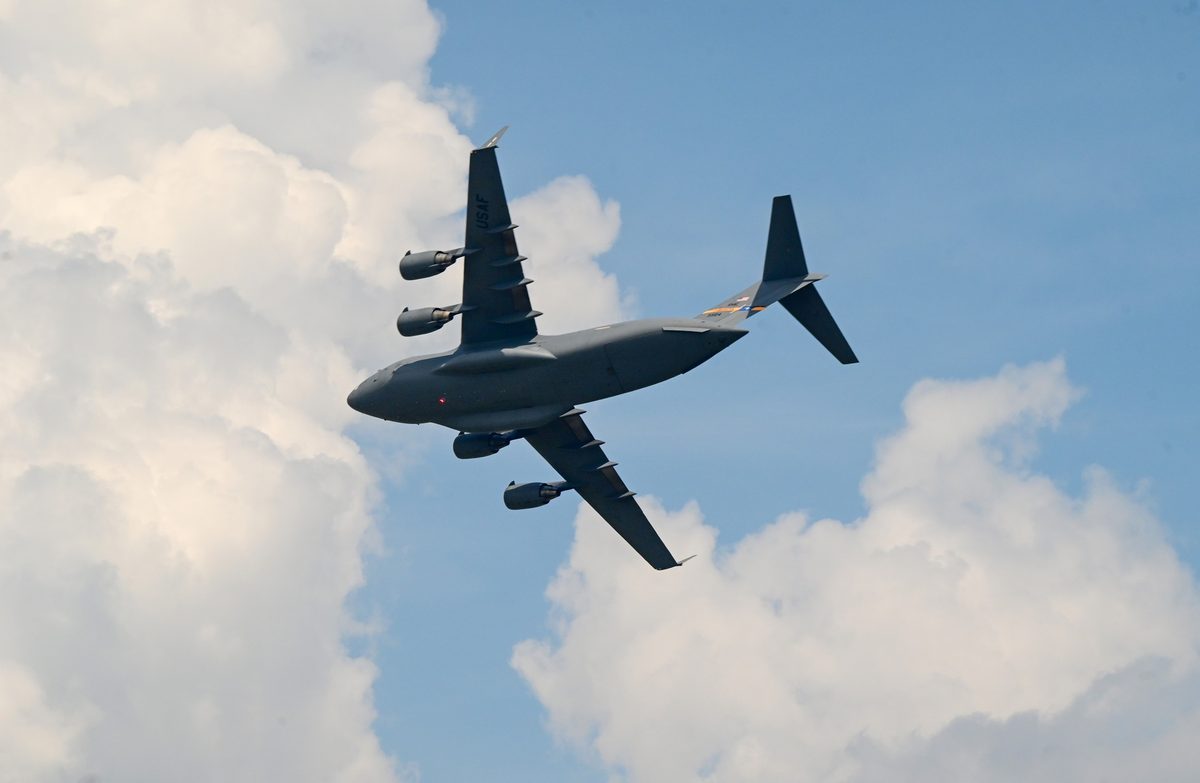
C-17 Globemaster III performing a steep approach demonstration at an airshow showing its short-field landing capability
A C-17 demonstrates its steep-approach capability at the 2024 Charleston Airshow. The externally blown flap system allows the aircraft to maintain stable flight at approach speeds that would stall a conventional transport. (U.S. Air Force photo)

This system allows the C-17 to fly stable approach profiles at speeds as low as 115 knots, roughly 130 mph, with a descent angle steep enough to clear obstacles on the approach path to short, austere runways. The result: a fully loaded C-17 can land on a paved runway as short as 3,500 feet, or on an unpaved surface (packed dirt, gravel, even grass) as short as 3,000 feet. For context, most regional airports in the United States have runways between 5,000 and 7,000 feet. The C-17 can operate from strips that would challenge a regional turboprop.

Landing on Dirt, and Backing Up

The C-17's landing gear was designed from the outset for unpaved surfaces. The main gear consists of six wheels per side in a tandem configuration that spreads the aircraft's weight across a larger footprint, reducing ground pressure to levels that packed earth and gravel can support. The nose gear is steerable through a wide arc, and the entire aircraft can perform a three-point turn on a 90-foot-wide runway, a maneuver that would be physically impossible for the C-5 Galaxy.

Most remarkably, the C-17 can reverse under its own power. The engines' thrust reversers allow the aircraft to back up on the ground, a capability that eliminates the need for a ground tug or turnaround pad at austere airfields. A C-17 can land on a short dirt strip, lower its ramp, offload an Abrams tank, back up, turn around, and take off, all without external ground support equipment. No other strategic airlifter in the world can do this.

102 Paratroopers or One Main Battle Tank

The C-17's versatility extends well beyond heavy armor. In its troop transport configuration, the aircraft can carry 102 paratroopers with full combat equipment and drop them through the two paratroop doors or from the rear ramp. In an aeromedical evacuation role, the cargo hold accommodates 36 litter patients and their medical attendants. In a humanitarian relief configuration, the aircraft can deliver more than 170,000 pounds of food, water, and medical supplies to disaster zones with minimal ground infrastructure.

C-17 Globemaster III cargo aircraft on the flightline ready for a strategic airlift mission
A C-17 Globemaster III prepares for a cargo mission. The aircraft's ability to switch between heavy equipment transport, paratroop delivery, and humanitarian relief makes it the most versatile strategic airlifter ever built. (U.S. Air Force photo)

The aircraft can also perform aerial delivery of heavy equipment. Using the Low-Altitude Parachute Extraction System (LAPES) or gravity-drop methods, a C-17 can air-drop pallets weighing up to 60,000 pounds (entire vehicle sets, artillery pieces, and pre-configured supply packages) to forces on the ground without landing. During the opening hours of Operation Iraqi Freedom in 2003, C-17s air-dropped nearly 1,000 paratroopers of the 173rd Airborne Brigade directly into northern Iraq, along with their vehicles and heavy equipment, opening a second front in a single night.

275 Built, None to Follow

Boeing delivered the last of 275 C-17 Globemaster IIIs in September 2015, closing the Long Beach production line after 24 years. The Air Force operates 222 aircraft, with the remainder serving the air forces of the United Kingdom, Australia, Canada, India, Qatar, Kuwait, and the United Arab Emirates, as well as the multinational Heavy Airlift Wing based in Hungary.

No replacement program exists. The Air Force has studied next-generation airlift concepts, but no aircraft in development combines the C-17's payload capacity, short-field performance, and austere-environment capability. The service life of existing C-17s is expected to extend into the 2040s and beyond, sustained by structural maintenance programs and avionics upgrades.

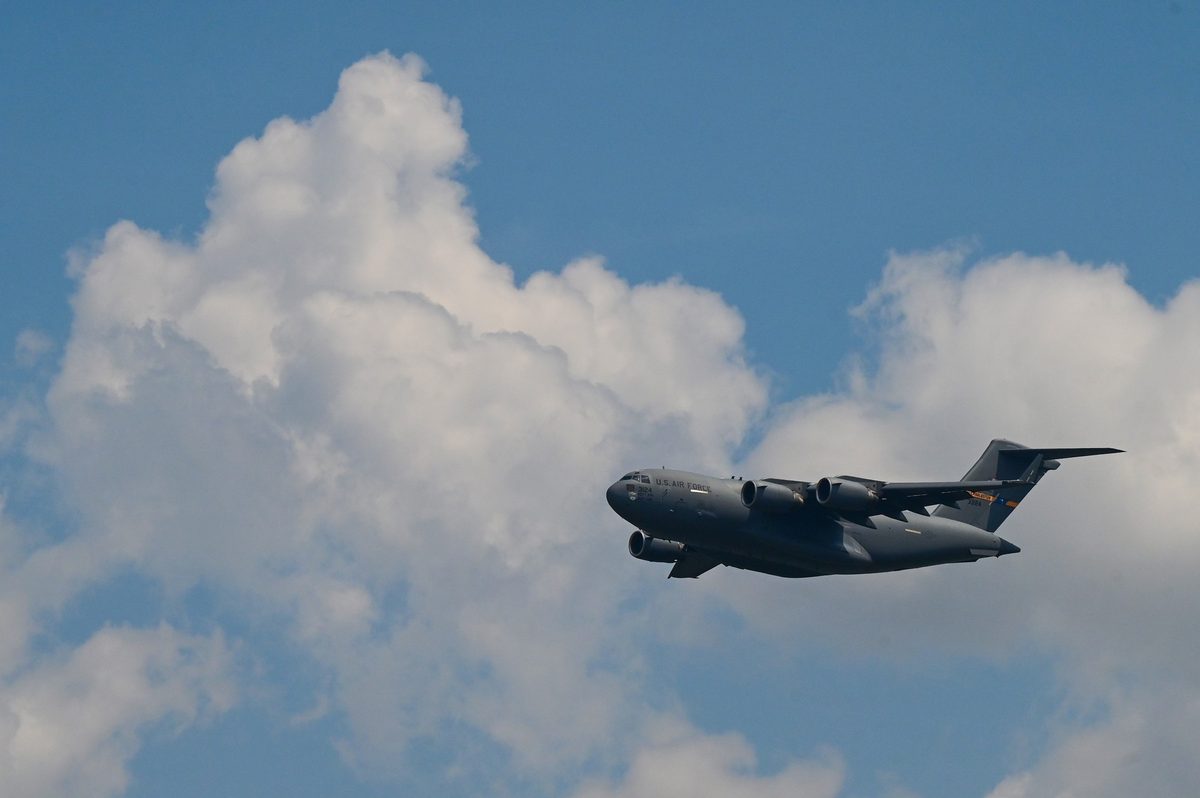
C-17 Globemaster III during a demonstration flight showing the aircraft's massive size and four-engine configuration
A C-17 Globemaster III during an aerial demonstration. With the Long Beach production line closed since 2015, the 275 aircraft delivered represent the entire fleet that will ever exist. (U.S. Air Force photo)

Why It Remains Irreplaceable

The C-17's value is not just in what it carries but in where it delivers. In a conflict scenario involving the Indo-Pacific, where potential adversaries could target major air bases with ballistic missiles, the ability to disperse forces to small, improvised airstrips becomes a survival requirement. Only the C-17 can deliver a main battle tank to a 3,500-foot coral runway on a Pacific atoll, or to a hastily prepared strip carved from jungle. The C-5M Super Galaxy carries more weight but needs a major runway. The C-130J Hercules lands anywhere but cannot carry heavy armor.

The C-17 occupies the only space where strategic payload meets tactical flexibility. Every operational plan the Air Force writes for contested logistics, from the European theater to the Western Pacific, depends on it. When defense planners describe the C-17 as irreplaceable, they mean it literally. No other aircraft in production or development can do what the Globemaster does, and no program to build one has been funded.

The C-17 Globemaster III was designed to solve a logistics problem that seemed impossible: moving the heaviest combat equipment to the most inaccessible places. It solved that problem so thoroughly that the Air Force has spent the decade since production ended trying to figure out what it will do when the last one can no longer fly. They have not found an answer.

Share this article

Share:

Recommended

Ace of The Skies: Can You Identify These Military Aircraft Throughout The Years?
Test Yourself

Ace of The Skies: Can You Identify These Military Aircraft Throughout The Years?

Can you identify these aircraft?

Take the Quiz

On This Day in Military History

April 23

The Zeebrugge Raid (1918)

On St. George's Day, the Royal Navy launched a daring raid on the German-held Belgian port of Zeebrugge, attempting to block the canal entrance used by German U-boats. HMS Vindictive stormed the harbor mole while blockships were scuttled in the canal. Eight Victoria Crosses were awarded for the action.

1951, Battle of the Imjin River

See all 4 events on April 23

Get Military News & History in Your Inbox

Join thousands of readers receiving our weekly digest of military technology, history, and analysis.

Test Your Knowledge