Skip to content
April 23:The Zeebrugge Raid108yr ago

The Phalanx CIWS Fires 75 Rounds Per Second as the Last Line of Defense. Here's What Happens When It Misses.

Nathan Cole · · 10 min read
Save
Share:
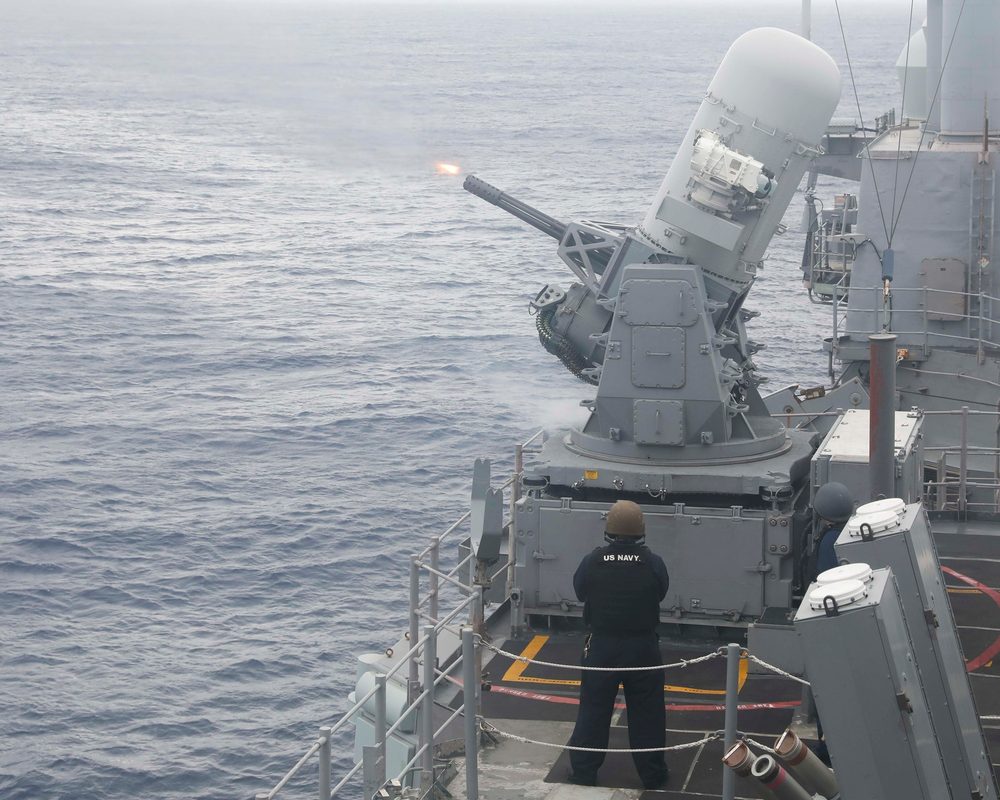
Phalanx CIWS close-in weapon system firing during a live-fire exercise aboard a U.S. Navy destroyer with smoke rising from the barrel
Nathan Cole
Nathan Cole

Naval Warfare & Maritime Systems Analyst

Nathan Cole covers naval warfare, maritime strategy, and the ships and submarines that project power across the world's oceans. His work focuses on fleet architecture, carrier operations, and how navies adapt to threats from missiles, drones, and undersea warfare.

By the time the Phalanx fires, everything else has already failed. The Standard Missiles did not intercept the incoming threat at 100 miles. The Evolved Sea Sparrow did not kill it at 30 miles. Electronic countermeasures did not deceive it. Chaff and decoys did not divert it. The last thing standing between an anti-ship missile and the hull of a warship is a white dome the sailors call "R2-D2", a radar-guided 20mm Gatling gun that fires 75 rounds per second in a fully autonomous engagement that begins and ends in roughly two seconds. If the Phalanx misses, the missile hits the ship.

How the System Works

The Phalanx Close-In Weapon System (CIWS), designated Mk 15, consists of a single M61A1 Vulcan six-barrel rotary cannon mounted atop a swiveling base that contains its own search radar, tracking radar, and fire control computer. The entire system is self-contained: it finds targets, tracks them, computes a firing solution, aims, and fires without any input from the ship's combat information center. The Navy designed it this way because the engagement window against a sea-skimming anti-ship missile is measured in seconds, not minutes, and no human operator can react fast enough.
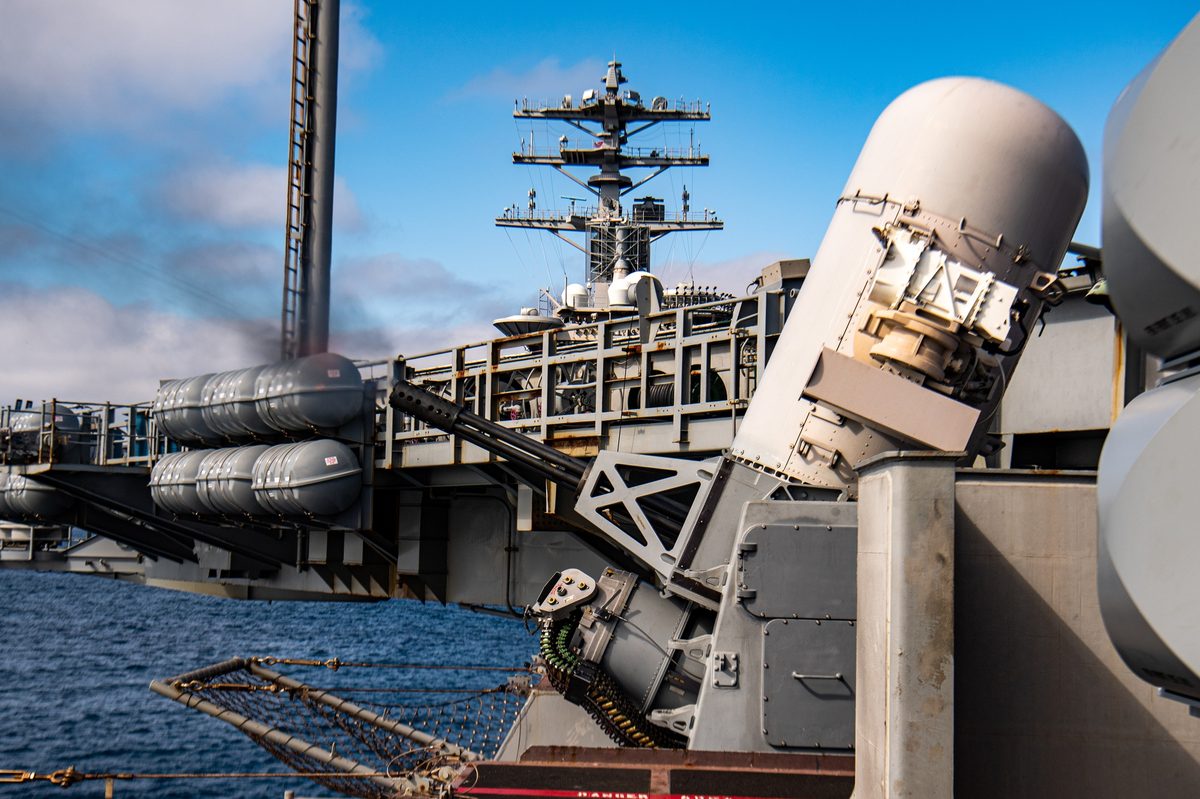
Close-up view of a Phalanx CIWS system showing the white radome and six-barrel Gatling gun
A close-up view of the Phalanx CIWS. The white radome houses both the search and tracking radars, while the M61A1 Vulcan cannon protrudes from the base. (U.S. Navy photo)

The system's Ku-band search radar constantly scans the horizon for incoming threats. When it detects an object approaching the ship at missile-like speed, it hands off the track to the tracking radar, which locks onto the target and measures its speed, altitude, and bearing with extreme precision. The fire control computer calculates an intercept point, the exact spot in space where the stream of 20mm rounds will intersect the missile's flight path, and begins firing.

The M61A1 fires 20mm tungsten armor-piercing discarding sabot (APDS) rounds at 4,500 rounds per minute, 75 per second. At that rate, the gun empties its 1,550-round magazine in approximately 20 seconds of continuous fire. But a typical engagement lasts only 2 to 3 seconds. The system fires a burst, observes where the rounds pass relative to the target using the tracking radar, adjusts its aim, and fires again. This closed-loop feedback process is what distinguishes Phalanx from a simple point-defense gun: it literally watches its own bullets in flight and corrects its aim in real time.

The Engagement Timeline

A modern anti-ship missile like the Harpoon or Exocet approaches its target at roughly 500 to 600 miles per hour, flying 10 to 15 feet above the wave tops. From the moment the Phalanx search radar first detects the missile to the moment it either destroys or misses the target, the entire engagement takes approximately 6 to 8 seconds. The system must detect, track, compute a firing solution, aim, fire, observe, adjust, and fire again, all within that window.

Against supersonic anti-ship missiles, such as the Russian Oniks (Mach 2+) or the BrahMos (Mach 2.8), the engagement window shrinks to roughly 3 to 4 seconds. Against hypersonic anti-ship weapons, the timeline may be less than 2 seconds, which pushes the system to its physical limits. The gun traverse rate, radar update rate, and projectile flight time all impose hard constraints that cannot be overcome by software alone.

Block 1B: Seeing in the Dark

Phalanx CIWS mounted on the deck of a U.S. Navy aircraft carrier during a live-fire exercise
A Phalanx CIWS fires during a live-fire exercise aboard a Nimitz-class carrier. The Block 1B upgrade added a forward-looking infrared sensor for engaging surface targets and slow-moving air threats. (U.S. Navy photo)

The original Phalanx (Block 0 and Block 1) relied entirely on radar for target detection and tracking. The Block 1B upgrade, fielded beginning in 1999, added a forward-looking infrared (FLIR) sensor mounted on the right side of the radome. This gave the system the ability to detect and engage targets that are difficult to track on radar, including small surface craft, slow-moving unmanned aerial vehicles, and helicopters.

Block 1B also introduced a surface mode that allows the system to engage small boats and waterborne threats. This capability became critical after the 2000 attack on USS Cole, when a small explosive-laden boat detonated alongside the destroyer in Aden harbor. The original Phalanx was not designed to shoot at boats. Block 1B was.

The system has been further upgraded with Optimized Gun Barrels (OGB) that improve accuracy and barrel life, and with the Phalanx 1B Baseline 2 configuration that integrates the system into the ship's combat network, allowing other sensors to cue the weapon onto threats the Phalanx's own radar has not yet detected.

What Happens When It Misses

On May 17, 1987, the Iraqi Air Force launched two Exocet anti-ship missiles at USS Stark (FFG-31), an Oliver Hazard Perry-class guided missile frigate operating in the Persian Gulf. Stark's Phalanx CIWS was in standby mode, it was not set to engage automatically. The ship's crew did not activate the system before both missiles struck. The first Exocet hit the port side and failed to detonate but spread burning rocket fuel through the crew's quarters. The second detonated, blowing a 10-by-15-foot hole in the hull. Thirty-seven sailors were killed.

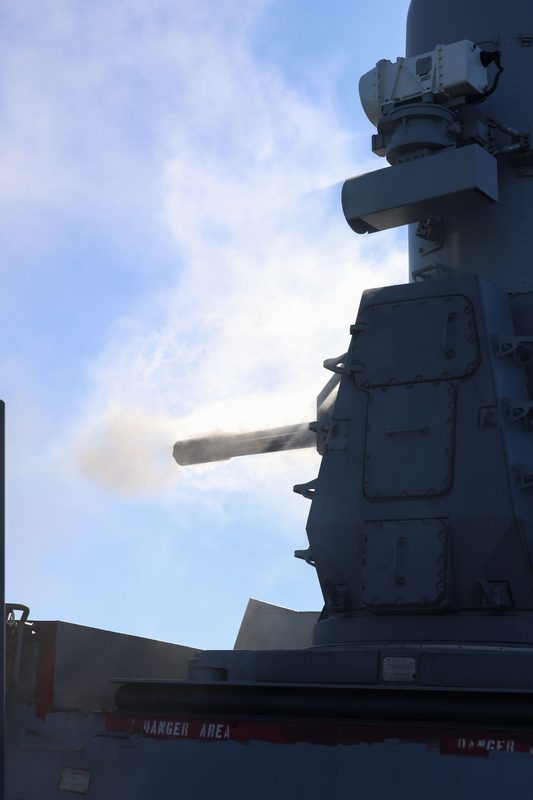
Smoke rising from the barrel of a Phalanx CIWS after a live fire exercise aboard USS Truxtun
Smoke rises from a Phalanx CIWS barrel after a live-fire exercise aboard USS Truxtun (DDG 103). The system fires 75 rounds per second, but it can only protect the ship if it is activated. (U.S. Navy photo)

The Stark incident illustrates the fundamental limitation of any last-ditch defense: it only works if it is turned on. The Phalanx system was aboard the ship and functional. It simply was not engaged. The Navy changed its doctrine after Stark, requiring CIWS to be in automatic engagement mode in combat zones. But the deeper problem remains: a system that engages targets at less than two miles gives the ship almost no margin for error. If the first burst misses, the system may get one more attempt. If the second burst misses, the missile impacts the ship.

The Limits of Kinetic Kill

The Phalanx has another limitation that is less well known: even a successful engagement does not always prevent damage. The system is designed to destroy the incoming missile, to break it apart or detonate its warhead at a safe distance. But a missile traveling at 600 mph that is shredded at 500 meters from the ship may still send warhead fragments and debris into the hull at high velocity. The Navy calls this the "mission kill" problem: the CIWS destroyed the missile, but the ship still took damage.

Against supersonic missiles, this problem intensifies. A Mach 2 missile destroyed at 300 meters still has enormous kinetic energy. Debris from a successful intercept can puncture radar arrays, damage topside equipment, or injure crew on deck. A truly clean kill, one that leaves no debris reaching the ship, requires the intercept to occur far enough away that the fragments lose energy before arriving. At the engagement ranges the Phalanx operates at, this margin barely exists.

SeaRAM: The Replacement That Supplements

The Navy began fielding SeaRAM in the 2000s as a complement to and eventual replacement for Phalanx on some ship classes. SeaRAM uses the same sensor and tracking system as Phalanx Block 1B but replaces the Gatling gun with an 11-cell Rolling Airframe Missile (RAM) launcher. The RIM-116 RAM is a heat-seeking missile with a range of approximately 5.6 miles, giving the ship a much larger engagement envelope than the Phalanx's 1-mile effective range.

SeaRAM can engage targets at 10 to 20 times the distance of Phalanx, giving the ship significantly more time and opportunity to kill incoming missiles. The system fires missiles that actively home on the target, rather than relying on a stream of bullets to intersect a flight path. This makes SeaRAM dramatically more effective against maneuvering targets and supersonic threats.

But SeaRAM has its own limitation: 11 missiles. Once the magazine is empty, there is no rapid reload at sea. Phalanx, by contrast, carries 1,550 rounds in its drum and can be reloaded by the ship's crew. For sustained engagements involving multiple incoming missiles, some ships carry both systems, SeaRAM for the first wave, Phalanx as the last resort.

The Last Two Seconds

Every naval defense system is designed to push the engagement further from the ship. Aegis and Standard Missiles engage at 100+ miles. ESSM engages at 30 miles. SeaRAM engages at 5 miles. The Phalanx engages at less than 1 mile. Each layer exists because the layer before it might fail. The Phalanx exists because every other system on the ship might fail simultaneously, and in combat, they sometimes do.

The white dome spinning on the deck of every U.S. Navy surface combatant is not a primary weapon. It is an admission that no defense is perfect, that missiles will sometimes get through, and that the last line of defense needs to fire 75 rounds per second because there is no second chance and no time to think. If the Phalanx misses, the next sound is an explosion.

Share this article

Share:

Recommended

Ace of The Skies: Can You Identify These Military Aircraft Throughout The Years?
Test Yourself

Ace of The Skies: Can You Identify These Military Aircraft Throughout The Years?

Can you identify these aircraft?

Take the Quiz

On This Day in Military History

April 23

The Zeebrugge Raid (1918)

On St. George's Day, the Royal Navy launched a daring raid on the German-held Belgian port of Zeebrugge, attempting to block the canal entrance used by German U-boats. HMS Vindictive stormed the harbor mole while blockships were scuttled in the canal. Eight Victoria Crosses were awarded for the action.

1951, Battle of the Imjin River

See all 4 events on April 23

Get Military News & History in Your Inbox

Join thousands of readers receiving our weekly digest of military technology, history, and analysis.

Test Your Knowledge