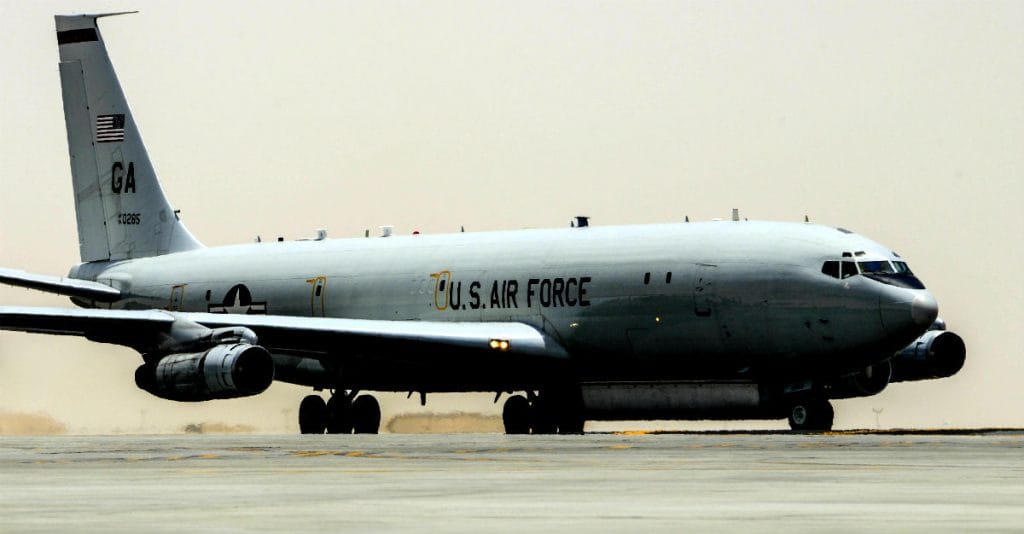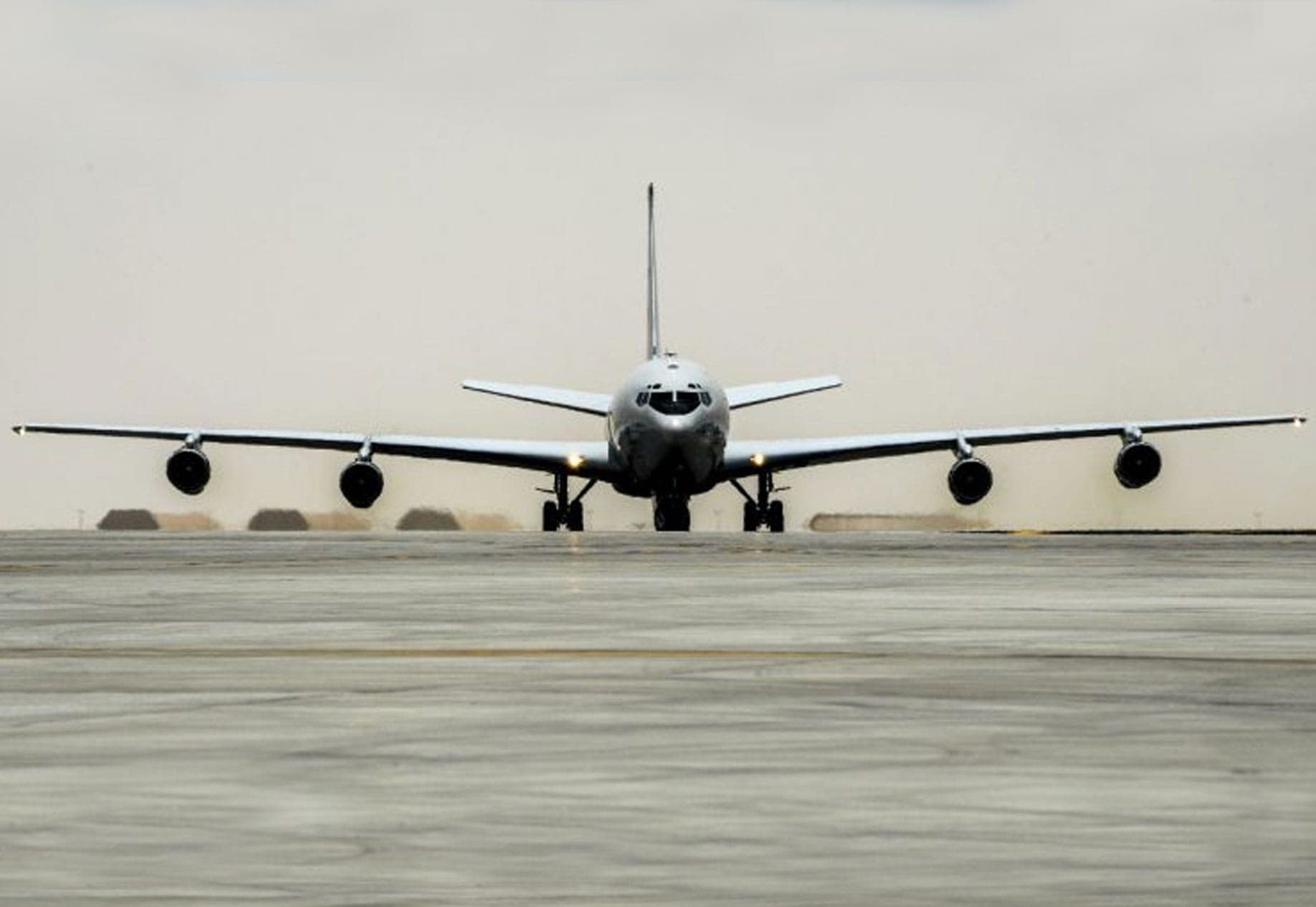

Often dubbed an “AWACS for ground pounders,” the Northrop Grumman E-8 Joint STAR provides the US military an unmatchable God’s eye view of a battlespace up to 19,305 square miles (50,000 square kilometers) in size. The massive onboard radar, visible as a large bulge under the aircraft’s fuselage, can detect small moving targets out to a range of 250 kilometers. Even individual dismounted enemy fighters can’t hide from the J-Stars’ next-generation sensor suite and AN/APY-7 synthetic aperture radar.
Cold War Design Carried Over To The 21st Century:
Officially named the Joint Surveillance Target Attack Radar System (Joint STARS), this military aircraft is built off of a heavily modified Boeing 707-300 commercial liner frame. Designed in the late Cold War, the Pentagon almost canceled the J-STAR program after the collapse of the Soviet Union. That all changed, however, when the Persian Gulf War began in 1991.

Facing an immediate need to scan large battle areas for mobile missile sites and dug-in armored units, the US Air Force rushed the first prototype E-8’s into service. In that short conflict, two J-Stars flew over 500 sortie flight hours with a 100% mission success rate. Between the Gulf War and the War on Terrorism, J-STARS also served as NATO’s go-to battle management platform during the Yugoslavian Civil War intervention.
God’s Eye:
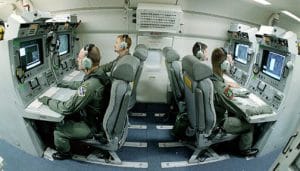
While the onboard radar, infrared and SIGNIT systems on the E-8C can gather and relay enemy information in near-real time to common ground stations, that’s only part of this unique aircraft’s job. The J-Star and its battle staff of 18 officers and sensor operators can handle the full spectrum of command, control, communications, computers and intelligence (C4I) missions. Essentially acting as an on-the-scene airborne command post to coordinate forces from different service branches or foreign allies, and all in real-time.