
INS
Inertial Navigation System
An Inertial Navigation System uses accelerometers and gyroscopes to calculate an object's position, velocity, and orientation without relying on external references like GPS satellites.
Inertial Navigation Systems (INS) determine position by continuously measuring acceleration and rotation from a known starting point. Using precision accelerometers and gyroscopes, the system calculates changes in velocity and direction over time, integrating these measurements to maintain a running estimate of the platform's position. Because INS relies entirely on internal sensors, it is immune to GPS jamming, spoofing, or denial.
Modern INS uses ring laser gyroscopes or fiber optic gyroscopes that have no moving parts, providing high accuracy and reliability. However, all inertial systems suffer from drift, small measurement errors that accumulate over time, causing the calculated position to diverge from the actual position. High-quality military INS systems drift at rates measured in fractions of a nautical mile per hour, but this error is not self-correcting.
For this reason, INS is almost always paired with GPS in military applications. The GPS signal periodically corrects the INS drift, while the INS provides continuous navigation between GPS updates and maintains accurate navigation if GPS is lost or jammed. This GPS/INS combination is the standard navigation and guidance system for cruise missiles, precision-guided munitions, aircraft, and submarines, providing resilient navigation across the full spectrum of operating environments.
Related Terms
GPS(Global Positioning System)
Global Positioning System is a satellite-based navigation network operated by the U.S. Space Force that provides precise location, velocity, and timing data to military and civilian users worldwide.
CEP(Circular Error Probable)
Circular Error Probable is a measure of a weapon's accuracy, defined as the radius of a circle centered on the target within which 50% of strikes are expected to land.
JDAM(Joint Direct Attack Munition)
Joint Direct Attack Munition is a low-cost guidance kit that converts unguided gravity bombs into precision-guided weapons using GPS and inertial navigation.
Related Articles
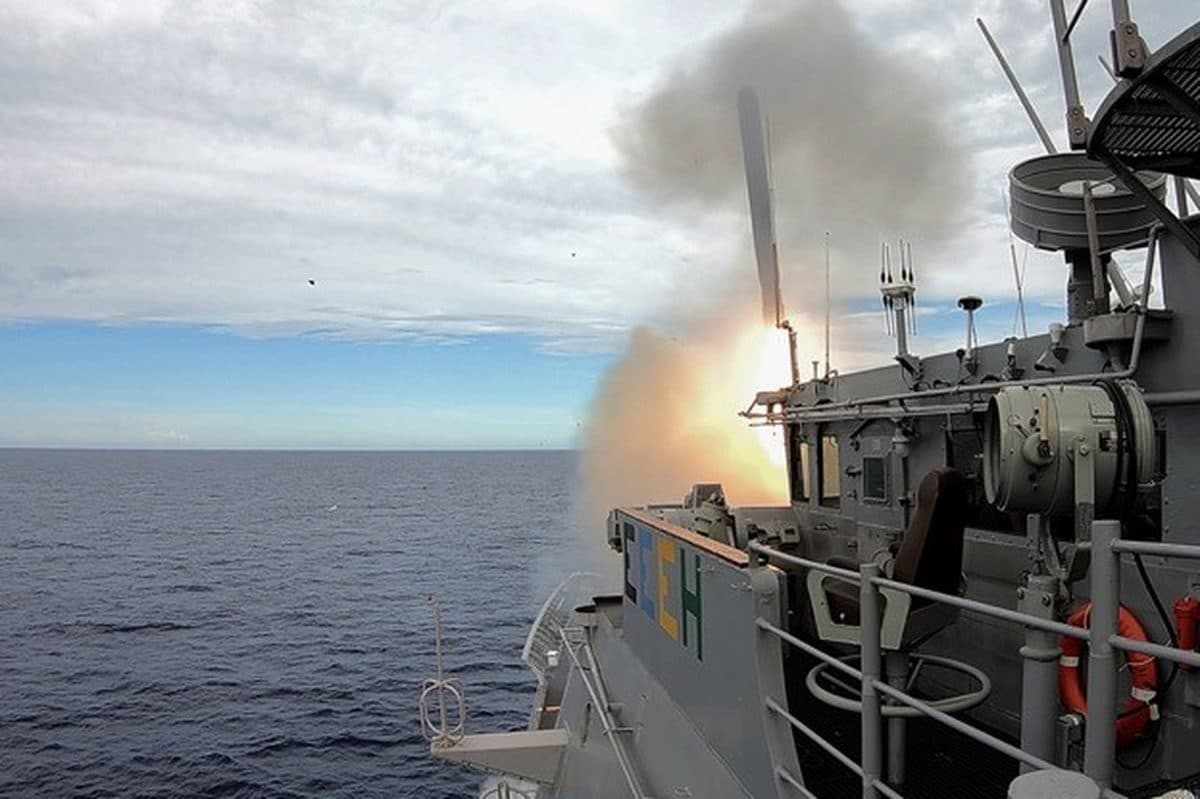
A Tomahawk Flies 1,000 Miles and Hits a Specific Window. Here's How It Knows Where to Go.
A Tomahawk cruise missile flies 1,000 miles and hits a specific window on a specific floor of a specific building. Here is how it works, from launch to impact, with every guidance method explained.