James Holloway writes about military readiness, logistics, and the practical limits of modern forces. His work focuses on how training, sustainment, and organizational decisions shape what militaries can actually do -- not just what they are designed to do on paper.
The M1 Abrams and the Leopard 2 represent the two dominant Western tank designs of the past four decades. Both emerged from the Cold War, both equip major NATO armies, and both are regularly cited as among the best tanks in the world. When people ask which is better, they expect a clear answer. But asking which tank is better is a bit like asking which tool is better: a hammer or a screwdriver. The answer depends entirely on the job, the workshop, and who is holding it.
This comparison does not exist to crown a winner. It exists because understanding why these tanks differ reveals something deeper about how nations approach war, what they prioritize, and how doctrine shapes hardware choices in ways that specifications alone cannot capture.
Why This Comparison Exists at All
The M1 Abrams and Leopard 2 are frequently compared because they occupy similar roles and have comparable performance on paper. Both mount 120mm smoothbore guns. Both use advanced composite armor. Both have been upgraded repeatedly since their introduction in the early 1980s. And both serve as the main battle tanks for major military powers and their allies.
But the surface similarities obscure significant differences in philosophy, logistics, export strategy, and operational assumptions. The Abrams was designed for a military that could project logistics anywhere in the world. The Leopard 2 was designed for a European battlefield where sustainment would need to be simpler and interoperability with allied forces would be essential.
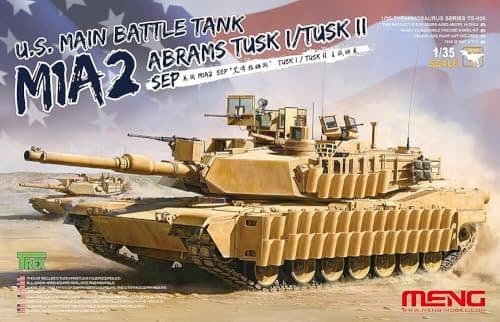
Meng's Abrams includes parts for both TUSK I and TUSK II configurations, which adds explosive reactive armor, a CROWS remote weapon station, and loader's armored gun shield. Sharper detail than Tamiya's version, with workable individual track links.
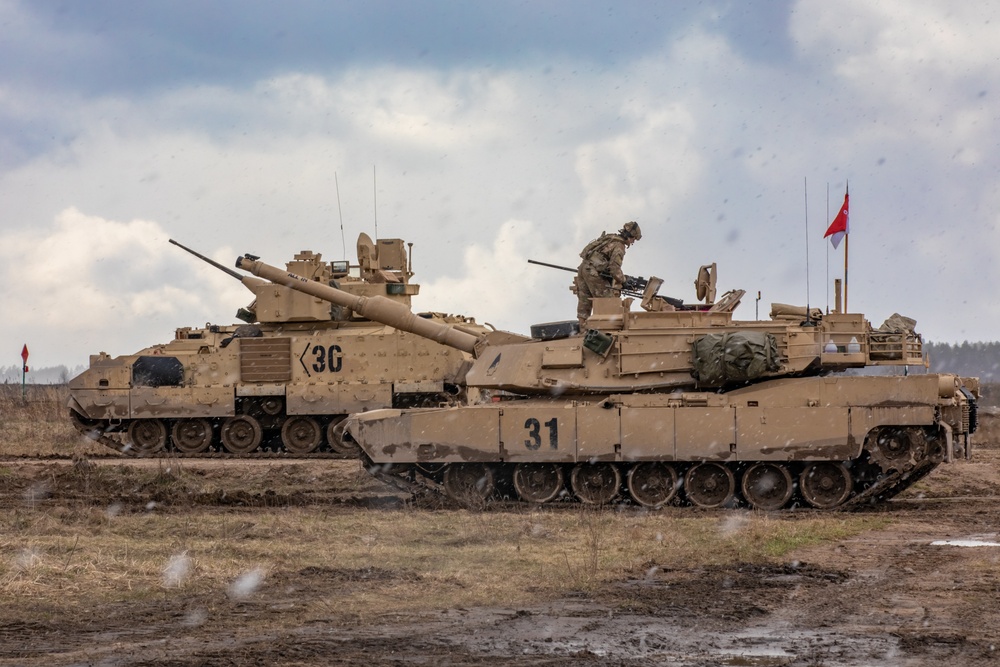
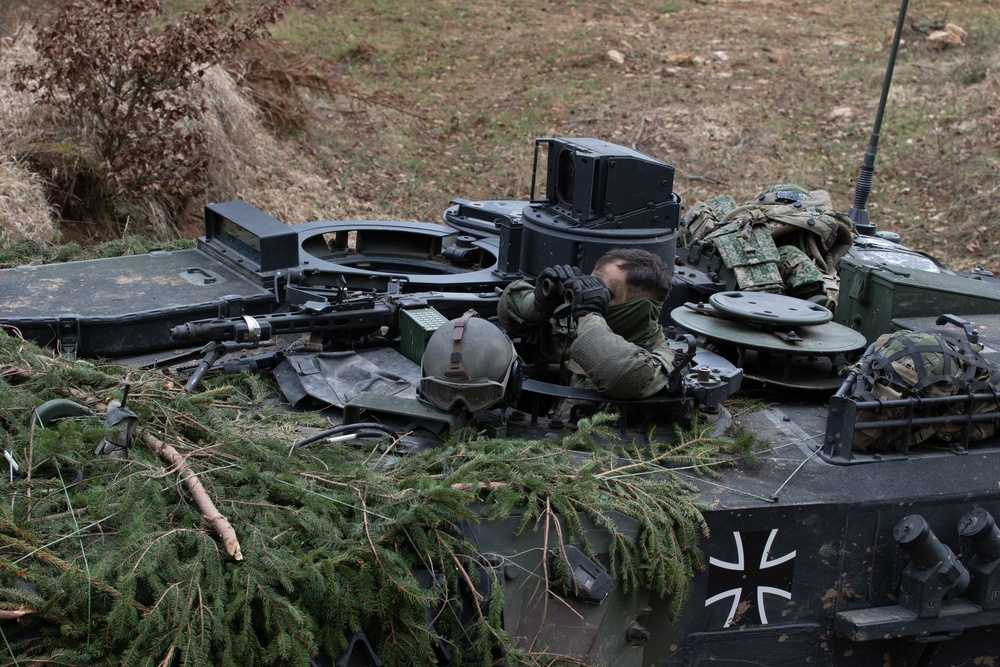
German Leopard and U.S. M1 Abrams tanks operating together in Poland, April 2023. U.S. Army photo by Staff Sgt. Matthew Foster.
These differences are not flaws. They are design choices reflecting different strategic realities. The United States operates the most sophisticated military logistics network in history, capable of moving fuel, parts, and ammunition to almost any location. Germany and other Leopard 2 operators generally assume more constrained logistics and prioritize ease of maintenance and fuel economy.
When analysts compare these tanks, they often focus on armor thickness, gun penetration, and top speed. These metrics matter, but they miss the larger picture. Tanks do not fight in isolation. They fight within doctrines, supported by logistics, crewed by trained soldiers, and employed according to tactical and strategic assumptions. The same tank can perform brilliantly in one context and struggle in another.
This is why the question "which tank is better" resists simple answers. The better question is: better for what, for whom, and under what conditions?
Design Philosophy and Doctrinal Roots
The M1 Abrams entered service in 1980, designed to counter Soviet armor in a potential European war. American planners assumed that any conflict would require rapid, decisive action. Tanks would need to engage and destroy enemy armor at long range, survive hits, and keep fighting. Crew survival was a paramount concern because American doctrine valued trained tankers as irreplaceable assets.
This philosophy shaped every major design decision. The Abrams uses a gas turbine engine, which provides exceptional power and acceleration. It can start in extreme cold, operate on multiple fuel types, and deliver smooth power across the performance envelope. The tradeoff is high fuel consumption and the need for specialized logistics support. American planners accepted this because U.S. forces could be expected to have robust supply lines.
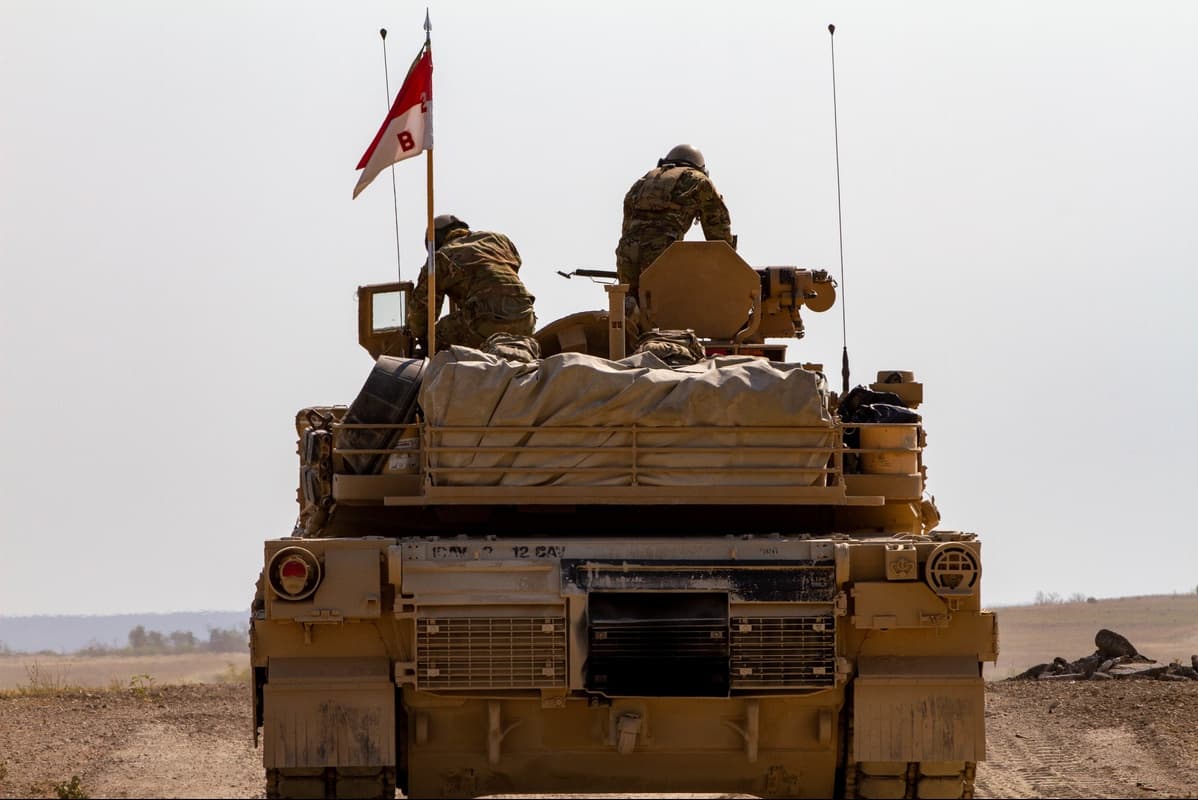
M1 Abrams fires at a target during gunnery exercises at McGregor Range, New Mexico, September 2023. U.S. Army photo by Spc. David Poleski.
The Leopard 2, entering service in 1979, was designed with different constraints. Germany anticipated fighting on its own territory, with shorter supply lines but also with the need to integrate with allied forces from multiple NATO nations. The Leopard 2 uses a conventional diesel engine, which consumes less fuel, is easier to maintain in the field, and uses the same fuel as most other military vehicles.
This choice was not about capability alone. It was about logistics, sustainability, and interoperability. German doctrine assumed that in a European conflict, forces would need to operate for extended periods with whatever supplies were available. A tank that burned through fuel at half the rate of its competitor would be able to stay in the fight longer when supply lines were contested.
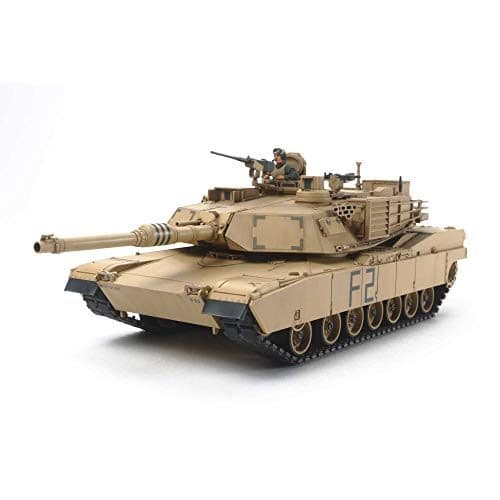
Tamiya's 1/48 Abrams packs serious detail into a smaller footprint. Around 130 parts, excellent fit, and the smaller scale means a faster build and less shelf space. A solid first "real" armor kit for someone stepping up from snap-fits.
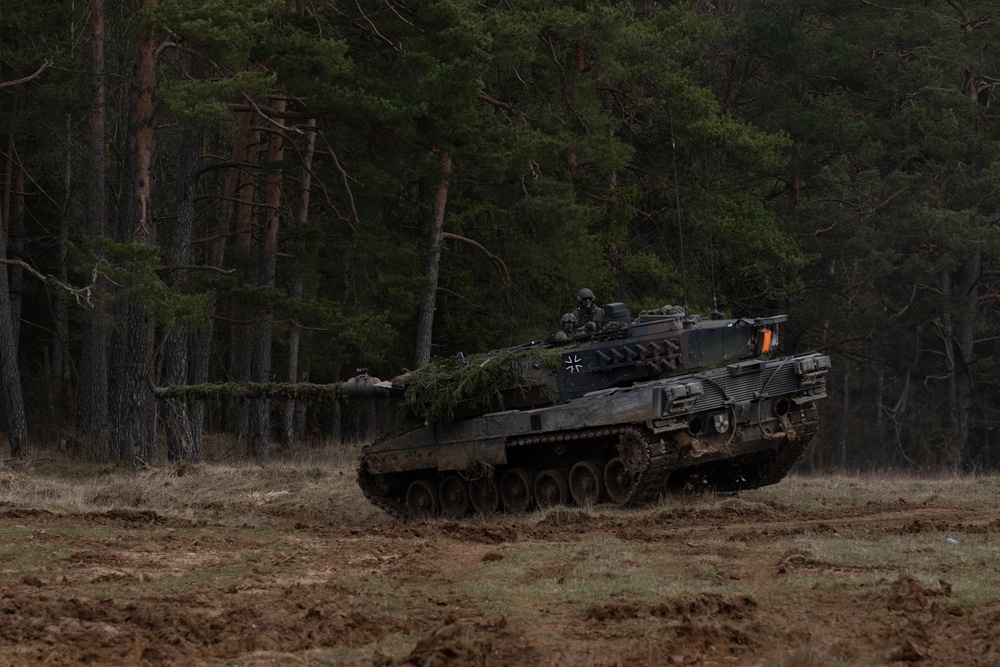
Leopard 2A7 during Allied Spirit 24 training at Hohenfels, Germany, March 2024. U.S. Army photo by Pfc. Ayden Norcross.
The difference in engine choice cascaded through the entire design. The Abrams is heavier, in part because the turbine and its supporting systems add weight. The Leopard 2 is somewhat lighter and, by some measures, easier to deploy across European infrastructure that was not always designed for extremely heavy vehicles.
Neither approach is wrong. Both reflect careful thinking about how tanks would actually be used. But the implications extend far beyond the engine bay. They shape training, maintenance, deployment planning, and the entire support structure that makes armored operations possible.
Armor, Firepower, and Survivability as Systems
On paper, both tanks appear similarly armed and armored. Both use 120mm smoothbore guns capable of firing advanced kinetic energy penetrators and programmable munitions. Both use composite armor of varying configurations depending on the variant. And both have been upgraded repeatedly over their service lives to address new threats.
The Abrams uses depleted uranium armor inserts in some variants, providing exceptional protection against kinetic penetrators. The dense material is highly effective at stopping incoming rounds, and the Abrams has demonstrated remarkable survivability in combat. Tanks have taken multiple hits and continued fighting. When ammunition has cooked off, the separated storage and blowout panels have repeatedly saved crews.
M1 Abrams
Leopard 2
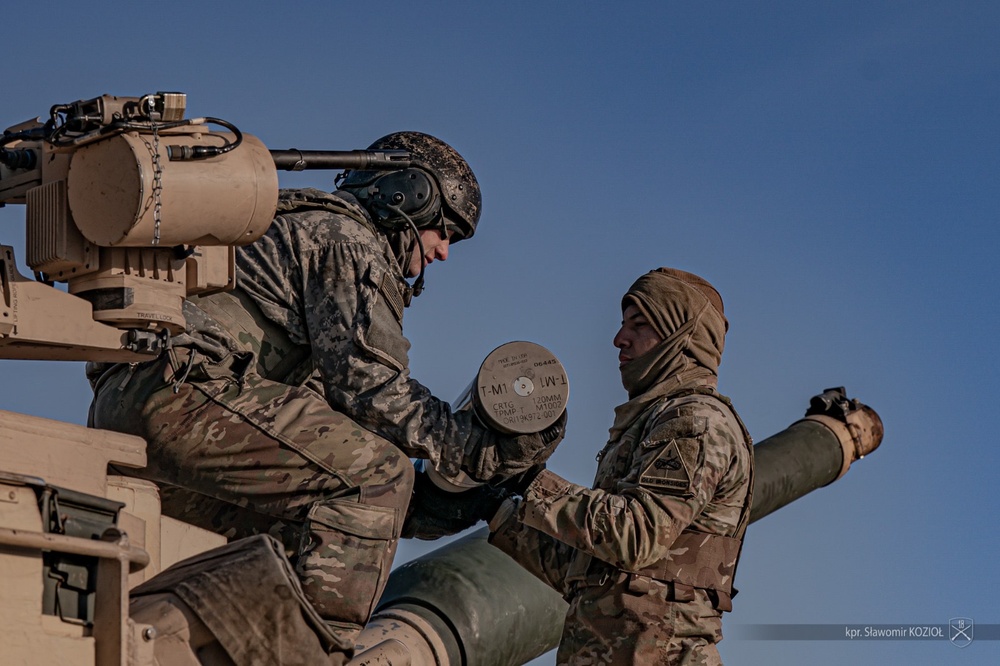
Training approaches: U.S. Army instructors train Polish crews on M1A2 Abrams (left), while NATO partners train together on Leopard 2 systems (right). Both programs emphasize crew integration with vehicle systems.
The Leopard 2 uses modular composite armor that can be upgraded or replaced relatively easily. This design philosophy prioritizes adaptability. As threats evolve, armor modules can be swapped out without rebuilding the entire turret or hull. The latest variants, like the Leopard 2A7V, incorporate additional protection packages that significantly enhance survivability.
Comparing armor protection directly is difficult because both manufacturers and militaries classify detailed specifications. What we know from combat experience is that both tanks have demonstrated the ability to survive hits that would destroy less protected vehicles. But neither tank is invulnerable. In recent conflicts, both Abrams and Leopard 2 tanks have been destroyed by advanced anti-tank weapons, top-attack munitions, and improvised explosive devices.
This points to an important reality: armor is one layer of survivability, but not the only one. Active protection systems, crew training, tactical employment, and situational awareness all contribute to whether a tank and its crew survive combat. A tank with slightly better armor but worse sensors might be more vulnerable than a less-armored tank that sees threats first and engages from advantageous positions.
Specifications tell you what a tank can do in ideal conditions. Doctrine tells you what a tank is expected to do. And logistics determine what a tank actually does.
Mobility, Logistics, and Sustainment Realities
The engine debate between the Abrams and Leopard 2 is often framed as turbine versus diesel, but the real issue is what each choice implies for operations. The Abrams' Honeywell AGT1500 turbine is a remarkable piece of engineering. It provides smooth, reliable power, starts quickly in extreme cold, and can run on jet fuel, diesel, or gasoline. In a logistics network designed to supply American forces, multi-fuel capability is valuable.
The turbine also has drawbacks. Fuel consumption is roughly double that of the Leopard 2's diesel engine. This means more fuel trucks, more logistics convoys, and more exposure to supply disruptions. In sustained combat operations, fuel becomes a strategic consideration. Armies have lost battles not because their tanks were destroyed but because they ran out of fuel.
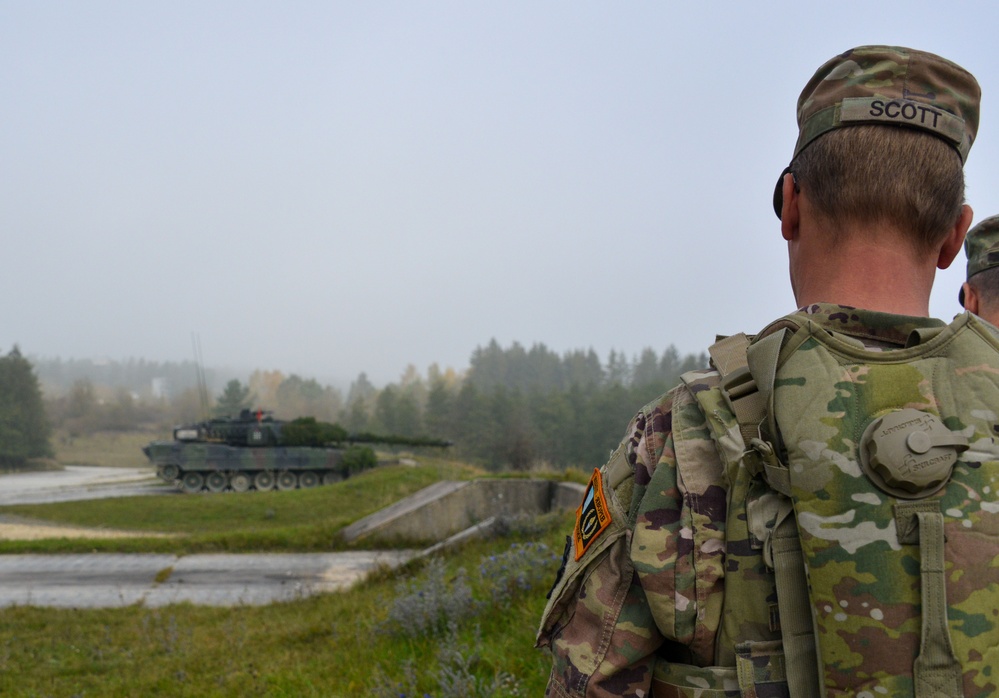
Leopard 2 A7V during demonstration at Grafenwoehr Training Area, Germany, October 2024. U.S. Army photo by Pfc. Israel Fernandez.
The Leopard 2's MTU diesel engine is more fuel-efficient and uses standard diesel that is available throughout NATO. Maintenance is more straightforward, and field repair is generally easier. For nations that cannot maintain the logistics infrastructure of the United States, these factors are decisive.
Weight matters as well. The Abrams, particularly in its latest variants, is significantly heavier than the Leopard 2. This affects transportability by rail, road, and sea. It affects which bridges can support the tank. And it affects how quickly forces can be deployed. The Leopard 2's lighter weight has been one factor in its export success, as many nations have infrastructure that struggles with the Abrams' mass.
Sustainment Comparison: Fuel and Logistics
Fuel Economy and Operational Range Comparison
M1 Abrams
(Gas Turbine)
Fuel per 100km:
~400 liters
Road Range:
~426 km
Leopard 2
(Diesel)
Fuel per 100km:
~240 liters
Road Range:
~500 km
The Leopard 2 consumes roughly 40% less fuel while achieving greater range.
Actual consumption varies by terrain, load, and operating tempo.
Relative fuel economy comparison showing how engine choice affects logistics requirements and operational range.
None of this means the Abrams is poorly designed. It means the Abrams was designed for a specific operational context: an American military with global reach and unmatched logistics capability. In that context, the tradeoffs are acceptable. For other nations with different logistics networks, the equation changes.
Upgrade Paths and Modernization
Both tanks have been continuously upgraded since their introduction, and both manufacturers continue to develop new variants. The ability to modernize existing platforms is crucial because modern main battle tanks are enormously expensive to develop and produce from scratch.
The Abrams has evolved from the original M1 through the M1A1, M1A2, and various SEP (System Enhancement Package) versions. Each upgrade has added improved armor, better fire control systems, enhanced electronics, and integration with networked battlefield systems. The latest SEPv3 variants incorporate third-generation thermal sights, improved data sharing, and enhanced survivability features.
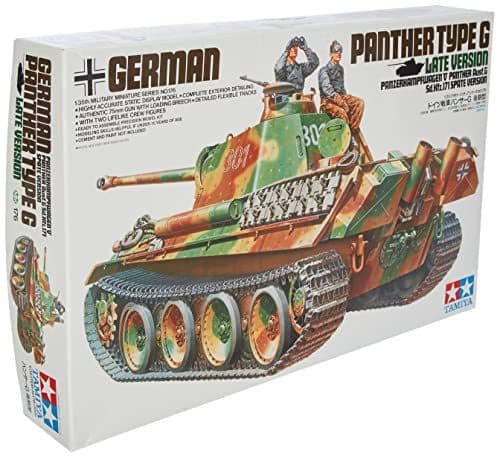
Tamiya's 1/35 Panther Ausf. G is a traditional styrene kit with excellent fit and clear instructions. At this scale, the finished model is roughly 25cm long with good surface detail and working suspension.
The Leopard 2 has followed a similar path, from the original 2A0 through the current 2A7V. German and international operators have added improved armor packages, extended-range gun barrels, enhanced electronics, and active protection systems. The modular nature of the Leopard 2's armor design has made upgrades relatively straightforward, allowing operators to tailor protection to specific threats.
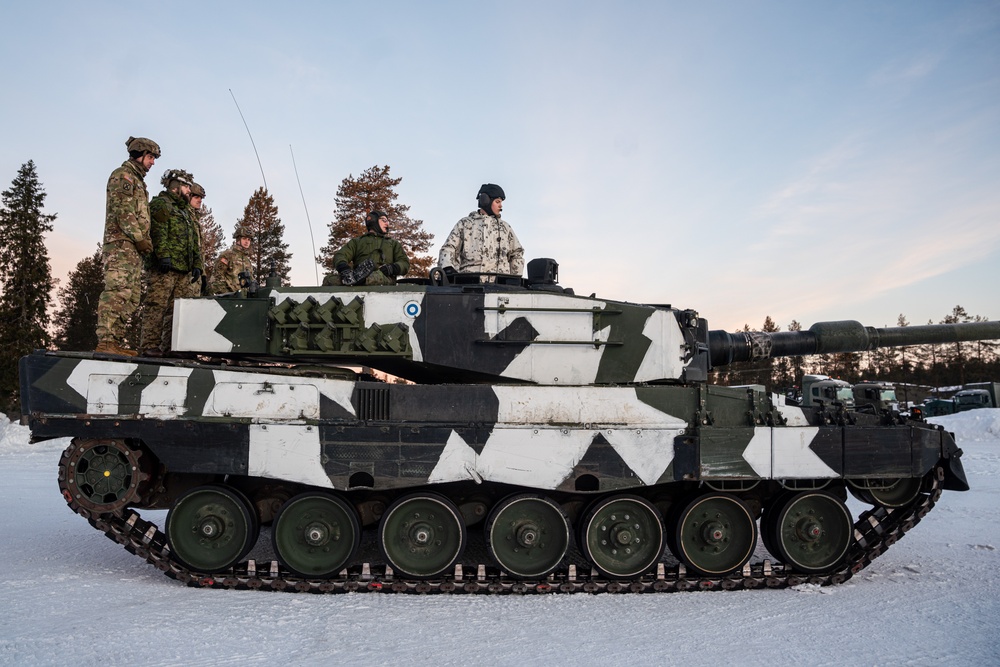
Allied soldiers explore a Finnish Leopard 2A4 during Arctic Forge 25 exercise in Finland, February 2025. U.S. Army photo by Sgt. Salvador Castro.
Both platforms face similar challenges going forward. Modern anti-tank weapons, including top-attack missiles and loitering munitions, pose threats that passive armor alone cannot fully address. Both tanks are being fitted with active protection systems designed to intercept incoming threats before they strike. And both are being integrated into networked battle management systems that share targeting data across multiple platforms.
The upgrade question is also an industrial one. The United States maintains the capacity to build and upgrade Abrams tanks at the Joint Systems Manufacturing Center in Ohio. Germany and its partners maintain Leopard 2 production and upgrade capacity. For nations choosing between these tanks, the availability of long-term support and upgrade paths is often as important as the tanks' current specifications.
Doctrinal Positioning: Logistics vs Capability
Doctrinal Fit: Logistics Support vs Tactical Emphasis
Logistics infrastructure available (higher to right)
Tactical capability emphasis (higher up)
High capability
Limited logistics
High capability
Strong logistics
Balanced approach
Limited logistics
M1
Abrams
Leopard
2
Position reflects design philosophy and typical operational context, not absolute capability.
How each tank fits different operational assumptions. The Abrams assumes robust logistics support; the Leopard 2 is designed for more constrained sustainment environments.
Export Success and Coalition Warfare
One of the starkest differences between these platforms is their export history. The Leopard 2 is operated by more than 15 countries, making it one of the most successful Western tank exports ever. The Abrams has a smaller export footprint, though it has expanded in recent years with sales to Poland, Australia, and others.
This difference reflects several factors. Germany pursued an aggressive export strategy for the Leopard 2, recognizing that export sales would sustain the production line and spread development costs. The United States was more restrictive about Abrams exports for decades, concerned about protecting sensitive technology, particularly the depleted uranium armor used in some variants.
Political factors also play a role. Some nations that might prefer American equipment find the Leopard 2 easier to acquire due to fewer political conditions on sales. Others prefer the Leopard 2 precisely because it is not American, reducing perceived dependency on U.S. foreign policy decisions.
For coalition operations, the Leopard 2's widespread adoption creates interoperability benefits. When multiple NATO nations operate the same platform, they can share parts, maintenance expertise, and training. They can integrate more easily in combined operations. And they can support each other's forces in ways that would be more difficult with dissimilar platforms.
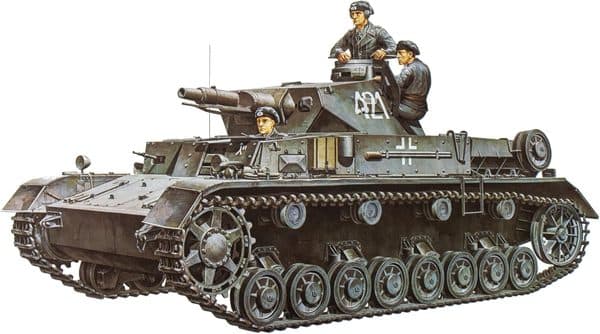
The Panzer IV was the workhorse of the German armored divisions, and Tamiya's 1/35 kit captures the Ausf. H variant with its characteristic Schurzen side skirts and long-barrel 75mm gun.
The Abrams' smaller export base means that U.S. forces often operate the only Abrams in a coalition. This is not necessarily a problem, as American logistics are designed to support U.S. forces independently. But it does mean that Abrams operators cannot benefit from the same kind of multi-national sustainment sharing that Leopard 2 operators enjoy.
Poland presents an interesting case study. Poland operates both Leopard 2 tanks and has recently acquired M1 Abrams. This dual fleet gives Poland flexibility and interoperability with both the German-led European tank community and American forces. It also creates logistics complexity, as Poland must now sustain two different main battle tank platforms with different parts, training, and support requirements.
Combat Experience and Real World Performance
The M1 Abrams has the more extensive combat record, particularly from the Gulf War, Iraq, and Afghanistan. In the Gulf War, Abrams tanks achieved remarkable success against Iraqi armor, often engaging and destroying T-72s at ranges where return fire was ineffective. Crew survivability was exceptional, with the separated ammunition storage and blowout panels saving lives when tanks were hit.
Later conflicts presented different challenges. In urban combat and against insurgent forces using improvised explosive devices, the Abrams proved vulnerable in ways that open desert warfare had not revealed. Losses occurred, though crew survival rates remained high compared to less protected vehicles.
The Leopard 2's combat record is more limited but growing. Canadian and Danish Leopard 2s saw combat in Afghanistan, where they performed effectively in the counter-insurgency role. Turkish Leopard 2s were used in Syria, where several were destroyed by anti-tank missiles, highlighting vulnerabilities when tanks operate without proper combined arms support.
Most recently, both tanks have been used in Ukraine. Ukrainian forces have operated donated Abrams and Leopard 2 tanks against Russian forces. Both types have suffered losses, primarily to mines, artillery, and anti-tank guided missiles rather than tank-on-tank combat. These losses have reinforced lessons about the importance of combined arms tactics, the threat of modern anti-tank weapons, and the limits of armor protection against determined adversaries.
Combat experience is valuable but must be interpreted carefully. Tanks destroyed due to poor tactics or inadequate support do not tell us much about the tank's design. What matters is whether the tank performed as its designers intended when used correctly. By that measure, both the Abrams and Leopard 2 have demonstrated that they are capable, survivable platforms when employed properly and supported adequately.
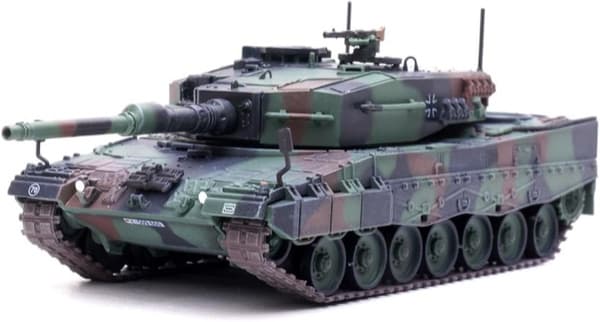
Germany's Leopard 2A4 in NATO three-tone camouflage. Same Panzerkampf build quality as the Abrams with a rotating turret and the Leopard's distinctive flat turret profile.
After examining design philosophy, specifications, logistics, modernization, exports, and combat experience, the question of which tank is better still lacks a universal answer. This is not evasion. It is an accurate reflection of reality.
Choose the M1 Abrams if:
You have robust, U.S.-style logistics infrastructure
Maximum protection is the top priority
Operating alongside U.S. forces is a key requirement
Multi-fuel capability matters for your operational environment
Choose the Leopard 2 if:
Fuel efficiency and simpler logistics are priorities
Interoperability with European NATO allies matters
Easier maintenance in austere conditions is required
Infrastructure limitations favor a somewhat lighter platform
For the United States, the Abrams remains the right choice because the entire American way of war is built around the logistics that make it effective. For Germany and many NATO allies, the Leopard 2 is the right choice because it fits their operational assumptions and coalition relationships.
For nations choosing between them, the decision should not be based on which tank looks better on a specifications sheet. It should be based on honest assessment of logistics capability, alliance relationships, operational doctrine, and long-term sustainment capacity. A tank that cannot be kept running is not better than a tank that can, regardless of what the brochure says.
Both the M1 Abrams and Leopard 2 are exceptional main battle tanks. Both represent decades of engineering refinement and billions of dollars in development. Both have proven themselves in combat and continue to evolve to meet new threats. The question of which is better is not a question about the tanks themselves. It is a question about what kind of army you are building and what kind of war you expect to fight.
Frequently Asked Questions
Which is better, the M1 Abrams or the Leopard 2?
Neither tank is universally better. The Abrams excels in protection and logistics support within American doctrine, while the Leopard 2 excels in fuel efficiency, export flexibility, and NATO interoperability. The answer depends on doctrine, support infrastructure, and operational context.
Which tank would win in a direct engagement?
This question oversimplifies tank combat. Outcomes depend on who sees whom first, terrain, supporting assets, crew training, ammunition quality, and tactical positioning. Both tanks can destroy the other with well-placed shots. Real tank battles are decided by combined arms effectiveness, not one-on-one duels.
Which tank has been more successful in actual combat?
The Abrams has the more extensive combat record, particularly in the Gulf War where it achieved remarkable success. The Leopard 2's combat experience in Afghanistan, Syria, and Ukraine provides more limited data. Both tanks have performed well when properly employed and have suffered losses when used without adequate support.
Which tank has been more successful in export markets?
The Leopard 2 has been significantly more successful in exports, with over 15 operator nations compared to the Abrams' handful of export customers. This reflects Germany's aggressive export strategy, the Leopard 2's easier logistics, and historical U.S. restrictions on Abrams technology transfer.
Which armies use the Leopard 2?
The Leopard 2 is operated by over 15 countries including Germany, Poland, Spain, Turkey, Canada, Finland, Sweden, Norway, Denmark, Greece, Austria, Switzerland, the Netherlands, Portugal, Singapore, Indonesia, Chile, and Ukraine. It is one of the most widely exported Western main battle tanks.
Why did Poland buy both Abrams and Leopard 2 tanks?
Poland operates both platforms to achieve interoperability with both German-led European forces and American forces. This provides diplomatic and military flexibility but creates logistics complexity. Poland must now maintain two different supply chains, training programs, and maintenance infrastructures.
How do the tanks compare in urban combat?
Both tanks face similar challenges in urban environments: limited visibility, vulnerability to top-attack weapons from buildings, and difficulty maneuvering in confined spaces. Both have been upgraded with improved situational awareness systems. Success in urban combat depends more on combined arms tactics and infantry support than tank design.
Which tank has better active protection systems?
Both tanks are being fitted with active protection systems. The Abrams can mount the Israeli Trophy system, while the Leopard 2 variants are being equipped with various systems. Active protection adoption is ongoing for both platforms, with capabilities depending on the specific configuration.