Daniel Mercer writes about military history with a focus on the 20th century, including World War II, the Cold War, and Vietnam. His work looks at how decisions made decades ago still influence doctrine, planning, and assumptions today.
On the morning of July 28, 1976, two days after America's bicentennial celebrations, Captain Eldon W. Joersz lined up an SR-71A Blackbird on a measured course over Beale Air Force Base in California. In the back seat, Major George T. Morgan Jr. monitored instruments that registered temperatures, pressures, and speeds that most aircraft designers still considered theoretical. Joersz pushed the throttles forward. The twin Pratt & Whitney J58 engines, already screaming, found another gear. The desert floor 80,000 feet below became an abstraction. And then the instruments recorded a number: 2,193.2 miles per hour. Mach 3.32.
That was nearly fifty years ago. The record still stands.
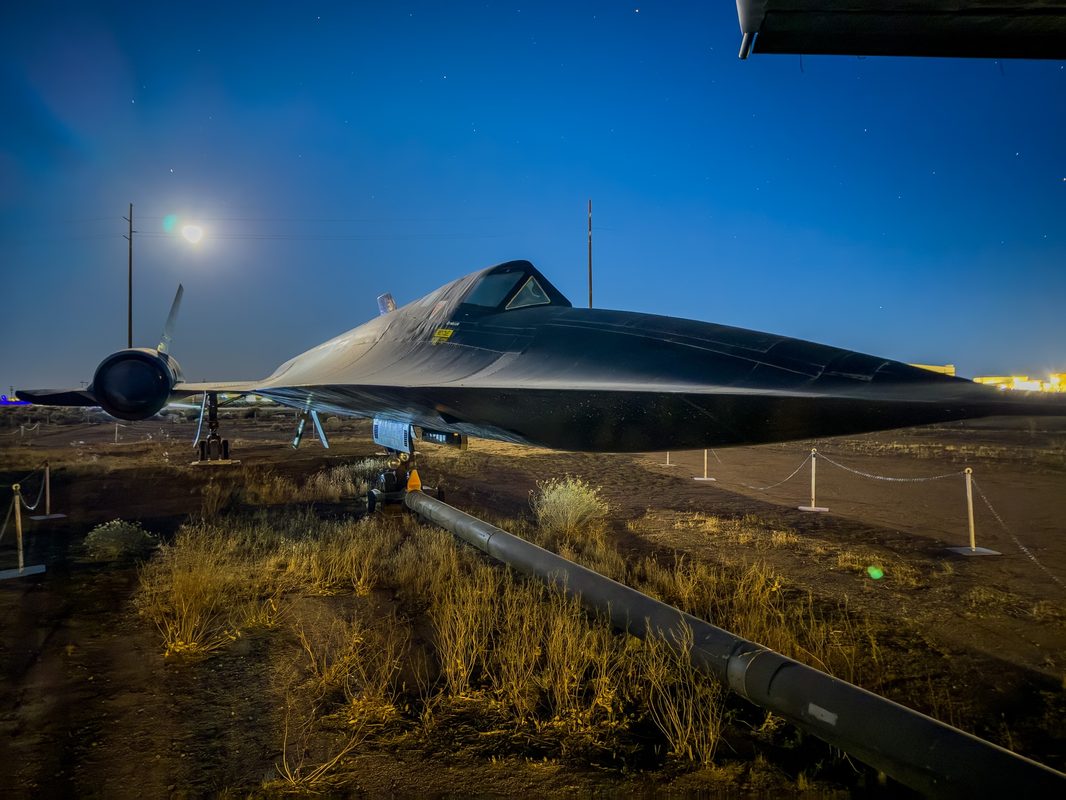
Not because no one has tried to break it. Not because the technology doesn't exist to go faster. The SR-71 Blackbird was such a radical leap in engineering, so far ahead of everything else in the sky, that no other manned, air-breathing aircraft has come close. It remains the fastest jet aircraft ever to fly, a record set during the Ford administration that has outlasted the Cold War, the Space Shuttle program, and the entire era it was built for.
Born in Secrecy: Kelly Johnson's Impossible Airplane
The SR-71 began its life in the late 1950s inside Lockheed's legendary Skunk Works, the Advanced Development Programs division run by Clarence "Kelly" Johnson. As Ben Rich later wrote in Skunk Works, Johnson was arguably the greatest aircraft designer in American history, having already produced the P-38 Lightning, the F-104 Starfighter, and the U-2 spy plane. But after Francis Gary Powers was shot down over the Soviet Union in 1960, the CIA needed something the Soviets couldn't touch. Johnson's answer was a machine that would fly so high and so fast that no missile or interceptor on Earth could catch it.
The A-12 Oxcart, the SR-71's CIA predecessor, flew first. Per CIA declassified documents on Project Oxcart, the SR-71 itself, a larger two-seat reconnaissance variant built for the Air Force, made its maiden flight on December 22, 1964, at Air Force Plant 42 in Palmdale, California. Test pilot Robert J. Gilliland took it up, and from the very first sortie, the aircraft performed unlike anything the world had seen.
Building it required solving problems that didn't have solutions yet. The airframe had to withstand surface temperatures exceeding 600 degrees Fahrenheit at sustained Mach 3 cruise. No conventional aluminum alloy could handle that. Johnson's team turned to titanium and discovered, as Rich detailed in Skunk Works, that 93% of the world's supply of the rutile ore needed to produce aerospace-grade titanium came from the Soviet Union. The CIA set up a network of shell companies and third-party buyers to secretly purchase the very material that would be used to build an aircraft designed to spy on the Soviets. Moscow never knew it was supplying its own adversary's most advanced reconnaissance platform.
Working with titanium nearly broke the program. The metal was brittle, reacted badly to common chemicals, and shattered cadmium-plated tools on contact. According to Lockheed's declassified program history, engineers had to invent new manufacturing processes from scratch. Bolts had to be specially designed. Entire batches of titanium were rejected. The learning curve was brutal, but when they finished, they had an airframe that could withstand the furnace of Mach 3 flight day after day.
The Engine That Reinvented Itself in Flight
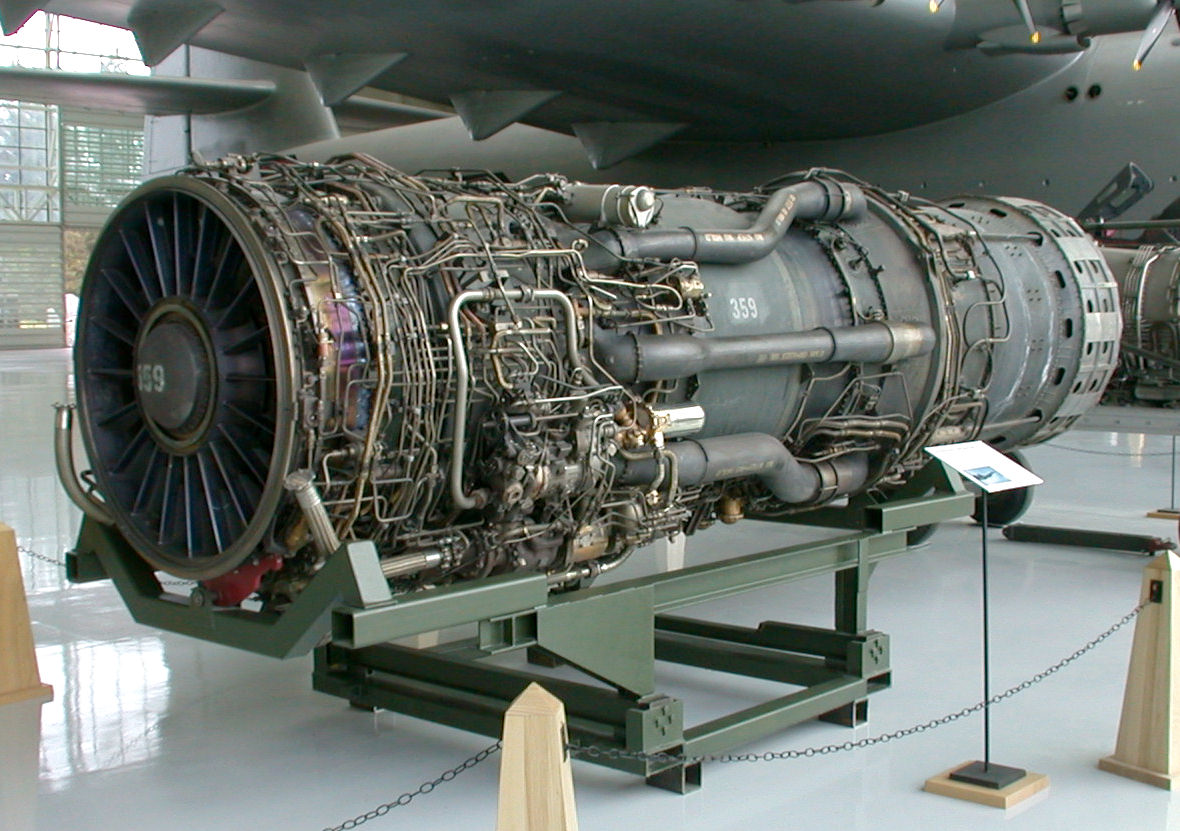
At the heart of the Blackbird's speed was the Pratt & Whitney J58, one of the most remarkable powerplants in aviation history. It was technically a turbojet, but calling it that undersells what it actually did. At low speeds, it functioned as a conventional afterburning turbojet. But as the aircraft accelerated past Mach 2.2, a system of bypass tubes began routing incoming air around the engine core and directly into the afterburner. By Mach 3, roughly 80% of the engine's thrust came from the inlet and bypass system rather than the core turbomachinery. Col. Richard Graham explained this cycle in detail in SR-71 Revealed: the J58 had effectively transformed itself from a turbojet into a ramjet, in flight, without the pilot doing anything.
The Pratt & Whitney J58 engine produced 32,500 pounds of thrust with afterburner. At Mach 3, it functioned more like a ramjet than a conventional turbojet. (U.S. Air Force)
The J58 burned JP-7, a fuel so specialized it had no equivalent. According to Pratt & Whitney's engine specifications, JP-7 had a flash point above 140 degrees Fahrenheit, meaning you could throw a lit match into a puddle of it and the match would go out. This was by design: at Mach 3, the fuel tanks doubled as heat sinks, absorbing thermal energy from the airframe. Standard jet fuel would have ignited from the heat alone. Because JP-7 was so resistant to combustion, the engines couldn't start it with a conventional ignition system. Instead, they used triethylborane, or TEB, a chemical so pyrophoric it ignites spontaneously on contact with air. Per Peter Merlin's Design and Development of the Blackbird, each engine carried a limited supply of TEB, enough for roughly six restarts per flight. The green flash of a TEB-initiated engine start became one of the Blackbird's visual signatures.
July 28, 1976: The Day the Records Fell
By the mid-1970s, the SR-71 had been operational for nearly a decade, flying reconnaissance missions over North Vietnam, North Korea, the Middle East, and the Soviet periphery. But its exact performance remained classified. The Air Force decided to let the Blackbird loose on the record books, and they picked America's bicentennial summer to do it.
On July 28, 1976, at Beale Air Force Base, California, two SR-71 crews set out to claim records recognized by the Fédération Aéronautique Internationale (FAI), the international body that certifies aviation records.
Captain Eldon W. Joersz, with reconnaissance systems officer Major George T. Morgan Jr., flew a straight-line course at an average speed of 2,193.2 miles per hour (3,529.6 km/h), Mach 3.32. FAI records certify this as the absolute speed record for an air-breathing manned aircraft, sanctioned under class C-1 (landplanes), Group III (turbojet). It has never been surpassed.
The same day, Captain Robert C. Helt and reconnaissance systems officer Major Larry A. Elliott took a second Blackbird to 85,069 feet (25,929 meters), the absolute altitude record for sustained horizontal flight in an air-breathing aircraft. At that height, the sky above is black. The curvature of the Earth is visible. And the air is so thin that an unprotected human's blood would boil at body temperature.
Air Force records from the 9th Strategic Reconnaissance Wing confirm that both records were set on the same date, at the same base, by crews from that wing. Neither record has been broken by any manned aircraft since.
What Mach 3.3 Felt Like
Numbers on paper are one thing. Flying at Mach 3.3 was something else entirely.
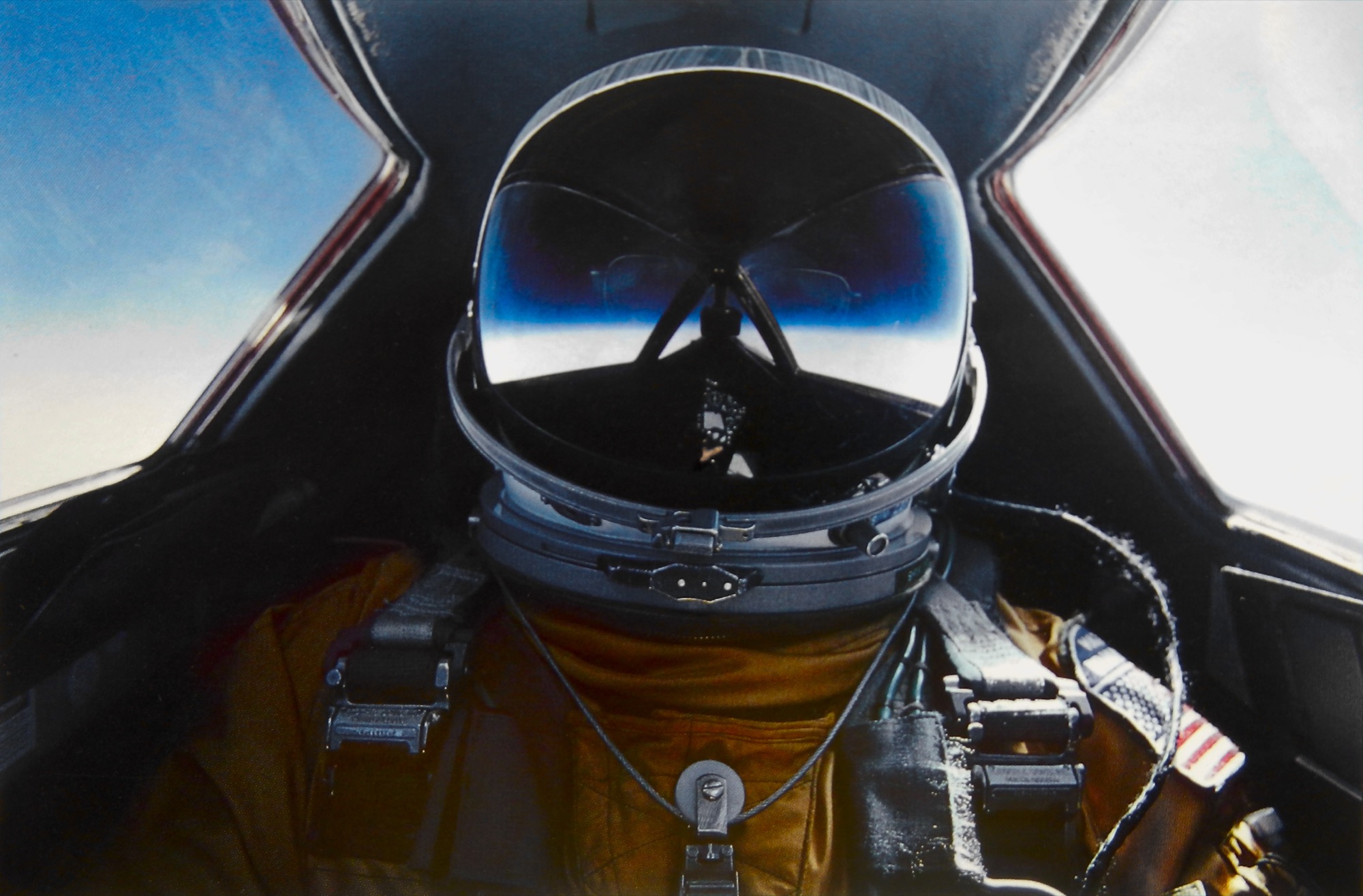
As Paul Crickmore documented in Lockheed SR-71: The Secret Missions Exposed, the pilots and RSOs (reconnaissance systems officers) wore full-pressure suits, the same David Clark Company suits used by astronauts, because at 85,000 feet the atmospheric pressure is roughly 0.4 PSI. Without the suit, exposed body fluids would vaporize. The crew compartment was pressurized, but if the cockpit breached at altitude, the suit was the only thing between the crew and the vacuum-like conditions of near-space.
SR-71 crews wore full-pressure suits identical to those used by astronauts. At operating altitude, the difference between life and death was measured in the integrity of the suit's seal. (U.S. Air Force)
Lockheed Martin's published performance data confirmed that at cruise speed, the windscreen temperature reached over 600 degrees Fahrenheit, hot enough that pilots could not touch the glass with a bare hand even from the inside. The titanium skin expanded so dramatically from thermal heating that the aircraft was actually designed with gaps in its panels on the ground. At rest on the tarmac, the SR-71 leaked fuel from these seams. It wasn't a flaw. The engineers knew that at Mach 3, thermal expansion would seal the gaps tight. The plane was literally designed to only be whole at speed.
The sensation of speed was paradoxical. Brian Shul described it in his book Sled Driver: at 80,000 feet and Mach 3, there was no sensation of velocity. The ground moved beneath you with a slow, glacial majesty. You could watch entire weather systems pass below. Los Angeles to the horizon in what felt like a glance. But the instruments told a different story. You were covering a mile every 1.6 seconds. A bullet from an M16 rifle travels at roughly 3,100 feet per second. The Blackbird was faster.
The Speed Check
No account of the Blackbird's speed would be complete without the story that has become the most repeated anecdote in aviation. As Brian Shul recounted in Sled Driver, he and his RSO Walter Watson were flying over Southern California when they heard a Cessna pilot ask Los Angeles Center for a ground speed readout. The controller responded with something in the low hundreds. A twin-engine Beechcraft then asked for its ground speed, a bit faster. Then a Navy F/A-18 pilot, clearly wanting to show off, keyed the mic and asked for his ground speed. The controller obliged: somewhere around 550 knots.
There was a pause. Then Watson, in the back seat of the Blackbird, calmly keyed the radio: "Center, Aspen 20, requesting ground speed check."
The controller's voice came back with unmistakable awe: "Aspen 20, I show you at one thousand eight hundred and forty-two knots."
Watson replied: "Ah, Center, we show closer to nineteen hundred."
The frequency went quiet.
The Speed Runs: Records That Read Like Fiction
The Blackbird didn't just set records in controlled test conditions. Some of its most jaw-dropping performances happened during operational flights and one-off demonstrations. Each of these records, certified by the FAI, still stands.
Record
Speed / Time
Date
Crew
Absolute Speed Record
2,193.2 mph (Mach 3.32)
July 28, 1976
Capt. Eldon W. Joersz / Maj. George T. Morgan Jr.
Absolute Altitude Record
85,069 ft (25,929 m)
July 28, 1976
Capt. Robert C. Helt / Maj. Larry A. Elliott
New York to London
1 hr 54 min 56.4 sec (1,806.96 mph avg)
Sept. 1, 1974
Maj. James V. Sullivan / Maj. Noel F. Widdifield
London to Los Angeles
3 hr 47 min 39 sec (1,435.59 mph avg)
Sept. 13, 1974
Capt. Harold B. Adams / Maj. William C. Machorek
Los Angeles to Washington, D.C.
1 hr 4 min 20 sec (2,144.83 mph avg)
Mar. 6, 1990
Lt. Col. Ed Yielding / Lt. Col. Joseph Vida
St. Louis to Cincinnati
8 min 32 sec (2,176.08 mph avg)
Mar. 6, 1990
Lt. Col. Ed Yielding / Lt. Col. Joseph Vida
Kansas City to Washington, D.C.
25 min 59 sec (2,200.94 mph avg)
Mar. 6, 1990
Lt. Col. Ed Yielding / Lt. Col. Joseph Vida
New York to London: September 1, 1974
On September 1, 1974, Major James V. Sullivan and Major Noel F. Widdifield flew an SR-71 from New York to London in 1 hour, 54 minutes, and 56.4 seconds. The average speed across the Atlantic was 1,806.96 mph. For context, the Concorde (the fastest commercial airliner ever) made the same trip in about 3 hours and 30 minutes. The Blackbird cut that in half and then some. A typical commercial flight today takes roughly 7 hours.
Col. Richard Graham noted in SR-71 Revealed that the route required multiple aerial refuelings from KC-135Q tankers, since the SR-71 burned fuel at roughly 44,000 pounds per hour at cruise speed. Its total fuel capacity was approximately 80,000 pounds. The tanker crews had to be positioned along the route in advance, a feat of logistics that was itself remarkable.
The Final Flight: March 6, 1990
The most famous speed run came on the Blackbird's final operational flight. On March 6, 1990, the Air Force officially retired the SR-71. Lt. Col. Ed Yielding and Lt. Col. Joseph Vida were tasked with ferrying aircraft #61-7972 from its home at Palmdale, California, to the Smithsonian's National Air and Space Museum at Dulles Airport outside Washington, D.C.
The true story of the Battle off Samar, where a handful of American destroyers and escort carriers took on the entire Japanese Center Force at the Battle of Leyte Gulf. One of the most lopsided naval engagements in history, told with the intensity it deserves.
Yielding and Vida flew from Los Angeles to Washington in 1 hour, 4 minutes, and 20 seconds, setting four city-to-city speed records along the way. The average speed for the coast-to-coast crossing was 2,144.83 mph. They covered the distance from St. Louis to Cincinnati (311 miles) in 8 minutes and 32 seconds. They were going so fast that the on-board navigation system, designed for normal flight profiles, had trouble keeping up with their ground track.
When the aircraft touched down at Dulles, its tires were still hot from the friction of reentry into denser atmosphere. The airframe was still ticking and popping as it cooled. That particular Blackbird, tail number 61-7972, is now on permanent display at the Udvar-Hazy Center. The Smithsonian's National Air and Space Museum notes its speed records on the fuselage, a museum piece that still holds records no active aircraft can touch.
Untouchable: Why the Records Still Stand
Every few years, someone asks the obvious question: why hasn't anyone broken the SR-71's speed records? The answer is layered.
There's no operational need. The reconnaissance mission the Blackbird was built for is now handled by satellites, drones, and cyber intelligence. No military is building a piloted Mach 3 reconnaissance aircraft because the mission doesn't require a pilot anymore. The RQ-4 Global Hawk and classified satellite constellations can do what the SR-71 did without risking a crew.
The engineering is still extraordinarily difficult. Sustained Mach 3 flight generates thermal and structural loads that push the boundaries of materials science. Modern aircraft materials have improved, but the fundamental physics haven't changed. Thermal management at Mach 3+ requires specialized fuels, exotic alloys, and design compromises that make the aircraft expensive and difficult to maintain. According to Air Force maintenance records, the SR-71 required over 50 hours of maintenance for every hour of flight time.
The cost is staggering. Congressional budget testimony from the late 1980s placed each SR-71 at roughly $34 million in 1990 dollars, equivalent to over $80 million today. The program's total cost, including development, was in the billions. No government or private entity has been willing to spend that kind of money to build a record-breaking manned aircraft when unmanned alternatives exist.
Hypersonic programs have taken a different path. Modern hypersonic research focuses on unmanned scramjet vehicles like the X-43A (which reached Mach 9.6 in 2004) and the X-51A Waverider. These are experimental, unmanned, and don't qualify for the same record categories. The SR-71's records are specifically for manned, air-breathing aircraft in sustained flight, a category that no one is actively competing in.
The Record That Couldn't Be Shot Down
The Blackbird's speed wasn't just for show. It was the aircraft's primary survival mechanism. During its operational career from 1966 to 1990, the SR-71 flew missions over some of the most heavily defended airspace on Earth: North Vietnam, North Korea, the Kola Peninsula, Libya, and the Soviet Far East. Col. Richard Graham documented in SR-71: The Complete Illustrated History that over the course of those missions, more than 1,000 surface-to-air missiles were fired at SR-71s.
One of the few attack helicopter options in the diecast market at this price. Includes Hellfire missile pylons, chain gun, and both main and tail rotors. 1:100 scale with display stand.
The Blackbird's defense was elegant in its simplicity: outrun everything. By the time a SAM site detected the aircraft, computed a firing solution, and launched a missile, the SR-71 was already miles past the engagement zone. The aircraft's electronic countermeasures suite, the most advanced of its era, could jam the guidance systems of Soviet SA-2 and SA-5 missiles. But even without jamming, the math was on the Blackbird's side. At Mach 3.2, the aircraft covered 54 miles every minute. A missile launched at the point of detection would be chasing a target that was accelerating away faster than the missile could close the gap.
According to Kelly Johnson's personal project logs, the standard evasive procedure for an SR-71 crew that detected a missile launch was breathtakingly simple: accelerate and climb. Push the throttles forward, gain speed, gain altitude, and let physics do the rest. No aircraft before or since has had "go faster" as its primary defensive tactic.
Air Force historical records confirm that of the 32 SR-71s built (including all A, B, and C variants), 12 were lost during the program. Every one of them went down to accidents or mechanical failures. Not a single Blackbird was ever lost to enemy action.
After the Blackbird: Retirement, Revival, and Legacy
The SR-71 was retired from Air Force service on January 26, 1990, officially a victim of budget politics. Satellites could do the job cheaper, the argument went, and the Blackbird's operating costs were enormous. The remaining aircraft were distributed to museums across the country or transferred to NASA for research.
SR-71 serial number 61-7972, which set the LA-to-DC record on its retirement flight, on permanent display at the Smithsonian's Udvar-Hazy Center. (National Air and Space Museum)
But the Blackbird refused to stay retired. Paul Crickmore reported in Lockheed SR-71: The Secret Missions Exposed that in 1995, Congress funded the reactivation of two SR-71s, arguing that satellites had limitations the Blackbird didn't. Satellites couldn't be repositioned quickly, they followed predictable orbits, and adversaries knew when they were overhead. Two aircraft from the 9th Reconnaissance Wing flew operational missions again from 1995 until the program was permanently defunded in 1998.
NASA continued flying its SR-71s (designated NASA 831 and NASA 844) as research platforms for high-speed aerodynamics experiments until October 9, 1999, when the final Blackbird flight in history took place at Edwards Air Force Base. The era of the fastest jet aircraft ever built had ended, but its records had not.
Fifty Years and Counting
As of 2026, the SR-71's absolute speed record has stood for exactly fifty years. Half a century in which computing power has increased by a factor of millions. In which stealth aircraft have become routine. In which drones can loiter over battlefields for days and humans have built a permanent space station. And yet no one has built a manned airplane that can fly faster than the one Kelly Johnson designed with slide rules and drafting tables in a windowless building in Burbank, California.
Tamiya's 1/48 Mustang offers a larger, more detailed version of America's most famous WW2 fighter. Excellent fit, a well-detailed cockpit, and the option for drop tanks or a clean configuration. A classic that has earned its reputation.
The Blackbird sits in museums now. You can see them at the Smithsonian, at the Air Force Museum in Dayton, at the Cosmosphere in Hutchinson, Kansas, at the Pima Air Museum in Tucson, and at several other locations around the country. They look like something from science fiction, long, black, impossibly sleek, even though they were built in the 1960s. Visitors stand in front of them and try to comprehend what 2,193 miles per hour means. Most can't. The human brain isn't wired to process that kind of speed.
But here's what matters: every speed record eventually falls. Chuck Yeager broke the sound barrier in 1947, and within a decade, fighters were doing it routinely. The X-15 reached Mach 6.7, and people assumed Mach 3 jets would soon be commonplace. They weren't. The SR-71 set its records and then the world moved on, not to faster aircraft, but to different ones. Stealth replaced speed. Unmanned replaced manned. The strategic calculus changed.
And so the Blackbird's records endure, not as targets waiting to be surpassed, but as monuments to a moment in history when one team of engineers, working in secrecy with technologies they had to invent as they went, built something so far beyond the state of the art that the rest of the world still hasn't caught up.
Mach 3.32. Eighty-five thousand feet. Coast to coast in sixty-four minutes.
Fifty years and counting.
Frequently Asked Questions
What is the SR-71 Blackbird's speed record?
The SR-71 holds the absolute speed record for a manned air-breathing aircraft at 2,193.2 mph (Mach 3.32 / 3,529.6 km/h). The record was set on July 28, 1976, by Captain Eldon W. Joersz and Major George T. Morgan Jr. over Beale Air Force Base, California. It is recognized by the Fédération Aéronautique Internationale (FAI) and has never been broken.
Why hasn't anyone broken the SR-71's speed record?
Several factors explain why the record still stands after 50 years. There is no military or commercial need for a manned Mach 3+ aircraft, as reconnaissance is now handled by satellites and drones. The engineering challenges of sustained Mach 3 flight remain extreme, requiring specialized fuels, exotic materials, and enormous maintenance costs. Modern hypersonic research focuses on unmanned vehicles, which don't compete in the same FAI record category.
How fast did the SR-71 fly from Los Angeles to Washington, D.C.?
On March 6, 1990, Lt. Col. Ed Yielding and Lt. Col. Joseph Vida flew from Los Angeles to Washington, D.C., in 1 hour, 4 minutes, and 20 seconds, averaging 2,144.83 mph. This was the SR-71's final operational flight, a retirement delivery to the Smithsonian's National Air and Space Museum. The aircraft set four speed records during that single flight.
Was the SR-71 ever shot down?
No. Despite flying over heavily defended airspace during the Cold War, no SR-71 was ever shot down or lost to enemy action. Over 1,000 surface-to-air missiles were fired at Blackbirds during operational missions. The aircraft's combination of extreme speed (Mach 3.2+), high altitude (85,000 feet), and electronic countermeasures made it effectively invulnerable. Of the 32 SR-71s built, 12 were lost, all to accidents or mechanical failures.
What is the "SR-71 speed check" story?
The famous speed check story comes from Brian Shul's book Sled Driver. As Shul tells it, while flying over Southern California, his RSO Walter Watson heard various aircraft asking Los Angeles Center for ground speed readouts. After a Cessna, a twin-engine aircraft, and a Navy F/A-18 each got progressively faster readings, Watson requested a speed check for their Blackbird. The controller reported 1,842 knots. Watson replied that they showed closer to 1,900. The radio went silent.
When was the SR-71 retired?
The SR-71 was retired from Air Force service on January 26, 1990. It was briefly reactivated from 1995 to 1998 after Congress funded the return of two aircraft for reconnaissance missions. NASA continued flying SR-71s as research platforms until October 9, 1999, when the final Blackbird flight took place at Edwards Air Force Base, ending the aircraft's 35-year flying career.