
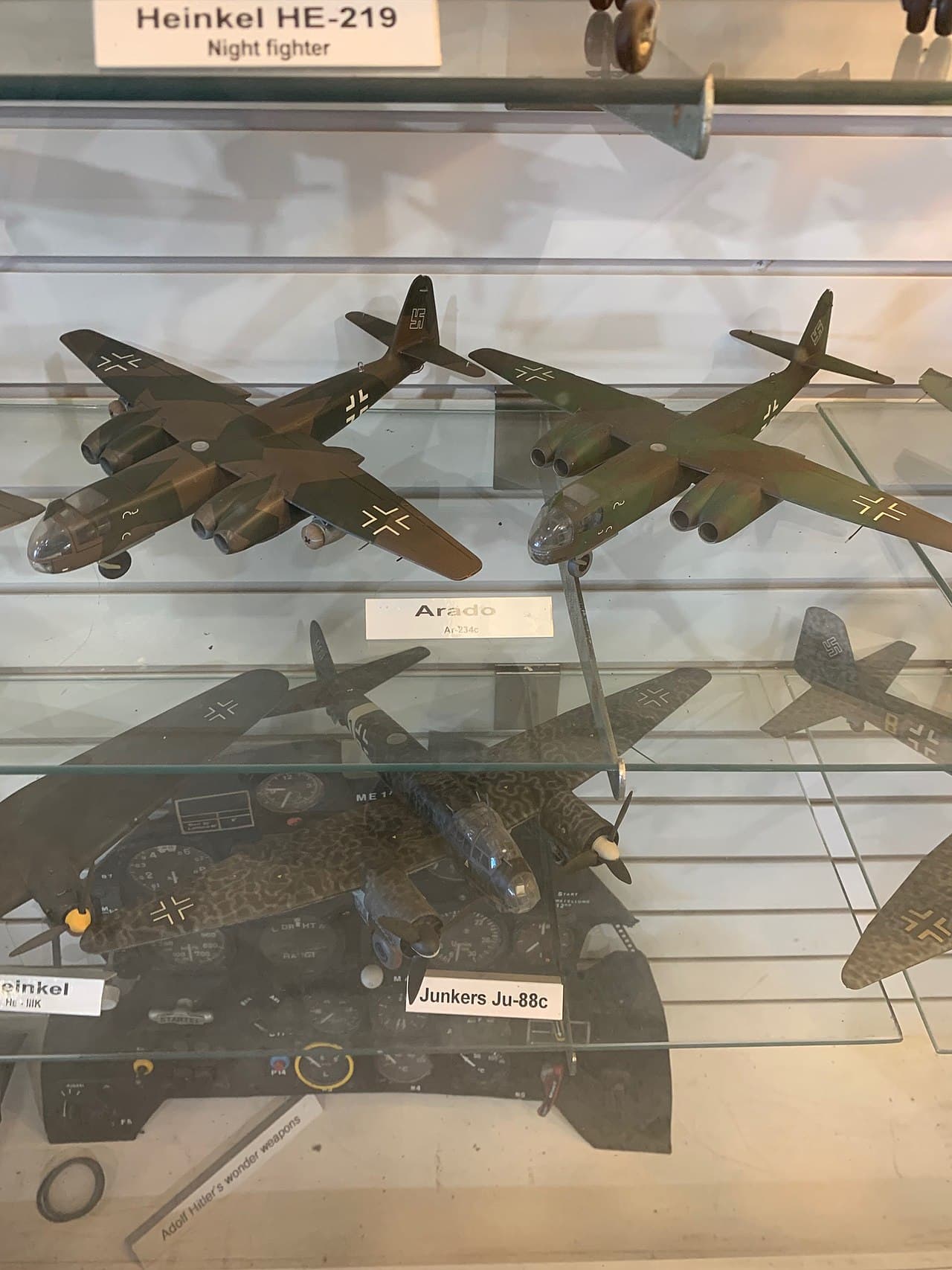
Arado Ar 234B Blitz
Arado
How does the Ar 234B stack up?
CompareOverview
The Arado Ar 234B Blitz (Lightning) was the world's first operational jet bomber and jet reconnaissance aircraft. Sleek, fast, and nearly impossible to intercept, the Ar 234 represented a quantum leap in bomber design. At 461 mph, it was faster than most Allied piston-engined fighters and could operate at altitudes where interception was extremely difficult. In the reconnaissance role, it was virtually immune to interception, no Allied aircraft could catch it.
The Ar 234B was a remarkably clean design for a wartime aircraft. Its slim fuselage housed a single pilot in a pressurized, glazed nose cockpit with an excellent view for bombing. The two Jumo 004B jet engines were mounted in underwing pods, and bombs were carried on external racks beneath the engines and fuselage. A periscopic bomb sight and an autopilot allowed the pilot to function as his own bombardier, an unusual arrangement dictated by the need to keep the aircraft as small and light as possible.
Only 214 Ar 234s were completed, and they arrived far too late to influence the war's outcome. But the aircraft demonstrated what jet-powered bombing could achieve: speed that made interception impractical, altitude that put it above most anti-aircraft fire, and precision that was adequate for tactical targets. The Ar 234 pointed unmistakably toward the future of aerial warfare.
Performance Profile
Max Speed
461 mph
at 19,685 ft
Range
1,013 miles
normal
Service Ceiling
32,810 ft
Rate of Climb
2,362 ft/min
Armament
2 guns
2x 20mm MG 151/20 (rear-firing)
Crew
1
Engine
Junkers Jumo 004B-1
1980 hp jet
Development History
Arado's design team, led by Professor Walter Blume, began work on a jet-powered reconnaissance aircraft in 1941 under the designation E.370. The original concept was radical: the aircraft had no undercarriage at all, launching from a jettisonable wheeled trolley and landing on retractable skids. This saved weight and internal volume but made the aircraft impractical for operational use, since it had to be lifted onto its trolley by a crane after each mission.
The first prototype, the Ar 234 V1, made its maiden flight on June 15, 1943, using the trolley-and-skid system. Test flights confirmed exceptional performance, the aircraft easily exceeded 460 mph, but the recovery system was clearly unworkable for combat operations. Arado redesigned the fuselage to accommodate a conventional tricycle undercarriage in the Ar 234B variant, which became the production version.
The transition to the B-model with its tricycle gear required a wider fuselage, which slightly increased drag but transformed the aircraft into a practical operational type. The cockpit, located in the extreme nose with a fully glazed transparency, gave the pilot an extraordinary forward and downward view. A Lotfe 7K bomb sight was integrated with the BZA autopilot, allowing hands-free bombing runs, essential since the single pilot had to fly, navigate, and bomb simultaneously.
Production was slow and erratic. Jumo 004 engine supplies were the primary bottleneck, the same engines were needed for the Me 262, which had higher production priority. Allied bombing of Arado's facilities at Alt-Loennewitz and Brandenburg further disrupted output. By war's end, only 214 Ar 234B aircraft had been completed, with many never reaching operational units due to fuel shortages and disrupted transportation.
Combat History
The Ar 234 first saw operational use in the reconnaissance role in August 1944, when Sonderkommando Gotz flew unarmed Ar 234B-1 aircraft over Allied-held France and the Normandy beachheads. These missions were spectacularly successful, the aircraft flew too fast and too high for any Allied fighter to intercept, bringing back the first complete photographic coverage of the invasion beaches and Allied buildup areas since D-Day. For the first time since the summer, German intelligence had accurate information about Allied dispositions.
The bomber variant entered service with KG 76 in late 1944. The Ar 234B-2 bomber's first significant action came during the Ardennes Offensive (Battle of the Bulge) in December 1944, when KG 76 flew tactical bombing missions against Allied supply lines and troop concentrations in Belgium. The jet bombers operated with near-impunity, Allied fighters could rarely intercept them, and anti-aircraft fire was largely ineffective against their speed and altitude.
The most famous Ar 234 mission was the repeated bombing of the Ludendorff Bridge at Remagen in March 1945. After American forces captured this last intact bridge across the Rhine on March 7, the Luftwaffe threw everything available against it, including Ar 234B bombers from KG 76. The jet bombers made multiple attack runs over several days, scoring near-misses that may have contributed to the bridge's eventual structural collapse on March 17, though the primary cause was cumulative battle damage.
In the reconnaissance role, the Ar 234 remained essentially invulnerable to the end. The final reconnaissance missions flown over Allied territory in April 1945 were conducted by Ar 234s, the last German aircraft capable of penetrating Allied airspace and returning. Several Ar 234s were captured intact at war's end and were extensively tested by both American and British aviation establishments.
Variants
| Designation | Key Differences | Produced |
|---|---|---|
| Ar 234B-1 | Unarmed reconnaissance variant with two Rb 50/30 or Rb 75/30 cameras in the rear fuselage. No bomb racks. Used by Sonderkommando Gotz and 1.(F)/100 for high-speed photographic reconnaissance. | - |
| Ar 234B-2 | Standard bomber variant with ETC 503 underfuselage bomb rack and two underwing racks. Could carry up to 1,500 kg of bombs. Lotfe 7K bomb sight with BZA autopilot for hands-free bombing runs. | 148 |
| Ar 234B-2/N | Night fighter conversion with FuG 218 Neptun radar in the nose, 2x MG 151/20 cannon in ventral tray, and second crew member squeezed into the rear fuselage. Only a small number converted. | - |
| Ar 234C | Four-engined variant with 4x BMW 003A-1 jets replacing the 2x Jumo 004B. Improved performance with top speed of 546 mph, but only 14 completed before war's end. None saw operational service. | 14 |
Strengths & Weaknesses
+Strengths
- Fastest operational bomber of the war at 461 mph, virtually immune to fighter interception
- Excellent reconnaissance platform due to speed, altitude capability, and glazed nose visibility
- JATO (jet-assisted takeoff) rockets available to shorten takeoff run from short or damaged runways
- Pressurized cockpit and autopilot-integrated bomb sight enabled accurate high-altitude bombing by a single pilot
-Weaknesses
- Single pilot had to simultaneously fly, navigate, bomb, and monitor engines, an extreme workload
- Same fragile Jumo 004 engines as the Me 262, with short operational life and throttle response limitations
- No forward-firing armament left it unable to engage enemy aircraft or strafe ground targets
- External bomb carriage increased drag significantly, reducing the speed advantage that was the aircraft's primary defense
Pilot Voices
“In the Arado, you felt invincible. Nothing could catch you, nothing could touch you. You flew over the enemy and there was nothing they could do about it.”
“The workload was incredible. You were pilot, navigator, bombardier, and gunner all in one. There was no moment of rest from takeoff to landing.”
Did You Know?
The original Ar 234 prototypes had no landing gear at all, they launched from a jettisonable three-wheeled trolley and landed on retractable belly and wing skids. This was abandoned as impractical since the aircraft had to be craned back onto its trolley after each mission.
Ar 234 reconnaissance aircraft brought back the first German aerial photographs of the Normandy invasion beaches since D-Day. No Allied fighter could catch them, and the photos revealed the massive scale of the Allied buildup.
The Ar 234B carried two rear-facing MG 151/20 cannon aimed by a periscope, the pilot looked backward through the scope while the autopilot flew the aircraft. This unusual arrangement was adequate only as a deterrent, since accurate gunnery while looking through a periscope was nearly impossible.
