
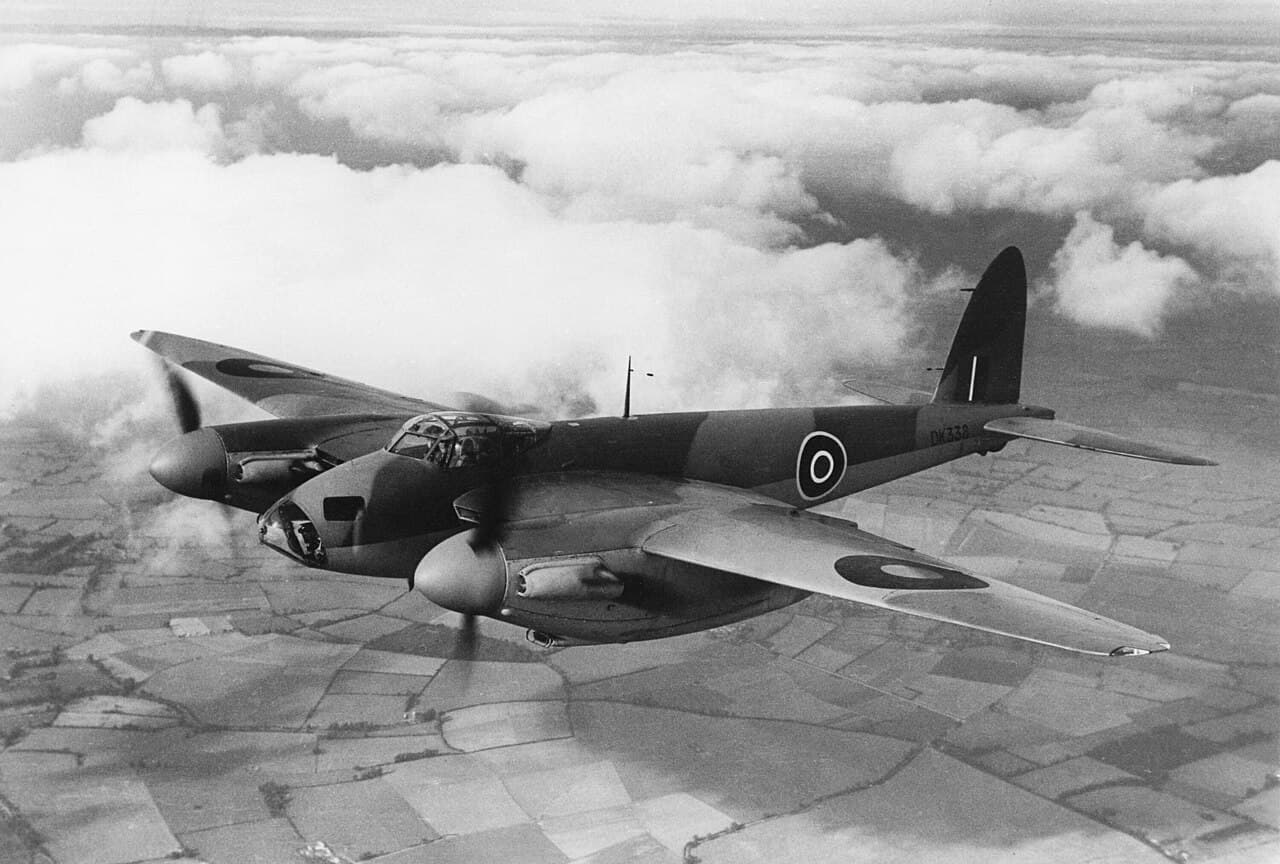
de Havilland Mosquito B Mk IV
de Havilland
How does the Mosquito B Mk IV stack up?
CompareOverview
The de Havilland Mosquito was one of the most remarkable aircraft of the Second World War, a wooden wonder that could outrun most fighters while carrying a useful bomb load. The B Mk IV was the first dedicated bomber variant, entering service with No. 105 Squadron in mid-1942 and immediately demonstrating that speed could replace defensive armament as a survival strategy.
Built almost entirely of wood using a stressed-skin balsa and plywood sandwich construction, the Mosquito was conceived at a time when the Air Ministry doubted that a wooden aircraft could perform in modern warfare. Geoffrey de Havilland proved them spectacularly wrong, creating a twin-engine aircraft that was faster than the Spitfire Mk V when it first flew, needed no defensive gunners, and could be built by furniture factories rather than competing for scarce aluminum.
The Mosquito ultimately served in more roles than any other British aircraft of the war: day and night bomber, night fighter, pathfinder, photo-reconnaissance, anti-shipping strike, intruder, and even carrier-borne fighter. The B Mk IV established the bomber lineage that would evolve through the legendary B Mk XVI and B Mk 35, carrying the precision bombing campaign deep into the heart of the Reich.
Performance Profile
Max Speed
380 mph
at 21,000 ft
Range
1,620 miles
normal
Service Ceiling
34,000 ft
Rate of Climb
2,850 ft/min
Armament
0 guns
Crew
2
Engine
Rolls-Royce Merlin 21
1460 hp inline
Development History
The Mosquito was born from Geoffrey de Havilland's radical 1938 proposal for a high-speed unarmed bomber built of wood. The Air Ministry was deeply skeptical, wooden construction seemed archaic, and the idea of a bomber with no defensive guns went against all prevailing doctrine. Only the personal advocacy of Air Marshal Sir Wilfrid Freeman, who championed the project against bureaucratic resistance, kept it alive.
De Havilland designed the aircraft around two Rolls-Royce Merlin engines and a crew of two sitting side by side. The wooden construction used a sandwich of balsa between two layers of birch plywood, formed over concrete molds, creating a structure that was both lightweight and remarkably strong. This technique meant production could be dispersed to furniture manufacturers, cabinet makers, and other woodworking firms not needed for metal aircraft production.
The prototype first flew on November 25, 1940, and immediately exceeded all performance expectations. It was 20 mph faster than the Spitfire Mk II and could reach altitudes beyond the effective ceiling of most Luftwaffe interceptors. The Air Ministry quickly ordered bomber, fighter, and reconnaissance variants simultaneously.
The B Mk IV was the first bomber Mosquito to enter production, featuring a shortened engine nacelle and a bomb bay capable of carrying four 500 lb bombs internally. Early aircraft were unarmed, relying entirely on speed for survival. The philosophy proved sound, Mosquito bomber losses were consistently the lowest of any Bomber Command type, running at less than one percent per sortie through much of the war.
Combat History
The Mosquito B Mk IV entered combat spectacularly on May 31, 1942, when four aircraft of No. 105 Squadron conducted a dramatic low-level raid on Cologne the morning after the first Thousand Bomber Raid, photographing the damage while Luftwaffe fighters were still recovering. This audacious debut set the tone for the Mosquito's entire operational career.
Throughout 1942-1943, Mosquito bombers conducted precision daylight raids at low and medium altitude against high-value targets across occupied Europe. The most famous early operation was the raid on Gestapo headquarters at Oslo on September 25, 1942, where Mosquitos placed bombs through specific windows of the target building. These surgical strikes were beyond the capability of any other bomber in the Allied arsenal.
The B Mk IV also pioneered the Pathfinder role with No. 109 Squadron, using the Oboe blind-bombing system to mark targets for the main Bomber Command force. Flying at 28,000 feet and over 300 mph, Oboe Mosquitos were virtually immune to interception and could place target markers with unprecedented accuracy, revolutionizing the night bombing campaign.
As the war progressed, later bomber Mosquitos (the B Mk IX, XVI, and 25) carried increasingly heavy loads, eventually including the 4,000 lb "Cookie" blockbuster bomb in a bulged bomb bay. But it was the B Mk IV that proved the concept: that a fast, wooden, unarmed bomber crewed by just two men could be more effective and far less costly in lives than formations of heavy bombers requiring thousands of aircrew.
Variants
| Designation | Key Differences | Produced |
|---|---|---|
| B Mk IV Series i | Initial production bomber with short engine nacelles; could carry four 250 lb or four 500 lb bombs internally. | 50 |
| B Mk IV Series ii | Main production variant with provision for drop tanks and bomb bay modifications for larger stores. | 223 |
| NF Mk II | Night fighter variant with AI Mk IV radar, four 20mm cannon and four .303 machine guns in a solid nose. | 466 |
| PR Mk IV | Photo-reconnaissance variant with cameras replacing bomb bay; among the highest-flying Allied reconnaissance aircraft. | - |
| FB Mk VI | Fighter-bomber with four 20mm cannon, four .303 guns, and two 500 lb bombs or eight rockets; most-produced variant. | 2,718 |
| B Mk XVI | Pressurized high-altitude bomber with two-stage Merlin 72/73 and bulged bomb bay for 4,000 lb Cookie. | 1,200 |
Strengths & Weaknesses
+Strengths
- Faster than most contemporary fighters, making defensive armament unnecessary
- Wooden construction freed up aluminum for other aircraft and used non-strategic materials
- Extraordinary versatility with over 30 variants covering nearly every conceivable role
- Two-man crew dramatically reduced aircrew losses compared to heavy bombers with 7-10 crew
-Weaknesses
- Wooden structure was vulnerable to tropical conditions, with glue failures in humid climates
- No defensive armament meant any loss of speed (engine failure) left the crew defenseless
- Relatively small bomb load of 2,000 lbs compared to heavy bombers carrying 10,000+ lbs
- The side-by-side seating made emergency egress difficult, with a low bail-out survival rate
Pilot Voices
“The Mosquito was a pilot's dream. Two Merlins, no gunners to worry about, faster than the fighters sent to catch us, and a bomb bay that could ruin any target's day.”
“In the Mossie, we relied on speed and altitude. If you kept both, nothing could touch you. If you lost either, you were in serious trouble.”
Did You Know?
The Mosquito was built by furniture companies including E. Gomme (makers of G-Plan furniture), using skills in woodworking that metal aircraft factories did not possess.
Mosquito bombers suffered a loss rate of only 0.63% per sortie, the lowest of any Bomber Command type, vindicating the unarmed speed bomber concept.
Hermann Goering was reportedly furious that a wooden aircraft could outperform Luftwaffe fighters, declaring it made him "green and yellow with envy" that British industry could build such machines while Germany could not.


