
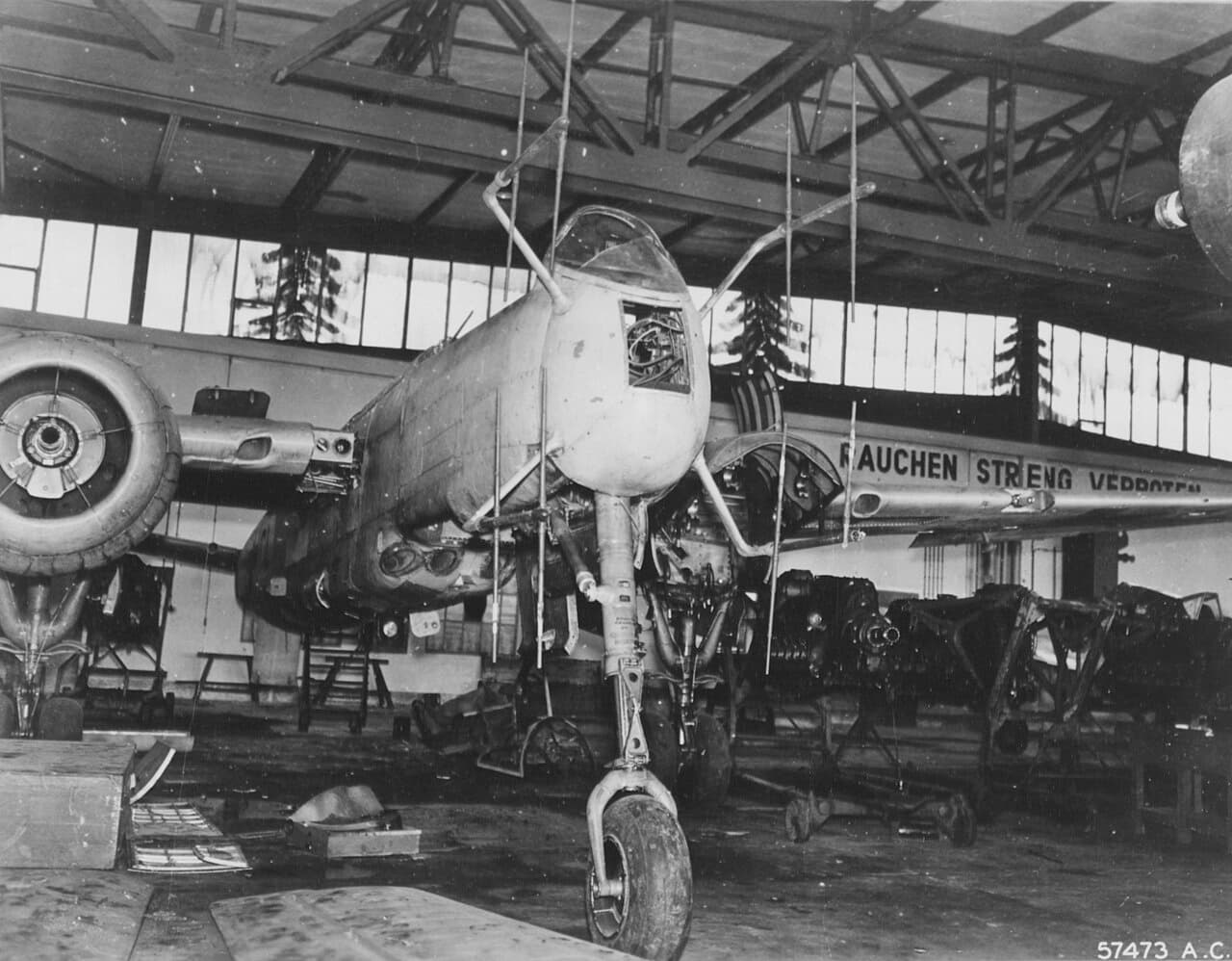
Heinkel He 219A Uhu
Heinkel
How does the He 219A stack up?
CompareOverview
The Heinkel He 219A Uhu (Eagle Owl) was the Luftwaffe's first purpose-designed night fighter and, by the assessment of many historians, the best dedicated night fighter of the entire war. Fast, heavily armed, and equipped from the outset with FuG 220 Lichtenstein SN-2 airborne interception radar, the Uhu represented exactly what Germany's night defense force needed, and it arrived in frustratingly small numbers due to political interference and production disputes.
On its first operational sortie on the night of June 11-12, 1943, Major Werner Streib shot down five RAF bombers in a single mission, including two of the feared de Havilland Mosquitos that had previously been virtually immune to night fighter interception. This remarkable debut confirmed what test pilots had already reported: the He 219 was fast enough to catch Mosquitos, well-armed enough to destroy heavy bombers in a single pass, and agile enough for a twin-engined aircraft to hold its own in combat maneuvering.
The Uhu was also the first operational military aircraft equipped with ejection seats, a prescient safety feature that saved several crews. Its tricycle landing gear provided excellent ground handling and forward visibility during night taxiing. Yet despite its obvious superiority, the He 219 was produced in only 294 examples, a victim of bureaucratic infighting between Heinkel and Erhard Milch's production ministry, which favored the cheaper and more readily available Ju 88G as the standard night fighter.
Performance Profile
Max Speed
416 mph
at 22,965 ft
Range
960 miles
normal
Service Ceiling
41,660 ft
Rate of Climb
1,804 ft/min
Armament
6 guns
2x 30mm MK 108, 2x 20mm MG 151/20, 2x 30mm MK 108 (Schrage Musik)
Crew
2
Engine
Daimler-Benz DB 603G
1900 hp inline
Development History
Ernst Heinkel had been developing the He 219 design since 1940 as a multi-role combat aircraft, but the project received low priority until the RAF's night bombing campaign forced the Luftwaffe to take night defense seriously. The original concept was for a high-speed, long-range fighter capable of operating as a bomber destroyer, intruder, and night fighter. As the night bombing threat grew, the design was progressively optimized for the dedicated night fighter role.
The He 219 V1 prototype flew on November 6, 1942, powered by two Daimler-Benz DB 603A engines. It was immediately obvious that the aircraft had exceptional performance, fast, with good climb and a service ceiling above 40,000 feet. The tricycle landing gear, unusual for German aircraft of the period, provided superb ground handling and eliminated the visibility problems that plagued tail-dragging night fighters during taxi and takeoff.
The path to production was bitterly contested. Erhard Milch, head of aircraft procurement, opposed the He 219 on grounds that it diverted resources from established types like the Ju 88, which could be adapted for night fighting at lower cost. Milch twice attempted to cancel the program entirely, and was only overruled by direct intervention from the night fighter force and its commanders. This political battle delayed and limited production throughout the He 219's career.
Production that did occur was plagued by the competing demands of too many sub-variants. Heinkel proposed dozens of versions optimized for different missions and engine combinations, the A-0, A-2, A-5, A-6, and A-7, each with multiple equipment fits, which prevented the economies of scale that high-volume production required. The DB 603G engines fitted to late-production aircraft delivered 1,900 hp each, giving the He 219 performance figures that few night fighters could match, but by 1944 the damage from limited production had been done.
Combat History
The He 219's operational career was concentrated primarily with I./NJG 1 at Venlo in the Netherlands, the unit chosen to prove the type in combat. Major Werner Streib's astonishing five-kill debut mission on June 11-12, 1943, set the tone for the aircraft's career, when available and properly maintained, the Uhu was devastating. In its first six operational sorties, He 219 crews claimed twenty bombers destroyed, including six Mosquitos.
The ability to catch and kill Mosquitos was particularly significant. The de Havilland Mosquito had been operating over Germany with virtual impunity, using its speed to outrun any night fighter in the Luftwaffe inventory. The Bf 110G and Ju 88 variants could not match its performance, but the He 219A, with a clean top speed of 416 mph, could engage the Mosquito on near-equal terms. This capability alone justified the type's existence in the eyes of night fighter commanders.
Despite its combat effectiveness, the He 219 never equipped more than a handful of Staffeln. NJG 1 remained the primary operator throughout, with small numbers reaching NJG 2 and NJG 3. The chronic shortage of aircraft meant that the Uhu could not be concentrated in sufficient numbers to have a decisive impact on the night air battle, even though individual sortie results were consistently impressive.
By late 1944, the He 219 force was being ground down by attrition that could not be replaced by the trickle of new production. Allied intruder Mosquitos targeted He 219 bases, and the general collapse of German infrastructure made spare parts and fuel increasingly scarce. The surviving Uhus flew their final combat missions in the spring of 1945, their pilots knowing they were flying what many considered the best night fighter of the war, in numbers too small to matter.
Variants
| Designation | Key Differences | Produced |
|---|---|---|
| He 219A-0 | Pre-production variant with DB 603A engines (1,750 hp each). Used for operational evaluation with NJG 1. Armament varied between individual aircraft. | 104 |
| He 219A-2 | Intended standard production variant with DB 603E engines, optimized armament of 2x MK 108 and 2x MG 151/20 forward, plus Schrage Musik installation. FuG 220 SN-2 radar as standard. | - |
| He 219A-5 | Simplified production variant with reduced equipment list to accelerate manufacturing. Some radar equipment deleted for use as high-speed intruder. | - |
| He 219A-7 | Final production variant with DB 603G engines (1,900 hp), six forward-firing cannon (2x MK 108, 4x MG 151/20), and Schrage Musik. Most powerful He 219 sub-variant. | 102 |
Strengths & Weaknesses
+Strengths
- Fast enough to intercept de Havilland Mosquitos, a feat no other German night fighter could reliably accomplish
- Purpose-designed night fighter with excellent radar integration, spacious cockpit, and good crew visibility
- Tricycle landing gear provided superior ground handling for night operations and eliminated ground-loop risks
- Pioneered ejection seats in an operational combat aircraft, saving several crews
-Weaknesses
- Produced in far too few numbers (294 total) to have a strategic impact on the night air battle
- Complex airframe with too many sub-variants hampered production efficiency
- DB 603 engines, while powerful, were less reliable than the more mature DB 605 used in the Bf 110G
- Large size made it detectable on radar at longer ranges and vulnerable to intruder attacks on the ground
Pilot Voices
“The He 219 was everything a night fighter pilot could wish for. It was fast, powerful, and the cockpit was laid out as if the designers had actually talked to the men who had to fly and fight at night.”
“When I first flew the Uhu, I knew immediately that this was the aircraft we had been waiting for. It could do everything, find them, catch them, and destroy them.”
Did You Know?
The He 219 was the first operational military aircraft to feature ejection seats. The compressed-air catapult system fired both crew members clear of the aircraft in an emergency, the pilot through the canopy and the radar operator through a separate hatch.
On its very first combat sortie, an He 219 shot down five bombers including two Mosquitos, a type that had been previously considered immune to night fighter interception.
Erhard Milch, in charge of German aircraft production, tried to cancel the He 219 program twice in favor of the cheaper Ju 88G. Night fighter crews threatened to refuse to fly the Ju 88 if their He 219s were taken away.

