
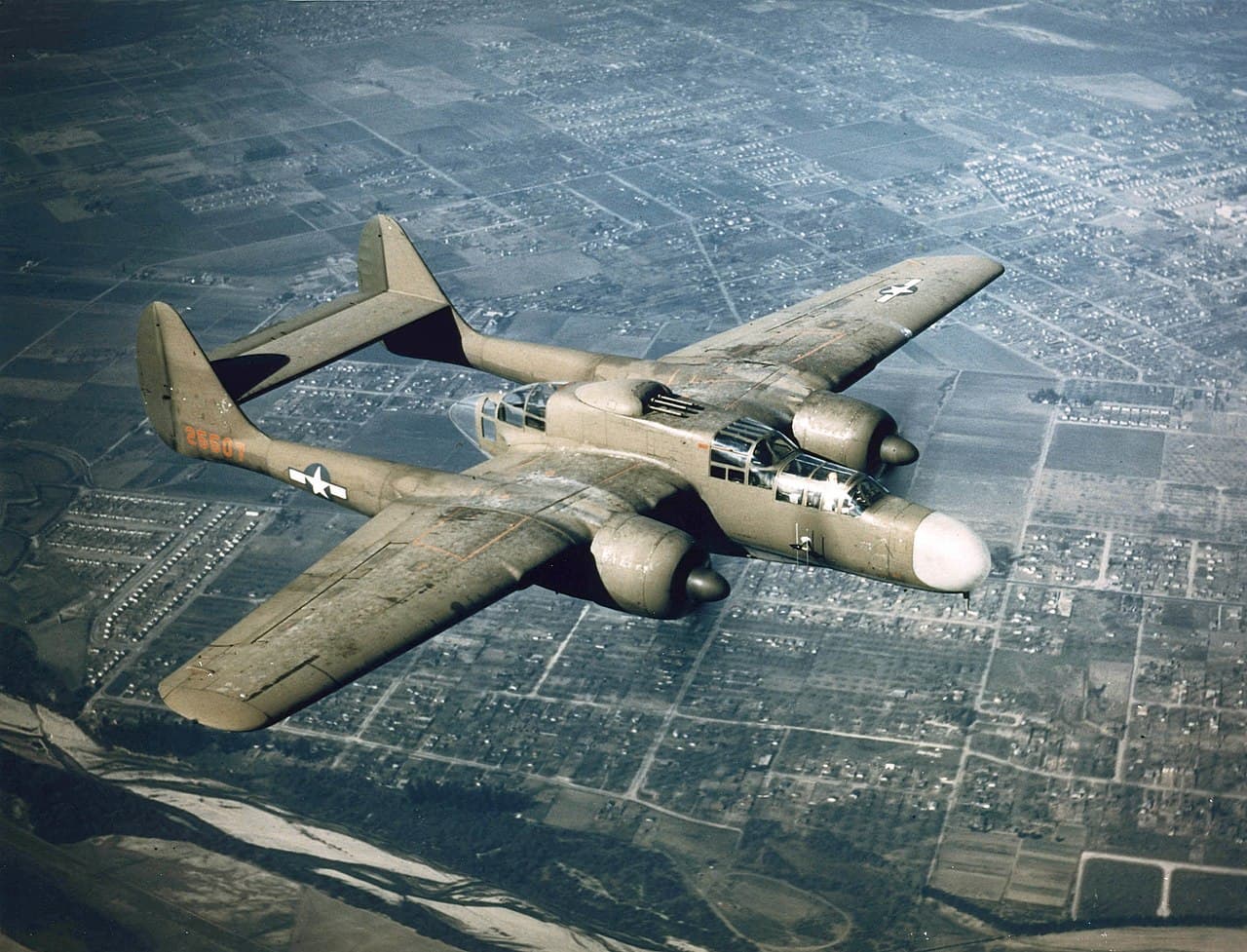
Northrop P-61B Black Widow
Northrop
How does the P-61B stack up?
CompareOverview
The Northrop P-61 Black Widow was the first aircraft specifically designed from the ground up as a radar-equipped night fighter. This massive, twin-engine, twin-boom aircraft was the largest and heaviest fighter of the war, weighing over 36,000 pounds fully loaded, more than a medium bomber. Painted entirely in glossy black to reduce visibility at night, the Black Widow carried the SCR-720 airborne intercept radar in its nose and was crewed by a pilot, radar operator, and gunner.
Armed with four 20mm cannons in a ventral pod and four .50-caliber machine guns in a remote-controlled dorsal turret, the P-61 packed the firepower of a destroyer escort. It could also carry up to 6,400 pounds of bombs on wing pylons, giving it genuine ground-attack capability. The Black Widow's ability to find, track, and destroy enemy aircraft in total darkness represented a quantum leap in night air defense.
Though only 706 were built and it arrived relatively late in the war, the P-61 served in both the European and Pacific theaters, shooting down enemy aircraft from Normandy to Okinawa. It was one of the most technologically advanced aircraft of the war and a direct ancestor of the dedicated night-fighter and all-weather interceptor concepts that would become essential in the Cold War era.
Performance Profile
Max Speed
366 mph
at 20,000 ft
Range
1,900 miles
normal
Service Ceiling
33,100 ft
Rate of Climb
2,540 ft/min
Armament
8 guns
4x 20mm, 4x .50 BMG
Crew
3
Engine
Pratt & Whitney R-2800-65 Double Wasp
2000 hp radial
Development History
The P-61's genesis lay in the Battle of Britain, where German night bombing raids devastated British cities. In September 1940, the Army Air Corps issued a requirement for a dedicated night fighter after observing British efforts to counter the Blitz. Northrop's Jack Northrop and chief designer Vladimir Pavlecka proposed a large twin-boom design optimized around the top-secret SCR-720 airborne intercept radar, which required a spacious nose section for its antenna dish.
The XP-61 prototype first flew on May 26, 1942, and quickly demonstrated that the concept worked. The large airframe accommodated the heavy radar and electronics, the twin Pratt & Whitney R-2800 engines provided adequate performance despite the aircraft's weight, and the spacious crew stations allowed the three-man crew to work effectively during the stress of night combat. However, the development of the radar, turret, and other systems took time, delaying the aircraft's operational debut.
The P-61A entered service in early 1944, though many early aircraft were delivered without the dorsal turret due to buffet problems that the rotating turret caused at certain angles. The P-61B, which followed quickly, solved the turret issues (though many B models also shipped without the turret), added four external pylons for bombs or drop tanks, and featured the improved SCR-720C radar. Northrop built the P-61B at their Hawthorne, California facility.
A high-altitude variant, the P-61C, incorporated turbochargers and more powerful R-2800-73 engines producing 2,800 hp with water injection. Only 41 were completed before the war's end. The P-61 design was also adapted into the F-15 Reporter photo-reconnaissance aircraft (no relation to the later McDonnell Douglas F-15).
Combat History
The P-61 Black Widow's first operational deployment was with the 422nd and 425th Night Fighter Squadrons in England, arriving in time for the D-Day invasion. The 422nd NFS scored the P-61's first confirmed kill on July 7, 1944, when a crew shot down a Junkers Ju 88 night intruder over Normandy. Through the summer and fall of 1944, Black Widows patrolled the night skies over France and the Low Countries, intercepting Luftwaffe bombers and intruders attempting to harass Allied supply lines.
In the Mediterranean, the 414th, 415th, 416th, and 417th Night Fighter Squadrons operated P-61s, converting from Douglas P-70 Havocs and Bristol Beaufighters. These units flew night patrols over southern France and Italy, intercepting German bombers and reconnaissance aircraft. The P-61 proved particularly effective in its ability to loiter for extended periods, find targets with its radar, and close to gun range without being detected.
The Pacific theater saw the widest P-61 deployment. Night fighter squadrons including the 6th, 418th, 419th, 421st, and 547th NFS operated Black Widows from New Guinea, the Philippines, Okinawa, and Iwo Jima. Pacific P-61 crews intercepted Japanese bombers, night reconnaissance aircraft, and "washing machine Charlie" harassment raiders that disrupted sleep at Allied airfields. The 421st NFS scored the last aerial victory of the war on August 14, 1945, shooting down a Japanese aircraft over Japan.
Beyond night interception, P-61 crews also flew night intruder missions, using the aircraft's heavy bomb load to attack enemy airfields, rail yards, and supply routes. The Black Widow's ability to deliver 6,400 pounds of ordnance accurately at night made it a valuable strike platform.
Variants
| Designation | Key Differences | Produced |
|---|---|---|
| P-61A | Initial production, R-2800-10, many delivered without dorsal turret due to buffet | 200 |
| P-61B | Four external pylons, improved SCR-720C radar, longer nose, most-produced variant | 450 |
| P-61C | Turbocharged R-2800-73 (2,800 hp), improved performance, arrived too late for combat | 41 |
| F-15 Reporter | Photo-reconnaissance derivative, cameras in nose replacing radar, unarmed | 36 |
Strengths & Weaknesses
+Strengths
- First purpose-built radar-equipped night fighter; SCR-720 radar could detect targets at several miles
- Devastating firepower: four 20mm cannon plus four .50-caliber guns
- Enormous ordnance capacity of 6,400 lbs gave it genuine bomber capability
- Three-man crew allowed effective workload distribution during complex night intercepts
- Excellent loiter time and range for extended night patrols
-Weaknesses
- Extremely large and heavy for a fighter; lacked the agility to dogfight conventional single-engine aircraft
- Relatively slow compared to contemporary single-engine fighters
- Complex to maintain, requiring specialized radar technicians and extensive ground support
- Limited production numbers meant it could never fully equip all night fighter squadrons
- Early dorsal turret buffet problems forced many aircraft to be delivered without the turret
Pilot Voices
“You couldn't see a thing out there, just black. But the radar operator would talk you in, calling range and bearing, until suddenly a shadow would appear in your windscreen and you'd open fire.”
“The Black Widow was a real weapons system, not just an airplane. The radar, the guns, the crew, it all worked together like nothing else we had.”
Did You Know?
The P-61 was the largest and heaviest fighter of World War II, weighing more than many medium bombers when fully loaded at 36,200 pounds.
Black Widow crews scored the last confirmed aerial victory of the war when the 421st NFS shot down a Japanese aircraft on August 14, 1945, just hours before the ceasefire.
The remote-controlled dorsal turret was so powerful that its recoil would pitch the aircraft nose-down when fired directly forward, requiring careful coordination between the gunner and pilot.
Jack Northrop designed the P-61 as a stepping stone toward his true passion: flying wing aircraft. The twin-boom layout kept the central fuselage clean and influenced his later YB-35 and YB-49 designs.


