
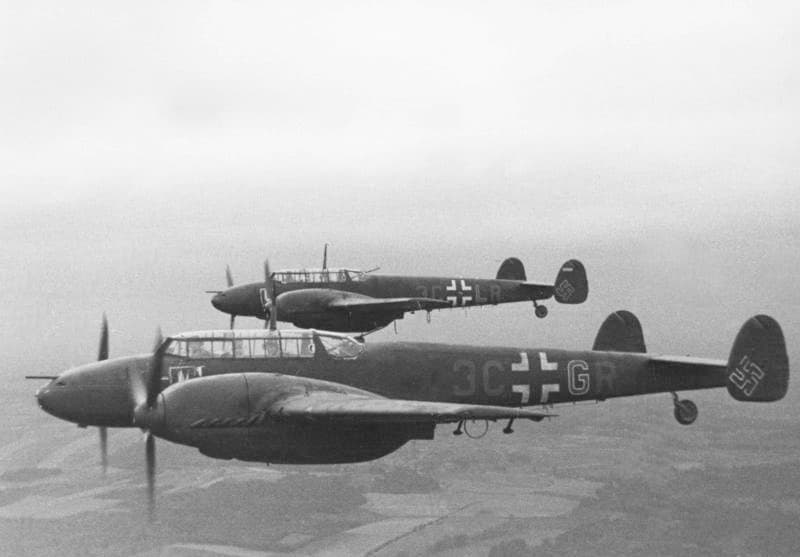
Messerschmitt Bf 110G
Messerschmitt
How does the Bf 110G stack up?
CompareOverview
The Messerschmitt Bf 110G was the definitive variant of the Luftwaffe's twin-engined heavy fighter, and while it inherited the Zerstorer (Destroyer) nickname from its earlier brethren, the G-model found its true calling not in daytime air combat but in the nocturnal skies over the Reich. After the Bf 110's humiliating losses during the Battle of Britain revealed its vulnerability to single-engined fighters, the aircraft was progressively redirected toward roles that exploited its genuine strengths: long endurance, heavy armament, and the ability to carry radar equipment.
Fitted with FuG 202/212 Lichtenstein radar and the lethal Schrage Musik (Jazz Music) upward-firing cannon installation, the Bf 110G became the Nachtjagd's most numerous and most effective night fighter during the critical years of 1943-44. Its two-man crew, pilot and radar operator, worked in concert to stalk RAF Bomber Command's Lancasters and Halifaxes through the darkness, closing to point-blank range before unleashing devastating bursts of 20mm and 30mm cannon fire.
The Bf 110G also served effectively as a bomber destroyer during daylight, using Wfr.Gr. 21 rocket mortars to break up American bomber formations before closing in with its heavy cannon armament. In this role it was dangerously vulnerable to escort fighters, but the aircraft's combination of firepower and survivability made it a potent weapon in the right tactical circumstances.
Performance Profile
Max Speed
342 mph
at 22,965 ft
Range
900 miles
normal
Service Ceiling
32,800 ft
Rate of Climb
2,165 ft/min
Armament
5 guns
2x 20mm MG 151/20, 2x 30mm MK 108, 1x 7.92mm MG 81Z (rear)
Crew
2
Engine
Daimler-Benz DB 605B
1475 hp inline
Development History
The Bf 110 was originally conceived in 1934 as a long-range escort fighter, the "strategic fighter" concept that Hermann Goering championed. Early variants performed well in the Polish and French campaigns, where air opposition was limited, but the type suffered devastating losses against Spitfires and Hurricanes during the Battle of Britain. Rather than abandon the aircraft, the Luftwaffe wisely repurposed it for roles that suited its capabilities.
The G-model, introduced in late 1942, was powered by the same Daimler-Benz DB 605B engines used in the Bf 109G, providing a significant performance increase over the earlier DB 601-powered variants. The additional power was needed to compensate for the ever-increasing weight of radar equipment, additional armor, and heavier armament that characterized the night fighter role.
The Bf 110G-4 became the standard night fighter variant, equipped with FuG 212 Lichtenstein C-1 radar (and later the improved FuG 220 Lichtenstein SN-2). The distinctive "antler" dipole antenna array protruding from the aircraft's nose reduced top speed by 15-25 mph but gave the crew the ability to detect and track bomber targets at ranges up to 4 miles. The later SN-2 radar operated on a frequency that was initially immune to the "Window" chaff countermeasure that had blinded the earlier FuG 212.
Perhaps the most devastating modification was Schrage Musik, a pair of 20mm MG 151/20 cannons mounted behind the cockpit at a 70-degree upward angle. This allowed the night fighter to approach a bomber from below and behind, in the target's blind spot, and fire directly into the unprotected belly and fuel tanks. Bombers struck by Schrage Musik often exploded or caught fire with no warning, and many crews died without ever knowing what hit them.
Combat History
The Bf 110G's night fighter career coincided with the most intense period of the RAF's strategic bombing campaign. During the Battle of Hamburg (July-August 1943), Bomber Command's introduction of Window (aluminum chaff strips) temporarily neutralized the Himmelbett ground-controlled interception system and the Lichtenstein BC radar, causing night fighter effectiveness to plummet. The crisis spurred rapid development of new tactics, including the Wilde Sau (Wild Boar) freelance system and the deployment of the SN-2 radar.
By early 1944, Bf 110G night fighters equipped with SN-2 radar and Schrage Musik were exacting a terrible toll on Bomber Command. The Nuremberg Raid of March 30-31, 1944, the RAF's costliest single operation, saw Bf 110G night fighters account for a significant portion of the 95 bombers lost. The long, straight routing of the bomber stream that night allowed night fighters to infiltrate the formation and pick off aircraft methodically for over an hour.
In the daylight heavy fighter role, Bf 110G units equipped with Wfr.Gr. 21 rockets were tasked with breaking up American bomber boxes. The tactic was to fire the 21cm rockets from outside the bombers' defensive gun range, scattering the tight formations and making individual aircraft vulnerable to follow-up attacks by single-engined fighters. However, the Bf 110G units themselves needed fighter escort to survive, creating a paradoxical situation where fighters needed fighters to protect them.
The Bf 110G's effectiveness as a night fighter began to decline in late 1944 as Bomber Command deployed increasingly sophisticated countermeasures, including Serrate homing devices that tracked night fighter radar emissions, and long-range Mosquito intruder patrols that hunted the hunters. Nevertheless, the Bf 110G remained the Nachtjagd's numerical backbone until war's end, simply because there were never enough He 219s or Ju 88G night fighters to replace it.
Variants
| Designation | Key Differences | Produced |
|---|---|---|
| Bf 110G-2 | Day heavy fighter/fighter-bomber variant with DB 605B engines, 2x MG 151/20 and 2x MK 108 forward cannon, plus extensive bomb/rocket options. Used for Zerstorer (bomber destroyer) missions. | 857 |
| Bf 110G-4 | Standard night fighter with FuG 212 or FuG 220 Lichtenstein radar, flame-damping exhaust shrouds, and optional Schrage Musik upward-firing cannon installation. Most important night fighter variant. | 1,250 |
| Bf 110G-4/R3 | Long-range night fighter variant with additional fuel tanks and FuG 220 SN-2 radar for extended patrol missions over the North Sea and western approaches. | - |
| Bf 110G-2/R1 | Bomber destroyer variant with 4x Wfr.Gr. 21 underwing rocket mortars for standoff attacks on American heavy bomber formations. | - |
Strengths & Weaknesses
+Strengths
- Devastating forward armament of mixed 20mm and 30mm cannons could destroy any bomber in a single pass
- Schrage Musik upward-firing installation was virtually undetectable, bombers were destroyed with no warning
- Long endurance of up to 3 hours allowed extended night patrol missions and multiple interception attempts
- Two-man crew allowed effective division of labor between flying and radar operation
-Weaknesses
- Far too slow and unmaneuverable to survive against single-engined fighters without escort
- Radar antenna arrays reduced speed by 15-25 mph and created significant aerodynamic drag
- Large size and twin engines made it visible to both ground observers and airborne radar at considerable range
- Rear gunner position with single MG 81Z provided minimal defense against fighter attacks
Pilot Voices
“The Bf 110 was a sitting duck by day, but at night it was the king of the sky. With Lichtenstein and Schrage Musik, we could find them and kill them without them ever knowing we were there.”
“I would position beneath the bomber, slightly to the rear, matching his speed exactly. Then a short burst upward into the wing fuel tanks. Usually there was a flash, then fire, and the bomber simply fell away.”
Did You Know?
The Schrage Musik installation was kept so secret that the RAF did not officially acknowledge its existence until well into 1944, despite months of bombers being destroyed from below with no apparent explanation.
Major Heinz-Wolfgang Schnaufer, the top-scoring night fighter ace of all time with 121 victories, achieved almost all of his kills flying the Bf 110G-4.
During the war, the British developed the "Serrate" device that could home in on Lichtenstein radar emissions, turning the night fighters' own radar into a beacon for Mosquito intruders.
Compare With

Mosquito B Mk IV Mosquito
🇬🇧 380 mph

P-61B Black Widow
🇺🇸 366 mph

Beaufighter Mk X Beaufighter
🇬🇧 303 mph