
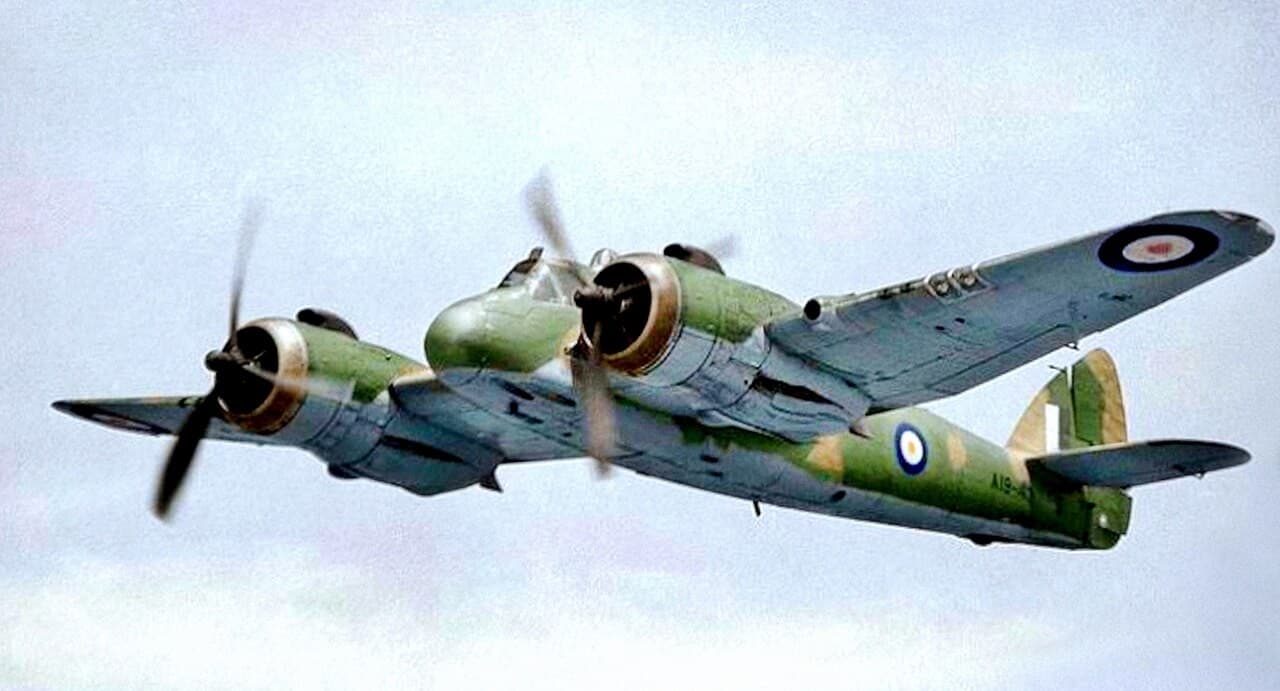
Bristol Beaufighter TF Mk X
Bristol Aeroplane Company
How does the Beaufighter Mk X stack up?
CompareOverview
The Bristol Beaufighter TF Mk X was the definitive torpedo-fighter variant of the powerful twin-engine Beaufighter, combining devastating forward-firing armament with the ability to carry a torpedo or rockets for anti-shipping strikes. Known as "Whispering Death" by Japanese forces in the Pacific for its quiet radial engines and lethal strafing attacks, the Beaufighter was one of the most heavily armed aircraft of the war.
The Mk X was specifically optimized for the Coastal Command anti-shipping role, carrying either a British 18-inch torpedo or eight RP-3 rockets alongside its four 20mm cannon. Operating in "strike wings" that combined torpedo-carrying Beaufighters with rocket-armed aircraft and fighter escorts, they devastated Axis coastal shipping from Norway to the Aegean.
The Beaufighter also served with distinction in the Far East, where RAAF and RAF squadrons used the type for devastating low-level ground attacks against Japanese positions in Burma and the Southwest Pacific. Its combination of firepower, range, and ruggedness made it ideal for operations over vast oceanic distances.
Performance Profile
Max Speed
303 mph
at 1,300 ft
Range
1,470 miles
normal
Service Ceiling
15,000 ft
Rate of Climb
1,600 ft/min
Armament
5 guns
4x 20mm Hispano Mk III, 1x .303 Browning
Crew
2
Engine
Bristol Hercules XVII
1770 hp radial
Development History
The Beaufighter began as a private venture by Bristol's chief designer Leslie Frise, who proposed adapting the existing Beaufort torpedo bomber into a long-range fighter using Bristol Hercules radial engines. The Air Ministry, desperately short of modern fighters in 1938, approved the concept because it used existing Beaufort production tooling and could enter service quickly.
The prototype first flew on July 17, 1939, and the type entered service as a night fighter in late 1940, filling a critical gap until the Mosquito night fighter became available. Early Mk I variants with AI Mk IV radar scored the first radar-guided night fighter kills in RAF history, helping defeat the Luftwaffe's night Blitz of 1940-41.
As the Mosquito progressively replaced the Beaufighter in the night fighter role, Bristol pivoted the design toward anti-shipping and ground attack. The Mk VI introduced torpedo capability, and the definitive Mk X combined the more powerful Hercules XVII engines with AI Mk VIII centimetric radar in a thimble nose, allowing all-weather anti-shipping operations.
The Mk X also featured a dorsal fin extension for improved directional stability when carrying external stores, strengthened wing structure for rockets, and improved pilot armor. Australian production at the Department of Aircraft Production in Fishermans Bend added further variants optimized for Pacific conditions.
Combat History
Beaufighter TF Mk Xs first entered combat with Coastal Command strike wings in early 1944, conducting devastating attacks on German coastal convoys along the Norwegian coast and in the North Sea. Operating in coordinated formations with "anti-flak" Beaufighters suppressing shipboard defenses while torpedo-carrying aircraft made their runs, these strike wings sank hundreds of thousands of tons of Axis shipping.
The most intense anti-shipping operations occurred in the waters around Norway, where German ore ships, troop transports, and U-boat supply vessels were systematically hunted. Strike wings from bases in Scotland and northern England ranged deep into Norwegian fjords, attacking at mast height in the face of intense flak from both ships and shore batteries. Losses were significant but so was the damage to German logistics.
In the Mediterranean, Beaufighters attacked Axis shipping in the Aegean, disrupting German supply lines to their island garrisons. The type also conducted devastating anti-shipping sweeps along the coasts of occupied Greece and Yugoslavia, working with partisan forces to isolate German garrisons.
In the Far East, RAAF Beaufighters earned their "Whispering Death" nickname through terrifying low-level attacks on Japanese positions in New Guinea, Borneo, and the Dutch East Indies. The quiet approach of the radial-engined aircraft, followed by a devastating barrage of cannon fire and rockets, proved psychologically devastating to Japanese troops who had no adequate air defenses.
Variants
| Designation | Key Differences | Produced |
|---|---|---|
| Mk IF | Original night fighter with AI Mk IV radar, four 20mm cannon, and six .303 machine guns in wings; Hercules III engines. | 914 |
| Mk VIF | Improved night fighter with Hercules VI engines, AI Mk VIII centimetric radar, and revised armament. | 1,832 |
| Mk VIC (ITF) | Interim torpedo fighter with Hercules VI engines; first Beaufighter variant to carry a torpedo operationally. | - |
| TF Mk X | Definitive torpedo-fighter with Hercules XVII engines, AI Mk VIII radar, provision for torpedo or 8 rockets, dorsal fin extension. | 2,205 |
| Mk 21 (Australian) | Australian-built variant with Hercules XVIII engines; optimized for Pacific theater conditions with tropical filters. | 365 |
Strengths & Weaknesses
+Strengths
- Devastating forward firepower with four 20mm cannon plus rockets or torpedo
- Long range allowed deep penetration anti-shipping strikes over the North Sea and Norwegian coast
- Rugged airframe with excellent damage tolerance, especially the reliable Hercules radial engines
- Centimetric AI Mk VIII radar enabled all-weather and night anti-shipping operations
-Weaknesses
- Relatively slow for a twin-engine fighter, vulnerable to interception by single-engine fighters
- Heavy and not particularly maneuverable, especially when loaded with torpedo or rockets
- Observer/navigator in rear cockpit had very limited field of fire with single .303 gun
- Significant torque swing on takeoff from counter-rotating propellers required careful handling
Pilot Voices
“Going in at mast height against a flak ship with a torpedo hanging underneath was the most terrifying thing I ever did. But the Beau could take punishment that would have destroyed any other aircraft.”
“Four cannon, eight rockets, and a torpedo, the Beaufighter packed more punch per aircraft than anything else we had. One pass could sink a destroyer.”
Did You Know?
Japanese soldiers called the Beaufighter "Whispering Death" because its radial engines were much quieter than inline engines, and the aircraft would appear at low level with little warning before unleashing devastating firepower.
The Beaufighter scored the first AI radar-guided night fighter kill in history on November 19, 1940, when a Mk IF of No. 604 Squadron shot down a Junkers Ju 88 using airborne interception radar.
Coastal Command Beaufighter strike wings sank more Axis shipping tonnage than any other RAF aircraft type during 1944-1945.

