
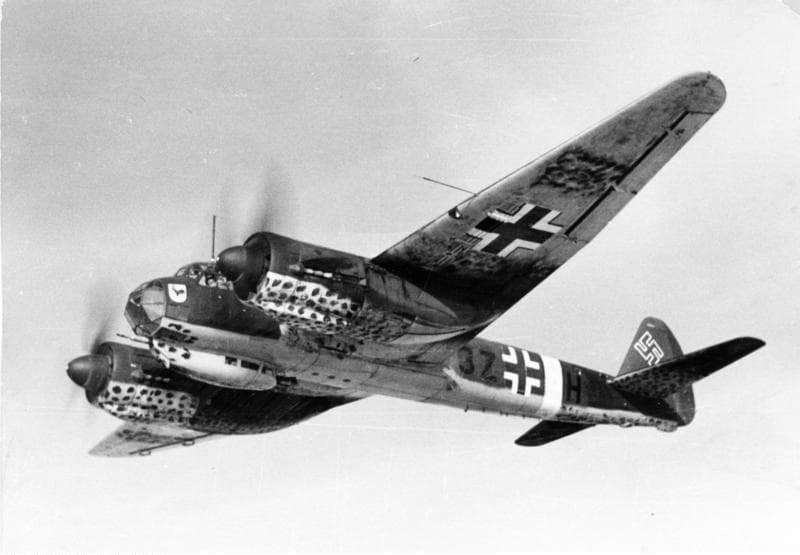
Junkers Ju 88A
Junkers
How does the Ju 88A stack up?
CompareOverview
The Junkers Ju 88 was the most versatile and arguably the most important German aircraft of World War II. With over 15,000 produced across dozens of variants, it served as a level bomber, dive bomber, torpedo bomber, night fighter, heavy fighter, reconnaissance platform, and even as the explosive-laden lower component of the Mistel composite weapon. No other aircraft of any nation matched the Ju 88's breadth of operational roles.
The Ju 88A was the primary bomber variant, and while it lacked the glamour of fighters, it carried the burden of the Luftwaffe's medium bombing campaign throughout the war. Its ability to perform shallow dive-bombing attacks gave it accuracy that conventional level bombers could not achieve, and its relatively high speed for a twin-engined bomber helped reduce losses, though never to acceptable levels over strongly defended targets.
Often called the "German Mosquito" for its versatility, the Ju 88 was arguably even more adaptable than its British counterpart. The basic airframe proved so successful that it spawned an entire family of derivatives: the Ju 88C/G night fighter series, the Ju 88D long-range reconnaissance variant, the Ju 88S high-speed bomber, and the Ju 188 and Ju 388 advanced developments. It was one of the true workhorses of the air war.
Performance Profile
Max Speed
292 mph
at 17,390 ft
Range
1,112 miles
normal
Service Ceiling
26,900 ft
Rate of Climb
1,312 ft/min
Armament
4 guns
1x 7.92mm MG 81, 3x 13mm MG 131
Crew
4
Engine
Junkers Jumo 211J
1420 hp inline
Development History
The Ju 88 originated from a 1935 Luftwaffe requirement for a fast twin-engined bomber capable of shallow dive-bombing. The design team, led by Ernst Zindel and Alfred Gassner under the overall direction of Ernst Heinkel's rival Hugo Junkers, produced an exceptionally clean airframe that met the demanding specification. The first prototype flew on December 21, 1936, and in March 1939, a pre-production Ju 88 set a 1,000 km closed-circuit speed record of 321 mph with a 2,000 kg payload, a remarkable demonstration of the design's potential.
However, the Air Ministry's insistence on adding dive-bombing capability, a demand driven by Ernst Udet's enthusiasm for the concept, significantly delayed production and added structural weight. The dive brakes, reinforced airframe, and associated systems required extensive redesign, and the Ju 88A that entered service in late 1939 was heavier and slower than the original concept. The crew was also increased from three to four, adding the dedicated bombardier position.
The Ju 88A evolved through numerous sub-variants. The A-4 was the first major production model with improved Jumo 211J engines and the ability to carry a substantially heavier bomb load than earlier variants. The A-14 introduced balloon-cable cutters for low-level operations over England. Throughout its production life, the Ju 88A received progressively heavier defensive armament, more powerful engines, and increased armor protection, the familiar wartime pattern of adding weight to compensate for growing threats.
The Ju 88's adaptability to other roles was recognized early. The C-series heavy fighter and the D-series reconnaissance aircraft entered service alongside the bomber variants, and by 1943 the Ju 88G had become the standard Luftwaffe night fighter, replacing most Bf 110G units. The Ju 88 airframe's combination of adequate speed, good range, structural strength, and interior volume made it the natural platform for every twin-engined mission the Luftwaffe needed to fill.
Combat History
The Ju 88A saw its first combat during the Norwegian campaign in April 1940, where it demonstrated its dive-bombing accuracy by sinking the destroyer HMS Gurkha. During the Battle of France, Ju 88 units attacked French and British airfields, troop concentrations, and transportation networks with considerable effectiveness. The aircraft's ability to deliver accurate bombs from shallow dives, typically 50-70 degrees, gave it a significant advantage over conventional level bombers.
During the Battle of Britain, Ju 88A units suffered heavy losses alongside other Luftwaffe bombers, but the type's relatively high speed and ability to absorb damage gave it better survival rates than the He 111 or Do 17. Ju 88s were responsible for some of the most damaging attacks of the Blitz, including strikes on airfields and aircraft factories that came perilously close to crippling Fighter Command's infrastructure.
On the Eastern Front, the Ju 88A was the Luftwaffe's primary medium bombing platform from Barbarossa onward. At Stalingrad, Ju 88 units flew hundreds of supply-dropping missions to the besieged 6th Army, suffering heavy losses to Soviet anti-aircraft fire and fighters. The aircraft also excelled in the anti-shipping role, Ju 88A torpedo bombers of KG 26 and KG 30 inflicted severe losses on Arctic convoys, including the ill-fated PQ-17.
Perhaps the Ju 88's most unusual combat role was in the Mistel (Mistletoe) composite weapon system. An unmanned Ju 88 loaded with 3,800 kg of high explosive was mounted beneath a Bf 109 or Fw 190 fighter. The fighter pilot would guide the combination toward the target, then release the explosive-laden Ju 88 to crash into it, an early precursor to the guided missile concept. Mistel attacks were directed against bridges on the Eastern Front and Allied shipping, with mixed results.
Variants
| Designation | Key Differences | Produced |
|---|---|---|
| Ju 88A-4 | Primary production bomber variant with Jumo 211J engines (1,420 hp each), increased wingspan, and maximum bomb load of 3,000 kg. Standard Luftwaffe medium bomber from 1941. | 3,950 |
| Ju 88A-14 | Low-level bombing variant with balloon-cable cutters on wing leading edges, additional armor, and provisions for close-support operations over England. | - |
| Ju 88A-17 | Torpedo bomber conversion of the A-4 with PVC torpedo rack for 2x LT F5b torpedoes. External fuel tanks for extended maritime patrol range. | - |
| Ju 88C-6 | Heavy fighter/intruder variant with solid nose housing 3x MG FF 20mm cannon and 3x MG 17 7.92mm machine guns. Used as night intruder and long-range heavy fighter. | 900 |
| Ju 88G-6 | Definitive night fighter variant with FuG 220 SN-2 radar, 4x MG 151/20 or 4x MK 108 forward cannon, Schrage Musik installation, and BMW 801G or Jumo 213A engines. | 2,500 |
Strengths & Weaknesses
+Strengths
- Unmatched versatility, successfully adapted to bomber, dive-bomber, torpedo bomber, night fighter, reconnaissance, and composite weapon roles
- Shallow dive-bombing capability gave accuracy far superior to conventional level bombers
- Robust airframe with good damage tolerance and excellent structural strength for high-speed maneuvers
- Relatively high speed for a medium bomber, improving survivability over defended targets
-Weaknesses
- Cramped crew positions, particularly the glazed nose, offered limited comfort on long missions
- Defensive armament was progressively improved but never truly adequate against fighters
- Dive-bombing capability added significant structural weight that reduced performance below the original design potential
- Complex systems and numerous sub-variants made logistics and maintenance challenging
Pilot Voices
“The Ju 88 could do everything. It was not the best at any single thing, but it could do everything reasonably well, and that made it invaluable.”
“When we transitioned from the He 111 to the Ju 88, it was like going from a truck to a sports car. The 88 was faster, more agile, and could dive-bomb with real accuracy.”
Did You Know?
With over 15,000 produced, the Ju 88 was the most-built twin-engined combat aircraft in history. It served in more different operational roles than any other aircraft of any nation during WW2.
A Ju 88 set a pre-war speed record of 321 mph carrying a 2,000 kg payload, demonstrating that the original clean design was exceptionally fast before dive-bombing requirements added weight and drag.
The Mistel composite weapon used an unmanned, explosive-laden Ju 88 guided by a fighter mounted on top. This early concept of a guided cruise missile was used against bridges and shipping in the war's final months.
The Ju 88's crew compartment was so compact that all four men sat within arm's reach of each other. This was actually a design feature, it concentrated the heaviest armor around the smallest possible area.
Compare With

Mosquito B Mk IV Mosquito
🇬🇧 380 mph

B-25J Mitchell
🇺🇸 272 mph

A-20G Havoc
🇺🇸 339 mph

Pe-2 Peshka
☆ 336 mph