
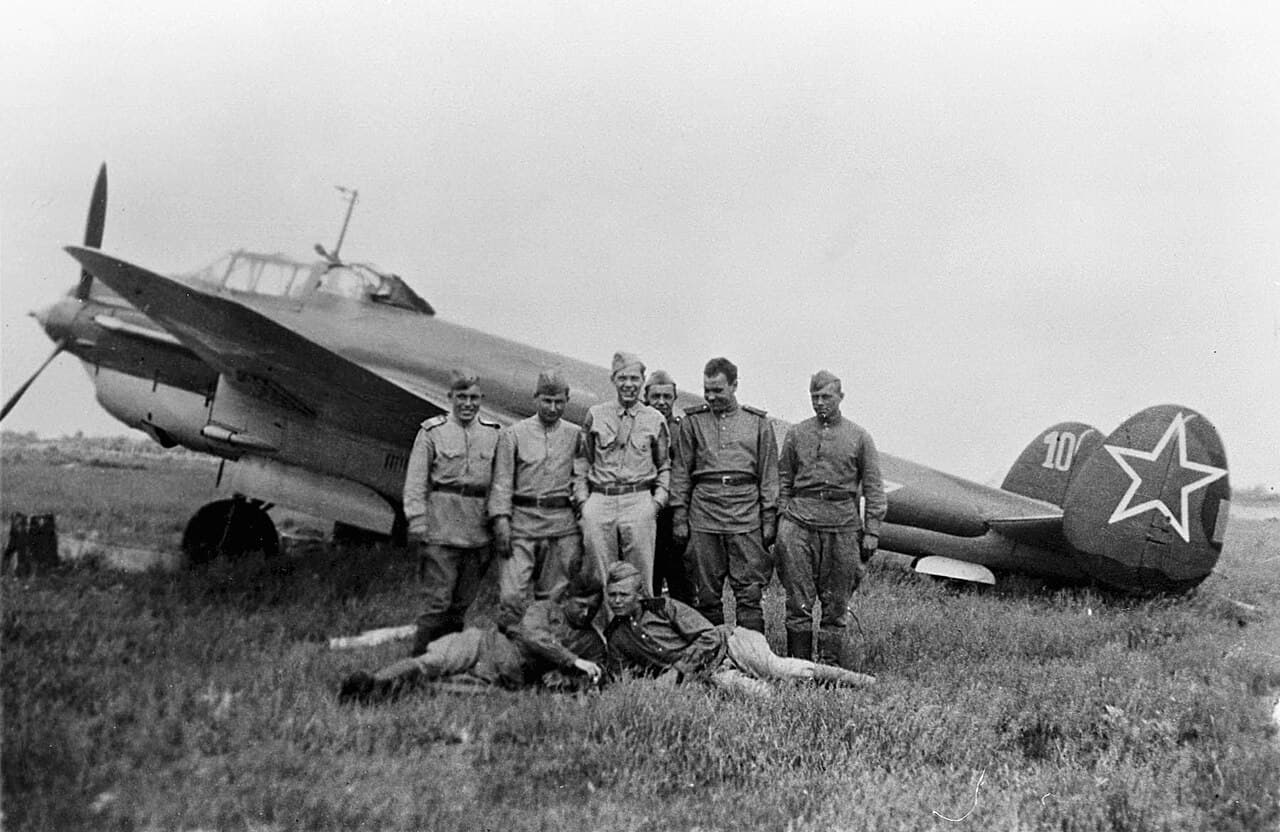
Petlyakov Pe-2
Petlyakov
How does the Pe-2 stack up?
CompareOverview
The Petlyakov Pe-2 "Peshka" was the Soviet Union's primary tactical bomber and the most-produced twin-engined combat aircraft of the Eastern Front. Fast, agile for its size, and capable of precision dive-bombing, the Pe-2 served from the first day of the German invasion to the final assault on Berlin and beyond, one of the few Soviet aircraft to remain in frontline service for the entire duration of the war.
Originally designed as a high-altitude pressurized interceptor under the designation VI-100, the Pe-2 was radically repurposed as a dive-bomber when the Soviet Air Force recognized its desperate need for a modern tactical strike aircraft. This unusual origin gave the Pe-2 fighter-like handling qualities and a performance envelope that few contemporary bombers could match. Its top speed of 336 mph made it faster than many fighters it encountered in 1941-42, and its ability to deliver bombs accurately in steep dives gave Soviet commanders a precision strike capability that level bombers simply could not achieve.
The Pe-2's designer, Vladimir Petlyakov, was arrested during Stalin's Great Purge and designed the aircraft while imprisoned in a sharashka, a secret research bureau staffed by political prisoners. He was released after the aircraft's success but died in a January 1942 air crash, never seeing the full impact of his creation. Over 11,400 Pe-2s were built, making it the third-most-produced Soviet combat aircraft after the Il-2 and the Yak-9.
Performance Profile
Max Speed
336 mph
at 13,120 ft
Range
721 miles
normal
Service Ceiling
28,870 ft
Rate of Climb
1,475 ft/min
Armament
5 guns
3x 12.7mm UBT, 2x 7.62mm ShKAS
Crew
3
Engine
Klimov VK-105PF
1210 hp inline
Development History
The Pe-2's genesis is one of the most unusual in aviation history. Vladimir Petlyakov, one of the Soviet Union's most brilliant aircraft designers, was arrested in 1937 during Stalin's purges and sentenced to a labor camp. He was transferred to a sharashka, a prison design bureau designated TsKB-29, where he was ordered to design a high-altitude pressurized fighter-interceptor. The resulting VI-100 was an innovative twin-engined, twin-boom design with a pressurized cabin and turbo-supercharged engines intended to intercept high-altitude bombers.
When the VI-100 prototype demonstrated excellent performance in late 1939, the Soviet Air Force abruptly redirected the project. The urgent need was not for a high-altitude interceptor but for a modern dive-bomber to replace the obsolete SB-2. Petlyakov's team redesigned the aircraft at breakneck speed: the pressurized cabin was replaced with a conventional cockpit, the turbo-superchargers were removed, dive brakes were added under the wings, and a bombardier's position was incorporated. The resulting PB-100 (renamed Pe-2 in honor of its designer) first flew in its dive-bomber configuration on December 22, 1939.
Production began in late 1940, and the Pe-2 entered service just months before the German invasion. The speed of its introduction meant that many crews received the aircraft with minimal training, contributing to high early losses. The aircraft itself was well-designed but demanding to fly, with tricky engine-out characteristics and narrow-track landing gear that made takeoffs and landings hazardous for inexperienced pilots.
Throughout the war, the Pe-2 underwent continuous improvement. The Pe-2FT (frontovoye trebovaniye, front-line requirement) variant incorporated field-recommended modifications including additional armor, improved defensive armament, and simplified systems. The Pe-2R reconnaissance variant served with distinction, and a night-fighter version equipped with radar operated in limited numbers. Late-war Pe-2 variants featured more powerful VK-105PF engines and detail aerodynamic improvements, though the basic airframe remained fundamentally unchanged from the 1940 design.
Combat History
The Pe-2 was among the very first Soviet aircraft to strike back at the German invasion on June 22, 1941, with several regiments mounting dive-bombing attacks against advancing Wehrmacht columns within hours of the first shots. These early missions were often flown without fighter escort and suffered devastating losses to Bf 109s, but they demonstrated the Pe-2's potential when its bombs found their targets. Unlike the obsolete SB-2 bombers that were being annihilated in droves, the Pe-2 could at least outrun some German fighters and had the agility to evade attacks.
During the Battle of Stalingrad, Pe-2 regiments provided critical precision bombing support for Soviet forces fighting in and around the city. The aircraft's dive-bombing capability allowed it to attack specific buildings, bridges, and strongpoints with an accuracy that level bombers could not achieve. Pe-2 units also played a key role in the air interdiction campaign against German supply lines leading into Stalingrad, targeting rail junctions, bridges, and supply convoys.
One of the most remarkable Pe-2 units was the 587th Bomber Aviation Regiment, an all-female regiment commanded by Major Marina Raskova until her death in a crash in January 1943. The regiment, later redesignated as the 125th Guards Bomber Aviation Regiment, flew Pe-2s with distinction throughout the war, completing over 1,100 combat missions. Its pilots proved beyond question that women could handle the demanding Pe-2 as effectively as their male counterparts.
By 1944-45, Pe-2 regiments had perfected their tactics, typically operating in formations of six to nine aircraft with dedicated fighter escort. During the Vistula-Oder offensive and the Battle of Berlin, Pe-2s systematically destroyed German defensive positions, road junctions, and command posts with precision dive-bombing. The aircraft also proved effective in the anti-shipping role with Soviet Naval Aviation, sinking several German and Finnish vessels in the Baltic Sea. By war's end, the Pe-2 had established itself as the most effective Soviet tactical bomber, a precision instrument in a force that often relied on brute-force mass.
Variants
| Designation | Key Differences | Produced |
|---|---|---|
| Pe-2 (series 1-83) | Early production models with M-105R engines (1,100 hp). Various improvements introduced incrementally across production series, including increased armor and modified defensive armament. | 1,549 |
| Pe-2FT | Front-line modified variant incorporating combat experience: upgraded VK-105PF engines (1,210 hp), additional armor, improved defensive gun positions, and simplified maintenance access. | 6,845 |
| Pe-2R | Dedicated reconnaissance variant with camera installations in the bomb bay. Retained defensive armament and light bomb capability. Used extensively for pre-strike and post-strike assessment. | - |
| Pe-2UT | Dual-control trainer variant with instructor position. Used for type conversion training given the Pe-2's demanding handling characteristics, especially in single-engine operations. | - |
| Pe-3 | Heavy fighter/night-fighter variant with fixed forward-firing armament of 1x 20mm ShVAK cannon and 3x 12.7mm UBT machine guns. Internal bomb bay retained. Used for bomber escort and night interception. | 360 |
Strengths & Weaknesses
+Strengths
- Excellent dive-bombing accuracy enabled precision strikes on point targets that level bombers could not achieve
- High speed for a twin-engined bomber, at 336 mph it could outrun many fighters it faced in 1941-42
- Fighter-like agility inherited from its interceptor origins made it difficult for enemy fighters to shoot down
- Versatile platform adapted for bombing, reconnaissance, night-fighting, and anti-shipping roles
-Weaknesses
- Demanding handling characteristics, especially on one engine, caused many training and operational accidents
- Defensive armament of rifle-caliber and medium machine guns was inadequate against determined fighter attack from the rear
- Internal bomb bay was relatively small, limiting the practical bomb load for level-bombing missions
- Narrow-track landing gear made ground handling difficult on rough forward airfields, leading to frequent gear collapses
Pilot Voices
“The Pe-2 was a beautiful aircraft but a demanding mistress. Fly her well and she would put your bombs exactly where you aimed them. Get sloppy, especially on one engine, and she would kill you without hesitation.”
“We dove at 70 degrees, watching the target grow in the gunsight. At 1,500 meters we released and pulled out, the g-forces pushing us into our seats. When we looked back, the bridge was gone.”
Did You Know?
Vladimir Petlyakov designed the Pe-2 while imprisoned in a sharashka, a secret prison design bureau for political prisoners. He was released after the aircraft's success but died in a January 1942 crash before seeing his creation's full impact.
The all-female 125th Guards Bomber Aviation Regiment flew Pe-2s in combat throughout the war, completing over 1,100 missions and proving that women could master one of the most demanding aircraft in Soviet service.
The Pe-2 was originally designed as a high-altitude pressurized fighter-interceptor (the VI-100) and was repurposed as a dive-bomber in a matter of months when the VVS realized it needed a modern tactical bomber more urgently.
Pe-2 crews developed a technique called "shuttle bombing" where aircraft would land at forward airstrips, rearm, and fly multiple sorties in a single day, sometimes four or five strikes before returning to their home base.

