
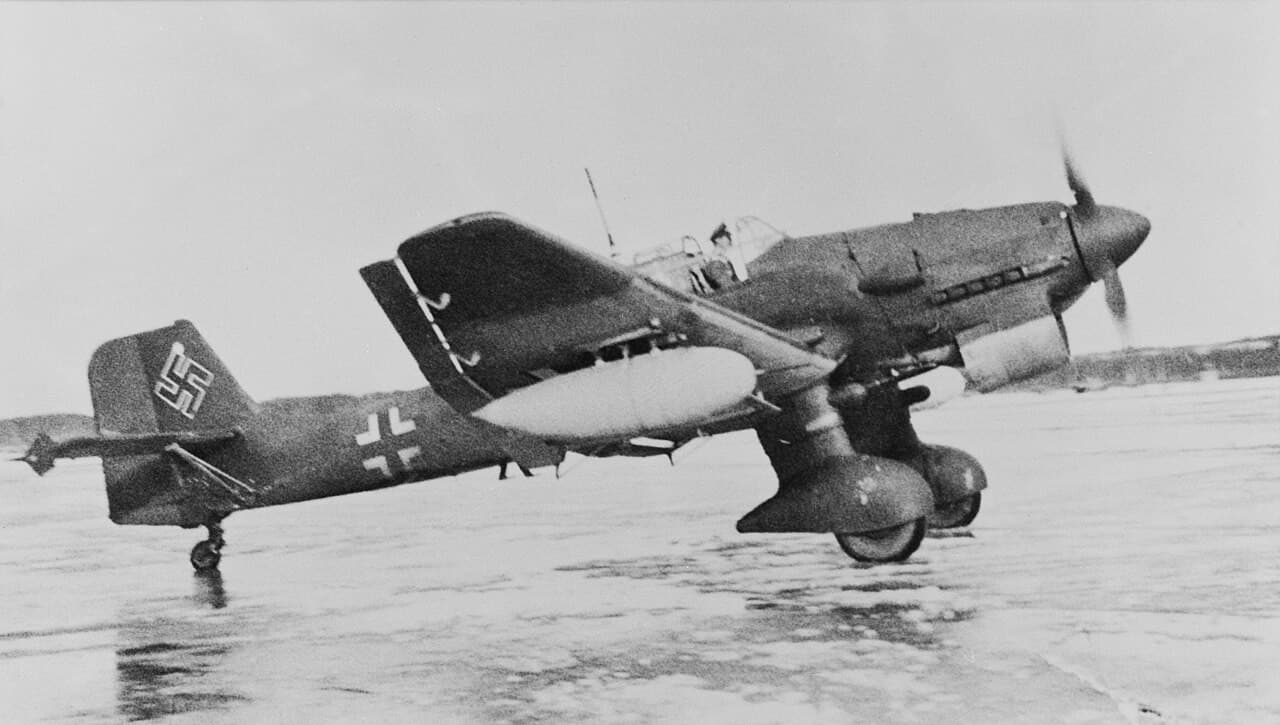
Junkers Ju 87D Stuka
Junkers
How does the Ju 87D stack up?
CompareOverview
The Junkers Ju 87 Stuka, its name derived from Sturzkampfflugzeug (dive-bombing aircraft), became the most recognizable symbol of Blitzkrieg and the terror of the early war years. With its cranked inverted gull wings, fixed spatted landing gear, and the banshee wail of its "Jericho Trumpet" sirens, the Stuka was designed as much for psychological warfare as precision bombing. The Ju 87D variant, entering service in late 1941, was a substantially improved aircraft over the earlier B-model that had terrorized Poland and France.
The D-model addressed many of the original Stuka's shortcomings. The new Jumo 211J engine delivered nearly 50% more power than the B-model's engine, bomb load capacity nearly doubled, and aerodynamic refinements improved speed and range. The D-model also incorporated better cockpit armor and a twin-barreled rear-firing MG 81Z machine gun that was far more effective than the single MG 15 it replaced.
Yet no amount of improvement could overcome the Stuka's fundamental vulnerability: it was slow. By 1943, any airspace contested by modern fighters was a death trap for the Ju 87. The aircraft's survival increasingly depended on the Luftwaffe maintaining local air superiority, a condition that became rare on all fronts. Despite this, the Stuka remained in production and service because no adequate replacement was available, and in the hands of masters like Hans-Ulrich Rudel, it continued to deliver devastating precision strikes against ground targets until the very end of the war.
Performance Profile
Max Speed
255 mph
at 13,780 ft
Range
620 miles
normal
Service Ceiling
23,950 ft
Rate of Climb
1,180 ft/min
Armament
3 guns
2x 7.92mm MG 17, 1x 7.92mm MG 81Z (rear)
Crew
2
Engine
Junkers Jumo 211J
1420 hp inline
Development History
The Ju 87's origins lie in a 1933 specification for a dive-bombing aircraft, championed by Ernst Udet after witnessing dive-bombing demonstrations by the U.S. Navy's Curtiss Helldiver. The prototype Ju 87 V1 flew in 1935, and the type entered service in 1937, seeing its first combat during the Spanish Civil War with the Condor Legion.
The Ju 87B, which saw action in Poland and France, proved devastatingly effective in the Blitzkrieg concept, destroying bridges, troop concentrations, and fortifications with pinpoint accuracy that level bombers could not match. However, the Battle of Britain exposed the Stuka's fatal weakness: it was slow, poorly armed, and incapable of defending itself against modern fighters. Losses were so catastrophic that the Ju 87 was withdrawn from the Channel front within weeks.
The Ju 87D, developed throughout 1940-41, represented Junkers' attempt to address these criticisms while maintaining the aircraft's precision bombing capability. The Jumo 211J engine with its two-speed supercharger boosted power to 1,420 hp, enabling the aircraft to carry a single 1,800 kg bomb on overload, a remarkable load for a single-engined aircraft. The redesigned cockpit, improved armor, and streamlined radiator bath all contributed to better survivability.
The Ju 87G variant, "Kanonenvogel" (cannon-bird), emerged in 1943 as a dedicated anti-tank aircraft. Equipped with two 37mm BK 3,7 cannon pods under the wings, the Ju 87G became the Luftwaffe's primary tank killer on the Eastern Front. Hans-Ulrich Rudel, flying the G-model exclusively from mid-1943, personally claimed the destruction of over 500 Soviet tanks, a figure that, while likely exaggerated, reflects the variant's genuine effectiveness in the hands of an expert pilot.
Combat History
The Ju 87D first saw combat on the Eastern Front in late 1941, where it immediately proved itself a vast improvement over the B-model in the ground-attack role. During the German summer offensive of 1942, Stukas played a crucial role in supporting the advance toward Stalingrad and the Caucasus, destroying Soviet fortifications, artillery positions, and armor concentrations with a precision that no other Luftwaffe aircraft could match.
At Stalingrad, Stukagruppen provided the German ground forces with their most effective close air support, functioning as aerial artillery for commanders who often lacked sufficient conventional guns. Ju 87D pilots learned to work intimately with frontline troops, responding to calls for support within minutes when conditions allowed. The accuracy of a near-vertical dive attack, placing a 500kg bomb within 30 feet of the target, gave the Stuka a capability that horizontal bombers could not approach.
On the Eastern Front, the Ju 87G anti-tank variant became legendary. Hans-Ulrich Rudel, the most decorated German soldier of the war, flew over 2,500 combat missions, the vast majority in Stukas. His claimed destruction of 519 tanks, a battleship (the Soviet battleship Marat at Kronstadt), and numerous other targets made him a propagandist's dream and a genuine tactical asset. Rudel continued flying Ju 87G missions even after losing a leg to anti-aircraft fire in February 1945.
By 1944, the Stuka was being replaced by the Fw 190F and G ground-attack variants, which combined adequate bombing capability with the ability to defend themselves against fighters. But the replacement was never complete, Ju 87D units continued flying combat missions through the final weeks of the war, their slow, angular aircraft increasingly anachronistic over a battlefield dominated by fast-moving fighter-bombers and ground-attack aircraft.
Variants
| Designation | Key Differences | Produced |
|---|---|---|
| Ju 87D-1 | Initial production D-model with Jumo 211J-1 engine, improved cockpit armor, streamlined radiator, and provision for 1,800kg bomb on overload. Principal variant from late 1941. | 592 |
| Ju 87D-3 | Dedicated close-support variant with additional cockpit and engine armor, provision for personnel containers under wings. Optimized for low-level attack role. | 1,559 |
| Ju 87D-5 | Extended-wing variant with 60cm wider wingspan for better handling at low speeds and high altitudes. Wing machine guns replaced by 20mm MG 151/20 cannon. | 1,488 |
| Ju 87G-1 | Tank-buster variant with 2x 37mm BK 3,7 cannon pods in place of bombs. Used by Rudel and other anti-tank specialists on the Eastern Front. Bombs deleted; purely an anti-armor platform. | - |
| Ju 87D-7/D-8 | Night ground-attack variants with flame-damping exhaust, deletion of dive brakes, and increased armor. Used for nocturnal harassment attacks on the Eastern Front. | - |
Strengths & Weaknesses
+Strengths
- Unmatched precision in dive-bombing, could place bombs within 30 feet of the target consistently
- Extremely rugged airframe that could absorb significant battle damage and remain flyable
- Psychological impact of the Jericho Trumpets (dive sirens) terrorized ground troops and caused panic among poorly trained formations
- Ju 87G anti-tank variant provided devastating anti-armor capability with its twin 37mm cannons
-Weaknesses
- Critically slow and vulnerable to any modern fighter, losses were catastrophic without air superiority
- Fixed landing gear created permanent aerodynamic drag that limited maximum speed
- Poor defensive armament, single rear gun was inadequate against fighter attacks
- Required near-total air superiority to operate, making it increasingly unusable as the war progressed
Pilot Voices
“The Stuka was honest. You told it what to do and it did it. Put the target in the sight, hold the dive, release, and pull out. Every time, the bomb went where you aimed it.”
“When fighters appeared, we knew it was going to be bad. The Stuka could not run, could not fight, could only try to get down to the treetops and hope.”
Did You Know?
The Ju 87's famous "Jericho Trumpet" wailing sirens were small propeller-driven devices mounted on the landing gear legs. They served no tactical purpose beyond psychological terror, and many pilots removed them because the drag slightly reduced the aircraft's already marginal speed.
Hans-Ulrich Rudel flew 2,530 combat missions, more than any other pilot in history. He was shot down or forced to crash-land 32 times, was wounded five times, and continued flying even after his right leg was amputated below the knee.
At Kronstadt in September 1941, Ju 87 pilot Hans-Ulrich Rudel scored a direct hit with a 1,000kg bomb on the Soviet battleship Marat, breaking its back and sinking it in harbor, one of the few cases of a single-engined aircraft sinking a capital ship.

