
Il-2 Shturmovik vs Ju 87D Stuka
The armored flying tank versus the precision dive bomber
The Bottom Line
The Il-2 Shturmovik and Ju 87D Stuka represent two fundamentally opposed philosophies of close air support, Soviet mass and survivability versus German precision and specialization. While the Stuka was the more precise weapon system and dominant in the early war, the Il-2's combination of armor, firepower, and staggering production numbers made it the more effective ground-attack platform for the grinding attritional warfare that defined the Eastern Front.
Who Wins Each Scenario?
Precision strike on a hardened point target (bridge, bunker)
Ju 87D
The Stuka's near-vertical dive-bombing with heavy ordnance was purpose-built for this mission. Its 1,800 kg bomb load and consistent 30-meter accuracy made it the superior precision strike platform.
Anti-armor strike against concentrated panzer formation
Il-2
The Il-2 with PTAB anti-tank bomblets was devastatingly effective against armor concentrations. A flight of four Il-2s could saturate a massive area with hundreds of hollow-charge submunitions.
Close air support under heavy anti-aircraft fire
Il-2
The Il-2's 700 kg armor shell was specifically designed for this scenario. It could press through concentrated ground fire that would destroy a Stuka outright.
Interdiction of enemy supply columns
Il-2
The Il-2's combination of speed, diverse armament, and low-altitude aggressiveness made it ideal for strafing long columns of trucks and transport.
Operating without fighter escort
Il-2
The Il-2 could survive without escort far better than the Stuka. Its armor, speed, and rear gunner provided meaningful self-defense. The unescorted Stuka was essentially a death sentence.
Sustained operational tempo over a multi-week offensive
Il-2
The Il-2's massive production numbers, ability to operate from forward strips, and structural durability allowed Soviet assault aviation to maintain crushing sortie rates throughout extended operations.
Interactive 3D Models
Performance Profile
Overall capability comparison across six combat dimensions
Head-to-Head Specifications
Key performance metrics compared side by side
Size Comparison
Both aircraft drawn to the same scale, the Il-2 has 2.6ft greater wingspan and is 0.3ft longer
Performance Analysis
How each aircraft performs across key combat dimensions
Speed
WINNER: Il-2The Il-2M's AM-38F engine produced 1,720 hp, giving a maximum speed of approximately 414 km/h at sea level, substantially faster than the Stuka at combat altitudes.
The Ju 87D's maximum speed of 410 km/h was achieved at altitude (3,840 m) with the Jumo 211J, but its typical combat speed during dive recovery and low-level operations was considerably lower, often around 340 km/h.
The Il-2 held a meaningful speed advantage at the low altitudes where both aircraft primarily operated. This translated directly into better survivability, faster ingress and egress meant less time exposed to ground fire and intercepting fighters.
Climb Rate
WINNER: Il-2The Il-2's climb rate of approximately 10.4 m/s was reasonable for a heavily armored aircraft, allowing it to regain altitude after attack passes more quickly than the Stuka.
The Ju 87D climbed at approximately 5 m/s, severely limited by its large fixed undercarriage and drag-inducing airbrake plates.
The Il-2 held a decisive advantage in climb rate, roughly double that of the Stuka. The Ju 87D's fixed landing gear created enormous parasitic drag that crippled its climb performance.
Maneuverability
EvenDespite its heavy armor, the Il-2 was reasonably maneuverable at low altitude, capable of executing the "circle of death" carousel tactic where a formation would orbit a target in a continuous banking turn.
The Ju 87D had effective dive control with its large airbrakes allowing stable, near-vertical dives. Its wide-span ailerons provided good roll authority for target tracking during the dive.
Both aircraft were optimized for different flight envelopes. The Il-2 was more agile in level flight and shallow-angle attacks, while the Stuka's controls were specifically designed for precision during steep dives. Neither was nimble enough to seriously engage fighters.
Altitude Performance
WINNER: Ju 87DThe Il-2 was optimized for operations below 1,000 meters, where its armor provided maximum protection from ground fire. Its AM-38F engine was specifically tuned for low-altitude performance.
The Ju 87D could operate at medium altitudes up to 7,300 m service ceiling, giving it the ability to initiate dive attacks from 4,000–5,000 meters, well above most light anti-aircraft fire.
The Stuka held an advantage in operational altitude ceiling, which was integral to its dive-bombing doctrine. Beginning a dive from high altitude gave more time for target acquisition and allowed the pilot to build up speed.
Range & Endurance
WINNER: Ju 87DThe Il-2M had a combat range of approximately 600–720 km depending on loadout, sufficient for supporting frontline operations from forward Soviet airstrips.
The Ju 87D offered a combat range of approximately 1,000 km with reduced bomb load, or 590 km with a full 1,800 kg payload.
The Ju 87D had a notable range advantage, particularly important as the Luftwaffe was increasingly forced to operate from rear-area airfields. However, range mattered less than sortie rate for ground-attack aircraft.
Dive Speed
WINNER: Ju 87DThe Il-2 typically attacked in shallow dives of 20–30 degrees or level passes, using its speed and armor to press through defensive fire.
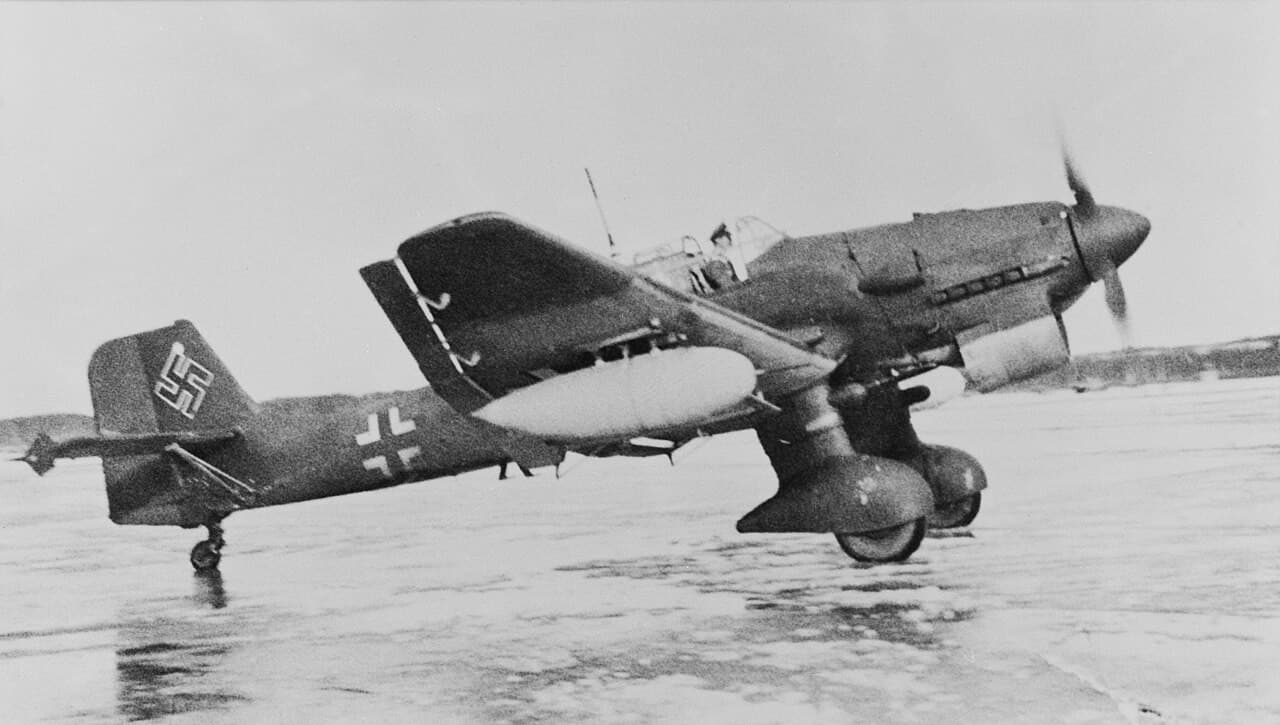
The Ju 87D was the finest dive-bomber of the war. Its automatic dive recovery system, hydraulic airbrakes, and bomb trapeze allowed near-vertical 80-degree dives with remarkable accuracy, experienced pilots could consistently place bombs within 30 meters of the target.
The Stuka held an overwhelming advantage in dive-bombing precision. No other aircraft of the war could match its ability to deliver ordnance accurately in a steep dive.
Photo Gallery, 20 Photos


Click any photo to enlarge · 20 photos
Historical Context
The strategic backdrop that shaped both aircraft
The Eastern Front of World War II was the largest and most brutal theater of ground combat in human history, and both the Ilyushin Il-2 Shturmovik and the Junkers Ju 87D Stuka were purpose-built to shape that battlefield from the air. These two aircraft represented fundamentally different philosophies of close air support that had evolved from very different prewar doctrines.
The Ju 87 Stuka had already earned a fearsome reputation during the Blitzkrieg campaigns of 1939–1941. Its precision dive-bombing capability made it effectively a form of flying artillery, able to place bombs with remarkable accuracy on point targets like bunkers, bridges, and individual tanks. The distinctive inverted gull wing and the terrifying Jericho Trumpet sirens had become symbols of German air power. By the time the D-model entered service in 1941, the Stuka had been upgraded with the more powerful Jumo 211J engine producing 1,400 hp, increased bomb capacity, and improved defensive armament. However, the fundamental vulnerability that had been exposed during the Battle of Britain remained, the Stuka was slow, poorly armored, and desperately dependent on fighter escort.
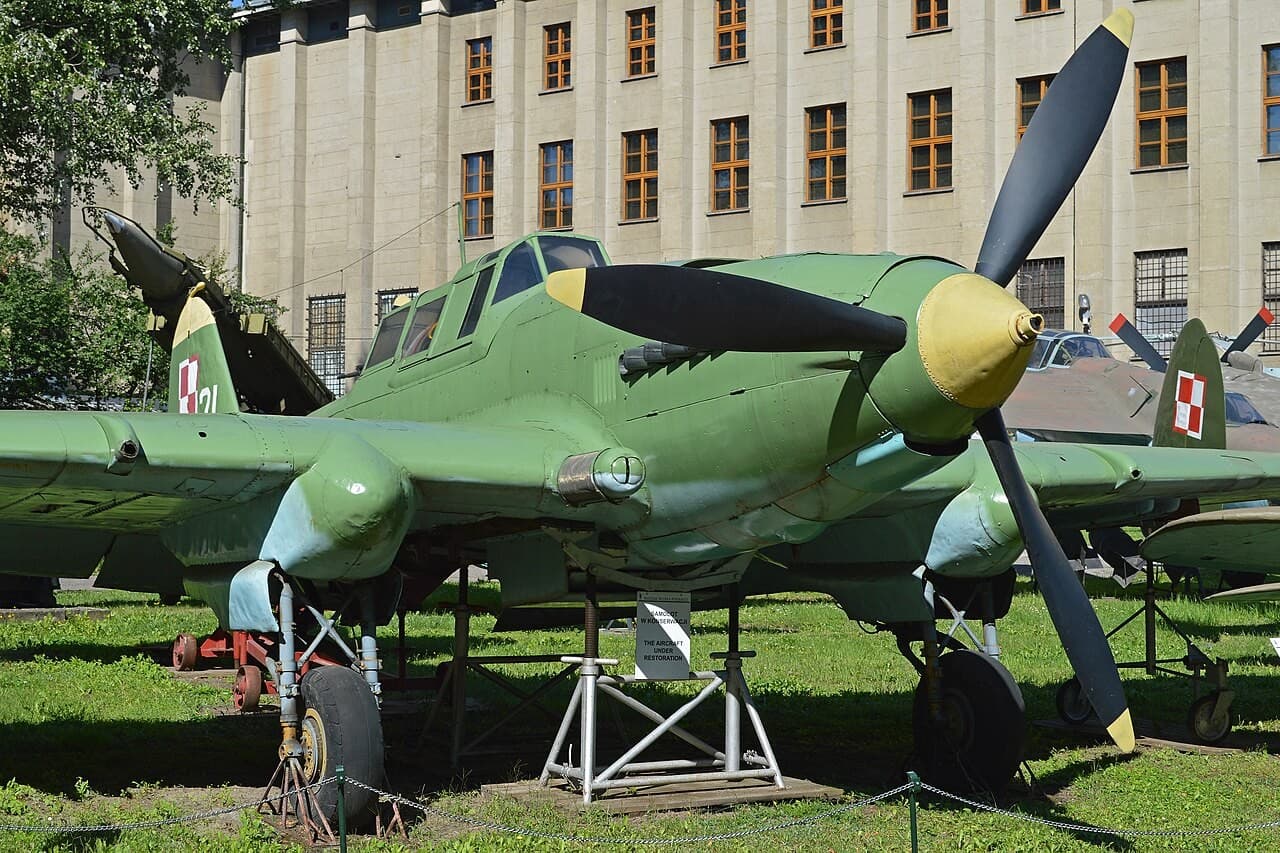
The Il-2 Shturmovik emerged from a radically different design philosophy championed by Sergei Ilyushin. Rather than relying on precision and escort protection, the Il-2 was built around an armored shell, a 700 kg bathtub of steel plate ranging from 4 to 12 mm thick that formed a structural part of the airframe, protecting the engine, fuel tanks, radiator, and pilot. Stalin himself famously declared that the Il-2 was "needed by the Red Army like air, like bread," and production was prioritized above nearly all other Soviet aircraft. The early single-seat versions suffered catastrophic rear-gunner losses, leading to the crucial addition of a rear-facing gunner position in the Il-2M beginning in 1942.
By 1943, both aircraft were locked in a deadly contest over the same battlefields, Stalingrad, Kursk, and the long Soviet drive westward. The Stuka's precision was pitted against the Shturmovik's survivability and mass employment, and the outcome of that contest would reflect the broader trajectory of the war itself.


Notable Combat Encounters
Key engagements where these aircraft faced each other in combat
During the German Sixth Army's advance on Stalingrad, StG 2 Immelmann flew intensive Ju 87D sorties against Soviet positions along the Don River crossings, while Il-2 regiments of the 8th Air Army conducted massed attacks against German armored columns and supply lines approaching the city. Both aircraft types suffered heavy losses, the Stukas from increasingly effective Soviet anti-aircraft fire and fighter interception, the Il-2s from Bf 109 attacks against their unprotected single-seat variants.
Outcome
Both sides sustained heavy losses; German air superiority gradually eroded as Soviet fighter strength increased
Stalingrad demonstrated that the Stuka's effectiveness was declining as Soviet air defenses matured, while Il-2 losses highlighted the urgent need for the two-seat variant with rear gunner protection.
The climactic Battle of Kursk saw the most concentrated employment of both aircraft types. Hans-Ulrich Rudel's III./StG 2 flew the new Ju 87G tank-buster variant with 37mm BK 3,7 cannons alongside standard D-models carrying SD-2 cluster bombs. Meanwhile, Soviet Shturmovik regiments deployed the PTAB anti-tank bomblet for the first time, each Il-2 carrying up to 192 of the 2.5 kg hollow-charge submunitions in their bomb bays. Massive formations of 30–40 Il-2s attacked in the devastating "circle of death" pattern over German panzer concentrations.
Outcome
Soviet Il-2 PTAB attacks proved devastatingly effective against concentrated German armor; Stuka tank-busting required exceptional pilot skill
Kursk proved the Il-2's mass-employment doctrine with area-effect weapons was more consistently effective than the Stuka's precision approach, which depended on elite pilots like Rudel to achieve results.
When the German XI and XLII Corps were encircled near Korsun, Ju 87D units attempted to fly supply and close support missions for the trapped forces while Il-2 regiments hammered the pocket and attacked German relief columns. The Stukas, now operating from increasingly distant airfields as the front shifted westward, struggled with reduced sortie rates and growing Soviet fighter dominance. Il-2 units flew at extremely low altitude in poor winter weather, exploiting their rugged construction and ability to operate from primitive forward strips.
Outcome
Soviet air power, spearheaded by Il-2 attacks, contributed significantly to the destruction of the pocket; German breakout cost over 20,000 casualties
By early 1944, the operational balance had shifted decisively. The Il-2's ability to operate in harsh conditions from rough fields gave it a logistical advantage the Stuka could not match as the Luftwaffe retreated.
The massive Soviet summer offensive saw Il-2 Shturmoviks employed in unprecedented numbers, over 4,000 ground-attack aircraft supported the operation. Nelson Stepanyan's 47th Assault Aviation Regiment conducted devastating attacks on German Army Group Centre's retreating columns. The few remaining Stuka units on the Eastern Front, now redesignated as Schlachtgeschwader (ground-attack wings), were overwhelmed by Soviet numerical and qualitative air superiority. Many Ju 87D units had begun transitioning to the Fw 190F fighter-bomber.
Outcome
Decisive Soviet victory; Army Group Centre destroyed as a fighting force; Stuka units effectively rendered combat-ineffective
Bagration represented the ultimate vindication of the Soviet mass-production doctrine. The Il-2's 36,000+ production run ensured overwhelming numbers that no precision weapon system could counter.
Armament & Firepower
Primary weapons, munitions capacity, and destructive capability
Il-2 Loadout
Two 23mm VYa-23 cannons (150 rpg), two 7.62mm ShKAS MGs (750 rpg), one rear-facing 12.7mm UBT (150 rounds), up to 600 kg of bombs/PTAB bomblets, eight RS-82 or four RS-132 rockets. Anti-tank variants carried two 37mm NS-37 cannons.
Ju 87D Loadout
Two wing-mounted 20mm MG 151/20 cannons (180 rpg), twin rear 7.92mm MG 81Z (1,500 rounds total), up to 1,800 kg of bombs on center and wing stations. G-variant: two underwing 37mm BK 3,7 cannon pods (12 rpg each).
Air-to-Air Verdict
Neither aircraft was designed for air combat, but the Il-2's heavier forward armament and superior speed gave it a marginal edge in head-on engagements. The Stuka was essentially defenseless against fighters from any aspect.
Ground Attack Verdict
The Il-2's combination of 23mm cannons, rockets, and PTAB bomblets made it devastating against a wider range of ground targets in a single sortie. The Stuka's advantage was concentrated bomb weight, its 1,800 kg maximum payload could destroy hardened targets like bridges and bunkers that the Il-2's lighter weapons could not.
The armament philosophies of these two aircraft perfectly reflected their nations' broader approaches to ground warfare. The Il-2 was a multi-tool, its combination of cannons, rockets, and bomblets allowed a flight of Shturmoviks to engage armor, infantry, trucks, and artillery in a single pass. The PTAB anti-tank bomblet, introduced at Kursk in July 1943, was a paradigm shift. Each 2.5 kg PTAB could penetrate 60–70mm of armor from above, the thinnest point on any tank. A single Il-2 carrying 192 PTABs could saturate a 15 x 70 meter strip, making it nearly impossible for concentrated armor to avoid hits.
The Stuka's strength was the precision delivery of heavy ordnance. A skilled Stuka pilot could place a 500 kg bomb directly on a bunker aperture or bridge support. Hans-Ulrich Rudel's claimed destruction of over 500 Soviet tanks, primarily with the Ju 87G's 37mm cannons, demonstrated what precision could achieve in the hands of an exceptional pilot. However, this precision approach was not scalable. Rudel was an extreme outlier; most Stuka pilots could not replicate his accuracy with the 37mm cannons, which had severe recoil and required attacking from very specific angles.
The Il-2's approach was inherently more scalable. Average Soviet pilots with average skill could achieve effective results because the weapon systems, area-effect bomblets, salvos of rockets, streams of 23mm cannon fire, did not require pinpoint accuracy. This was deliberate Soviet design philosophy: build the weapon so that the average soldier can use it effectively, rather than building for the expert and hoping to train enough experts.
Survivability & Protection
Armor, self-sealing tanks, pilot protection, and structural resilience
Il-2 Protection
4–12mm steel armor shell (700 kg total) forming structural airframe around engine, fuel tanks, radiator, oil cooler, and pilot cockpit. Windscreen of 64mm armored glass. Rear gunner received partial armor protection in later models.
Ju 87D Protection
Limited cockpit armor plate and armored headrest for pilot. Some armor around fuel tanks in D-model. Rear gunner position had minimal protection. Total armor weight approximately 200 kg.
Pilot Protection
The Il-2 pilot sat inside a steel bathtub that could absorb 20mm cannon hits at combat ranges. The 64mm armored glass windscreen could stop rifle-caliber projectiles. The Ju 87D pilot had far less protection, armor plate behind the seat and a basic headrest that could stop splinters but not direct cannon hits.
Structural Durability
The Il-2's mixed construction, armored steel forward fuselage and wooden rear fuselage, was remarkably damage-tolerant. Documented cases exist of Il-2s returning with entire sections of tail surfaces shot away. The Ju 87D's all-metal construction was sturdy but not designed to absorb punishment, damage to primary structure was typically catastrophic.
Crash Survivability
The Il-2's armor shell provided significant crash protection for the pilot. Belly landings on rough terrain were survivable thanks to the armor pan absorbing impact forces. The Ju 87D's fixed landing gear actually aided crash survivability in forced landings by absorbing impact energy, but the lack of armor meant that any ground fire that caused the forced landing had likely already wounded the crew.
The survivability comparison is not even close. The Il-2 was designed from the ground up to survive the most hostile low-altitude environment imaginable, and it succeeded. Soviet records indicate that on average, an Il-2 could sustain 50–80 combat sorties before being lost, an extraordinary figure for an aircraft that operated at treetop height over concentrated enemy defenses. The Stuka's survivability depended entirely on external factors: fighter escort, surprise, and the density of enemy air defenses.

Tactical Doctrine & Evolution
How pilots were trained to fight in each aircraft and how tactics adapted over time
Il-2 Tactics
Soviet Shturmovik tactics evolved dramatically from the costly trial-and-error of 1941 to the sophisticated combined-arms operations of 1944–45. The foundational tactic was the "circle of death", a formation of 6–12 Il-2s would orbit over the target area in a continuous banked circle, each aircraft firing its weapons as it passed over the objective. This ensured continuous fire on the target, mutual defensive coverage between aircraft, and made it extremely difficult for anti-aircraft gunners to concentrate on any single attacker.
Attack profiles varied by target type. Against armored concentrations, Il-2s would approach at 600–800 meters altitude, release PTAB bomblets in a shallow dive, then pull up and circle for cannon and rocket passes. Against soft targets like truck columns, they would attack at near-treetop height, using terrain masking for surprise.
Soviet doctrine emphasized mass over precision. A typical Shturmovik mission would involve a regiment of 30–40 aircraft attacking in waves, with the first wave suppressing anti-aircraft defenses and subsequent waves engaging the primary targets. By 1944, forward air controllers were embedded with frontline units, and Il-2 regiments were assigned to support specific ground formations for extended operations.
Ju 87D Tactics
Stuka tactics were built around the precision dive attack, a technique the Ju 87 was uniquely optimized to perform. The standard attack profile began with the formation climbing to 4,000–5,000 meters. The flight leader would identify the target and signal the attack, at which point the aircraft would peel off individually into near-vertical dives of 60–80 degrees.
During the dive, the pilot used the Stuvi 5B reflector sight to track the target while the aircraft's automatic dive brakes maintained a stable descent rate. At a pre-set altitude, typically 450 meters, the Abfanggerät automatic pull-out system would initiate recovery, the bomb trapeze would swing the ordnance clear of the propeller arc, and the bomb would release.
The critical weakness of Stuka doctrine was the pull-out phase. After releasing bombs, the aircraft was slow, low, and predictable, exactly the conditions that enemy fighters and ground gunners exploited. German doctrine required dedicated fighter escort for all Stuka operations, but by 1943, insufficient fighter strength meant Stukas increasingly flew without adequate protection.
How Tactics Evolved
The tactical evolution of both aircraft tells the story of the Eastern Front air war in microcosm. In 1941, the Stuka was the more effective weapon system, Luftwaffe air superiority allowed it to operate with near-impunity. The Il-2, rushed into service in its flawed single-seat configuration, suffered horrendous losses.
The turning point came in 1942–43. The introduction of the two-seat Il-2M dramatically improved Shturmovik survivability. The growth of Soviet fighter strength meant Il-2 formations increasingly operated under effective escort. And the introduction of PTAB anti-tank bomblets at Kursk gave every Il-2 pilot the ability to destroy tanks effectively.
By 1944, the doctrinal contest was decided. The Luftwaffe began withdrawing the Ju 87 in favor of the Fw 190F/G, tacitly acknowledging that the dive-bomber concept required air superiority that Germany could no longer achieve. The Soviet approach, build it tough, arm it heavily, produce it in overwhelming numbers, had proven more adaptable to the grinding attritional reality of the Eastern Front.


What the Pilots Said
Firsthand accounts from the men who flew and fought these aircraft
On the Il-2“We flew through a wall of fire every sortie. The armor saved us again and again, I could hear bullets hitting the belly like someone hammering on a steel drum, but we kept flying. The Il-2 was the most honest aircraft ever built. It did not promise you survival, but it gave you a fighting chance where no other aircraft would.”
On the Ju 87D“The Stuka was an old warrior by 1943, and we all knew it. But in the dive, nothing could touch her. You pushed over and the world narrowed to just the target in your sight. The automatic pull-out system was your life insurance, at the bottom of that dive, you were pulling 6g and the world went grey.”
On the Il-2“When we attacked in a circle, each aircraft protecting the one ahead, the fascists could not concentrate their fire on any single machine. We would orbit the target three, four, five times, each pass bringing our rockets and cannon to bear. The Germans on the ground would scatter like ants.”
On the Ju 87D“Without fighter cover, you were a dead man in the Stuka. We learned this the hard way over Kursk. The Russians sent their fighters down to our altitude and hunted us as we pulled out of dives. I lost three wingmen in two days.”
By the Numbers
Statistical combat performance and historical kill ratios
Exchange Ratio
Soviet records indicate approximately 23,600 Il-2/Il-10 losses from all causes during the war. Total Ju 87 losses on all fronts are estimated at over 5,000 airframes. Per-sortie loss rates shifted dramatically, the Stuka's loss rate increased sharply after 1942 while the Il-2's decreased as Soviet fighter cover improved.
Source: Soviet Air Force operational records, Luftwaffe Quartermaster General loss reports, postwar analysis by Von Hardesty
Comparing combat records requires careful contextualization. The raw loss numbers, roughly 23,600 Il-2s versus 5,000+ Ju 87s, initially suggest the Stuka was more survivable. But this is deeply misleading. The Il-2 force was vastly larger (over 36,000 produced versus approximately 6,500 Ju 87s of all variants), flew far more total sorties, and operated throughout a period when Soviet air defenses grew exponentially.
The more meaningful metric is the per-sortie loss rate and how it changed over time. In 1941–42, Il-2 losses were catastrophic, the single-seat variant suffered loss rates exceeding 5% per sortie during some operations. The introduction of the two-seat Il-2M and improved Soviet fighter escort reduced this dramatically. By 1944, Il-2 loss rates had fallen to approximately 1.5–2% per sortie.
The Stuka's trajectory was the opposite. In 1941, loss rates were manageable thanks to Luftwaffe air superiority. By 1943–44, Stuka units were suffering unsustainable losses. During Operation Citadel at Kursk, some Stuka Gruppen lost over 30% of their aircraft in a single week. The Luftwaffe began withdrawing the Ju 87 from frontline service in 1944, converting units to the Fw 190F and G fighter-bombers.
In terms of effectiveness, both aircraft achieved remarkable results. The Il-2 force is credited with destroying thousands of German tanks, tens of thousands of vehicles, and hundreds of bridges. The Stuka, particularly in the hands of elite pilots, achieved extraordinary precision kills. But the Il-2's impact was systemic and consistent across the entire force, while the Stuka's most impressive achievements were concentrated among a small number of exceptional pilots.
Production & the Numbers Game
How industrial output shaped the strategic balance
36,183
Il-2 Built
3,639
Ju 87D Built
The production comparison reveals one of the most stark contrasts in military aviation history. The Soviet Union produced over five times as many Il-2s as Germany produced Ju 87s of all variants, and this ratio accelerated as the war progressed.
Stalin's famous telegram, "The Il-2 aircraft are needed by our Red Army now like air, like bread. I demand more Il-2s", was not mere rhetoric. When Factory No. 18 was evacuated from Voronezh to Kuibyshev in October 1941, it resumed Il-2 production within weeks despite brutal winter conditions. Workers lived in the factory buildings and produced aircraft in open-sided halls before the walls were completed.
The Il-2's design facilitated mass production in ways the Stuka could not match. The armored shell was relatively simple to manufacture from steel plate. The rear fuselage was built from wood and fabric, deliberately chosen materials that did not compete with aluminum allocations for fighter production.
The production disparity had profound operational consequences. The Soviet Air Force could absorb Il-2 losses that would have been catastrophic for any Luftwaffe unit and continue operations at full intensity. The Germans could not replace Stuka losses, and more critically, could not replace the experienced pilots who were killed or captured. This asymmetry was ultimately decisive.

Advantages in This Matchup
Where each aircraft holds the edge in a head-to-head encounter
Il-2 Shturmovik
- Revolutionary armor protection, 700 kg armored shell virtually impervious to small arms and resistant to 20mm cannon fire
- Most-produced military aircraft in history (36,183 units) ensuring overwhelming numerical superiority
- Versatile armament suite combining cannons, rockets, bombs, and PTAB anti-tank bomblets in a single sortie
- Could operate from rough, unprepared forward airstrips close to the front line
- Superior speed at low altitude compared to the Stuka, improving survivability during attack runs
- Two-seat variant's rear gunner dramatically improved defensive capability against intercepting fighters
- PTAB bomblets made every average pilot effective against armored targets, not dependent on elite skill
Ju 87D Stuka
- Unmatched dive-bombing precision, experienced pilots could consistently hit within 30 meters from 4,000 meters
- Automatic dive recovery system (Abfanggerät) prevented pilot blackout-related crashes during high-g pull-outs
- Superior maximum bomb load of 1,800 kg allowed destruction of hardened targets like bridges and bunkers
- Jericho Trumpet sirens provided psychological warfare capability during dive attacks
- Ju 87G variant with 37mm cannons was devastating against armor when employed by skilled pilots
- Greater operational range allowed strikes deeper behind enemy lines
- Established dive-bombing doctrine gave German close air support unmatched precision in the early war
Final Verdict
Overall Winner
☆ Ilyushin Il-2 Shturmovik
Soviet Union
The Il-2 Shturmovik versus Ju 87D Stuka comparison is ultimately a case study in how different design philosophies succeed or fail when confronted with the realities of total war. The Stuka was, in many respects, the more elegant weapon system, its precision dive-bombing capability was unmatched, and in the hands of pilots like Hans-Ulrich Rudel, it achieved results that seem almost impossible. But the Stuka was a weapon designed for a short, decisive war fought under conditions of air superiority. When those conditions evaporated on the Eastern Front, the Stuka's fundamental vulnerabilities became fatal.
The Il-2 was designed for exactly the kind of war that actually happened, a grinding, attritional struggle where survivability and mass mattered more than precision and finesse. Sergei Ilyushin's decision to build the aircraft around an armored shell was perhaps the single most important design choice in the history of ground-attack aviation. That armor meant Il-2 pilots survived sorties that would have killed any Stuka crew. It meant damaged aircraft could be repaired and returned to service.
The production dimension is equally decisive. Over 36,000 Il-2s were built because the aircraft was designed to be mass-produced by a wartime economy with limited access to strategic materials. The wooden rear fuselage was not a compromise, it was a deliberate choice that freed aluminum for fighter production while allowing furniture factories to contribute to Il-2 output. The Stuka, requiring all-metal construction and precision manufacturing, could never be produced in comparable numbers.
But when measuring overall effectiveness as a weapon system across the full scope of the Eastern Front campaign, the Il-2 Shturmovik was the superior aircraft. It was tougher, more versatile, more numerous, less dependent on external conditions, and more effective in the hands of average pilots. The most-produced military aircraft in history earned that distinction not through bureaucratic inertia but because it worked, brutally, reliably, and at a scale that changed the course of the war.
Theaters of Operation
Shared Theaters
Ju 87D Only