
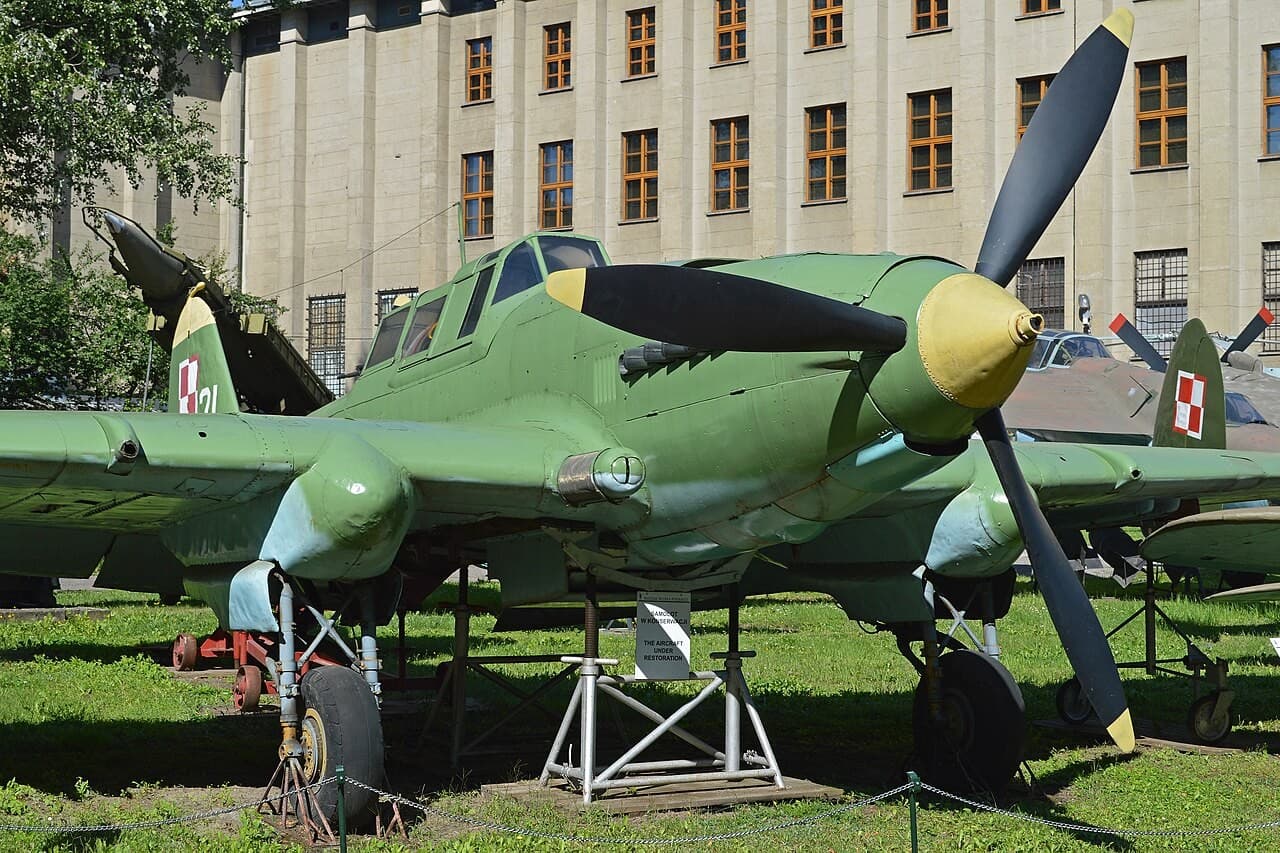
Ilyushin Il-2 Shturmovik
Ilyushin
How does the Il-2 stack up?
CompareOverview
The Ilyushin Il-2 Shturmovik is the most-produced military aircraft in history, with over 36,000 built during the Great Patriotic War. Conceived as a "flying tank", an armored ground-attack aircraft that could absorb punishment from small-arms fire and light flak while delivering devastating strikes against Axis ground forces, the Il-2 became the defining weapon of Soviet tactical aviation and a symbol of the Eastern Front itself.
Stalin famously declared the Il-2 as necessary to the Red Army "as bread and air," and production was treated with corresponding urgency. Entire factories were relocated east of the Urals during the catastrophic summer of 1941, rebuilt in open fields, and had Il-2s rolling off assembly lines within weeks. The aircraft's rugged construction, heavy armor shell, and powerful armament of cannons, bombs, and rockets made it lethally effective against German tanks, trucks, artillery, and troop concentrations.
The early single-seat Il-2 suffered appalling losses to Axis fighters due to the absence of a rear gunner, prompting the introduction of the two-seat Il-2M in 1942. Even with a rear-facing 12.7mm machine gun, the Shturmovik remained vulnerable at altitude, and its survival depended on fighter escort and low-level tactics. Despite loss rates that would have grounded any Western air force, the sheer volume of Il-2 production ensured that the VVS always had more to send into battle.
Performance Profile
Max Speed
251 mph
at 4,920 ft
Range
466 miles
normal
Service Ceiling
19,685 ft
Rate of Climb
2,050 ft/min
Armament
5 guns
2x 23mm VYa-23, 2x 7.62mm ShKAS, 1x 12.7mm UBT
Crew
2
Engine
Mikulin AM-38F
1720 hp inline
Development History
Sergei Ilyushin began work on the armored ground-attack concept in 1938, driven by the belief that a purpose-built aircraft could survive the intense ground fire that destroyed conventional bombers during close-support missions. His key innovation was the armored shell, not bolted-on armor plates, but a load-bearing structure of steel plating 5-12mm thick that formed part of the aircraft's airframe around the engine, fuel tanks, cockpit, and radiator. This shell weighed approximately 1,540 pounds, yet by making it structural, Ilyushin avoided the weight penalty of simply adding armor to a conventional airframe.
The prototype BSh-2 (later TsKB-55) first flew on October 2, 1939, as a two-seat aircraft. However, the Soviet Air Force demanded higher performance, and Ilyushin reluctantly removed the rear gunner's position to reduce weight, creating a single-seat version. This decision would prove catastrophic in combat. The single-seat Il-2 entered service just days before the German invasion on June 22, 1941, and immediately demonstrated both its devastating ground-attack capability and its vulnerability to rear-hemisphere fighter attacks.
Production was thrown into chaos by the German advance. The massive Voronezh factory was evacuated to Kuibyshev (modern Samara) in October 1941, with workers and machinery loaded onto trains even as German forces approached. In an extraordinary feat of wartime industrial mobilization, production resumed within six weeks. Stalin personally intervened to prioritize Il-2 output above nearly all other military production, sending a famous telegram to factory directors warning that the Red Army needed Il-2s "like bread, like air" and threatening consequences for any shortfall.
The critical Il-2M two-seat variant entered production in late 1942, restoring the rear gunner and dramatically improving survivability. Later improvements included the AM-38F engine with increased power, 23mm VYa cannons replacing the earlier 20mm ShVAK weapons, and anti-tank modifications carrying twin 37mm NS-37 cannons. By 1943, the Il-2 production line at Kuibyshev was the largest aircraft factory in the world, turning out over 40 aircraft per day at peak output.
Combat History
The Il-2's combat debut in the summer of 1941 was marked by both terrifying effectiveness and devastating losses. Pilots attacked German columns at extremely low altitude, often below 50 feet, strafing and bombing with great accuracy. The armored shell protected against rifle and machine-gun fire, and German soldiers quickly learned to fear the distinctive silhouette they called the "Schlachter" (Butcher) or "Schwarzer Tod" (Black Death). However, the single-seat Il-2 was essentially defenseless against Bf 109 attacks from behind, and loss rates in 1941-42 were staggering, the average Il-2 pilot survived only 8-12 combat sorties.
The arrival of the two-seat Il-2M and improved fighter escort tactics dramatically changed the equation. By the Battle of Kursk in July 1943, Shturmovik regiments had perfected the "circle of death", a continuous carousel of Il-2s orbiting over a target, with each aircraft making repeated attack passes while the rear gunners provided mutual defensive fire. During Kursk, Il-2 units claimed hundreds of German tanks destroyed, though postwar analysis suggests the actual kill rates were lower than wartime claims. The aircraft was more effective against soft-skinned vehicles, artillery positions, and troop concentrations than against heavily armored tanks.
From 1943 onward, the Il-2 was employed in massive formations, sometimes over 200 aircraft in a single strike, that overwhelmed German air defenses through sheer numbers. During Operation Bagration in the summer of 1944, Shturmovik regiments systematically destroyed German supply lines, headquarters, and reserve formations, contributing to the complete collapse of Army Group Center. The aircraft's psychological effect on German ground troops was immense, with veterans reporting that the sound of approaching Il-2 engines caused instant panic.
By 1945, the Il-2 was the most numerous combat aircraft in the world and had flown over 600,000 individual combat sorties. Its losses were equally staggering, approximately 10,762 Il-2s were lost to all causes during the war, representing roughly 30 percent of total production. No other aircraft type in history has been produced in such quantities, lost in such numbers, or had such a direct impact on the outcome of a ground campaign.
Variants
| Designation | Key Differences | Produced |
|---|---|---|
| Il-2 (single-seat) | Original production version with single pilot, no rear gunner. Armed with 2x 20mm ShVAK cannons and 2x 7.62mm ShKAS machine guns. Extremely vulnerable to fighter attack from the rear. | 1,542 |
| Il-2M (two-seat) | Restored rear gunner position with 12.7mm UBT machine gun. Upgraded to AM-38F engine (1,720 hp). Became the standard production variant from late 1942. | 22,000 |
| Il-2 Type 3 | Definitive late-war variant with redesigned wing featuring swept-back outer panels and leading-edge slats for improved low-speed handling. All-metal construction replaced wooden rear fuselage. | 11,000 |
| Il-2M3 NS-37 | Anti-tank variant armed with 2x 37mm NS-37 cannons in underwing pods. Highly effective against armor but heavy recoil degraded accuracy and handling. | 947 |
| Il-2T | Torpedo-bomber variant capable of carrying a single 45-36AN torpedo for anti-shipping strikes. Used by Soviet Naval Aviation in the Baltic and Black Sea theaters. | - |
Strengths & Weaknesses
+Strengths
- Integral armored shell weighing 1,540 lbs protected engine, fuel, cockpit, and radiator from small-arms fire and light flak
- Devastating combined armament of cannons, bombs, and rockets could destroy virtually any ground target
- Rugged construction and simple systems allowed operation from rough forward airstrips with minimal maintenance
- Massive production numbers ensured numerical superiority regardless of losses, the ultimate attrition weapon
-Weaknesses
- Slow speed and poor maneuverability made the Il-2 highly vulnerable to fighter attack, especially without escort
- Rear fuselage behind the armored shell was initially constructed of wood, offering almost no protection to the rear gunner
- Limited range restricted it to close-support missions near the front lines, preventing deeper interdiction strikes
- Engine overheating was a persistent problem, particularly during extended low-level operations in summer
Pilot Voices
“When attacking, I flew so low that I could see the fear in the Germans' faces. The Il-2 was made for this work, flying through fire, taking hits, and keeping fighting.”
“The Shturmovik was not a beautiful aircraft. It was heavy, it was slow, and it handled like a truck. But when you pressed the button and watched the rockets fly into a column of German tanks, nothing else in the world could do what it did.”
Did You Know?
With 36,183 built, the Il-2 is the most-produced military aircraft in history, more than the Spitfire, Bf 109, and P-51 Mustang combined.
Stalin's telegram to factory No. 18 in November 1941 read: "The Il-2 aircraft are necessary for our Red Army now, like air, like bread. I demand more. This is my final warning." The factory director was arrested the following day for insufficient output.
German soldiers called the Il-2 "Schwarzer Tod" (Black Death), "Zementbomber" (Cement Bomber), and "Eiserner Gustav" (Iron Gustav), all references to its seemingly indestructible armored construction.
An average Il-2 absorbed 50-70 hits per combat sortie. One aircraft returned to base with over 600 bullet holes and was repaired and flown again the next day.

