
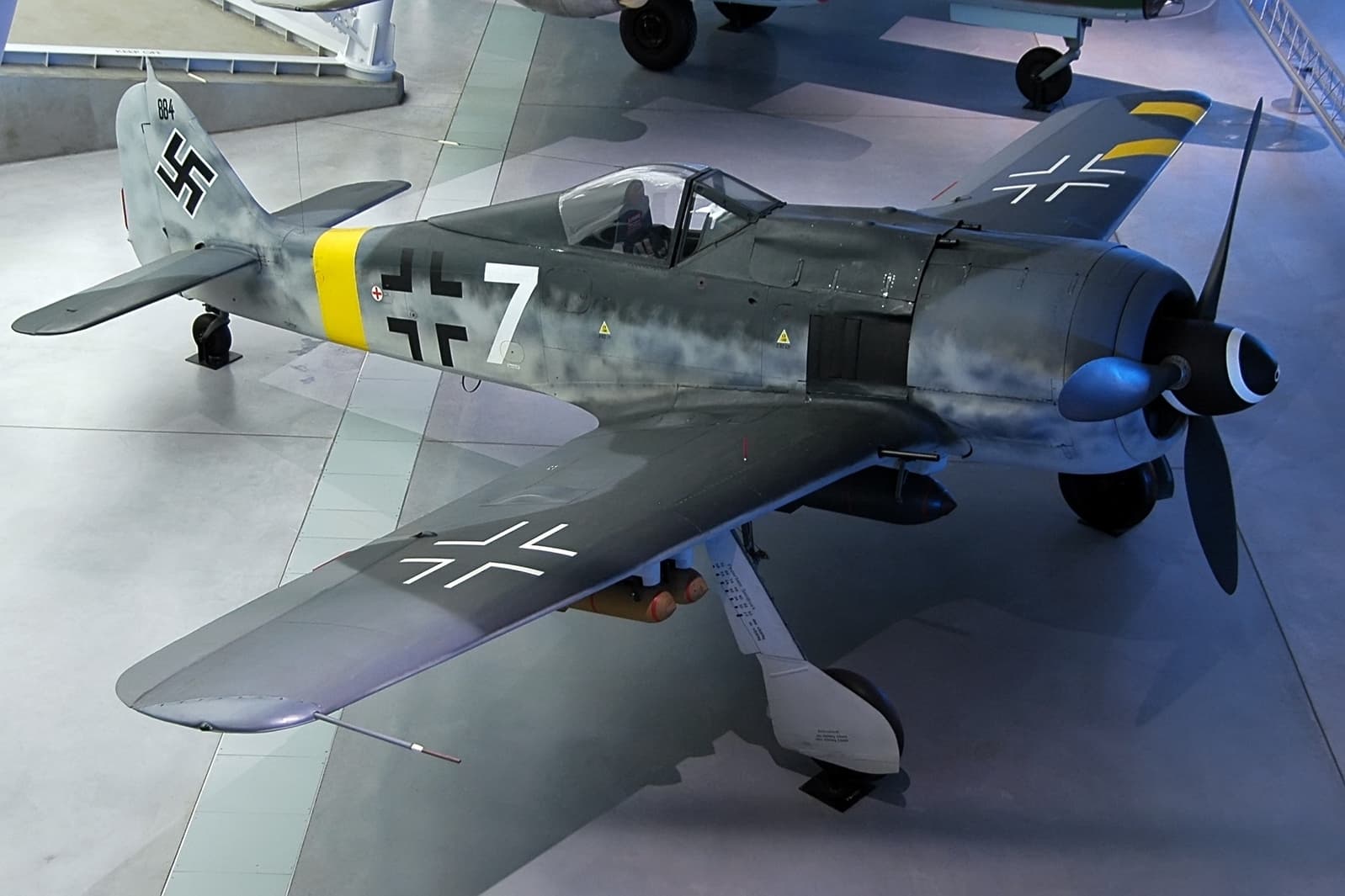
Focke-Wulf Fw 190A
Focke-Wulf
How does the Fw 190A stack up?
CompareOverview
The Focke-Wulf Fw 190A "Wurger" (Shrike) burst onto the scene over the English Channel in the summer of 1941 and immediately outclassed the Spitfire V in almost every performance category. Designed by the brilliant Kurt Tank, the Fw 190 took a radically different approach from the Bf 109, using an air-cooled BMW radial engine instead of the traditional inline, and placing the pilot in a spacious, well-laid-out cockpit with excellent visibility.
Where the Bf 109 was a racehorse, the Fw 190A was a warhorse: rugged, versatile, and easy to fly. Its wide-track landing gear eliminated the ground-handling nightmares that plagued the Bf 109, and its powerful armament of four 20mm cannons and two 13mm machine guns gave it devastating firepower. The aircraft excelled in every role it was assigned, air superiority, bomber interception, ground attack, and fighter-bombing.
The Fw 190A's only significant weakness was its performance above 20,000 feet, where the BMW radial engine lost power compared to the supercharged inline engines of Allied fighters. This limitation eventually led to the development of the Fw 190D "Dora" with an inline Jumo 213A engine, but the radial-engined A-series remained in production and frontline service until the end of the war, earning the respect of every Allied pilot who faced it.
Performance Profile
Max Speed
408 mph
at 20,670 ft
Range
500 miles
combat
Service Ceiling
34,775 ft
Rate of Climb
2,953 ft/min
Armament
6 guns
4x 20mm MG 151/20, 2x 13mm MG 131
Crew
1
Engine
BMW 801D-2
1700 hp radial
Development History
Kurt Tank began designing the Fw 190 in 1937 as a complement to the Bf 109, deliberately choosing an air-cooled radial engine for its greater resistance to combat damage and simpler maintenance. This was a bold decision, radial engines were considered inferior for fighters due to their greater frontal area and drag. Tank's solution was an exceptionally tight-fitting cowling with a ducted spinner that channeled cooling air efficiently around the BMW 139 engine (later replaced by the superior BMW 801).
The first prototype flew on June 1, 1939, and despite early engine overheating problems, the design showed outstanding potential. The switch from the BMW 139 to the larger BMW 801 radial required significant redesign of the forward fuselage, but the resulting Fw 190A-1 that entered service in August 1941 was a revelation. RAF pilots encountering the new fighter over France reported an aircraft that could outrun, outroll, and outclimb the Spitfire V, prompting an urgent British crash program to develop the Spitfire IX.
The Fw 190A evolved rapidly through its sub-variants. The A-3 standardized the armament at six guns, the A-4 introduced MW 50 water-methanol boost, and the A-5 lengthened the fuselage to improve handling. The A-8, produced in the largest numbers, became the definitive radial-engined variant with provisions for a wide range of field modification kits that could tailor the aircraft for specific missions.
Tank's design philosophy emphasized ease of manufacture and maintenance. The Fw 190's engine cowling could be removed as a complete unit, exposing the entire powerplant for servicing. The electrically-operated landing gear and flaps used a sophisticated Kommandogerat engine management system that automatically adjusted propeller pitch, mixture, boost pressure, and supercharger gear, freeing the pilot to concentrate on fighting rather than engine management.
Combat History
The Fw 190A's combat debut over the Channel coast in August 1941 was a shock to the RAF. For nearly a year, until the Spitfire IX arrived in sufficient numbers, the Fw 190A enjoyed qualitative superiority over all Allied fighters in the West. JG 26, the first unit to receive the type, used it to devastating effect during the Channel Dash of February 1942, when the Scharnhorst, Gneisenau, and Prinz Eugen sailed through the English Channel under Fw 190 air cover.
On the Eastern Front, the Fw 190A proved equally effective in the ground-attack role. Schlachtgeschwader units equipped with the Fw 190F and G variants (close-support optimized A-series derivatives) wreaked havoc on Soviet armor and troop concentrations. The aircraft's rugged radial engine could absorb ground fire that would have disabled a liquid-cooled inline engine, making it far more survivable in the low-level attack role than the Bf 109.
The Fw 190A's most brutal combat came during the Defense of the Reich, where Sturmgruppen (assault groups) of heavily armored Fw 190A-8/R8 fighters flew in tight formations directly into American bomber streams. These Sturmbock variants carried additional armor plating and 30mm MK 108 cannons, and their pilots were expected to press attacks to point-blank range, or even ram if their guns failed. The tactic was terrifyingly effective against individual bomber formations but could not stem the tide of American air power.
In Operation Bodenplatte on January 1, 1945, hundreds of Fw 190s participated in a massive surprise attack on Allied airfields in Belgium and the Netherlands. While significant damage was inflicted on parked aircraft, the Luftwaffe suffered catastrophic pilot losses, including many experienced formation leaders, that it could never replace. The Fw 190A continued flying combat missions until the final days, its rugged airframe and powerful armament making it a dangerous opponent to the very end.
Variants
| Designation | Key Differences | Produced |
|---|---|---|
| Fw 190A-3 | First major production variant with standardized armament of 2x MG 151/20 wing cannons, 2x MG FF/M wing root cannons, and 2x MG 17 cowl guns. | 910 |
| Fw 190A-5 | Extended forward fuselage by 15cm to improve center of gravity. Introduced numerous Rustsatze field kits for role adaptation. | 1,752 |
| Fw 190A-8 | Definitive variant with MW 50 boost, 13mm MG 131 replacing MG 17, ETC 501 bomb rack, and provision for 30mm MK 108 outboard cannons. | 6,655 |
| Fw 190A-8/R8 Sturmbock | Bomber destroyer with 30mm MK 108 outboard cannons, additional cockpit and engine armor plating, armored windscreen. Used by Sturmgruppen for massed attacks on bomber formations. | - |
| Fw 190F-8 | Dedicated ground-attack variant based on A-8 with additional belly armor, ETC 501 centerline rack, underwing bomb racks, and deletion of outboard wing cannon bays. | 3,400 |
Strengths & Weaknesses
+Strengths
- Outstanding roll rate, superior to virtually all Allied fighters, giving decisive advantage in defensive maneuvers
- Air-cooled radial engine far more resistant to battle damage than liquid-cooled inline engines
- Excellent cockpit layout with wide-track landing gear made it easy for novice pilots to fly and fight
- Extremely versatile platform adaptable to fighter, bomber-destroyer, ground-attack, and fighter-bomber roles with field kits
-Weaknesses
- Performance degraded significantly above 20,000 feet due to BMW 801 radial engine limitations at altitude
- Heavier than the Bf 109, resulting in inferior sustained climb rate at high altitude
- Early models suffered from cockpit overheating due to engine heat radiation through the firewall
- Complex Kommandogerat engine management system was difficult to repair in field conditions
Pilot Voices
“The Fw 190 was the best fighter I ever flew. Compared to the 109, it was like driving a modern car after a horse and buggy.”
“In the Fw 190 I felt like the master. In the 109, the airplane was the master and you had to obey it.”
Did You Know?
When an Fw 190A-3 accidentally landed at RAF Pembrey in Wales on June 23, 1942, the captured aircraft was so superior to British fighters that it prompted an emergency redesign of the Spitfire.
Kurt Tank personally test-flew production Fw 190s and once outran a group of Allied fighters in a prototype Ta 152H by engaging emergency boost, while wearing a business suit rather than flight gear.
The Fw 190A's Kommandogerat automatic engine management system was so advanced for its era that it essentially gave pilots a single-lever throttle decades before modern FADEC systems.
Featured Matchups
Compare With

Spitfire Mk IX Spitfire
🇬🇧 408 mph

P-47D Thunderbolt
🇺🇸 428 mph

P-51D Mustang
🇺🇸 437 mph

La-5FN La-5FN
☆ 402 mph

Typhoon Mk IB Typhoon
🇬🇧 412 mph