
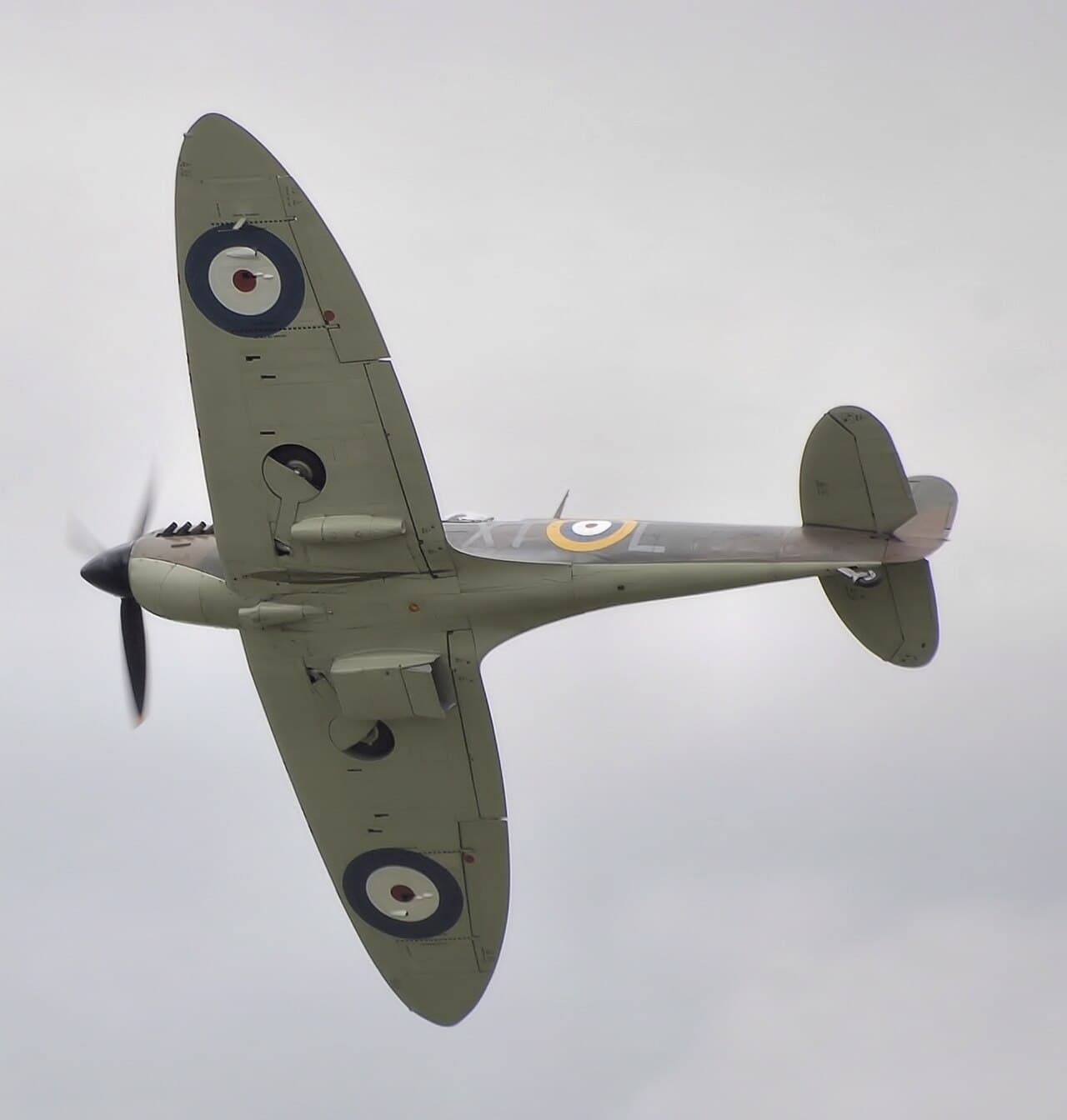
Supermarine Spitfire Mk IX
Supermarine
How does the Spitfire Mk IX stack up?
CompareOverview
The Supermarine Spitfire Mk IX was the definitive mid-war variant of Britain's most celebrated fighter, developed as an urgent response to the fearsome Focke-Wulf Fw 190. Powered by the two-stage supercharged Rolls-Royce Merlin 61, it restored the RAF's qualitative edge over the Luftwaffe in 1942 and remained a frontline fighter through the end of the war.
Originally conceived as a stopgap measure until the Mk VIII could enter production, the Mk IX proved so successful that it became the most-produced Spitfire variant. Its combination of superb high-altitude performance, excellent rate of climb, and the proven Spitfire airframe made it one of the finest piston-engine fighters of the entire conflict.
The Mk IX served across every theater where the RAF operated, from the skies over Normandy to the deserts of North Africa and the jungles of Burma. It was the mount of many top Allied aces and remained competitive against the best Axis fighters through 1945.
Performance Profile
Max Speed
408 mph
at 25,000 ft
Range
434 miles
normal
Service Ceiling
43,000 ft
Rate of Climb
3,950 ft/min
Armament
6 guns
4x .303 Browning, 2x 20mm Hispano Mk II
Crew
1
Engine
Rolls-Royce Merlin 61
1565 hp inline
Development History
The Spitfire Mk IX was born from crisis. When the Focke-Wulf Fw 190 appeared over northern France in late 1941, it outperformed the Spitfire Mk V in almost every metric except turning radius. Fighter Command desperately needed a counter, but the purpose-designed Mk VIII with its redesigned airframe was months away from production.
Supermarine's solution was elegantly simple: mate the new two-stage supercharged Merlin 61 engine, originally developed for high-altitude bomber interception, with the existing Mk V airframe. The marriage required surprisingly few modifications, primarily a longer nose, four-blade propeller, and additional radiator under the port wing for the intercooler.
The first Mk IXs reached No. 64 Squadron at Hornchurch in June 1942, and the results were immediate. The new variant could match the Fw 190 below 25,000 feet and surpass it above, restoring confidence to RAF fighter pilots who had been mauled for months. What was intended as an interim design became the backbone of Fighter Command.
Production ramped up quickly through 1942-1943, with Castle Bromwich becoming the primary manufacturing site. The type was built in both LF (low-altitude, clipped wings) and HF (high-altitude, extended wingtips) sub-variants, along with fighter-bomber and reconnaissance versions, demonstrating the extraordinary adaptability of R.J. Mitchell's original 1936 design.
Combat History
The Spitfire Mk IX first saw combat during the Dieppe Raid in August 1942, where it proved decisively superior to the Fw 190 at medium and high altitudes. From that point forward, it became the primary RAF air superiority fighter over Western Europe, flying bomber escort missions, fighter sweeps, and defensive patrols.
During the Combined Bomber Offensive of 1943-1944, Mk IXs provided withdrawal support for USAAF heavy bomber formations returning from deep penetration raids into Germany. On D-Day, Mk IXs formed a significant portion of the fighter umbrella over the Normandy beaches, and they continued supporting the Allied advance through France, the Low Countries, and into Germany itself.
In the Mediterranean theater, Mk IXs operated over North Africa, Sicily, and Italy, where they tangled with both Luftwaffe and Regia Aeronautica fighters. The type also served in the Far East, though in smaller numbers. Soviet Mk IXs, delivered via Lend-Lease, fought on the Eastern Front where their high-altitude performance was less relevant but their overall quality was appreciated.
The Mk IX scored victories against the full spectrum of Luftwaffe fighters, from the Bf 109G through the Fw 190D, and even recorded kills against Me 262 jets by catching them during takeoff and landing. It remained in frontline RAF service until replaced by the Griffon-engined Mk XIV in late 1944, though many units retained their Mk IXs until VE Day.
Variants
| Designation | Key Differences | Produced |
|---|---|---|
| Mk IXc | Early production with "c" universal wing, two 20mm cannon and four .303 machine guns. Most common sub-variant. | 4,010 |
| Mk IXe | Late production with "e" wing housing two 20mm cannon and two .50 caliber Browning machine guns, replacing the .303s. | 1,655 |
| LF Mk IX | Low-altitude fighter with clipped wingtips (reduced span to 32 ft 7 in) and Merlin 66 optimized for performance below 20,000 ft. | - |
| HF Mk IX | High-altitude fighter with extended pointed wingtips and Merlin 70 optimized for performance above 25,000 ft. | - |
| FR Mk IX | Fighter-reconnaissance variant fitted with oblique camera behind the cockpit for tactical photo-reconnaissance. | - |
Strengths & Weaknesses
+Strengths
- Outstanding rate of climb and high-altitude performance above 25,000 feet
- Excellent maneuverability with tight turning circle, superior to most contemporary fighters
- Superb two-stage Merlin 61/66/70 engine family providing flexible altitude optimization
- Proven, reliable airframe with extensive operational experience and logistics support
-Weaknesses
- Limited range of 434 miles made it unsuitable for long-range escort missions
- Narrow-track undercarriage caused frequent ground accidents, especially on rough fields
- Relatively light armament compared to Axis fighters carrying 30mm cannon
- Rearward visibility limited by high fuselage spine (partially addressed by later bubble canopy)
Pilot Voices
“The Spitfire IX was the finest thing that ever happened to me. After the Mk V, it was like getting out of a family car and into a racing car.”
“The Spit IX was the answer to our prayers. We could now meet the Fw 190 on equal terms and, above 25,000 feet, beat it.”
Did You Know?
The Mk IX was originally meant as a temporary stopgap until the Mk VIII entered service, but it ended up being produced in far greater numbers than the Mk VIII it was supposed to replace.
A Spitfire Mk IX flown by Pilot Officer Emmanuel Galitzine set an unofficial altitude record of 51,550 feet in 1943 during high-altitude interception trials.
The Mk IX was the first Spitfire variant to be successfully used for dive-bombing, carrying a 500 lb bomb under the fuselage.

