
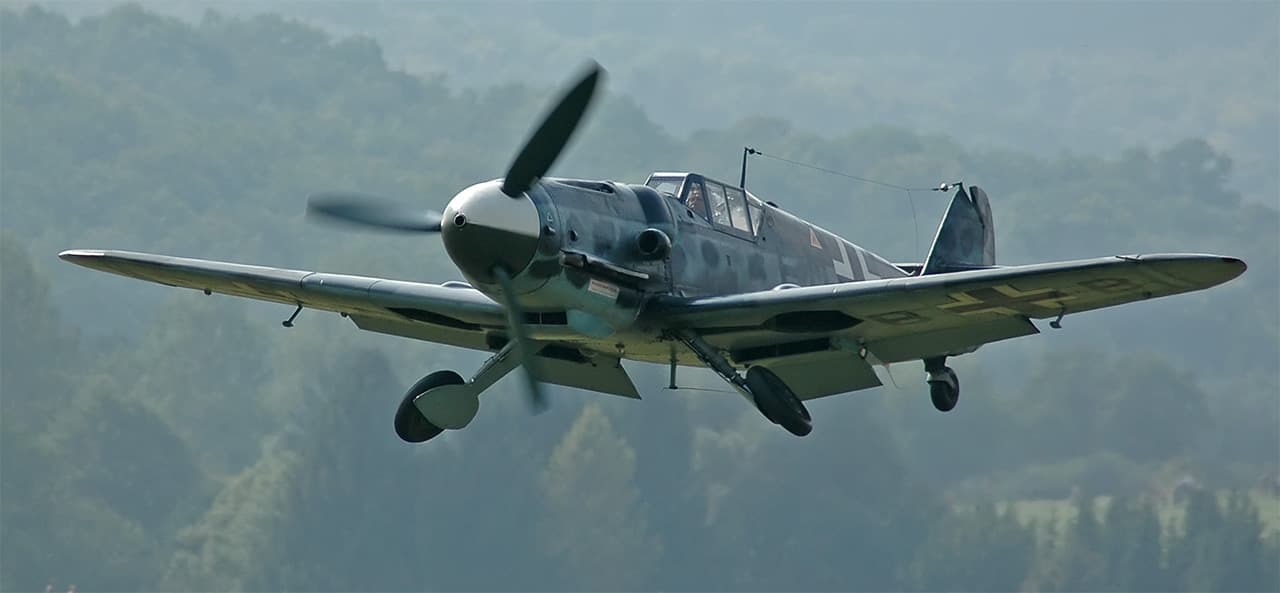
Messerschmitt Bf 109G
Messerschmitt
How does the Bf 109G stack up?
CompareOverview
The Messerschmitt Bf 109G "Gustav" was the most-produced variant of the most-produced fighter aircraft in history. Entering service in mid-1942, the Gustav represented a significant jump in power over the earlier Friedrich model, trading some of the airframe's legendary handling qualities for raw performance needed to counter increasingly capable Allied fighters at higher altitudes.
Armed with a hub-firing 20mm cannon and two cowl-mounted 13mm heavy machine guns, the Gustav packed a lethal punch in a compact, lightweight airframe. Its narrow-track landing gear, a persistent weakness inherited from the original 1935 design, continued to cause ground-handling accidents throughout its career, but once airborne the Bf 109G remained one of the deadliest dogfighters of the war.
By 1944, the Gustav formed the backbone of the Reich defense fighter force, engaging American bomber formations at altitudes above 25,000 feet while simultaneously dueling P-51 Mustangs and P-47 Thunderbolts. Over 23,500 G-models were built in dozens of sub-variants, making it by far the most numerous Bf 109 version and a symbol of the Luftwaffe's desperate struggle for air superiority.
Performance Profile
Max Speed
386 mph
at 22,640 ft
Range
350 miles
combat
Service Ceiling
38,550 ft
Rate of Climb
3,345 ft/min
Armament
3 guns
1x 20mm MG 151/20, 2x 13mm MG 131
Crew
1
Engine
Daimler-Benz DB 605A
1475 hp inline
Development History
The Bf 109G grew out of an urgent need to counter the improved Allied fighters appearing over Europe in 1941-42. The earlier Bf 109F "Friedrich" was a superb dogfighter but lacked the engine power to operate effectively at the altitudes where American bombers flew. Messerschmitt's solution was straightforward: install the new Daimler-Benz DB 605A engine, which delivered nearly 1,500 horsepower, a 175 hp increase over the Friedrich's DB 601E.
This engine swap was not seamless. The DB 605A was larger and heavier, and early production engines suffered from serious reliability problems, including overheating and bearing failures. These teething troubles were eventually resolved, but they caused significant losses during the Gustav's first months in service. The airframe itself required only modest changes to accommodate the new powerplant, though the added weight pushed the wing loading higher and degraded low-speed handling.
Throughout 1943-44, Messerschmitt introduced a bewildering array of sub-variants and field modification kits (Rustsatze) to adapt the Gustav for different missions. The G-6 became the most numerous sub-variant, introducing 13mm MG 131 machine guns in place of the earlier 7.92mm weapons. This required distinctive bulges on the cowling, nicknamed "Beulen" (bumps) by pilots, that slightly degraded the aircraft's previously clean aerodynamic profile.
Late-war Gustavs received increasingly powerful armament options, including 30mm MK 108 cannons for bomber interception and underwing rocket launchers. The G-10 and G-14 variants introduced the Erla Haube clear-vision canopy and various aerodynamic refinements, partially restoring performance lost to the accumulating weight and drag of successive modifications. By war's end, the Gustav had evolved far beyond Willy Messerschmitt's original lightweight fighter concept, yet it remained competitive through sheer engine power and pilot skill.
Combat History
The Bf 109G first saw major combat on the Eastern Front in the summer of 1942, where it quickly proved superior to most Soviet fighters of the period. Pilots like Erich Hartmann and Gerhard Barkhorn amassed extraordinary victory tallies in Gustavs against the numerically overwhelming Soviet Air Force. The aircraft's excellent high-altitude performance and powerful armament made it devastatingly effective against the Il-2 Sturmoviks and early Yak and LaGG fighters that formed the bulk of Soviet tactical aviation.
In the Mediterranean and North African theaters, Gustavs clashed with Spitfire Vs and P-40 Warhawks throughout 1942-43. The Bf 109G generally held the performance advantage, particularly at altitude, but the tide began to turn with the arrival of the Spitfire IX, which was specifically designed to counter the Gustav. Over Tunisia and Sicily, the Bf 109G fought a losing battle against growing Allied numerical superiority, even as its pilots continued to achieve impressive kill ratios.
The Gustav's greatest test came in the Defense of the Reich campaign, 1943-45. Tasked with intercepting massed American bomber formations escorted by long-range P-51 Mustangs and P-47 Thunderbolts, Bf 109G pilots faced a nearly impossible tactical situation. The fighters had to climb through escort screens, attack heavily armed B-17 and B-24 formations, and then disengage, all while outnumbered and increasingly short of fuel and experienced pilots. The introduction of 30mm cannons and air-to-air rockets gave individual Gustavs fearsome anti-bomber firepower, but the strategic battle for air superiority over Germany was being lost.
Despite the increasingly desperate situation, the Bf 109G remained in frontline service until the last day of the war. Postwar, several nations continued to operate the type, Czechoslovakia built its own version as the Avia S-199, which ironically saw combat with the Israeli Air Force in 1948. Spain manufactured Gustavs under license as the Hispano Aviacion HA-1112 Buchon well into the 1950s.
Variants
| Designation | Key Differences | Produced |
|---|---|---|
| Bf 109G-2 | Initial production model with DB 605A engine, pressurized cockpit, 7.92mm MG 17 cowl guns retained from F-series. Clean cowling without bulges. | 1,586 |
| Bf 109G-6 | Most-produced sub-variant. Replaced 7.92mm MG 17s with 13mm MG 131s, requiring distinctive cowl bulges. Could mount 20mm or 30mm Motorkanone and underwing gondola cannons. | 12,000 |
| Bf 109G-6/U4 Pulk-Zerstorer | Bomber destroyer variant with 30mm MK 108 engine-mounted cannon replacing the 20mm MG 151, plus optional underwing WGr.21 rocket mortars. | - |
| Bf 109G-10 | Late-war high-performance variant with DB 605D engine (1,800 hp with MW 50), Erla Haube clear-vision canopy, improved supercharger. Top speed 426 mph. | 2,600 |
| Bf 109G-14 | Simplified production G-6 with Erla Haube canopy, wooden tailplane, MW 50 boost system. Built to ease manufacturing bottlenecks. | 5,500 |
Strengths & Weaknesses
+Strengths
- Exceptional high-altitude performance with superb climb rate and acceleration
- Compact airframe with small frontal area gave low drag and high speed for its power class
- Devastating armament options, 30mm MK 108 could destroy a bomber with two or three hits
- Proven, mature design with well-understood maintenance requirements and extensive parts availability
-Weaknesses
- Narrow-track landing gear caused frequent ground-handling accidents, especially for novice pilots
- Limited range severely restricted operational flexibility, especially for escort missions
- Cramped cockpit with poor rearward visibility until Erla Haube canopy was introduced
- Leading-edge slats could deploy asymmetrically in hard maneuvering, causing unpredictable handling
Pilot Voices
“The Bf 109 was like a fine thoroughbred racehorse, fast, responsive, but unforgiving if you handled her roughly.”
“When Goering asked me what I needed, I told him I'd like an outfit of Spitfires. He was not amused.”
“In the 109 you had to fly every second. You could not relax for a moment. But the airplane rewarded skill like no other.”
Did You Know?
The Bf 109 was designed in 1934 to meet a specification that called for a top speed of just 250 mph, the Gustav exceeded that by over 130 mph a decade later.
Erich Hartmann, the all-time leading ace with 352 victories, scored nearly all of his kills in Bf 109G variants on the Eastern Front.
The "Bf" in Bf 109 stands for Bayerische Flugzeugwerke (Bavarian Aircraft Works), the company name before it was renamed Messerschmitt AG in 1938. Despite common usage, "Me 109" is technically incorrect for early variants.
Swiss Air Force Bf 109G pilots shot down several USAAF bombers that violated Swiss airspace, and also engaged Luftwaffe aircraft, one of the few cases of a neutral nation using German fighters against Germany.
Featured Matchups
Compare With

Spitfire Mk IX Spitfire
🇬🇧 408 mph

P-51D Mustang
🇺🇸 437 mph

P-47D Thunderbolt
🇺🇸 428 mph

Yak-3 Yak-3
☆ 407 mph

La-5FN La-5FN
☆ 402 mph