
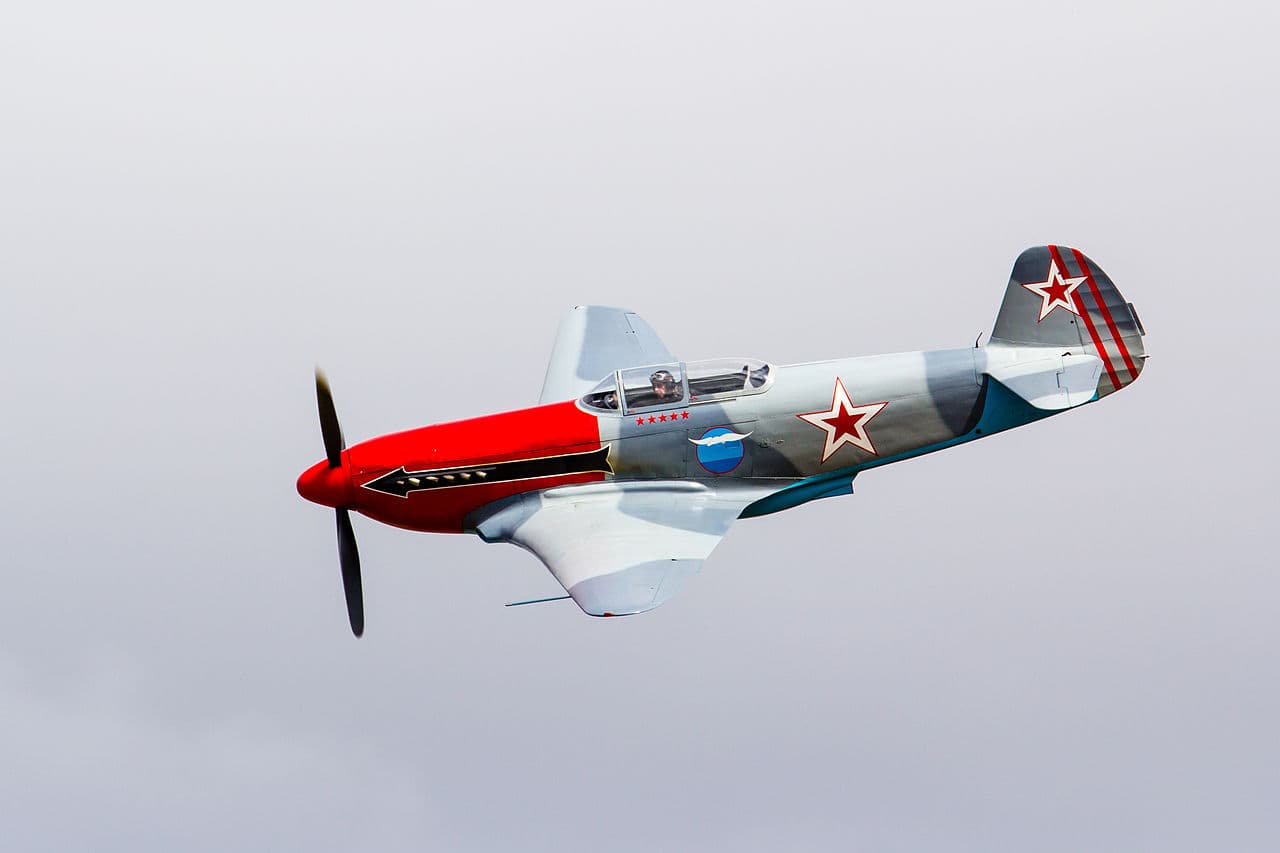
Yakovlev Yak-3
Yakovlev
How does the Yak-3 stack up?
CompareOverview
The Yakovlev Yak-3 was the lightest and most agile fighter of the Eastern Front, a stripped-down air-superiority machine that could outmaneuver any opponent below 16,000 feet. Entering service in the summer of 1944, the Yak-3 arrived too late for the desperate early years of the war but proved devastatingly effective during the great Soviet offensives that drove the Wehrmacht back to Berlin.
Weighing barely 5,860 pounds loaded, lighter than a Bf 109G by over a thousand pounds, the Yak-3 was built around a simple philosophy: minimum weight, maximum agility. Its small wing, clean aerodynamics, and powerful Klimov engine gave it a rate of climb and turn performance that alarmed Luftwaffe pilots accustomed to dominance in these areas. German tactical reports from the summer of 1944 specifically warned pilots to avoid dogfighting any Yakovlev fighter below 5,000 meters, a remarkable concession from an air force that had swept Soviet aviation aside three years earlier.
The Yak-3's reputation was cemented by the legendary Normandie-Niemen regiment, Free French pilots fighting on the Eastern Front who chose the Yak-3 over all other available Soviet or Western fighters. Their enthusiastic endorsement of the aircraft was a powerful propaganda coup and a genuine testament to the Yak-3's handling qualities. When the war ended, the French pilots were allowed to fly their Yak-3s home to France, the only Allied unit permitted to keep their Soviet aircraft.
Performance Profile
Max Speed
407 mph
at 10,170 ft
Range
506 miles
normal
Service Ceiling
35,105 ft
Rate of Climb
3,940 ft/min
Armament
3 guns
1x 20mm ShVAK, 2x 12.7mm UBS
Crew
1
Engine
Klimov VK-105PF-2
1290 hp inline
Development History
The Yak-3 originated from Yakovlev's I-30 fighter project of 1941, which was shelved due to the wartime aluminum shortage. When the design was revived in 1942 as the Yak-1M, Alexander Yakovlev took a radical approach: instead of adding power and armament to the existing Yak-1, he stripped everything down to the absolute minimum. The wing area was reduced from 184 to 159 square feet, the fuselage was narrowed, the oil cooler was relocated for reduced drag, and every non-essential gram of weight was eliminated.
The first prototype flew on February 28, 1943, and testing revealed spectacular performance. The Yak-1M could reach 407 mph, faster than any German fighter at low and medium altitudes, and its rate of climb exceeded 3,900 feet per minute. The turn time was among the shortest of any WW2 fighter. State acceptance trials were completed by October 1943, and the aircraft was redesignated Yak-3 for production.
Production was delayed by six months due to ongoing shortages of duralumin, which was needed for the wing spars and other structural components. Yakovlev's team worked to maximize the use of wood and plywood in non-critical structures while reserving aluminum alloys for the areas where they were structurally essential. The mixed-construction approach, metal wing spars and frame, plywood skinning on the rear fuselage and tail, fabric covering on control surfaces, was a pragmatic solution to wartime material constraints.
Serial production began at Factory No. 292 in Saratov in early 1944, with the first combat-ready Yak-3s reaching frontline units in July 1944. Late-production aircraft received the improved VK-105PF-2 engine and minor aerodynamic refinements. A planned Yak-3 variant with the VK-107A engine producing 1,650 hp was tested and achieved 447 mph, but engine reliability problems prevented large-scale production before the war ended.
Combat History
The Yak-3 entered combat during the Lvov-Sandomierz offensive in July 1944, and its impact was immediate. On July 14, 1944, eighteen Yak-3s of the 91st Fighter Regiment engaged thirty German fighters, a mixed formation of Bf 109G-6s and Fw 190A-8s, and shot down fifteen for the loss of just one Yak-3. This engagement, and others like it during the summer of 1944, prompted the Luftwaffe's Eastern Front command to issue a remarkable tactical directive: "Avoid combat below five thousand meters with Yakovlev fighters lacking an oil cooler intake under the nose", a specific physical description of the Yak-3.
The French Normandie-Niemen regiment received Yak-3s in June 1944 and immediately fell in love with the aircraft. French pilots, many of whom had previously flown Spitfires and P-39 Airacobras, unanimously praised the Yak-3's handling qualities. Marcel Albert, the top-scoring French ace of the war with 23 victories, scored many of his kills in the Yak-3. The regiment's combat record with the type was exceptional, during one 15-day period in October 1944, Normandie-Niemen pilots destroyed 119 German aircraft for the loss of six Yak-3s.
During the Vistula-Oder offensive and the final drive on Berlin in early 1945, Yak-3 regiments provided air superiority cover for advancing Soviet ground forces. By this point, Luftwaffe resistance was sporadic but occasionally fierce, as desperate German pilots fought with the courage of men defending their homeland. The Yak-3 proved decisive in these encounters, its low-altitude superiority ensuring that Soviet ground forces operated under friendly skies during the most critical phase of the war.
The Yak-3's combat record reflected its design philosophy perfectly: in engagements below 16,000 feet, it was virtually unbeatable. Above that altitude, its light construction and smaller engine became disadvantages, but since the vast majority of Eastern Front combat occurred below 15,000 feet, this limitation was largely academic. The aircraft's kill-to-loss ratio was among the best of any Soviet fighter, a tribute to both the design and the increasingly experienced pilots who flew it.
Variants
| Designation | Key Differences | Produced |
|---|---|---|
| Yak-3 (standard) | Initial production variant with VK-105PF-2 engine (1,290 hp), 1x 20mm ShVAK cannon and 2x 12.7mm UBS machine guns. Mixed wood-and-metal construction. | 4,111 |
| Yak-3P | All-cannon armament variant with 3x 20mm B-20 cannons replacing the mixed gun/cannon arrangement. Entered production in early 1945. | 596 |
| Yak-3T | Tank-buster variant armed with a 37mm NS-37 cannon firing through the propeller hub. Only small numbers produced due to heavy recoil affecting airframe integrity. | - |
| Yak-3U | Re-engined variant with Shvetsov ASh-82FN radial engine (1,850 hp). Improved performance but arrived too late for wartime service. Influenced postwar Yak-11 trainer. | - |
| Yak-3 VK-107A | High-performance variant with Klimov VK-107A engine (1,650 hp), achieving 447 mph. Engine reliability problems prevented mass production during the war. | - |
Strengths & Weaknesses
+Strengths
- Lightest major fighter of the war at 5,864 lbs loaded, giving exceptional power-to-weight ratio and climb rate
- Outstanding turn performance and roll rate below 16,000 feet, could outturn any German fighter at combat altitudes
- Extremely responsive controls and docile handling made it accessible to average pilots while rewarding expert ones
- Clean aerodynamic design extracted maximum performance from a modest engine, proving that refinement could substitute for raw power
-Weaknesses
- Performance deteriorated significantly above 16,000 feet where its smaller engine and light construction became disadvantages
- Light armament of one cannon and two machine guns was adequate for fighters but insufficient against bombers or ground targets
- Limited fuel capacity restricted range and endurance, confining it to short-radius air superiority missions
- Plywood skinning was vulnerable to moisture and delamination in prolonged wet conditions, requiring careful maintenance
Pilot Voices
“I had flown Spitfires, Hurricanes, and Airacobras. The Yak-3 was better than all of them below 5,000 meters. It turned like a motorcycle, climbed like an elevator, and the controls were light as a feather.”
“The Yak-3 was the best fighter I ever flew. When I pulled back on the stick, the aircraft leaped upward like it wanted to fly to the sun.”
Did You Know?
The Luftwaffe issued a specific order in 1944 warning pilots to avoid combat below 5,000 meters with "Yakovlev fighters lacking an oil cooler intake under the nose", a description that precisely identified the Yak-3.
When the Normandie-Niemen regiment returned to France after the war, Stalin allowed the French pilots to keep their Yak-3s as a gift, the only case of Soviet combat aircraft being given to a Western ally.
At 5,864 lbs loaded, the Yak-3 weighed less than the empty weight of a P-47 Thunderbolt (9,950 lbs). It embodied the opposite design philosophy: minimum weight versus maximum firepower.
A modern reproduction Yak-3 powered by an Allison V-1710 engine is one of the most popular warbird racing aircraft, regularly competing at the Reno Air Races.

