
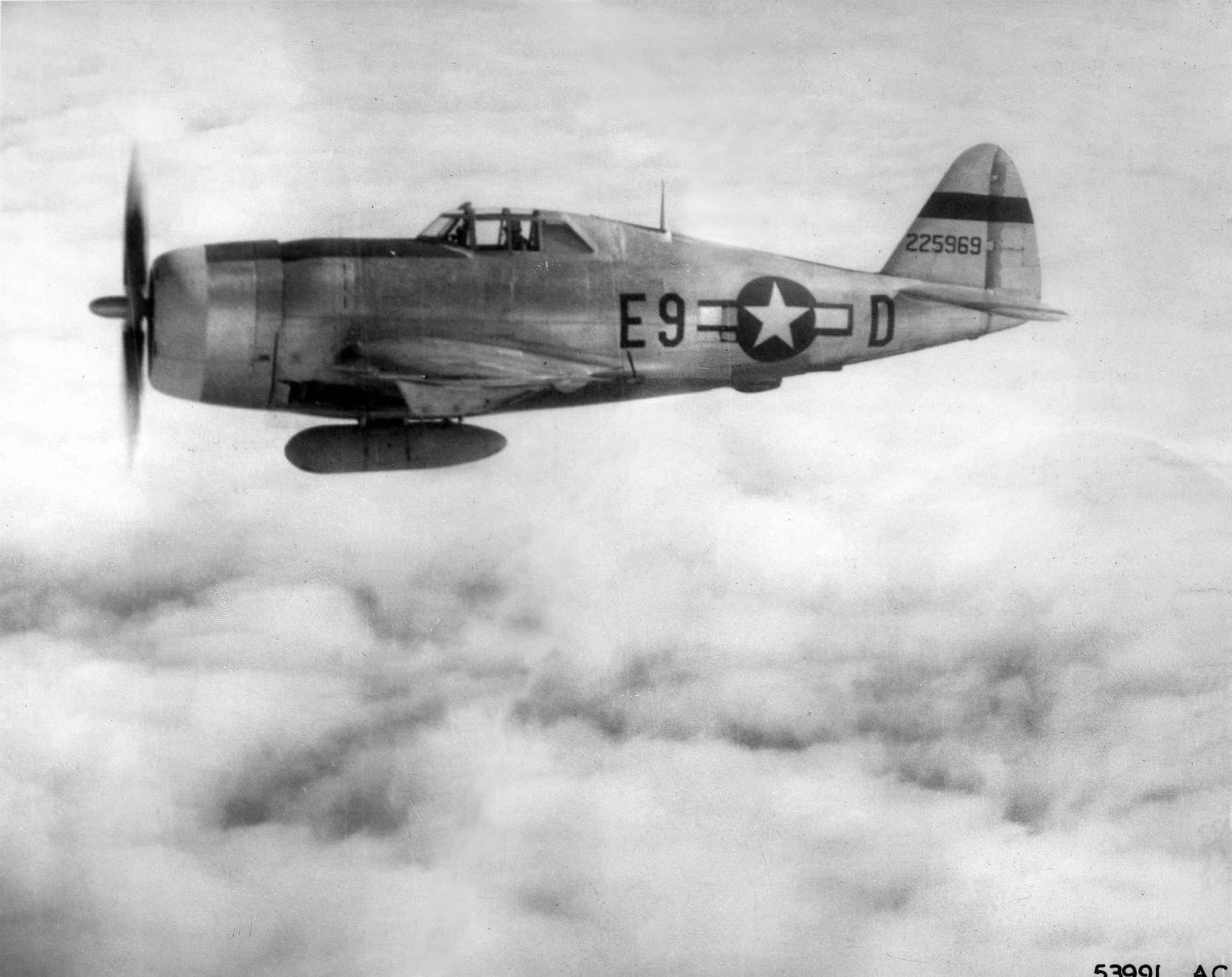
Republic P-47D Thunderbolt
Republic Aviation
How does the P-47D stack up?
CompareOverview
The Republic P-47D Thunderbolt was the heaviest and most powerful single-engine piston fighter of World War II, and arguably the most effective ground-attack aircraft in the European theater. Nicknamed the "Jug" by its pilots, the massive Thunderbolt weighed nearly eight tons fully loaded and carried an armament of eight .50-caliber machine guns with an extraordinary ammunition supply. Its air-cooled radial engine and rugged construction made it legendary for absorbing battle damage that would have destroyed lesser aircraft.
The P-47 was the mount of some of America's highest-scoring aces, including Francis "Gabby" Gabreski and Robert S. Johnson. In the escort fighter role it initially lacked the range of the P-51 Mustang, but with external drop tanks it proved a formidable high-altitude dogfighter. Where the Thunderbolt truly excelled, however, was in the fighter-bomber mission. IX Tactical Air Command P-47 groups devastated German armor, transport, and supply lines across France, the Low Countries, and into the Reich itself.
With 15,636 built, the P-47 was produced in greater numbers than any other American fighter of the war. It served with air forces around the world, from the jungles of the Pacific to the steppes of the Eastern Front, and its combat record of a 4.6-to-1 kill ratio speaks to its effectiveness as a weapon of war.
Performance Profile
Max Speed
428 mph
at 30,000 ft
Range
1,900 miles
ferry
Service Ceiling
43,000 ft
Rate of Climb
3,120 ft/min
Armament
8 guns
8x .50 BMG
Crew
1
Engine
Pratt & Whitney R-2800-59 Double Wasp
2535 hp radial
Development History
The P-47 Thunderbolt traced its lineage to Alexander Kartveli, Republic Aviation's chief designer. Kartveli initially designed the lighter XP-47 and XP-47A around the Allison V-1710 inline engine, but these underpowered concepts were rejected by the Army Air Corps. The breakthrough came with the availability of the massive Pratt & Whitney R-2800 Double Wasp radial engine producing over 2,000 horsepower, coupled with an exhaust-driven turbosupercharger mounted in the rear fuselage.
The XP-47B prototype first flew on May 6, 1941, and at 12,086 pounds was the heaviest single-engine fighter ever built at the time. The turbocharger ducting ran the entire length of the fuselage, contributing to the aircraft's bulk but providing exceptional high-altitude performance. Early production P-47Bs and Cs suffered from various teething problems including compressibility issues in high-speed dives, fabric-covered control surfaces that ballooned at speed, and a canopy that was difficult to jettison in emergencies.
The definitive P-47D model incorporated hundreds of improvements based on combat experience. The most visible change came with the P-47D-25 "bubbletop," which replaced the original "razorback" framed canopy with a clear-view teardrop canopy similar to the P-51D. Curtiss-Wright also manufactured the P-47G at their Buffalo plant. Late-model D variants featured a dorsal fin fillet to restore directional stability lost with the cut-down rear fuselage, paddle-blade propeller for improved climb, and water injection for emergency power.
The final wartime variant, the P-47M, was a sprint model capable of 473 mph, developed specifically to intercept V-1 flying bombs and Me 262 jets. The P-47N was a long-range variant with larger wings and increased fuel capacity, designed for the Pacific theater and B-29 escort missions.
Combat History
The P-47 entered combat with the 4th, 56th, and 78th Fighter Groups of VIII Fighter Command in April 1943 over occupied Europe. Early missions were escort sorties over France and the Low Countries, where the big fighter proved it could hold its own against the Fw 190 and Bf 109 in high-altitude engagements. The 56th Fighter Group, commanded by Colonel Hubert Zemke, became one of the top-scoring fighter units in the ETO with 674.5 aerial victories.
As P-51 Mustangs increasingly took over the long-range escort mission in 1944, the P-47 found its true calling as a fighter-bomber. IX Tactical Air Command deployed massive formations of P-47s in support of the D-Day landings and the subsequent breakout from Normandy. During Operation Cobra in July 1944, P-47 groups decimated German armored columns attempting to counterattack at Mortain. The Thunderbolt's eight .50-caliber guns and ability to carry 2,500 pounds of bombs or ten HVAR rockets made it a devastating ground-attack platform.
In the Pacific and CBI theaters, the P-47 served with distinction in the island-hopping campaign and over Burma and China. The 348th Fighter Group under Colonel Neel Kearby operated P-47s in New Guinea, where Kearby earned the Medal of Honor for shooting down six Japanese aircraft in a single mission. Brazilian P-47 pilots of the 1st Fighter Group flew combat missions in Italy, and the Mexican Expeditionary Air Force operated P-47Ds in the Philippines.
By war's end, P-47 pilots claimed 3,752 aerial victories in the ETO and destroyed thousands of locomotives, tanks, armored vehicles, and supply trucks in ground attacks. The aircraft's ability to absorb punishment was legendary: many P-47s returned to base with cylinders shot off, control surfaces shredded, and structural damage that would have been fatal to lighter fighters.
Variants
| Designation | Key Differences | Produced |
|---|---|---|
| P-47B | Initial production model, fabric-covered control surfaces, metal-framed canopy | 171 |
| P-47C | Lengthened fuselage, belly shackle for drop tank or bomb, improved radio | 602 |
| P-47D (razorback) | R-2800-21/63, water injection, improved turbo, main production variant | 12,602 |
| P-47D-25 (bubbletop) | Cut-down rear fuselage, bubble canopy, dorsal fin, paddle-blade prop | 2,000 |
| P-47M | Sprint variant, R-2800-57(C), 2,800 hp, 473 mph, airbrakes, for V-1/jet interception | 130 |
| P-47N | Long-range Pacific variant, larger "wet" wing, 2,350-mile ferry range, squared-off wingtips | 1,816 |
Strengths & Weaknesses
+Strengths
- Extraordinary ruggedness; the air-cooled radial engine and heavy construction absorbed tremendous battle damage
- Eight .50-caliber guns with generous ammunition supply provided devastating firepower
- Excellent high-altitude performance above 25,000 feet thanks to turbocharger
- Outstanding dive speed and energy retention; could out-dive any Axis fighter
- Superb fighter-bomber platform capable of carrying 2,500 lbs of ordnance
-Weaknesses
- Heavy weight resulted in poor rate of climb and sluggish acceleration at low altitudes
- Large size and weight made it less maneuverable than smaller fighters in turning fights
- Shorter combat radius than the P-51 before drop tanks became standard
- High fuel consumption limited patrol time over the battlefield
Pilot Voices
“It could take a terrific amount of punishment and keep right on flying. I saw P-47s come back with one whole side of the engine shot away.”
“In a dive, nothing could touch the P-47. We learned to use that advantage and never get into a turning fight below 15,000 feet.”
Did You Know?
The P-47 was so large that early models could not roll fast enough at low altitude. Republic engineers eventually solved this with improved ailerons and boosted controls.
P-47 pilots developed the "split-S" diving attack specifically to exploit the Thunderbolt's superior dive speed against German fighters, which could not follow without risking structural failure.
The turbocharger ducting in the P-47 ran nearly 20 feet from the engine exhaust at the front to the turbine at the rear of the fuselage, making the aircraft essentially a flying air-handling system.
Colonel Neel Kearby of the 348th Fighter Group shot down six Japanese aircraft in a single P-47 mission over Wewak, New Guinea, earning the Medal of Honor.

