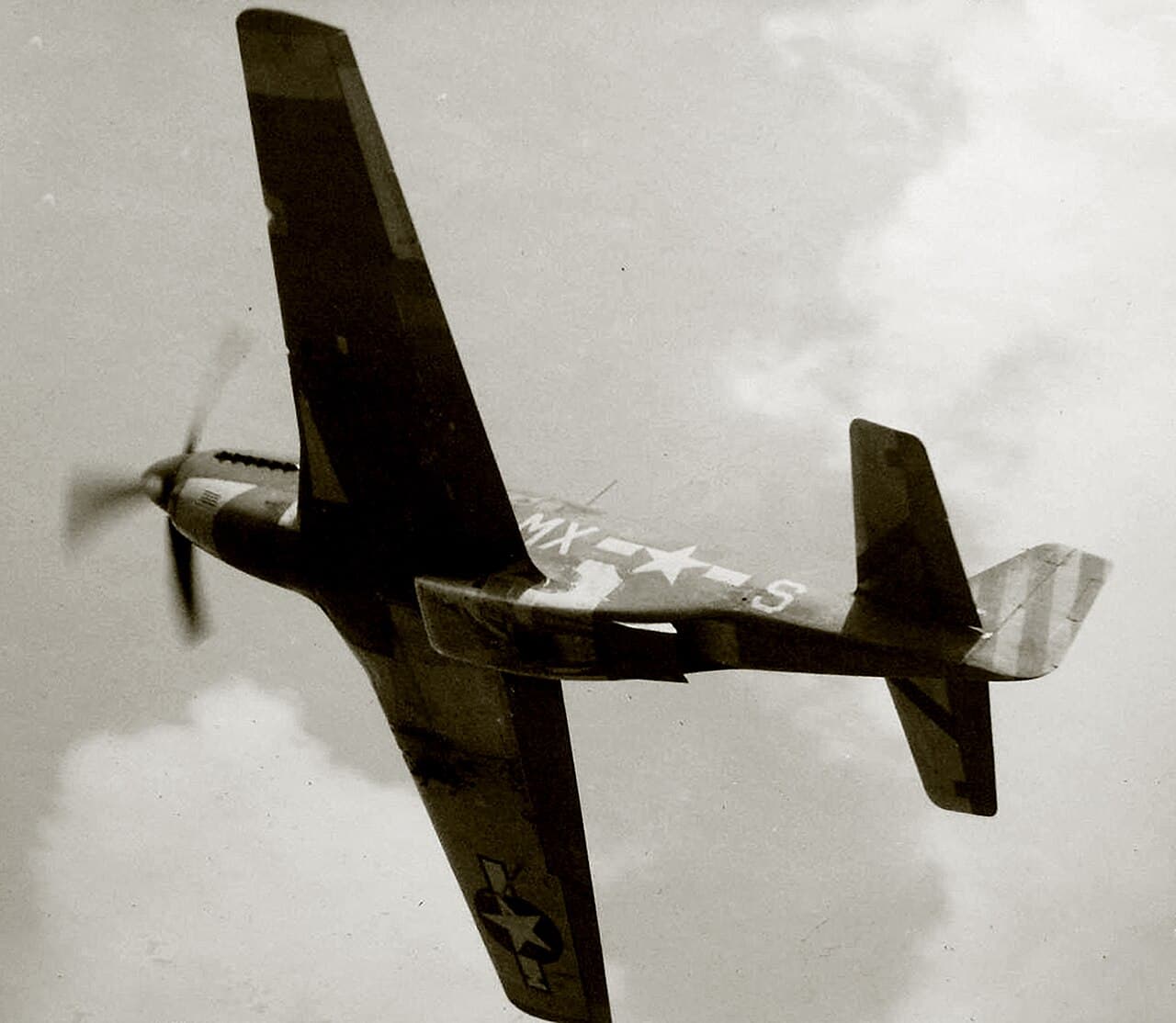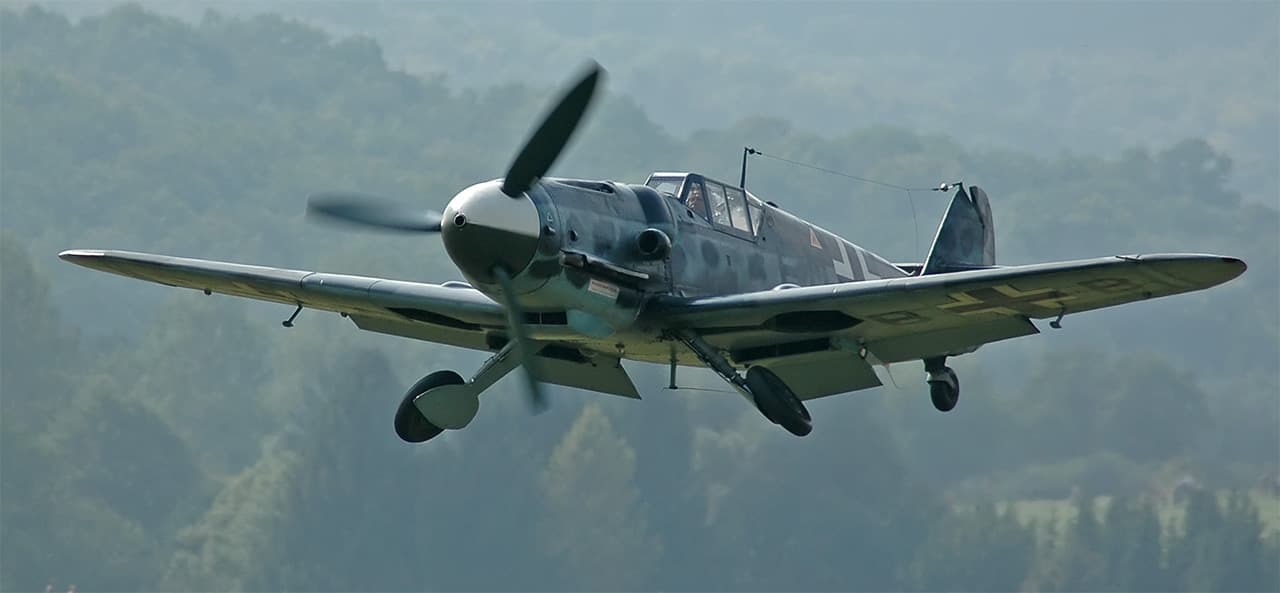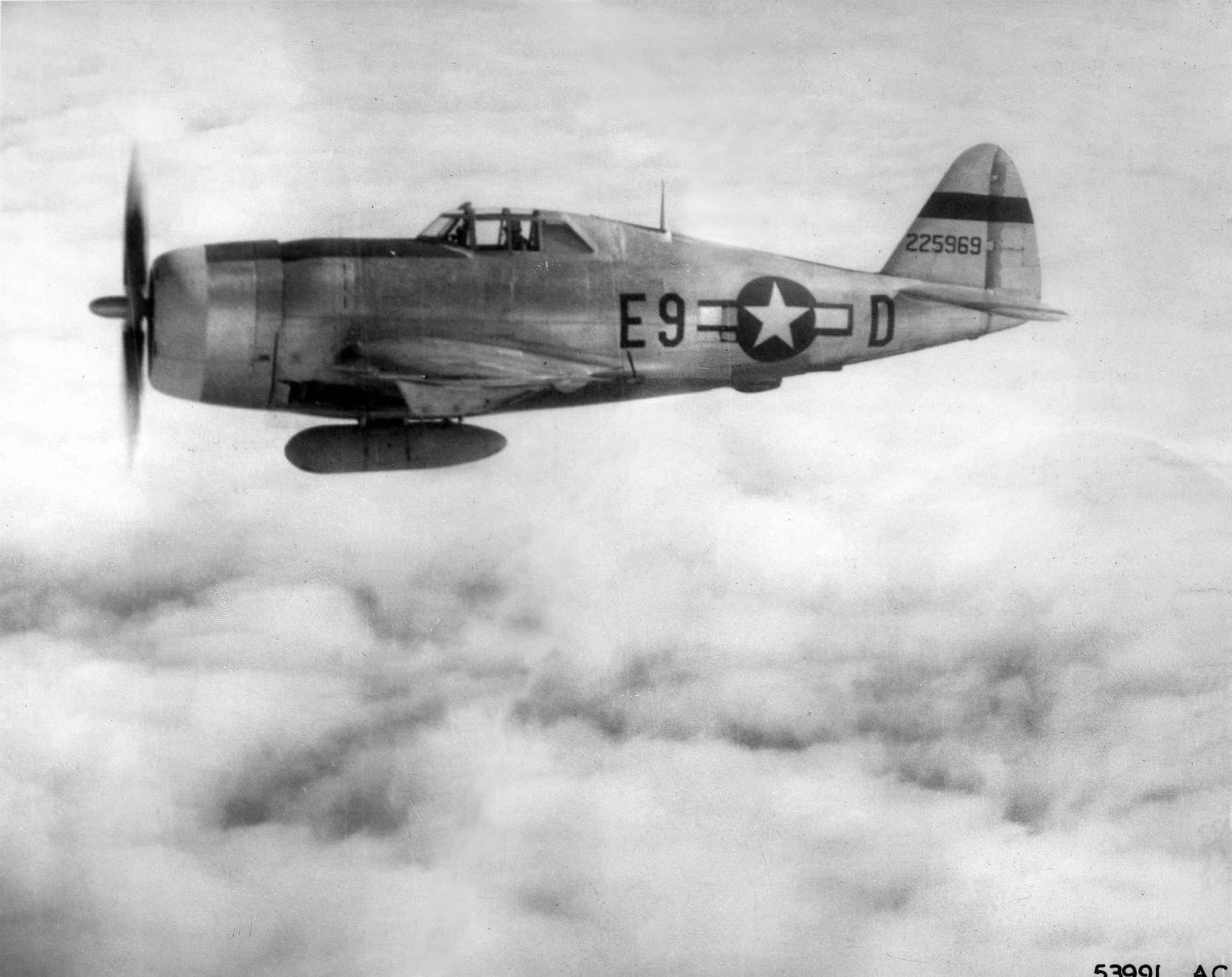
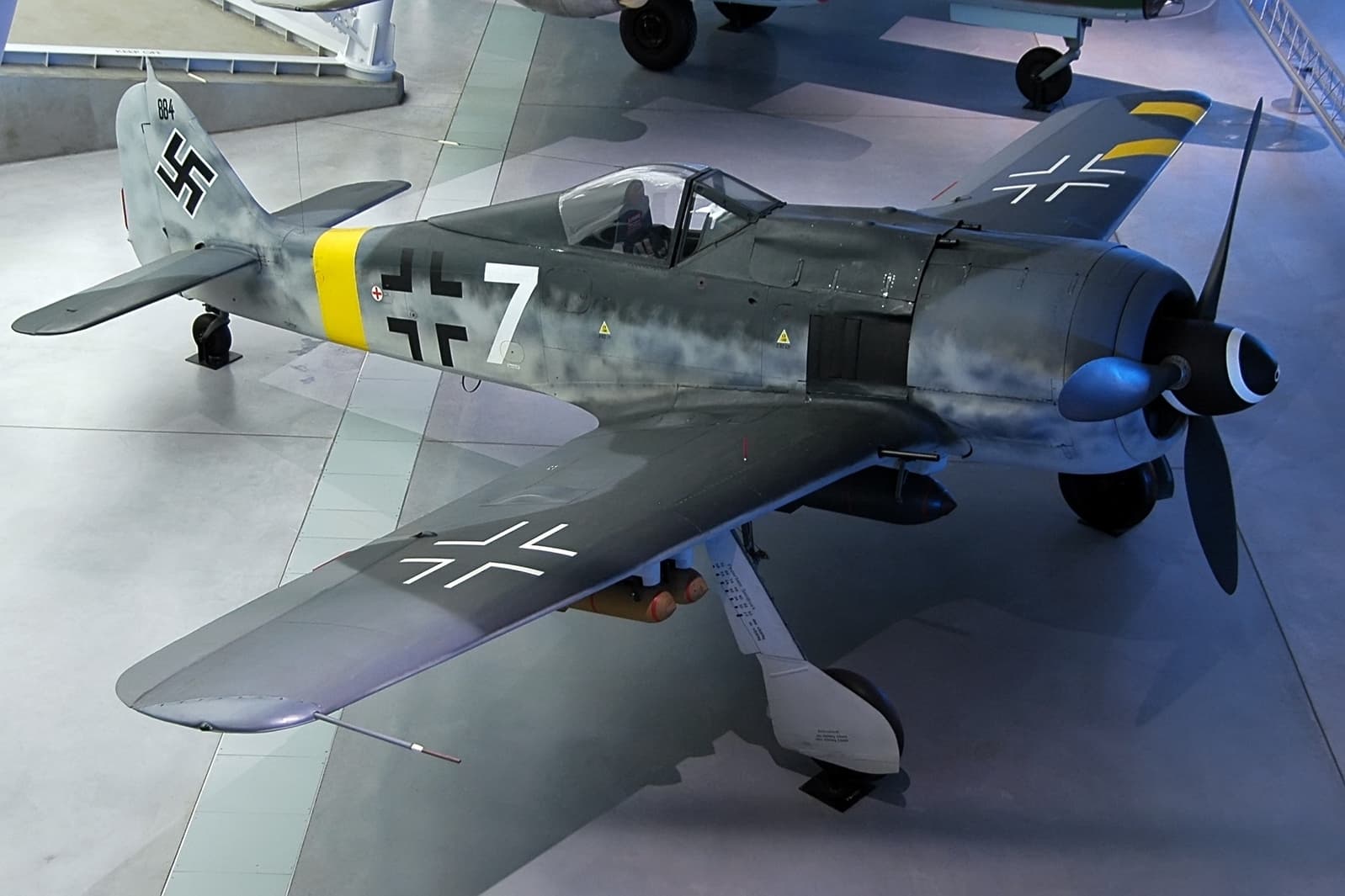
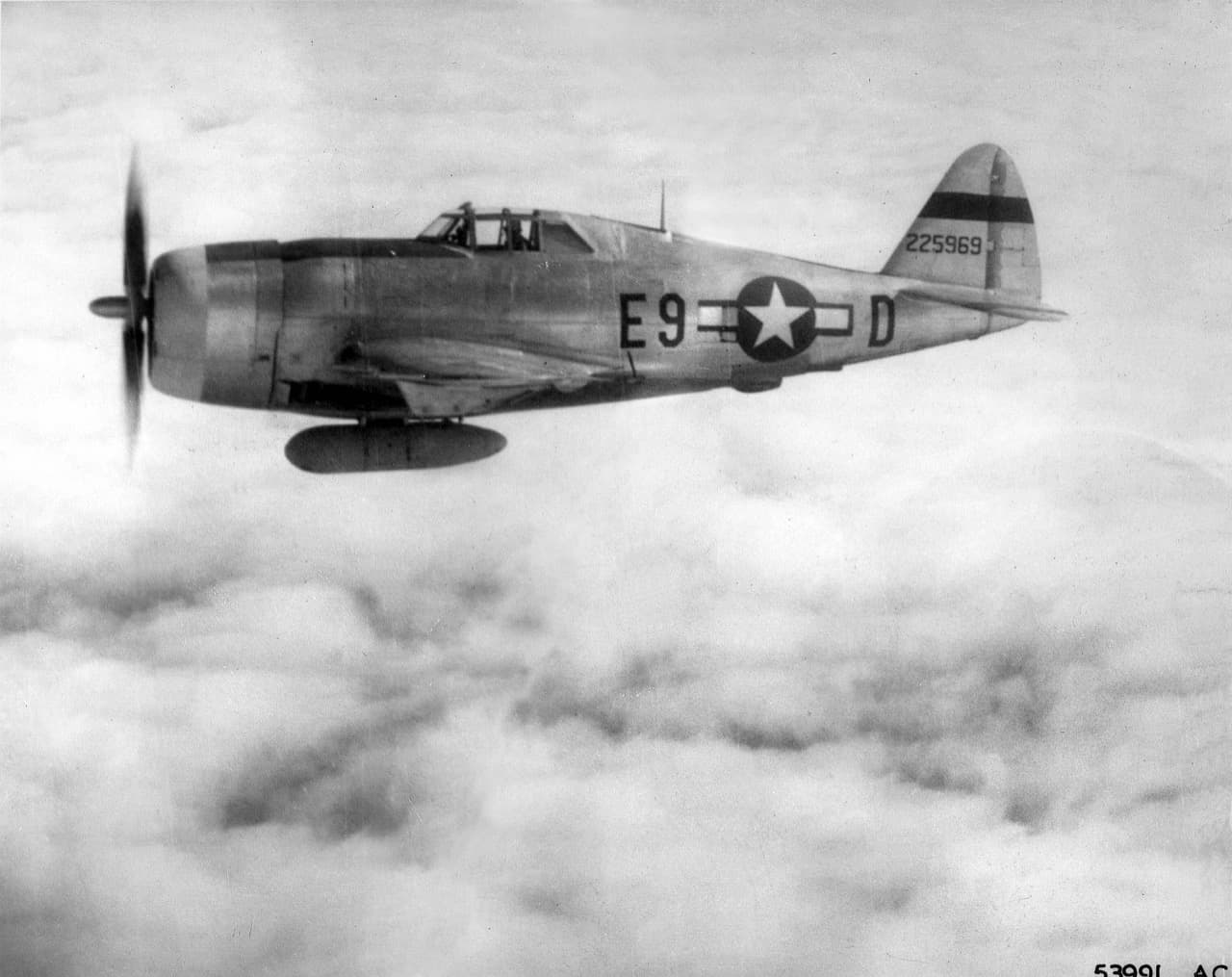
P-47D Thunderbolt vs Fw 190A
Heavyweight brawlers of the European air war
The Bottom Line
The P-47D Thunderbolt and Fw 190A were the two toughest single-engine fighters of the war, radial-engine heavyweights that could dish out and absorb punishment in equal measure. The P-47D held decisive advantages in dive performance, high-altitude combat, range, and payload, while the Fw 190A dominated in roll rate, low-altitude maneuverability, and hitting power per burst. Context determined the winner: above 20,000 feet, the Thunderbolt was king; below 10,000 feet, the Focke-Wulf ruled.
Who Wins Each Scenario?
High-altitude combat (25,000+ ft)
P-47D
The P-47D's turbosupercharged engine gave it a crushing advantage above 25,000 feet. The Fw 190A's performance fell off sharply at these altitudes, it was fighting outside its optimum envelope while the Thunderbolt was in its element.
Low-altitude dogfight (<10,000 ft)
Fw 190A
Below 10,000 feet, the Fw 190A's superior roll rate, better turning performance, and stronger low-altitude power gave it a clear edge. P-47 pilots who let themselves be dragged to the deck were fighting the Fw 190's war.
Bomber escort (deep penetration)
P-47D
The P-47D's range with drop tanks allowed escort missions deep into Germany. The Fw 190A's limited fuel capacity made it exclusively a short-range defensive fighter, it could not project power beyond its own airfields.
Ground attack / fighter-bomber role
P-47D
The P-47D's 2,500-lb bomb capacity, ten HVAR rockets, eight .50-calibers, and legendary toughness against ground fire made it the superior ground-attack platform. The Fw 190F/G was also excellent, but the Thunderbolt's survivability against flak was unmatched.
Bomber interception
Fw 190A
The Fw 190A's four 20mm cannons, and the Sturmbock variant's additional armor for pressing attacks through defensive fire, made it the more effective bomber destroyer. The P-47's .50-calibers required longer engagement windows against heavy bombers.
Survivability under fire
P-47D
While both were exceptionally tough air-cooled designs, the P-47D's sheer mass, massive engine, and documented ability to absorb extreme damage give it the edge. Its 0.7% loss rate per sortie, in the dangerous ground-attack role, was the lowest of any American fighter in the ETO.
Snap deflection shooting
Fw 190A
The Fw 190A's unmatched roll rate allowed pilots to snap onto fleeting targets faster than any opponent. Combined with the 20mm cannons' explosive hitting power, a skilled Fw 190 pilot could destroy an enemy in a momentary crossing shot that a P-47 pilot could not have executed.
Interactive 3D Models
Performance Profile
Overall capability comparison across six combat dimensions
Head-to-Head Specifications
Key performance metrics compared side by side
Size Comparison
Both aircraft drawn to the same scale, the P-47D has 6.3ft greater wingspan and is 7.0ft longer
Performance Analysis
How each aircraft performs across key combat dimensions
Speed
WINNER: P-47DThe P-47D reached 428 mph at 30,000 feet, its turbosupercharged R-2800 delivered peak performance at high altitude where most European air combat took place. With water injection (introduced on the P-47D-25), emergency power pushed the top speed even higher for brief periods.
The Fw 190A-8 reached 408 mph at 20,670 feet, its optimum altitude. Below 15,000 feet, the speed difference between the two aircraft narrowed considerably, and the Fw 190A was competitive in level flight at low altitude where its BMW 801 performed well.
The P-47D held a meaningful speed advantage at the altitudes where most air-to-air combat occurred (20,000–30,000 feet). Above 25,000 feet, the Thunderbolt's turbocharger gave it a decisive edge, while the Fw 190A's performance fell off sharply above its rated altitude. Below 10,000 feet, the gap narrowed enough that speed alone was not decisive, tactics, energy state, and pilot skill mattered more than the modest speed differential at low altitude.
Climb Rate
EvenThe P-47D climbed at approximately 3,120 ft/min at best rate, modest for a 1943–44 fighter, but its climb performance improved dramatically at higher altitudes where the turbocharger maintained manifold pressure. Above 20,000 feet, the Thunderbolt could still climb strongly while naturally aspirated fighters began to labor.
The Fw 190A climbed at approximately 2,953 ft/min but with better initial acceleration from a standing start and stronger performance through the low and medium altitude bands where most tactical situations developed. The Fw 190A could gain separation quickly with a zoom climb after a diving attack.
Climb rate was close enough between these two fighters that the advantage shifted with altitude. Below 15,000 feet, the Fw 190A's lighter wing loading and strong low-altitude power gave it a slight edge in zoom climbs. Above 20,000 feet, the P-47D's turbosupercharged engine pulled away steadily. Neither aircraft was an outstanding climber compared to lighter fighters like the Bf 109 or Spitfire, both were heavy machines that relied on energy management rather than raw climb performance.
Maneuverability
WINNER: Fw 190AThe P-47D was more maneuverable than its size suggested, with responsive ailerons at high speed and good control harmony above 300 mph. In high-speed maneuvering, the kind that followed a diving attack, the Thunderbolt was surprisingly agile for a seven-ton fighter.
The Fw 190A out-turned the P-47D at all altitudes, particularly below 15,000 feet where its lighter wing loading and electric-hydraulic controls gave it a clear turning advantage. The Fw 190 could reverse direction and get its nose onto an opponent faster than the heavier Thunderbolt.
The Fw 190A was the more maneuverable aircraft in a sustained turning fight at any altitude, the P-47D was simply too heavy to match it in a bank-and-yank contest. However, the P-47's maneuverability was better than most pilots expected, and above 15,000 feet the gap narrowed enough that a skilled Thunderbolt pilot could hold his own if he kept his speed up. The key tactical lesson was clear: P-47 pilots who entered a turning fight with an Fw 190 below 10,000 feet were playing the German pilot's game.
Altitude Performance
WINNER: P-47DThe P-47D had a service ceiling of 43,000 feet, one of the highest of any propeller-driven fighter in the war. Its General Electric turbocharger maintained engine power at altitudes where naturally aspirated engines were gasping. Above 25,000 feet, the Thunderbolt was in its element.
The Fw 190A had a service ceiling of 34,775 feet, respectable, but its BMW 801 radial lost power progressively above 20,000 feet. The aircraft was optimized for the low and medium altitude bands (sea level to 20,000 feet) where most tactical fighter operations took place.
This was one of the P-47D's most decisive advantages. The 8,000-foot difference in service ceiling translated to a massive tactical advantage, P-47 pilots could position above any Fw 190 formation and attack with a speed and energy advantage that was nearly impossible to counter. Zemke's 56th Fighter Group exploited this relentlessly, gaining altitude above 30,000 feet before diving on Fw 190s at 20,000 feet. The Fw 190A simply could not compete at the altitudes where the Thunderbolt was strongest.
Range & Endurance
WINNER: P-47DThe P-47D had a ferry range of approximately 1,900 miles with external tanks and a combat radius of roughly 800 miles. Even without drop tanks, the Thunderbolt's internal fuel capacity of 305 gallons (370 gallons with the fuselage tank) gave it endurance that dwarfed any Luftwaffe single-engine fighter.
The Fw 190A had a combat radius of approximately 250 miles and a maximum range of roughly 500 miles, adequate for the defensive interception and short-range ground-attack missions the Luftwaffe required, but severely limiting for any offensive or deep-penetration role.
Range was no contest. The P-47D could fly escort missions deep into Germany, loiter over a target area, engage in combat, and still return to base in England. The Fw 190A was tethered to its airfield by its limited fuel supply. This strategic advantage meant P-47 groups could bring the fight to the Luftwaffe on American terms, while German pilots had to accept combat whenever and wherever it was offered. The range disparity also made the P-47D a superior ground-attack platform, it could range far behind enemy lines and still make it home.
Dive Speed
WINNER: P-47DThe P-47D had absolute dive superiority over virtually every fighter in the war. Its terminal velocity in a dive approached 550 mph, and its massive weight gave it tremendous momentum that no lighter aircraft could match. The Thunderbolt's controls remained effective at speeds that would lock up or overstress most contemporary fighters.
The Fw 190A was itself an excellent diver with good high-speed handling, but it could not match the P-47D's dive acceleration or terminal velocity. At speeds above 400 mph in a dive, the Fw 190A's controls began to stiffen, though they remained better than many contemporaries.
The dive was the P-47D's signature maneuver and its ultimate tactical escape. Nothing in the Luftwaffe inventory could catch a diving Thunderbolt, not the Fw 190, not the Bf 109, not even the Me 262 in certain configurations. American pilots who found themselves in trouble could simply roll over and push the nose down, accelerating away from any pursuer within seconds. This gave every P-47 pilot a built-in escape mechanism that made the aircraft extraordinarily survivable in combat. The Fw 190A was a good diver by any standard, but the Thunderbolt operated in a class of its own.
Roll Rate
WINNER: Fw 190AThe P-47D had a respectable roll rate of approximately 100 degrees per second at 250 mph IAS, and its ailerons remained effective at very high speeds where other fighters' controls stiffened. In the high-speed regime above 350 mph, the P-47's roll rate held up well.
The Fw 190A had the highest roll rate of any major fighter in World War II, approximately 150 degrees per second at 250 mph IAS. Its electrically actuated ailerons provided crisp, immediate response at all speeds. This gave Fw 190 pilots an enormous advantage in defensive maneuvering, snap rolls, and deflection shooting.
Roll rate was the Fw 190A's defining advantage and one of the most significant performance differences in this matchup. The ability to snap into a roll and reverse direction faster than any opponent allowed Fw 190 pilots to break out of tracking solutions, set up deflection shots, and execute the "rolling scissors" defensive maneuver with devastating effect. P-47 pilots quickly learned that trying to follow an Fw 190 through a rapid series of direction changes was futile, the German aircraft could change plane faster than the heavier Thunderbolt could follow. At very high speeds (above 400 mph), the gap narrowed, but in the medium-speed maneuvering band where most combat occurred, the Fw 190's roll rate superiority was unmistakable.
Photo Gallery, 16 Photos


Click any photo to enlarge · 16 photos
Historical Context
The strategic backdrop that shaped both aircraft
The P-47D Thunderbolt and the Focke-Wulf Fw 190A first clashed over the skies of occupied France on April 15, 1943, when the 4th, 56th, and 78th Fighter Groups of the Eighth Air Force flew their first combat missions in the massive Republic fighter. Major Don Blakeslee of the 4th Fighter Group scored the first confirmed P-47 victory that day, against an Fw 190. It was a fitting beginning: these two air-cooled heavyweights would hammer each other across Western Europe for the next two years.
The Fw 190A had been the dominant Luftwaffe fighter since its combat debut in August 1941, when it shocked the RAF by outclassing the Spitfire Mk V in nearly every performance category. By the time the P-47 arrived, Fw 190A units of JG 2 and JG 26, the two Jagdgeschwader tasked with defending the Channel coast, had been mauling Allied aircraft for over a year. These were elite units with experienced pilots, and they initially regarded the big, heavy Thunderbolt with something close to contempt. The early P-47C models lacked the range and low-altitude performance to challenge the Fw 190A on equal terms below 15,000 feet, and German pilots quickly learned to drag engagements down to the deck where their aircraft held the advantage.
The introduction of the P-47D with its improved turbocharger, paddle-blade propeller, and water injection changed the equation. The 56th Fighter Group under Colonel Hubert "Hub" Zemke became the premier P-47 unit in the European Theater, developing the dive-and-zoom tactics that exploited the Thunderbolt's crushing advantages at high altitude and in the dive. Zemke's pilots learned never to follow an Fw 190 into a low-altitude turning fight, instead, they gained altitude, dove at tremendous speed, fired a burst, and zoomed back up before the German pilot could react. This "boom and zoom" doctrine turned the P-47's weight from a liability into a weapon.
As the war progressed, both aircraft evolved beyond pure air superiority into devastating ground-attack platforms. The P-47D became the premier Allied fighter-bomber in the ETO, carrying 2,500 pounds of bombs or ten HVAR rockets to targets across France, Belgium, and Germany. The Fw 190F and G ground-attack variants performed the same role for the Luftwaffe on both the Eastern and Western Fronts. By 1944, these two fighters were as likely to encounter each other at treetop level during a strafing run as they were at 25,000 feet in a classic dogfight, a testament to the extraordinary versatility of both designs.


Notable Combat Encounters
Key engagements where these aircraft faced each other in combat
The 4th, 56th, and 78th Fighter Groups flew the first P-47 combat missions over France, sweeping ahead of medium bomber formations targeting Channel coast targets. Major Don Blakeslee of the 4th FG spotted a pair of Fw 190As from JG 26 and dove on them, scoring the first confirmed P-47 aerial victory. The engagements were brief and inconclusive overall, most pilots were still learning the Thunderbolt's handling characteristics, but they marked the beginning of a two-year rivalry.
Outcome
Three Fw 190s claimed destroyed against three P-47s lost. A modest start, but the Thunderbolt had drawn first blood.
The first combat between these two air-cooled fighters established patterns that would define the matchup: P-47s attacking from altitude with a speed advantage, Fw 190s attempting to draw the fight to lower altitudes.
Captain Robert S. Johnson of the 56th Fighter Group was jumped by an Fw 190A during an escort mission over northern France. In one of the most remarkable survival stories of the war, Johnson's P-47 absorbed over 200 hits from cannon and machine gun fire. The canopy was shattered, hydraulics destroyed, controls barely functional, and the engine cowling was riddled with holes, yet the massive R-2800 radial kept running. The Fw 190 pilot, reportedly Oberfeldwebel Georg-Peter Eder of JG 2, eventually pulled alongside and examined the shattered Thunderbolt before breaking away, apparently out of ammunition or convinced the American was doomed.
Outcome
Johnson nursed his crippled P-47 back across the Channel and landed safely in England. The aircraft was so badly damaged it was written off, but Johnson was uninjured and returned to combat.
This incident became the defining legend of P-47 toughness. Johnson's account, published in his memoir "Thunderbolt!", cemented the Thunderbolt's reputation as the most survivable single-engine fighter of the war. He went on to score 27 victories, all in the P-47.
The 56th Fighter Group "Wolfpack" escorted B-17 formations attacking Bremen and encountered a massive Luftwaffe interception force that included Fw 190As from JG 1 and JG 11. Colonel Zemke led the 56th into the German fighter formations in a series of running engagements that lasted nearly an hour. The P-47s used their altitude advantage to bounce Fw 190s that were climbing to intercept the bombers, picking off fighters before they could form up for coordinated attacks.
Outcome
The 56th FG claimed 23 German fighters destroyed (a mix of Fw 190As and Bf 109Gs) against three P-47s lost, one of the most lopsided victories of the air war. Captain Walker "Bud" Mahurin became an ace in a single mission.
The Bremen mission validated Zemke's tactical doctrine and demonstrated that the P-47, properly employed from altitude, could dominate the Fw 190A. The 56th FG's tactics became the model for all P-47 units in the ETO.
D-Day saw the P-47 in its dual role: air superiority patrols over the beaches and ground attack against German positions inland. The Luftwaffe managed only token resistance, famously, Oberstleutnant Josef "Pips" Priller and his wingman Feldwebel Heinz Wodarczyk made a lone strafing pass along Sword Beach in their Fw 190As, the only Luftwaffe fighter sortie over the invasion beaches during the initial landings. P-47 groups flew continuous patrols, but the air opposition they expected never materialized in force.
Outcome
Allied air supremacy was total. The Luftwaffe flew approximately 100 sorties on D-Day against over 14,000 Allied sorties. Priller and Wodarczyk survived their extraordinary lone attack unscathed.
Priller's defiant two-ship attack became one of the most famous incidents of D-Day, symbolizing the Luftwaffe's hopeless position. The absence of significant German air opposition over Normandy was itself a testament to the attritional victory that P-47 and P-51 groups had won over the preceding months.
When Germany launched Operation Luttich, a counterattack at Mortain intended to cut off the American breakout from Normandy, P-47 Thunderbolts of the IX Tactical Air Command responded with devastating effect. For a solid week, P-47s flew continuous ground-attack sorties against German armored columns funneled into the narrow roads around Mortain and later into the Falaise Pocket. Armed with 500-pound bombs, HVAR rockets, and their eight .50-caliber guns, the Thunderbolts turned the German retreat into a killing ground. Fw 190 fighter-bombers attempted to provide close air support for the German counterattack but were overwhelmed by the sheer number of Allied fighters.
Outcome
The German counterattack was shattered. In the Falaise Pocket alone, over 10,000 German vehicles were destroyed or abandoned. P-47 groups claimed hundreds of armored vehicles, trucks, and horse-drawn wagons. The Luftwaffe lost dozens of Fw 190s attempting to operate over the battlefield.
Mortain and Falaise demonstrated the P-47D's devastating effectiveness as a ground-attack platform. The destruction of German armor from the air became the defining image of Allied tactical airpower in Normandy.
Operation Bodenplatte was the Luftwaffe's last major offensive operation, a surprise dawn attack by roughly 900 fighters (including hundreds of Fw 190As) against Allied airfields across Western Europe. The attack achieved tactical surprise and destroyed or damaged over 450 Allied aircraft on the ground. However, the attacking force suffered catastrophic losses to anti-aircraft fire and to Allied fighters that scrambled to intercept. P-47 groups at several targeted airfields managed to get aircraft airborne during the attack and engaged the low-flying Fw 190s in chaotic dogfights at treetop height.
Outcome
The Luftwaffe destroyed approximately 465 Allied aircraft (mostly on the ground) but lost an estimated 270–300 pilots killed, captured, or missing, including many irreplaceable experienced formation leaders and unit commanders. Allied aircraft losses were replaced within a week; the Luftwaffe's pilot losses were permanent.
Bodenplatte was a Pyrrhic victory that effectively finished the Luftwaffe as a coherent fighting force. The loss of experienced leaders crippled the remaining Fw 190 and Bf 109 units beyond recovery. It was the last time large numbers of Fw 190As went into action on the Western Front.
Armament & Firepower
Primary weapons, munitions capacity, and destructive capability
P-47D Loadout
Eight .50-caliber (12.7mm) M2 Browning machine guns with 3,400 rounds total (425 rounds per gun). Rate of fire: approximately 6,000 rounds per minute combined. Effective range: 300–600 yards. Could carry 2,500 pounds of bombs (typically two 1,000-lb and one 500-lb) or ten 5-inch HVAR rockets on underwing pylons.
Fw 190A Loadout
Four 20mm MG 151/20 cannons (two in wing roots with 250 rpg, two in outer wings with 140 rpg) and two 13mm MG 131 machine guns above the engine (475 rpg each) on the Fw 190A-8. Earlier A models carried two 20mm and two 7.92mm MG 17s. Ground-attack variants could carry a 500kg bomb centerline plus four 50kg bombs on underwing racks.
Air-to-Air Verdict
The P-47D's eight .50-calibers created an enormous cone of fire that was forgiving of slight aiming errors, at 300 yards, the bullet spread covered a roughly six-foot-diameter circle, making it devastating in a deflection shot. The Fw 190A's four 20mm cannons hit incomparably harder per round, a single Minengeschoss high-explosive shell could blow a wing spar apart, but required more precise aim and carried less total ammunition.
Ground Attack Verdict
Both were superb ground-attack platforms. The P-47D's combination of 2,500 pounds of bombs, ten HVAR rockets, and eight .50-calibers made it arguably the most heavily armed single-engine fighter-bomber of the war. The Fw 190F/G ground-attack variants were similarly effective, with their 20mm cannons particularly lethal against soft-skinned vehicles. The P-47D had the edge in payload capacity, while the Fw 190's cannon shells were more effective per hit against armored targets.
The armament comparison between these two fighters reflects fundamentally different philosophies. The American approach emphasized volume: eight machine guns throwing a wall of lead that required less precise aim and allowed longer engagement windows thanks to deep ammunition reserves. A P-47 pilot could fire for approximately 30 seconds of continuous fire, enough for multiple engagements in a single sortie.
The German approach emphasized hitting power: four 20mm cannons that could destroy any single-engine fighter with a one-second burst, but that carried ammunition for only about 12 seconds of firing time total. This demanded more disciplined trigger control and closer engagement ranges. Against heavy bombers, the Fw 190A's 20mm armament was devastatingly effective, the MG 151/20's Minengeschoss shells detonated with a blast effect that ripped through bomber structures.
For air-to-air combat against single-engine fighters, the P-47D's armament was arguably more practical, the volume of fire compensated for the difficulty of hitting a maneuvering target. For bomber interception, the Fw 190A's heavier cannon armament was clearly superior. Both aircraft were equally devastating in the ground-attack role, where the distinction between .50-caliber volume and 20mm explosive power mattered less than bomb and rocket payload.
Survivability & Protection
Armor, self-sealing tanks, pilot protection, and structural resilience
P-47D Protection
The P-47D featured extensive armor protection including a 1/2-inch steel plate behind the pilot, armor glass windscreen, and armor plate around critical engine components. But the Thunderbolt's greatest survivability asset was its massive Pratt & Whitney R-2800 Double Wasp radial engine, an air-cooled powerplant with no vulnerable liquid cooling system. The engine could absorb extraordinary punishment: individual cylinders could be shot away and the remaining cylinders would continue to produce power.
Fw 190A Protection
The Fw 190A carried pilot back armor, an armored headrest, and a bulletproof windscreen. The Sturmbock variant (A-8/R2), designed for attacking heavy bomber formations, added additional cockpit side armor and armored glass panels. Like the P-47, the Fw 190A's air-cooled BMW 801 radial had no vulnerable coolant system, though its annular radiator was somewhat more exposed.
Pilot Protection
Both aircraft provided solid pilot protection with rear armor and bulletproof windscreens. The P-47D's razorback (early) and bubble canopy (late) models offered different trade-offs, the razorback had a stronger rear fuselage structure while the bubble provided better visibility for threat detection. The Fw 190's cockpit was well-armored as standard, and the Sturmbock variant's additional armor panels made it one of the best-protected fighter cockpits of the war.
Structural Durability
The P-47D was legendarily tough. Its massive airframe, the largest and heaviest single-engine fighter of the war at over 13,000 lbs loaded, was built to absorb punishment that would have destroyed lighter aircraft. The wide-track landing gear was forgiving on rough fields. The Fw 190A was also a notably robust design with a wide-track undercarriage and a strong structure, though it lacked the P-47's sheer mass advantage in absorbing damage.
Crash Survivability
The P-47D's high wing loading and heavy weight made forced landings challenging, but the air-cooled engine meant no risk of a glycol fire from a ruptured cooling system, a significant advantage over inline-engine fighters. The Fw 190A was considered one of the safest fighters to crash-land thanks to its wide undercarriage, strong fuselage, and well-protected cockpit. Both aircraft were far more survivable than their liquid-cooled contemporaries.
Survivability was the defining shared characteristic of these two fighters, and the quality that distinguished them from the Mustangs, Spitfires, and Bf 109s they fought alongside. Both the P-47D and Fw 190A were built around large, air-cooled radial engines that had no liquid cooling system to puncture, no radiator to rupture, and no single-hit-kill vulnerability that plagued inline-engine designs. A single bullet through a Merlin's coolant line could force down a Mustang; the same bullet hitting an R-2800 or BMW 801 would destroy one cylinder out of eighteen and the engine would keep running.
The P-47D held the edge in raw damage absorption, Robert Johnson's aircraft survived over 200 hits, and there are documented cases of Thunderbolts returning to base with entire cylinders shot off, control surfaces shredded, and chunks of wing missing. The aircraft's loss rate of approximately 0.7% per combat sortie was the lowest of any American fighter in the ETO, despite its frequent employment in the extremely dangerous ground-attack role. The Fw 190A was similarly tough, its electric (not hydraulic) control actuators reduced vulnerability to system damage, and the BMW 801's Kommandogerät automatic engine management meant that even a badly damaged aircraft required less pilot input to keep flying.
Both aircraft earned the fierce loyalty of their pilots precisely because they brought their crews home from situations that would have killed them in any other fighter.

Tactical Doctrine & Evolution
How pilots were trained to fight in each aircraft and how tactics adapted over time
P-47D Tactics
American P-47 tactics were built entirely around energy management and the vertical dimension. The core doctrine, developed by Zemke, refined by Gabreski, and drilled into every Thunderbolt pilot, was devastatingly simple: climb to 30,000 feet, spot the enemy below, roll into a near-vertical dive, build speed to 400+ mph, fire a burst at close range, and zoom-climb back to altitude before the enemy can react. Repeat until out of targets or ammunition.
This "boom and zoom" approach exploited every P-47 advantage, altitude performance, dive speed, weight (which became an asset in the dive), firepower density, and the ability to disengage at will. The 56th Fighter Group's standard patrol altitude was 30,000 feet, a height at which no Fw 190 could operate effectively and from which a diving Thunderbolt could reach any engagement below within seconds.
Zemke's "Fan" tactic spread the group's fighters in a wide lateral arc during sweeps, maximizing the area covered and ensuring that at least one element would spot any enemy formation. When ground-attack became the P-47's primary role from mid-1944, tactics shifted to low-level approaches using terrain masking, pop-up attacks, and the "cab rank" system where flights of Thunderbolts orbited at altitude waiting for forward air controllers to direct them onto targets.
Fw 190A Tactics
Fw 190A tactics against the P-47 emphasized the aircraft's two decisive advantages: roll rate and low-altitude performance. The standard defensive tactic when bounced from above was a rapid split-S or snap roll into a steep diving turn, using the Fw 190's phenomenal roll rate to change direction faster than the heavier Thunderbolt could follow. If the Fw 190 pilot could drag the fight below 10,000 feet, the dynamic shifted dramatically in his favor.
Offensively, Fw 190A Schwarm (four-ship) formations used coordinated slash attacks: diving through P-47 formations at high speed, firing a brief burst, and extending away before the Americans could react. The key was to avoid getting drawn into a sustained fight at altitude where the P-47's turbocharger gave it the advantage.
Late in the war, the Sturmgruppe concept paired heavily armed Fw 190A-8/R2 "Sturmbock" variants, carrying additional armor for attacks on bomber formations, with Bf 109G escorts that would hold off the American fighters while the Fw 190s bored in on the B-17s and B-24s. This was the Luftwaffe's most sophisticated tactical response to the combined threat of American bombers and their fighter escorts.
How Tactics Evolved
The tactical evolution of the P-47 vs Fw 190 matchup tracked the broader arc of the air war over Western Europe. In early 1943, when the P-47 was new and its pilots inexperienced, Fw 190 units of JG 2 and JG 26 held a distinct tactical advantage, they knew the terrain, they knew their aircraft, and they could exploit the early Thunderbolt's limited range and poor low-altitude performance. Several American pilots were lured into low-altitude turning fights where the Fw 190 dominated, and the lessons were expensive.
By late 1943, American tactics had matured. Zemke's 56th FG had perfected the high-altitude bounce, and P-47 pilots had internalized the discipline of never following an Fw 190 to the deck. The introduction of the paddle-blade propeller and water injection on the P-47D-25 closed some of the performance gaps at medium altitude, and the arrival of belly tanks extended the Thunderbolt's range enough to escort bombers deeper into Germany.
The transformation from 1944 onward was dramatic. As the P-47 shifted increasingly to the ground-attack role, replaced by the P-51 for deep escort duty, the tactical dynamic reversed. Now it was Fw 190 pilots who had to intercept P-47s attacking ground targets, fighting in the low-altitude regime where the German fighter was strongest but where ground fire was most dangerous. The final phase of the war saw both aircraft primarily employed as fighter-bombers, their air superiority roles secondary to the relentless work of destroying the German war machine on the ground.


What the Pilots Said
Firsthand accounts from the men who flew and fought these aircraft
On the P-47D“It was like flying a bathtub, big, heavy, and not particularly graceful. But my God, could it take a beating. I got hit so many times I lost count, and the Jug just kept flying. You could lean on those eight guns and saw a Focke-Wulf in half if you got the deflection right.”
On the P-47D“You had to get in close with the Thunderbolt, really close, inside 200 yards, and let the eight fifties do the work. At that range the concentration of fire was murderous. The trick was the approach: always come from above, always keep your speed up, and never, ever try to turn with a 190 down low.”
On the P-47D“We developed the tactics to match the airplane. The Thunderbolt could not turn with the Fw 190 or the Bf 109, so we did not try. We used altitude, speed, and the dive. My boys would come screaming down from 30,000 feet with the throttle wide open and the Huns never knew what hit them. By the time they reacted, we were already climbing back up for another pass.”
On the Fw 190A“The Focke-Wulf was the finest fighter I ever flew. It was fast, it was strong, it rolled like nothing else in the sky, and it could take punishment. Against the Thunderbolt, I always tried to get the fight down low where my aircraft was at its best. Up high, the big American had too much power, but below 5,000 meters, the Fw 190 had no equal.”
By the Numbers
Statistical combat performance and historical kill ratios
Exchange Ratio
P-47 groups in the European Theater claimed 3,752 air-to-air victories against all Luftwaffe types between April 1943 and May 1945, with total P-47 losses of approximately 3,499 aircraft to all causes (combat, accidents, ground fire). The air-to-air exchange ratio was heavily favorable to the Thunderbolt. In the ground-attack role, P-47s claimed the destruction of 86,000 railroad cars, 9,000 locomotives, 6,000 armored vehicles, and 68,000 trucks. The 56th Fighter Group alone scored 665 aerial victories, the highest total of any Eighth Air Force group, entirely in the P-47.
Source: USAAF Statistical Digest, Eighth and Ninth Air Force records
The P-47D's combat record in the European Theater is one of the most impressive of any fighter in the war, but the raw numbers require context. The favorable exchange ratio reflects the same factors that benefited the P-51: America's overwhelming numerical superiority, superior pilot training, and the progressive collapse of Luftwaffe pilot quality from mid-1944 onward. Against experienced Luftwaffe experten, individual engagements were far more closely contested.
What distinguishes the P-47D's record is its dual excellence in both air-to-air and ground-attack roles. No other fighter in the ETO matched the Thunderbolt's combination of aerial victories and ground targets destroyed. The Ninth Air Force's P-47 groups were the backbone of Allied tactical airpower from D-Day through VE-Day, and their destruction of German transportation, armor, and logistics behind the front lines may have had a greater strategic impact than their air-to-air victories.
The Fw 190A's combat record is harder to quantify in type-vs-type terms. Over 20,000 Fw 190s of all variants were produced, and the type formed the backbone of the Luftwaffe's day fighter force from 1942 through 1944. Fw 190 units achieved remarkable success against Allied bomber formations and in the ground-attack role on the Eastern Front. But by late 1944, Fw 190 units were being ground down by the same attritional pressure that destroyed the Bf 109 force, too many sorties, too few experienced pilots, and an enemy that could absorb losses and keep coming.
Production & the Numbers Game
How industrial output shaped the strategic balance
15,636
P-47D Built
13,367
Fw 190A Built
The production numbers tell a story of industrial asymmetry similar to the P-51 vs Bf 109 matchup but with an important distinction: the P-47 was itself a product of American industrial excess. It used more raw materials, more engine capacity, and more factory space per unit than any other single-engine fighter in the war. The fact that America could afford to produce 15,636 of these enormous machines, while simultaneously building even more P-51s, P-38s, and tens of thousands of bombers, speaks to an industrial base that Germany could not hope to match.
The Fw 190's production story is one of remarkable resilience. Kurt Tank's design was optimized for mass production from the outset, the BMW 801 engine used an innovative Kommandogerät automatic engine management system that simplified both production and pilot training, and the airframe was designed with modular construction that allowed rapid variant conversion. This production efficiency allowed Germany to build more Fw 190s than any Allied fighter type except the P-47 and P-51.
But production numbers alone do not tell the whole story. Germany could build Fw 190s but could not train enough pilots to fly them or produce enough fuel to keep them in the air. By January 1945, the Luftwaffe had more aircraft in inventory than at any point in the war, but most sat idle on dispersed airfields, grounded by fuel shortages and crewed by pilots with barely enough training to take off and land. American P-47s, meanwhile, flew multiple sorties per day with well-trained pilots and unlimited fuel supplies. The production battle was won not at the factory but at the refinery and the flight school.


Advantages in This Matchup
Where each aircraft holds the edge in a head-to-head encounter
P-47D Thunderbolt
- Absolute dive superiority, terminal velocity near 550 mph made the Thunderbolt impossible to catch in a dive
- High-altitude dominance above 25,000 feet thanks to the turbosupercharged R-2800
- Eight .50-caliber guns with 3,400 rounds, the heaviest machine gun armament and deepest ammunition supply of any single-engine fighter
- Legendary structural toughness, the most survivable single-engine fighter of the war, bar none
- Enormous external payload capacity (2,500 lbs bombs + 10 HVAR rockets) for ground attack
- Vastly superior range and endurance for deep-penetration missions
- Air-cooled radial engine with no single-point coolant vulnerability
Fw 190A Wurger
- Highest roll rate of any major WW2 fighter (~150 deg/sec), decisive for defensive maneuvering and snap deflection shots
- Superior low-altitude performance below 15,000 feet where the BMW 801 was at its best
- Four 20mm cannons delivering devastating hitting power per burst, lethal against both fighters and bombers
- Excellent pilot protection with standard armor and optional Sturmbock reinforcement
- Outstanding versatility, fighter, fighter-bomber, bomber destroyer, and ground attack in a single adaptable airframe
- Modular production design optimized for rapid manufacture and field modification
- Electric control actuators reduced hydraulic vulnerability and provided crisp response at all speeds
Final Verdict
Overall Assessment
Context-Dependent
Neither aircraft holds a definitive advantage, the winner depends on the scenario.
The P-47D Thunderbolt and Fw 190A represent one of the most closely matched fighter rivalries of the war, two radial-engine heavyweights that shared more design philosophy with each other than with any of their liquid-cooled contemporaries. Both were built around the concept of a powerful air-cooled engine in a robust airframe, both sacrificed some agility for firepower and survivability, and both evolved from air superiority fighters into devastating ground-attack platforms. In many ways, they were mirror images built by opposing industrial systems.
The performance comparison reveals complementary rather than overlapping advantages. The P-47D owned the vertical dimension, its turbosupercharged engine gave it high-altitude performance that the naturally aspirated Fw 190A simply could not match, and its dive acceleration was the best of any propeller-driven fighter in the war. The Fw 190A owned the horizontal dimension at low altitude, its roll rate, turning performance, and sea-level speed gave it the edge in the close-in maneuvering fights that developed below 15,000 feet. Neither aircraft could defeat the other on the opponent's terms, and the outcomes of their encounters were determined as much by altitude, energy state, and tactical position as by any inherent design superiority.
Armament philosophy split along national lines. The P-47D's eight .50-calibers provided a sustained hose of fire with enormous ammunition depth, 3,400 rounds gave American pilots the luxury of long engagements and multiple targets per sortie. The Fw 190A's four 20mm cannons hit like a sledgehammer but ran dry quickly, German pilots needed to be more disciplined marksmen, closing to shorter range and making every burst count. For ground attack, both were superb: the P-47D carried more bombs and rockets, while the Fw 190's cannon shells were more effective per hit against armored targets.
Survivability is where these two fighters stood apart from all their contemporaries. The P-47D's documented ability to absorb catastrophic damage and keep flying, Robert Johnson's 200-hit survival, aircraft returning with entire cylinder banks shot away, Thunderbolts landing safely with control surfaces shredded, was unmatched by any single-engine fighter in the war. The Fw 190A was similarly tough, with its air-cooled engine, electric controls, and robust structure making it one of the most damage-resistant fighters the Luftwaffe fielded. Engagements between these two aircraft were grinding affairs where neither fighter was easily killed.
The strategic verdict favors the P-47D, but not overwhelmingly. Its range allowed it to project power deep into enemy territory; its payload made it the most effective Allied fighter-bomber; and its toughness meant it survived the dangerous ground-attack role at a rate that no other fighter could match. The Fw 190A was a brilliant defensive fighter that excelled in the interception and point-defense roles the Luftwaffe needed, but it lacked the range and high-altitude performance to contest the strategic air war on equal terms.
If forced to choose one aircraft for all missions, the P-47D's versatility, high-altitude escort, ground attack, air superiority, and reconnaissance, with the survivability to excel in the most dangerous roles, gives it the edge. But any honest assessment must acknowledge that below 15,000 feet, in a rolling, turning fight between equally skilled pilots, the Fw 190A was the more dangerous machine. These were the two toughest single-engine fighters of the war, and the men who flew them knew they were in a fair fight every time they met.
Theaters of Operation
Shared Theaters
P-47D Only
Fw 190A Only