
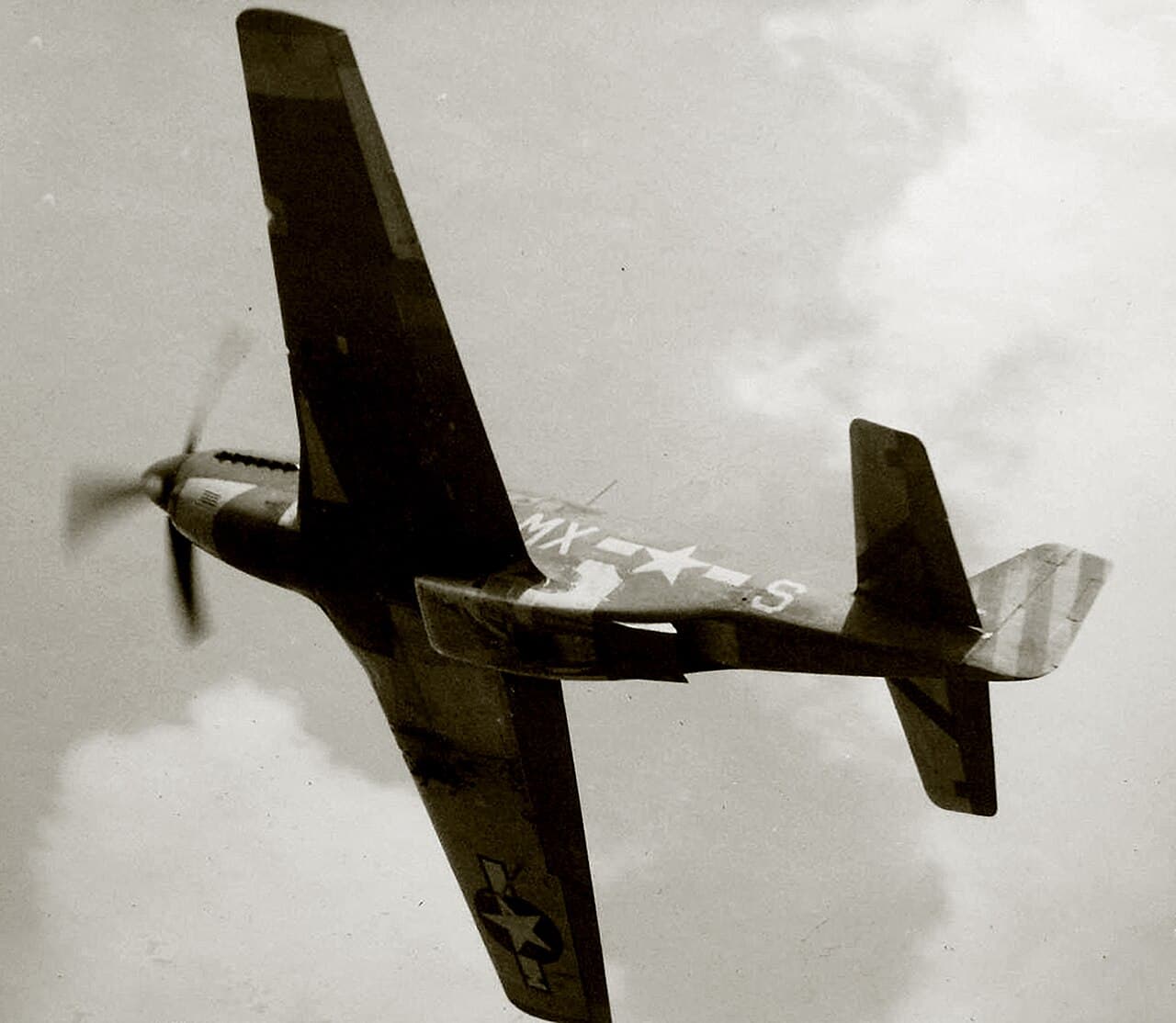
North American P-51D Mustang
North American Aviation
How does the P-51D stack up?
CompareOverview
The North American P-51D Mustang is widely regarded as the finest all-around piston-engine fighter of World War II. Combining exceptional range with outstanding high-altitude performance, the Mustang solved the Eighth Air Force's most critical problem: escorting heavy bombers all the way to Berlin and back. Its arrival over Germany in early 1944 fundamentally shifted the air war and hastened the destruction of the Luftwaffe as an effective fighting force.
Powered by the legendary Packard-built Rolls-Royce Merlin engine and armed with six .50-caliber machine guns, the P-51D married British engine technology with American airframe ingenuity. The distinctive bubble canopy of the D model gave pilots unmatched visibility in combat, while the laminar-flow wing design provided both speed and fuel efficiency. At roughly $50,000 per unit, it was also one of the most cost-effective fighters of the war.
The Mustang served in every theater of the war and continued flying combat missions well into the Korean War. With over 15,000 built, it remains the most recognized American fighter of the Second World War and an enduring symbol of Allied air superiority.
Performance Profile
Max Speed
437 mph
at 25,000 ft
Range
1,650 miles
ferry
Service Ceiling
41,900 ft
Rate of Climb
3,475 ft/min
Armament
6 guns
6x .50 BMG
Crew
1
Engine
Packard V-1650-7 Merlin
1490 hp inline
Development History
The P-51 was born from a British request. In April 1940, the British Purchasing Commission approached North American Aviation about license-building Curtiss P-40s for the RAF. North American's president, James "Dutch" Kindelberger, counter-proposed designing a completely new fighter using the same Allison V-1710 engine. The British agreed on the condition that the prototype be ready within 120 days. The NA-73X prototype rolled out in 102 days, first flying on October 26, 1940.
The early Allison-powered Mustangs (Mustang I, A-36, P-51A) performed well at low altitudes but lacked the supercharger needed for high-altitude combat over Europe. The breakthrough came when Rolls-Royce test pilot Ronald Harker suggested fitting the aircraft with the two-stage supercharged Merlin 61 engine in April 1942. The conversion was a revelation: the Merlin-powered Mustang gained 50 mph at altitude, turning a capable low-level fighter into the premier high-altitude escort fighter of the war.
The P-51B/C with the Merlin entered combat in December 1943, immediately proving its worth on long-range escort missions. However, the framed "Malcolm hood" canopy limited rearward visibility. North American responded with the definitive P-51D, which introduced a cut-down rear fuselage and a teardrop bubble canopy, six rather than four .50-caliber guns, and strengthened wings with improved ammunition feed. The P-51D entered production in mid-1944 and accounted for the majority of all Mustangs built.
Production ramped up rapidly, with North American's Inglewood, California and Dallas, Texas plants turning out thousands of airframes. The final Mustang variant of the war, the P-51H, was the fastest propeller-driven aircraft accepted by the USAAF at 487 mph, though it arrived too late to see significant combat.
Combat History
The Mustang's combat career divides into two distinct chapters. The early Allison-powered variants served primarily with the RAF in the tactical reconnaissance and ground attack roles from mid-1942, proving effective in the Dieppe Raid and low-level operations over France. The A-36 Apache dive-bomber variant saw extensive action in the Mediterranean, supporting the invasions of Sicily and Italy.
The Merlin-powered P-51B arrived in England in November 1943 with the 354th Fighter Group and flew its first escort mission on December 1. The impact was immediate and dramatic. For the first time, American bombers had a single-engine fighter that could escort them to Berlin and beyond. During "Big Week" in February 1944, Mustangs helped break the back of the Luftwaffe's day fighter force. By D-Day, the P-51 equipped most of VIII Fighter Command's groups, providing air superiority over the invasion beaches.
In the Pacific, P-51Ds operated from Iwo Jima beginning in March 1945, escorting B-29 Superfortresses on missions to Japan. The 15th, 21st, and 506th Fighter Groups flew long-range escort and strafing missions that helped establish complete air dominance over the Japanese home islands. Mustang pilots also participated in some of the last aerial combats of the war.
By war's end, P-51 pilots in the European theater alone claimed 4,950 enemy aircraft destroyed in the air and 4,131 on the ground, making it the top-scoring American fighter in the ETO. The Mustang's combination of range, speed, and combat effectiveness made it the single most important American fighter of the war.
Variants
| Designation | Key Differences | Produced |
|---|---|---|
| P-51A | Allison V-1710-81, four .50 cal guns, first USAAF Mustang variant | 310 |
| P-51B/C | First Merlin-powered variant (V-1650-3), four .50 cal guns, razorback fuselage | 3,738 |
| P-51D | Bubble canopy, six .50 cal guns, V-1650-7, definitive variant | 8,156 |
| P-51H | Lightweight, V-1650-9 (2,218 hp WER), 487 mph top speed, arrived late war | 555 |
| P-51K | Dallas-built D model with Aeroproducts propeller instead of Hamilton Standard | 1,337 |
| A-36 Apache | Dive-bomber variant with dive brakes, Allison engine, six .50 cal guns | 500 |
Strengths & Weaknesses
+Strengths
- Exceptional range allowed escort missions deep into Germany, something no other single-engine fighter could match
- Outstanding high-altitude performance above 25,000 feet where most air combat occurred
- Excellent speed at all altitudes, competitive with or superior to all Axis fighters
- Efficient laminar-flow wing design provided both speed and fuel economy
- Relatively inexpensive to produce compared to twin-engine alternatives
-Weaknesses
- Liquid-cooled engine was vulnerable to even minor combat damage; a single bullet to the coolant system could bring it down
- Less robust than the P-47 in the ground-attack role, more susceptible to ground fire
- Early B/C models had gun jamming issues due to canted wing-mounted gun positions
- Laminar-flow wing could be less forgiving at low speeds and during landing
Pilot Voices
“The Mustang was the best fighter anybody had in World War II. It could do everything.”
“It could outdive, outclimb, and outrun the Me 109 and Fw 190. It was a pilot's dream.”
“When I saw Mustangs over Berlin, I knew the jig was up.”
Did You Know?
The original NA-73X prototype was designed and built in just 102 days, one of the fastest aircraft development programs of the war.
Luftwaffe General Adolf Galland famously told Hermann Goering that what he needed was "a squadron of Spitfires," but privately considered the P-51 the most dangerous Allied fighter.
The P-51 almost never received the Merlin engine. It was a chance encounter between test pilot Ronald Harker and the Mustang I that sparked the idea.
P-51D units in the ETO adopted a tactic called "area superiority" where fighters ranged ahead of bomber formations to hunt and destroy Luftwaffe aircraft before they could attack.

