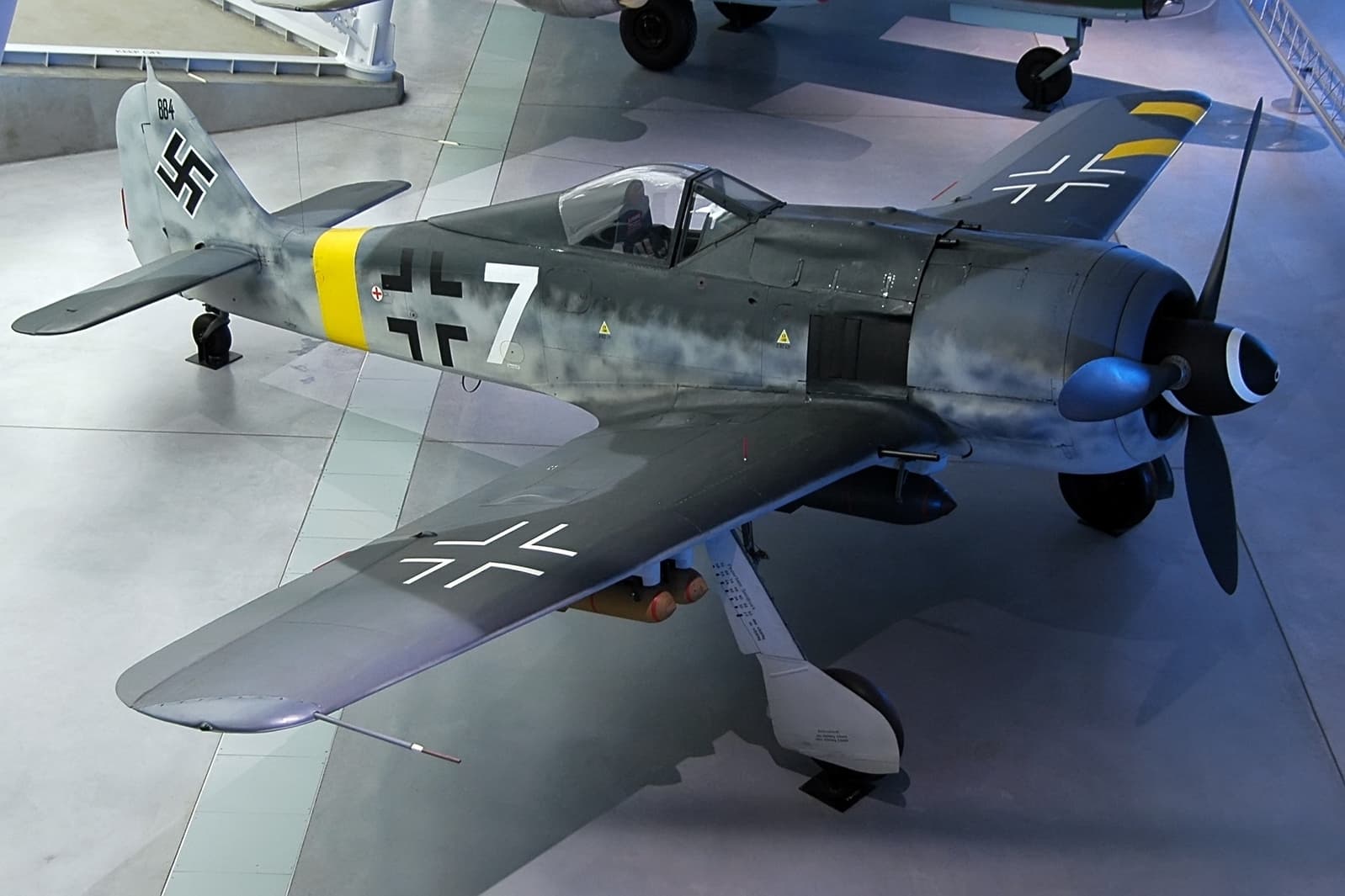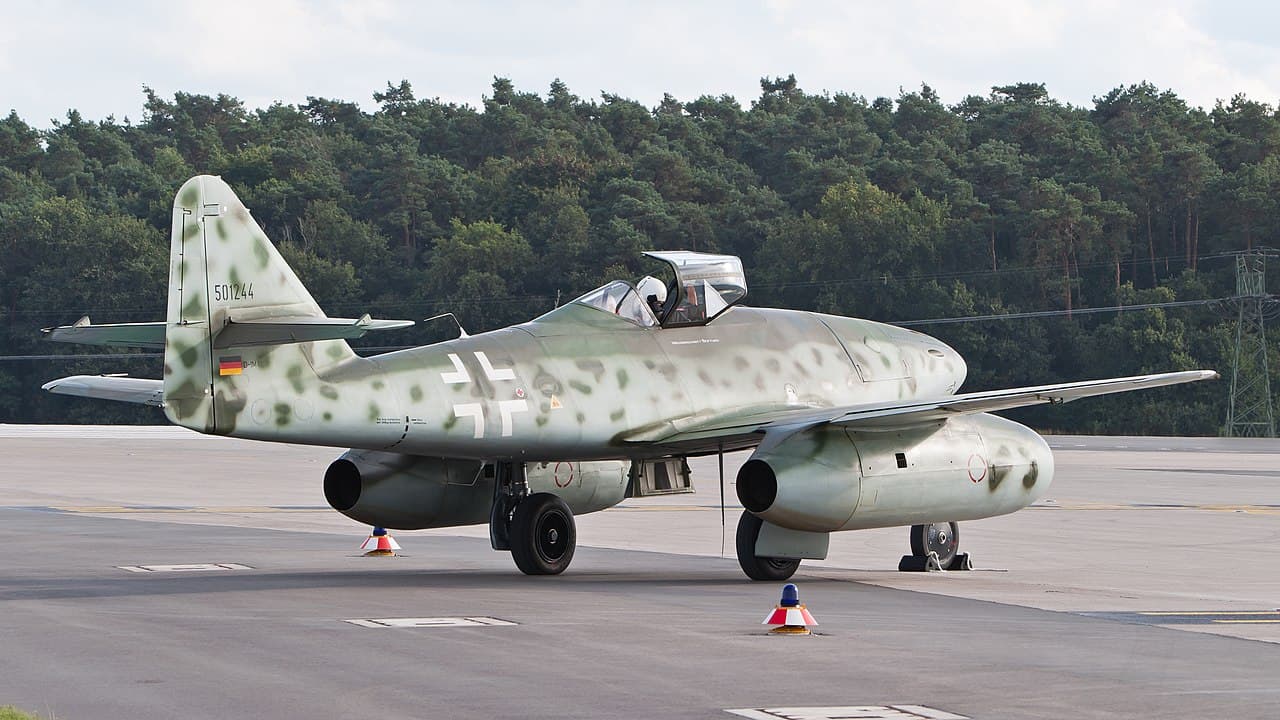
Messerschmitt Me 262A
Messerschmitt
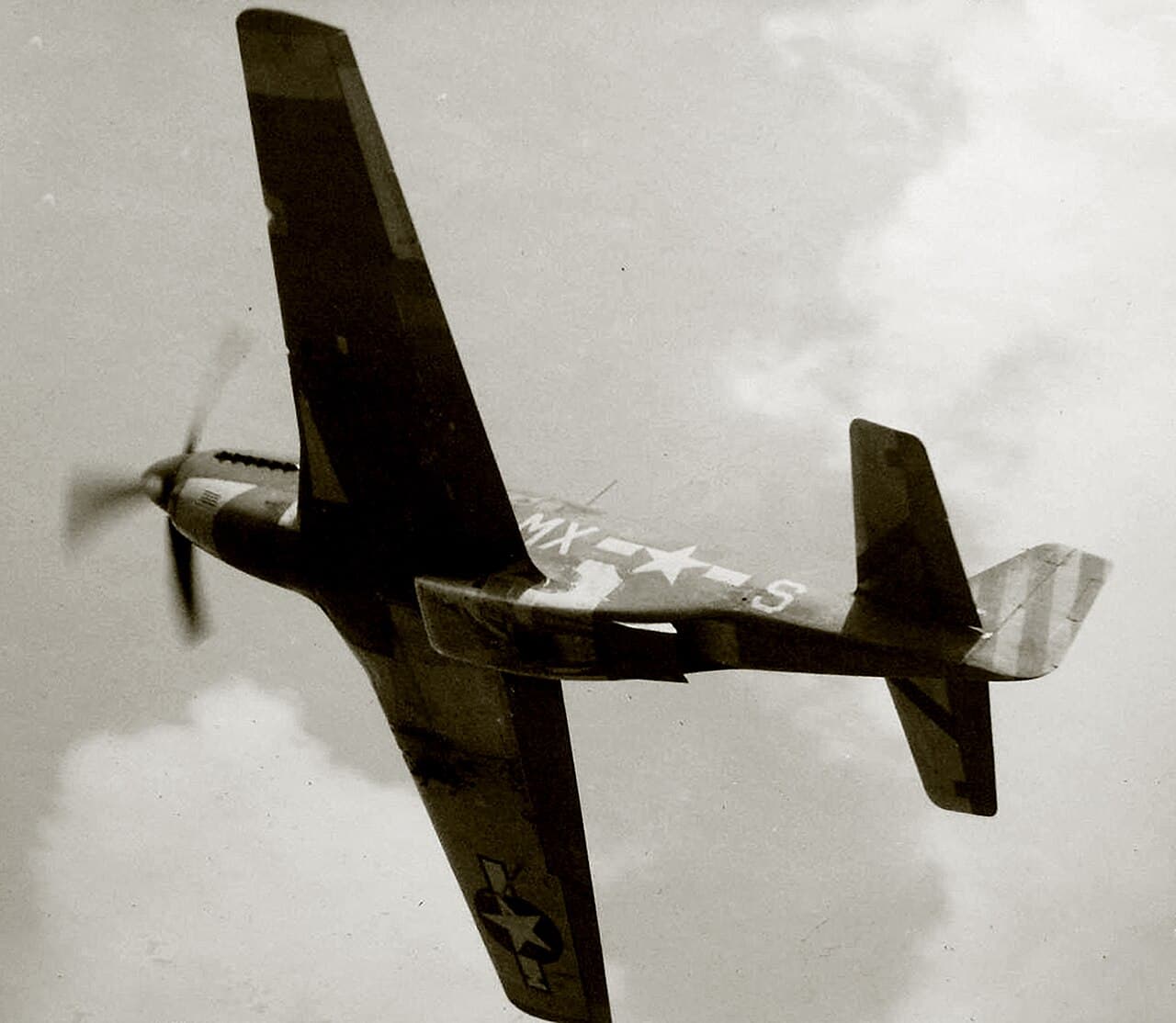
North American P-51D Mustang
North American Aviation
Me 262A Schwalbe vs P-51D Mustang
The world's first jet fighter against the war's finest piston-engined escort
The Bottom Line
The Me 262 was the more revolutionary aircraft, faster, more powerfully armed, and a harbinger of the jet age. The P-51D was the more effective weapon system, reliable, numerous, strategically versatile, and backed by an industrial and training infrastructure that the Luftwaffe could not match. In war, effective beats revolutionary.
Who Wins Each Scenario?
Head-to-head speed engagement
Me 262A
No contest. The Me 262 was 100+ mph faster and could dictate engagement terms at will. No propeller-driven fighter could catch it in level flight.
Dogfight below 300 mph
P-51D
If the Me 262 lost its speed advantage, the Mustang's superior turn rate, roll rate, and acceleration were decisive. German pilots knew entering a turning fight was suicidal.
Bomber interception
Me 262A
The combination of uncatchable speed, four 30mm cannons, and R4M rockets made the Me 262 the most lethal bomber interceptor of the war. A single pass could destroy a heavy bomber.
Long-range escort mission
P-51D
The Me 262's 652-mile range limited it to roughly 90 minutes of flight. The P-51D's 1,650-mile range made deep penetration escort possible, the strategic mission that won the air war.
Airfield patrol and ambush
P-51D
P-51 "Rat Catcher" patrols exploited the Me 262's vulnerability during takeoff and landing, negating its speed advantage entirely. P-51s claimed 93 jet kills, mostly through this tactic.
Strategic impact on the air war
P-51D
Numbers, reliability, range, and trained pilots meant the Mustang shaped the air war's outcome. The Me 262 arrived too late in too few numbers with too many mechanical problems to reverse the Luftwaffe's decline.
Performance Profile
Overall capability comparison across six combat dimensions
Head-to-Head Specifications
Key performance metrics compared side by side
Size Comparison
Both aircraft drawn to the same scale, the Me 262A has 4.0ft greater wingspan and is 2.5ft longer
Performance Analysis
How each aircraft performs across key combat dimensions
Speed
WINNER: Me 262AThe Me 262 reached 540 mph, approximately 100 mph faster than any Allied fighter. This speed made it virtually uncatchable in level flight and allowed pilots to dictate engagement terms at will.
The P-51D's 437 mph was the fastest among Allied escort fighters. While it could not match the jet in level flight, the Mustang could exceed 500 mph in a dive, narrowing the gap enough to engage jets caught at lower speeds.
Speed was the Me 262's defining advantage and the reason it existed. The 100-mph gap was unprecedented in fighter combat and fundamentally changed engagement dynamics, P-51 pilots could not pursue, could not escape, and had only seconds to fire when a jet passed through their formation. However, the Me 262's acceleration was sluggish compared to piston fighters, and its speed advantage evaporated during takeoff, landing, and low-speed maneuvering.
Maneuverability
WINNER: P-51DDecent handling for a twin-engine jet, with stable flight characteristics at high speed. The absence of propeller torque made it a steady gun platform during attack passes.
The P-51D was dramatically more maneuverable, tighter turn radius, better sustained turn rate, responsive controls at all speeds, and superior roll authority. If an Me 262 slowed below 300 mph to maneuver, any P-51 in the vicinity could out-turn it.
Maneuverability was the P-51D's great equalizer. The Me 262's swept wing and twin-engine layout gave it a wider turning radius and less responsive handling in sustained maneuvering. German pilots knew that entering a turning fight with P-51s was suicidal, their entire tactical doctrine was built around avoiding exactly this scenario. When jets were forced to maneuver at lower speeds, the piston fighters held every advantage.
Climb Rate
WINNER: Me 262AInitial climb rate of 3,900 feet per minute at sea level, allowing rapid ascent to intercept altitude. The jet engines provided consistent thrust during climb without the power loss that affected piston engines at altitude.
The P-51D climbed at 3,475 feet per minute, competitive with the Me 262 and superior at very high altitudes where the Merlin's two-stage supercharger maintained power output that the Jumo 004's thrust could not match.
The climb rate difference was moderate, not the dramatic gap that existed in speed. The Me 262 climbed faster at low and medium altitudes, but the P-51D's supercharged Merlin remained competitive throughout the altitude range. Above 30,000 feet, the Mustang actually gained an advantage as the Jumo 004's thrust dropped off significantly.
Altitude Performance
WINNER: P-51DService ceiling of 37,600 feet. The jet could operate effectively at altitudes where it had clear speed superiority over all piston fighters.
Service ceiling of 41,900 feet, over 4,000 feet higher than the Me 262. The Merlin's two-stage supercharger provided excellent power output at extreme altitude, where the Jumo 004's thrust deteriorated markedly.
The P-51D held a meaningful altitude advantage that is often overlooked. At extreme altitude, the Mustang could operate above the Me 262's effective ceiling, potentially using altitude to dive onto jets and close the speed gap. This advantage was exploited by American pilots who climbed above known Me 262 operating altitudes and converted altitude into attack speed.
Range & Endurance
WINNER: P-51DNone. The Me 262's 652-mile range on internal fuel limited it to roughly 60–90 minutes of flight time. Jet engines consumed fuel at voracious rates, and no practical external tank solution was widely fielded.
Range of 1,650 miles with drop tanks, more than two and a half times the Me 262's reach. The Mustang could escort bombers from England deep into Germany and back, loitering over targets for extended periods.
Range was the P-51D's decisive strategic advantage and the Me 262's most crippling limitation. The Mustang's ability to project fighter power across the entire European theater was the foundation of Allied air superiority. The Me 262 could barely patrol its own airspace. This disparity meant the Mustang could always be where it was needed, while the Me 262 could never be far from its base.
Dive Speed
WINNER: P-51DCould reach very high indicated airspeeds in a dive, though some pilots reported compressibility effects and control stiffening at extreme speeds approaching the transonic regime.
The P-51D's laminar-flow wing gave excellent high-speed dive characteristics, with pilots regularly exceeding 500 mph. American pilots discovered they could actually catch Me 262s in a dive, the Mustang's clean aerodynamics and gravity could temporarily close the speed gap.
P-51 pilots found that diving from altitude was one of the few ways to engage an Me 262 on anything approaching equal terms. The Mustang dove cleanly and predictably, while the Me 262 could encounter compressibility issues at extreme speeds. This made the dive a viable attack option for Mustang pilots who could achieve an altitude advantage.
Roll Rate
WINNER: P-51DAcceptable roll rate for a twin-engine aircraft, with stable characteristics that aided gunnery during high-speed passes.
Superior roll rate at combat speeds, with lighter, more responsive ailerons. The single-engine configuration and lighter overall weight gave the Mustang more agile roll authority critical for defensive and offensive maneuvering.
The P-51D's roll rate advantage was a meaningful combat factor, particularly during the split-second opportunities that characterized engagements with jets. Faster roll allowed Mustang pilots to snap onto a target and begin tracking more quickly, essential when an Me 262 presented only a fleeting firing opportunity.
Cockpit Visibility
WINNER: P-51DForward visibility was adequate through the armored windscreen, and the fighter's speed meant threats had limited time to approach from blind spots.
The P-51D's teardrop bubble canopy provided exceptional 360-degree visibility, among the best of any WW2 fighter. Pilots could scan for threats in every direction, critical for situational awareness in the chaotic multi-aircraft engagements over Germany.
The P-51D's visibility advantage was substantial. The Me 262's heavily framed canopy with thick armored windscreen created blind spots that were dangerous at jet speeds, where threats could close rapidly from unexpected angles. The Mustang's bubble canopy was purpose-built for the kind of swirling, multi-bogey engagements that characterized the air war over Germany.
Photo Gallery, 10 Photos
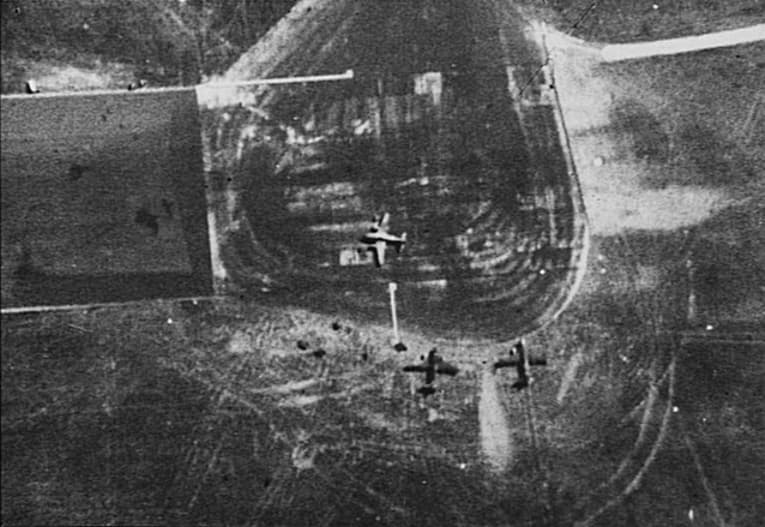
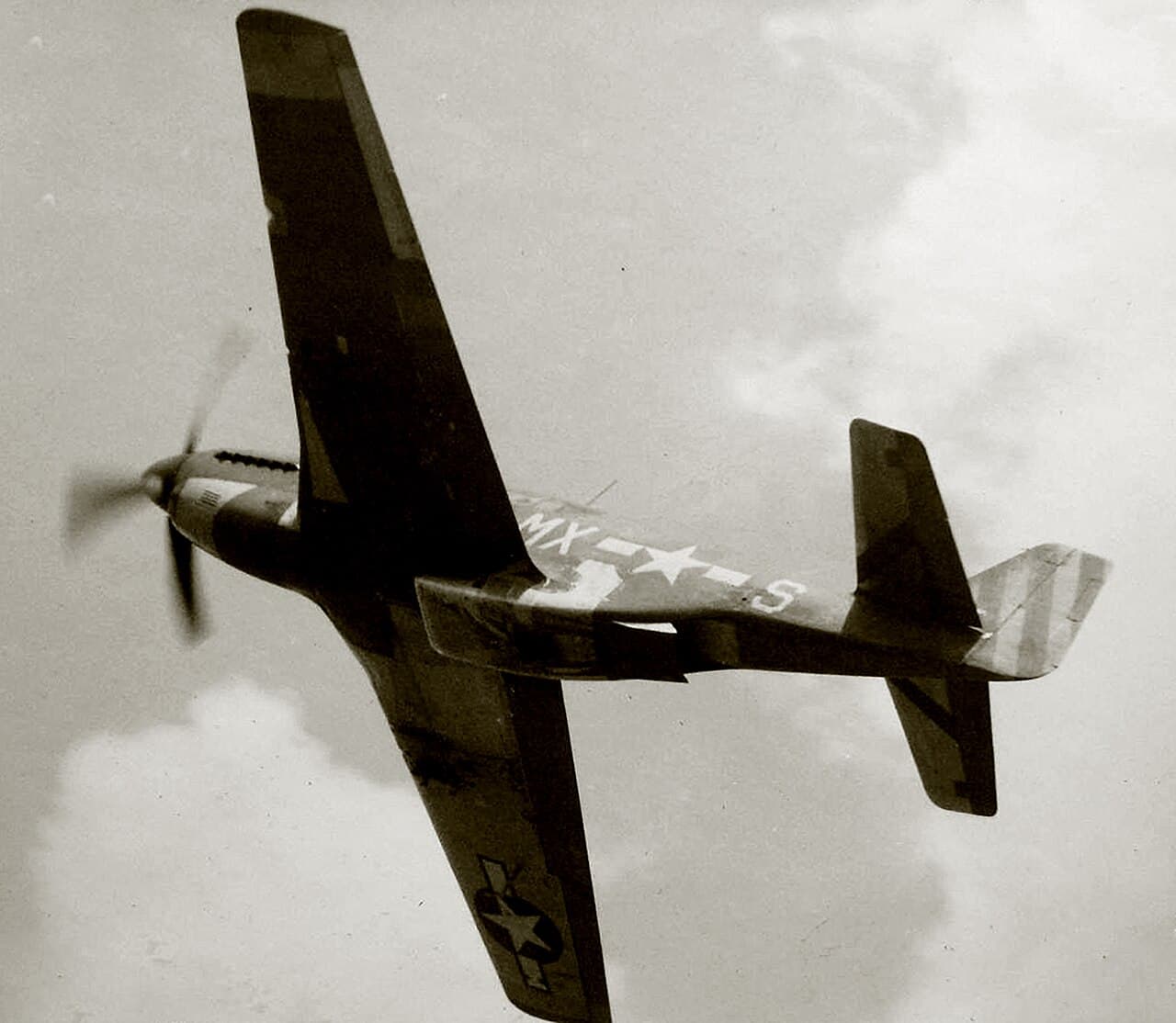

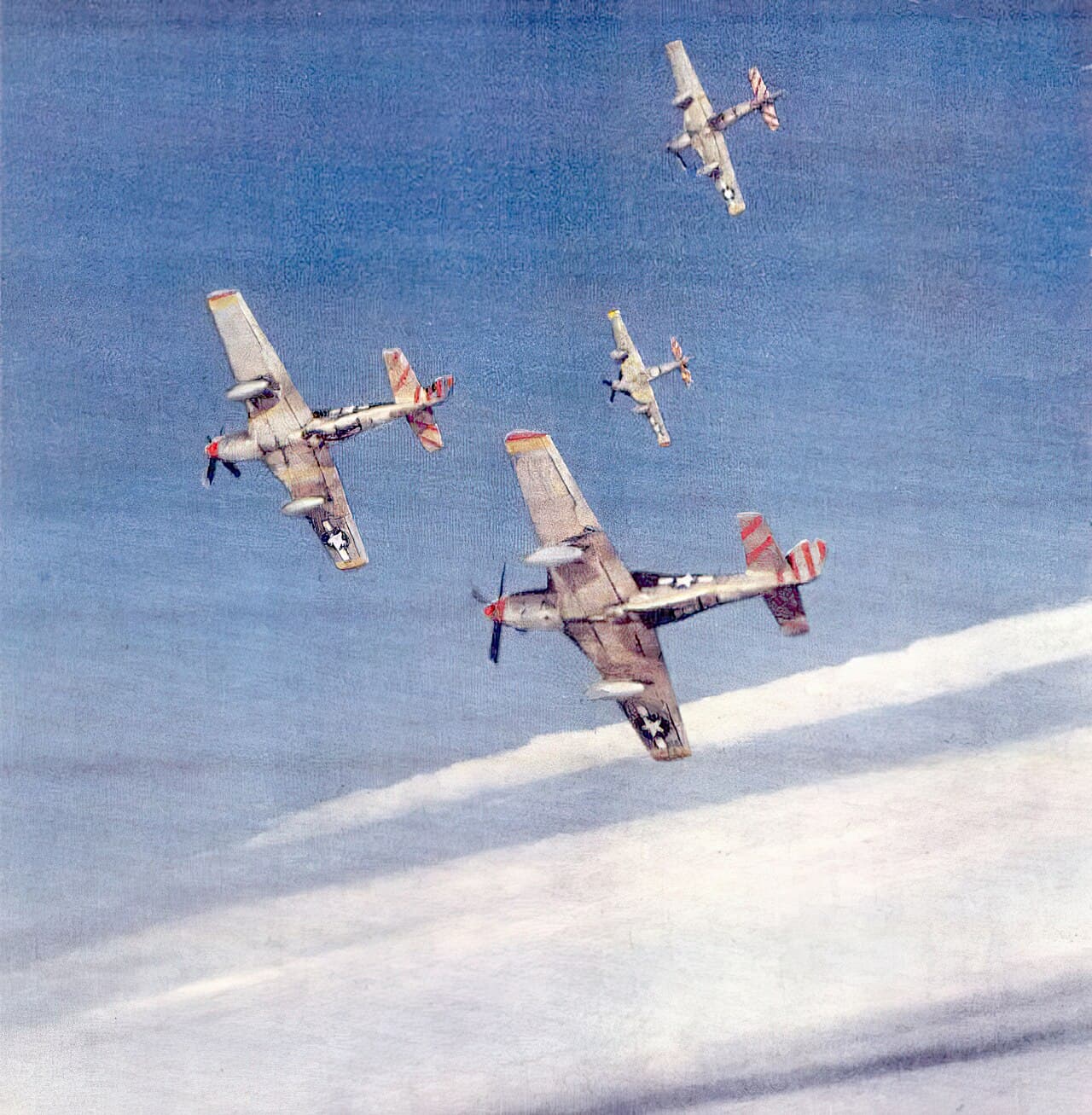
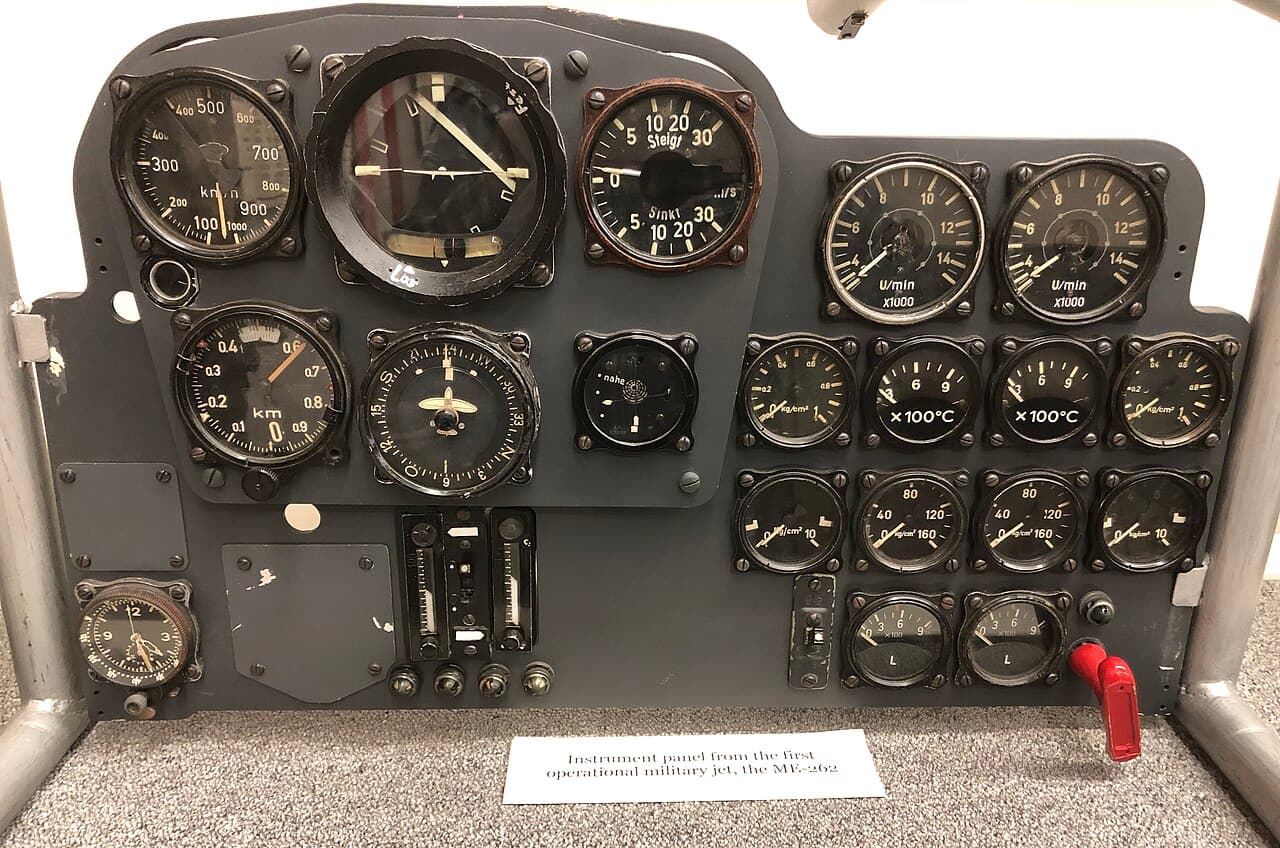
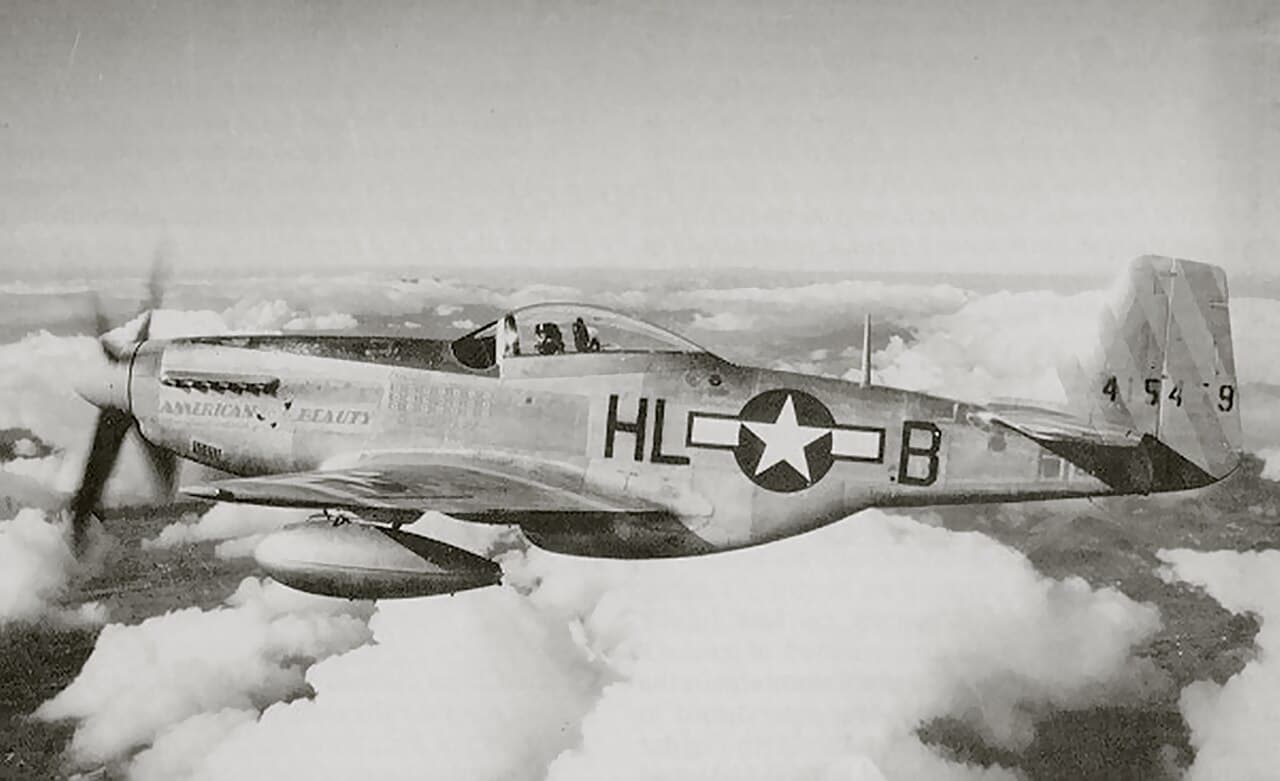
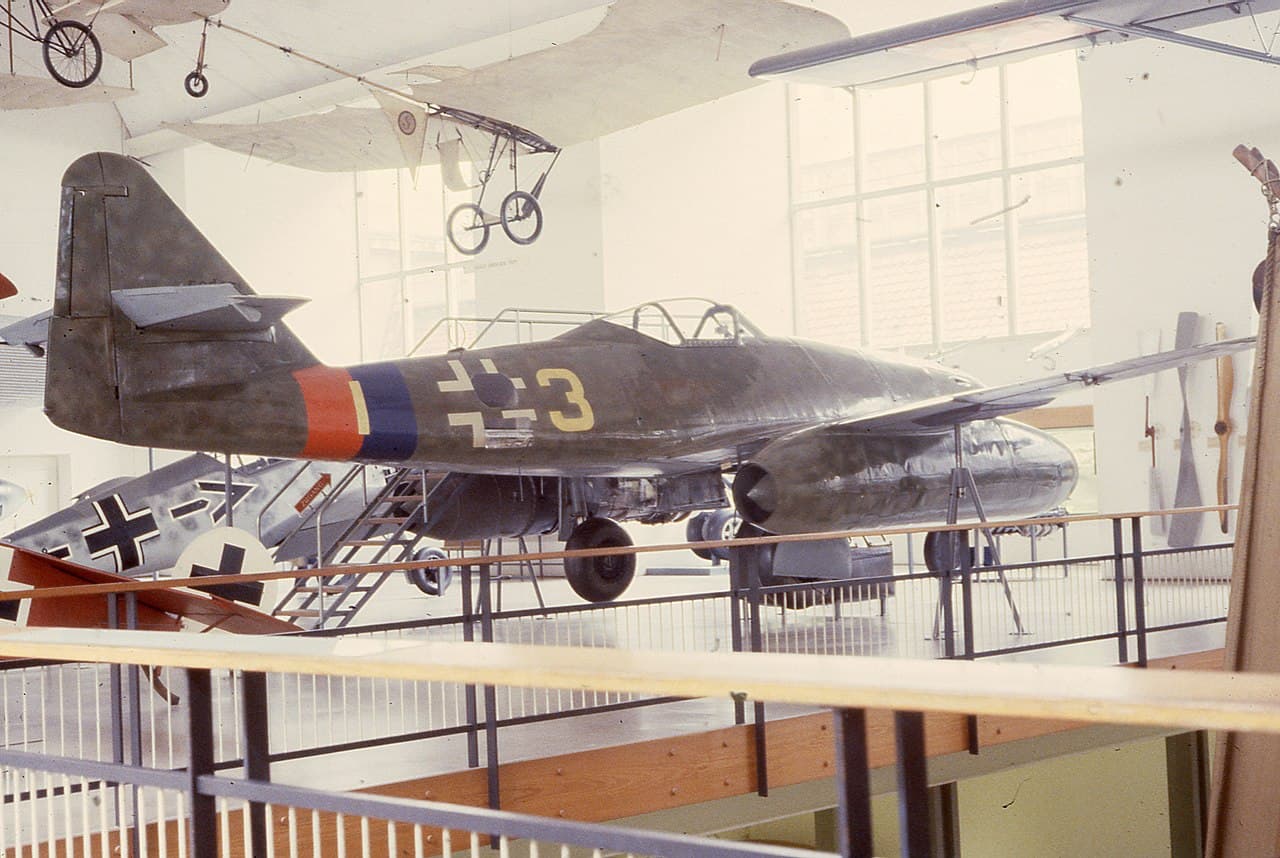
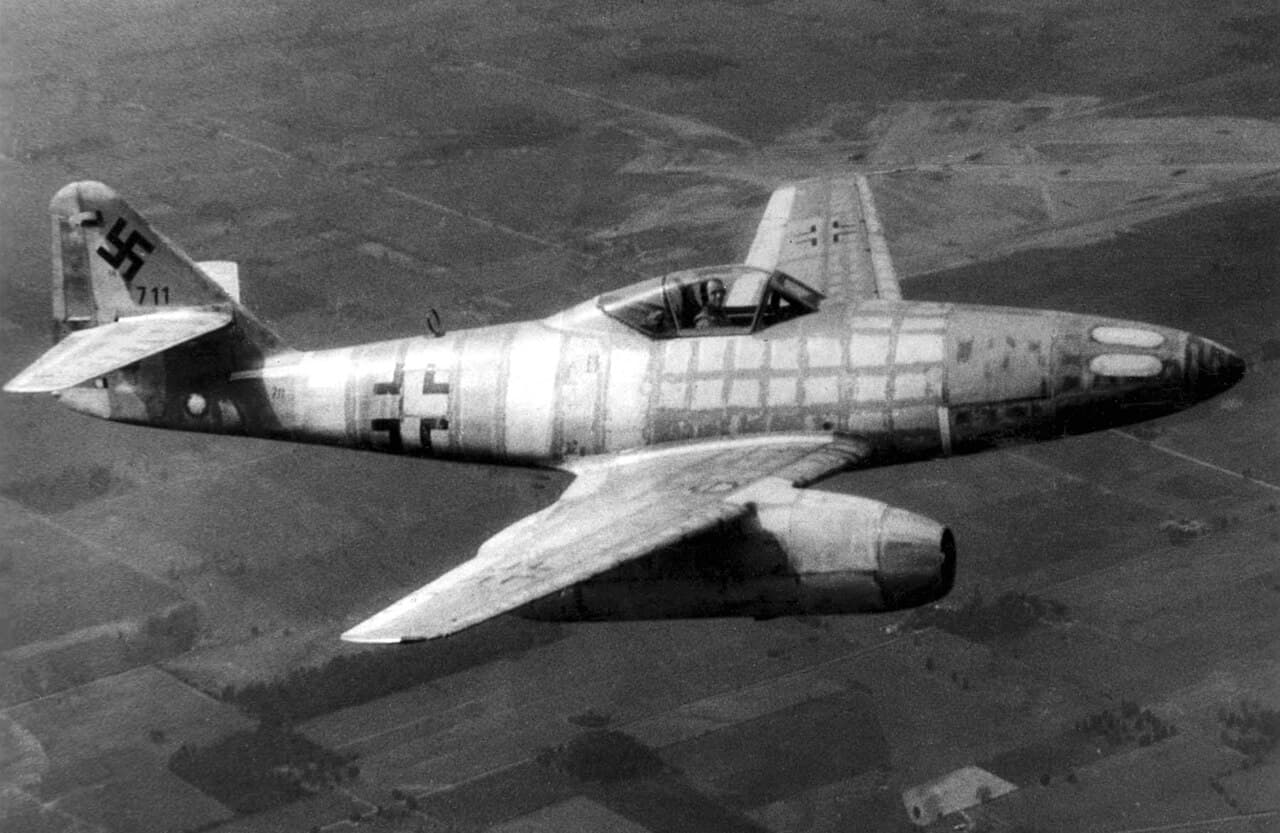
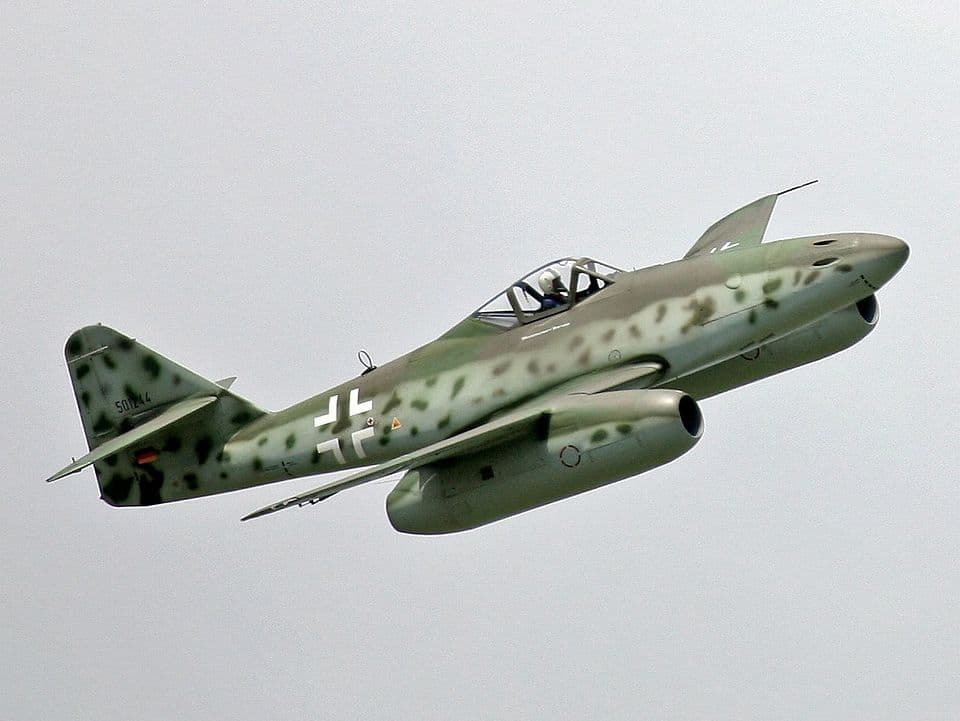
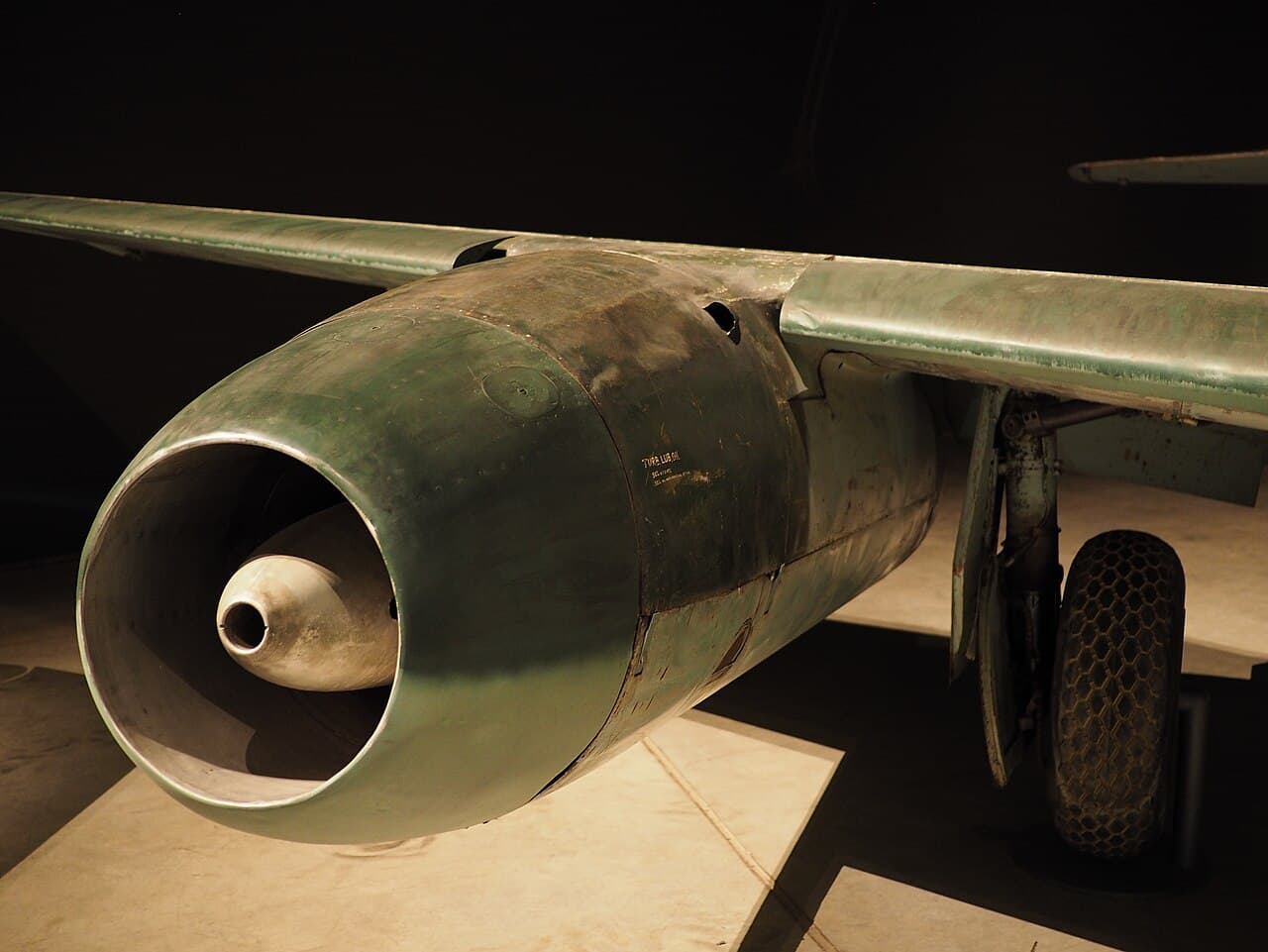
Click any photo to enlarge · 10 photos
Historical Context
The strategic backdrop that shaped both aircraft
The Me 262A Schwalbe and P-51D Mustang collided over the skies of Germany during the final year of the European air war, their confrontation embodying the most dramatic technological disparity the conflict had yet produced. The Me 262 was the world's first operational jet-powered fighter, conceived by Messerschmitt in 1938, first flown under jet power in July 1942, and representing a generational leap in aviation technology. The P-51D was the pinnacle of piston-engined fighter design, a masterpiece of aerodynamic refinement powered by the Packard-built Rolls-Royce Merlin that had become the instrument of Allied air superiority over Europe.
Their meeting was born from desperation on one side and dominance on the other. By late 1944, the Luftwaffe was being systematically destroyed by the Combined Bomber Offensive and its escort fighters. Over a thousand bombers and a thousand fighters appeared over Germany daily, methodically dismantling the Reich's industrial capacity. The Me 262 represented Germany's best hope for breaking the bomber offensive, a fighter so fast that no escort could catch it, armed with cannons so powerful that a single pass could destroy a heavy bomber. Hitler, however, infamously insisted the aircraft be used as a Schnellbomber to repel the expected Allied invasion, delaying its deployment as a fighter by critical months. Adolf Galland and other Luftwaffe leaders were furious, recognizing that the Me 262 was desperately needed as an interceptor, not a light bomber carrying two 250-kilogram bombs.
The P-51D's role against the Me 262 was not one its designers had anticipated. Built as a long-range escort fighter to protect bomber formations deep into Germany, the Mustang suddenly found itself tasked with neutralizing an adversary it could not catch. The USAAF's response was characteristically pragmatic, if you cannot outrun the jet, ambush it where it is vulnerable. The Eighth Air Force developed "Rat Catcher" patrols specifically targeting jets during takeoff and landing, exploiting the Me 262's critical weakness: its engines' sluggish acceleration and the long takeoff roll required to reach flying speed.
Notable Combat Encounters
Key engagements where these aircraft faced each other in combat
The first encounters between Me 262s and P-51 Mustangs were disorienting for American pilots accustomed to air superiority. P-51 pilots spotted jets streaking through bomber formations at speeds that made pursuit impossible. Early reports described aircraft traveling so fast they appeared to be standing still by comparison. USAAF intelligence scrambled to develop counter-tactics.
Outcome
Initial engagements were largely one-sided, Me 262 pilots made high-speed slashing attacks through bomber formations and escaped before escorts could react. Few jets were downed in these early months.
Established the fundamental dynamic of the matchup: the Me 262 could dictate engagement terms through speed, but P-51 pilots quickly began identifying the jet's vulnerabilities during takeoff and landing.
Lieutenant Chuck Yeager of the 357th Fighter Group spotted a lone Me 262 on final approach at about 500 feet, moving slowly at roughly 200 mph. Yeager executed a split-S, dove at 500 mph, and fired a single short burst from 400 yards, scoring hits on both wings. Intense flak from the airfield defenses forced him to break straight up, but the Me 262 crash-landed 400 yards short of the runway.
Outcome
Yeager's kill was among the first Me 262s downed by a P-51. He later remarked, "First time I saw a jet, I shot it down. Not very sportsmanlike, but what the hell?"
Demonstrated the tactic that would account for the majority of Me 262 kills, catching the jets during their vulnerable approach phase when speed could not save them.
Major Walter Nowotny, one of the Luftwaffe's highest-scoring aces with 258 victories and commander of Kommando Nowotny, the first operational Me 262 unit, took off for his final mission. After claiming a B-17 and a P-51, Nowotny was intercepted by P-51s believed to be from the 357th Fighter Group during his return approach. He radioed "my turbine" before his Me 262 crashed near Epe.
Outcome
Nowotny was killed. His death shocked the Luftwaffe high command and led to the disbanding of Kommando Nowotny, which was reorganized as JG 7.
The loss of one of Germany's most experienced aces proved that even elite pilots in Me 262s were vulnerable during the critical takeoff and landing phases. The tactical lesson was clear: speed alone could not protect the jet at all points of a mission.
The 332nd Fighter Group, the Tuskegee Airmen, flew their longest mission, escorting heavy bombers to Berlin. The Luftwaffe launched approximately 30 Me 262s from Brandenburg-Briest to intercept the formation. In the ensuing combat, Captain Roscoe Brown, First Lieutenant Earl Lane, and First Lieutenant Charles Brantley each shot down an Me 262, despite the jets being over 100 mph faster than their P-51s.
Outcome
Brown became the first 15th Air Force pilot to shoot down a jet. The 332nd earned a Distinguished Unit Citation for the mission.
Proved that skilled, disciplined P-51 pilots could defeat Me 262s even in open-air combat, not just during takeoff and landing. The Tuskegee Airmen's achievement demonstrated that tactical discipline and marksmanship could overcome a massive speed disadvantage.
Armament & Firepower
Primary weapons, munitions capacity, and destructive capability
Me 262A Loadout
4x 30mm MK 108 cannons (nose-mounted), with 80 rounds per gun for the upper pair and 100 rounds for the lower pair (360 rounds total). Rate of fire: 660 rounds per minute per cannon. The MK 108 fired Minengeschoss mine-shell ammunition, thin-walled, high-explosive rounds devastating against bombers. Optional: 24x R4M unguided folding-fin rockets (12 per underwing rack) with 520g warheads capable of destroying a heavy bomber with one or two hits.
P-51D Loadout
6x .50 caliber (12.7mm) M2 Browning machine guns, with 400 rounds per inboard pair and 270 per outboard pair (1,880 rounds total). Rate of fire: approximately 750–850 rounds per minute per gun. High muzzle velocity (887 m/s) providing flat trajectory and effective engagement range exceeding 600 yards.
Air-to-Air Verdict
Against bombers, the Me 262's armament was devastatingly superior, one to three hits from its 30mm MK 108 cannons could destroy a B-17, and R4M rocket salvos allowed standoff attacks from beyond defensive gun range. Against fighters, the P-51D's six .50-caliber Brownings were more effective, their higher muzzle velocity, flatter trajectory, and five times greater ammunition supply allowed sustained, accurate fire at combat ranges. The MK 108's extremely low muzzle velocity (540 m/s) created severe ballistic drop at range and made hitting maneuvering fighters at jet-speed closing rates extraordinarily difficult.
These were weapons optimized for entirely different missions. The MK 108 was a bomber-killer, designed to destroy heavy aircraft in a single high-speed pass. The M2 Browning was a dogfight weapon, designed for sustained, accurate fire against maneuvering targets. The Me 262's armament was more destructive per hit but far harder to employ effectively at jet speeds. The P-51D's armament was less powerful per round but vastly more practical in the chaotic reality of air combat.
Survivability & Protection
Armor, self-sealing tanks, pilot protection, and structural resilience
Me 262A Protection
Armored windscreen glass and armored seat back, though armor was reduced in some variants to save weight. The twin Jumo 004 engines were mounted in nacelles under the wings with fuel lines running through the fuselage, battle damage to fuel lines often caused catastrophic fires. The engines themselves had a service life of just 10–50 hours and required such delicate throttle management that sudden inputs could cause flameout or fire.
P-51D Protection
Pilot armor including seat back and headrest plates. No armor around the liquid-cooled Merlin engine or its vulnerable glycol coolant system, a single hit to the belly-mounted radiator scoop could cause coolant loss and engine seizure within minutes. However, the airframe was structurally robust with good gliding characteristics if the engine failed.
Pilot Protection
Both aircraft had critical single-point-of-failure vulnerabilities. The Me 262's fragile engines and fire-prone fuel system were compounded by the absence of an ejection seat, bailing out at 500+ mph was extremely dangerous. The P-51D's exposed coolant system was its Achilles heel, particularly during ground strafing runs when the belly radiator was exposed to flak. However, the Mustang offered better bail-out characteristics at normal combat speeds.
Structural Durability
The P-51D was the more structurally resilient aircraft. The Mustang's Merlin engine, while vulnerable to coolant loss, was mechanically mature and reliable, it could fly mission after mission without the constant maintenance demands of the Jumo 004. The Me 262's engines were so unreliable that more jets were lost to mechanical failure and accidents than to enemy action.
The Me 262 was the less survivable platform overall. Its engines had a service life measured in hours rather than hundreds of hours, its vulnerability during takeoff and landing was exploited ruthlessly by Allied pilots, and its fire-prone fuel system made battle damage frequently fatal. The P-51D's coolant vulnerability was serious but represented a single point of failure in an otherwise reliable and robust airframe. More Me 262s were destroyed on the ground, in accidents, and through mechanical failure than were ever shot down in air combat.
Tactical Doctrine & Evolution
How pilots were trained to fight in each aircraft and how tactics adapted over time
Me 262A Tactics
German Me 262 tactics were built entirely around speed. The standard attack profile was a high-speed slashing pass through bomber formations, diving from altitude, firing 30mm cannons or launching R4M rocket salvos, then using jet speed to escape before escorts could react. Head-on attacks were avoided because combined closing speeds exceeding 700 mph made aiming the low-velocity MK 108 nearly impossible. Pilots attacked in pairs or small groups, fired in brief bursts, and disengaged immediately. The largest coordinated jet attack occurred on March 18, 1945, when 37 Me 262s engaged over 1,800 Allied aircraft. Late in the war, the Luftwaffe was forced to divert conventional fighters to protect jet airfields from American patrols, a cruel irony that reduced pressure on the very bomber formations the jets were meant to destroy.
P-51D Tactics
Allied counter-tactics evolved rapidly from futile pursuit to systematic exploitation of the jet's vulnerabilities. The USAAF developed "Rat Catcher" patrols, P-51 formations loitering at altitude over known Me 262 airfields, using radar tracking to scramble when jets were detected taking off or landing. Pilots learned to maintain altitude above the jet's operating ceiling and dive onto targets, using gravity to close the speed gap. Medium bombers struck jet bases while fighters patrolled overhead. On February 25, 1945, Mustangs of the 55th Fighter Group surprised an entire Staffel of Me 262s at takeoff and destroyed six jets. The tactical philosophy was simple: if you cannot outrun the jet, ambush it where it cannot run.
How Tactics Evolved
The Me 262 versus P-51D confrontation was a case study in asymmetric adaptation. Germany built the faster aircraft but could never solve the systemic problems, engine reliability, fuel supply, pilot training, that prevented it from achieving critical mass. The Americans could not match the jet's speed but adapted their tactics, training, and operational planning to neutralize the threat within weeks. The Eighth Air Force's "Rat Catcher" patrols, airfield strafing campaigns, and altitude-advantage diving attacks transformed what should have been the Luftwaffe's technological triumph into a manageable tactical problem. The lesson was clear: revolutionary technology without the infrastructure to sustain it is less effective than evolutionary technology backed by overwhelming logistics.
What the Pilots Said
Firsthand accounts from the men who flew and fought these aircraft
On the Me 262A“It was as though angels were pushing. For the first time I was flying by jet propulsion. No engine vibrations. No torque and no lashing sound of the propeller. Accompanied by a whistling sound, my jet shot through the air.”
On the Me 262A“My first reaction when I saw the jet plane was that I was standing still. It seemed hopeless to try to attempt to overtake them, but my actions were prompted by a curiosity to get as close to them as possible.”
On the P-51D“First time I saw a jet, I shot it down. I was first in my group to shoot down an Me 262. He was on final, not very sportsmanlike, but what the hell?”
On the P-51D“We were told the jets couldn't turn with us, so get them when they're slow. The trick was patience, wait over their field, catch them when their wheels are down, and don't chase them when they're running.”
By the Numbers
Statistical combat performance and historical kill ratios
Exchange Ratio
The Me 262 achieved an estimated 4:1 to 5:1 kill-to-loss ratio in air combat, an impressive figure that reflected its devastating speed and firepower advantage against bomber formations. However, total Me 262 losses from all causes far exceeded air combat kills: hundreds were destroyed by ground strafing, accidents, mechanical failure, and bombing of airfields. Of approximately 1,443 built, only about 300 ever saw combat.
Source: USAAF combat records; Luftwaffe quartermaster returns; Osprey "Me 262 vs P-51 Mustang" analysis
The Me 262's air combat record was genuinely formidable, when jets reached the bomber streams, they were lethally effective. The March 18, 1945 engagement saw 37 Me 262s of JG 7 shoot down 12 bombers and a fighter for the loss of just 3 jets. But this record must be weighed against the aircraft's catastrophic attrition from non-combat causes and its minuscule impact on the overall air war. The P-51D's 93 confirmed kills against Me 262s, achieved mostly through tactical innovation rather than performance superiority, demonstrated that the Mustang community adapted faster than the Luftwaffe could exploit its technological advantage. The P-51D's overall record of approximately 4,950 aerial victories across 213,873 sorties dwarfed the Me 262's contribution and reflected the systemic dominance that no wonder weapon could overcome.
Production & the Numbers Game
How industrial output shaped the strategic balance
1,430
Me 262A Built
15,586
P-51D Built
The production disparity tells the story of why the Me 262 could not change the war's outcome. Germany built a revolutionary jet fighter but could not produce it in sufficient numbers, keep it flying reliably, or train enough pilots to exploit it. The Jumo 004's catastrophic unreliability, caused largely by the substitution of inferior materials as Germany's strategic resources collapsed, meant that the Me 262 consumed maintenance hours at a rate wholly incompatible with sustained operations. The P-51D, by contrast, was produced in massive numbers by an industrial base operating at peak capacity, with reliable engines, abundant fuel, and a pilot training pipeline that turned out thousands of combat-ready aviators. The Me 262 was the better machine in isolation; the P-51D was part of a better system.
Advantages in This Matchup
Where each aircraft holds the edge in a head-to-head encounter
Me 262A Schwalbe
- Speed supremacy, 100+ mph faster than any Allied fighter, virtually uncatchable in level flight
- Devastating armament, four 30mm MK 108 cannons could destroy a heavy bomber in one to three hits
- R4M rocket capability, 24 rockets allowed standoff attacks from beyond defensive gun range
- Psychological impact, the sound and speed of jet attacks disrupted bomber formations and terrified crews
- No propeller torque, stable gun platform during high-speed attack passes
- Rapid climb to intercept altitude to engage bomber streams from advantageous position
- Technological paradigm shift, its design principles influenced all postwar jet fighters worldwide
P-51D Mustang
- Strategic range of 1,650+ miles with drop tanks, could escort bombers from England to Berlin and back
- Superior maneuverability, could out-turn, out-roll, and out-dogfight the Me 262 at any speed
- Mechanical reliability, the Packard Merlin was mature, field-maintainable, and flew mission after mission
- Overwhelming numbers, 7,954 P-51Ds gave numerical superiority the Luftwaffe could never match
- Exceptional bubble canopy visibility, 360-degree situational awareness critical for threat detection
- Sustained firepower, 1,880 rounds of .50-caliber ammunition for extended engagements
- Operational flexibility, equally effective as escort fighter, air superiority fighter, and ground attack platform
Final Verdict
Overall Winner
🇺🇸 North American P-51D Mustang
United States
The Me 262A Schwalbe was the more extraordinary aircraft, the world's first operational jet fighter, 100 mph faster than anything in the Allied inventory, armed with cannons that could destroy a B-17 in a single pass. Adolf Galland was right when he said it felt like angels were pushing. But the P-51D Mustang was the more effective weapon of war. It had the range to go anywhere, the reliability to fly mission after mission, the numbers to overwhelm, and the pilots to exploit every advantage. American tactical adaptation, the "Rat Catcher" patrols, airfield ambushes, and altitude-advantage diving attacks, neutralized the jet threat within weeks of its appearance. The Me 262's speed was formidable but could not compensate for engines lasting 10 hours, fuel that couldn't be delivered, pilots who couldn't be trained, and factories that couldn't survive Allied bombing. The P-51D Mustang claimed 93 Me 262 kills and helped ensure that the world's first jet fighter became a footnote rather than a turning point. In the calculus of total war, consistent excellence backed by industrial might will always defeat revolutionary technology without the infrastructure to sustain it.
Theaters of Operation
Shared Theaters
Me 262A Only
P-51D Only