
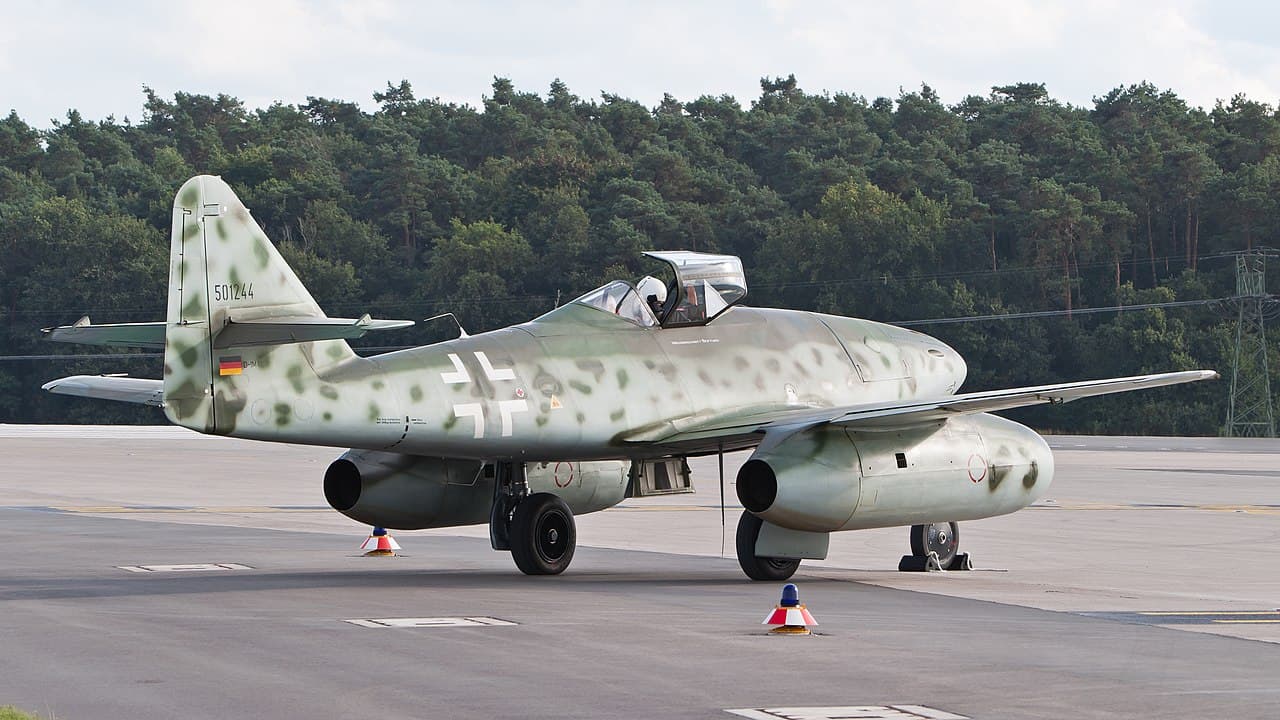
Messerschmitt Me 262A
Messerschmitt
How does the Me 262A stack up?
CompareOverview
The Messerschmitt Me 262A Schwalbe (Swallow) was the world's first operational jet fighter and one of the most revolutionary aircraft ever built. With a top speed of 559 mph, over 100 mph faster than any Allied piston fighter, the Me 262 rendered conventional air combat tactics obsolete overnight. Its four 30mm MK 108 cannons could shatter a B-17 with a single well-aimed burst, and its swept-wing silhouette heralded the jet age decades ahead of schedule.
Yet the Me 262's story is as much tragedy as triumph. Chronic shortages of strategic materials, particularly the heat-resistant alloys needed for jet engine turbine blades, meant that the Jumo 004 engines had a service life of barely 25 hours before requiring overhaul. Allied fighters learned to ambush the jets during takeoff and landing, when they were slowest and most vulnerable. Hitler's insistence that a portion of production be configured as fighter-bombers (the A-2a Sturmvogel) further diluted its impact as an interceptor.
Despite all these handicaps, the Me 262 demonstrated the future of aerial warfare. In the hands of experienced pilots like Adolf Galland, Heinz Bar, and the legendary JV 44 squadron of aces, the Schwalbe proved devastatingly effective. Had it been available in larger numbers a year earlier, it could conceivably have altered the air war over Europe. Instead, it became a brilliant weapon that arrived too late to change the outcome of the conflict it was designed to win.
Performance Profile
Max Speed
559 mph
at 19,685 ft
Range
652 miles
normal
Service Ceiling
37,565 ft
Rate of Climb
3,937 ft/min
Armament
4 guns
4x 30mm MK 108
Crew
1
Engine
Junkers Jumo 004B-1
1980 hp jet
Development History
The Me 262's origins date back to 1938, when the German Air Ministry issued a specification for a jet-powered fighter. Messerschmitt's design team, led by Woldemar Voigt, produced a sleek, twin-engined airframe with moderately swept wings, the sweep chosen not for aerodynamic reasons at high speed but to adjust the center of gravity after the engines proved heavier than expected. This accidental feature would prove prescient as jet aircraft evolved.
The first prototype, the Me 262 V1, initially flew on April 18, 1941, powered by a conventional Jumo 210G piston engine in the nose because the jet engines were not yet ready. The first all-jet flight occurred on July 18, 1942, using two BMW 003 turbojets, but both engines failed during the flight, and test pilot Fritz Wendel barely managed to land safely. The switch to the more reliable Junkers Jumo 004 engine finally produced a workable combination.
Development was agonizingly slow. The jet engines consumed enormous quantities of scarce nickel, chromium, and cobalt, materials Germany could ill afford as the war turned against it. Albert Speer's armaments ministry repeatedly shuffled the program's priority rating. Hitler himself intervened in late 1943, demanding that the Me 262 be developed primarily as a fast bomber (Schnellbomber) rather than a fighter, a decision that delayed its deployment as an interceptor by several critical months.
Production finally began in earnest in early 1944, but Allied bombing of assembly plants and transportation networks meant that completed airframes often sat waiting for engines, and finished aircraft could not reach their units. The dispersal of production to forest clearings and autobahn strips kept output alive but at reduced rates. By war's end, approximately 1,430 Me 262s had been completed, but fewer than 300 ever saw combat simultaneously due to serviceability issues, fuel shortages, and pilot training bottlenecks.
Combat History
The Me 262 entered combat in July 1944 with Erprobungskommando 262, a test unit under Major Werner Thierfelder. The first confirmed jet-on-jet-age kill came on August 8, 1944, when an Me 262 shot down a USAAF reconnaissance Mosquito. Initial engagements proved that no Allied piston fighter could catch the Schwalbe in straight-line flight, and its four MK 108 cannons could destroy a heavy bomber with just a few rounds.
Kommando Nowotny, formed in October 1944 under top ace Walter Nowotny, was the first dedicated Me 262 fighter unit. The unit scored heavily against American bomber formations but suffered unsustainable losses, including Nowotny himself, killed on November 8, 1944, largely due to Allied fighters patrolling around known jet airfields and attacking the 262s during their vulnerable takeoff and landing phases.
The most famous Me 262 unit was Jagdverband 44, formed in February 1945 by Adolf Galland after his removal as General der Jagdflieger. JV 44 was an elite squadron of aces, including Galland, Bar, Steinhoff, and Lutzow, who collectively held thousands of aerial victories. Flying from Munich-Riem, they scored impressive results against Allied bombers in the war's final weeks, but could do nothing to reverse Germany's strategic collapse.
The Me 262A-2a Sturmvogel (Stormbird) variant served as a fast bomber with KG 51, striking Allied targets in France and Belgium with 250kg bombs. While nearly immune to interception in its bombing role, it could carry only a small bomb load and its accuracy at high speed was poor. The diversion of airframes to the bomber role remains one of the most debated decisions of the air war. In total, Me 262 pilots claimed approximately 542 Allied aircraft destroyed, though the actual figure was likely lower.
Variants
| Designation | Key Differences | Produced |
|---|---|---|
| Me 262A-1a | Standard fighter variant with 4x 30mm MK 108 cannons. Core interceptor configuration used by most fighter units. | 780 |
| Me 262A-2a Sturmvogel | Fighter-bomber variant with 2x 250kg bomb racks under forward fuselage. Two of four MK 108 cannons sometimes removed. Used by KG 51. | 300 |
| Me 262A-1a/U1 | Mixed armament test variant with 2x MK 108, 2x MG 151/20, and 2x MK 103 cannons. Only small numbers produced for evaluation. | - |
| Me 262B-1a/U1 | Two-seat night fighter conversion with FuG 218 Neptun radar antenna array and second crew member as radar operator. Used by 10./NJG 11. | 15 |
| Me 262A-1a/R1 | Rocket-armed interceptor carrying 24x R4M "Orkan" 55mm unguided rockets on underwing racks. Devastating against bomber formations in salvo fire. | - |
Strengths & Weaknesses
+Strengths
- Top speed of 559 mph made it virtually uncatchable by any Allied piston-engined fighter
- Four 30mm MK 108 cannons provided devastating firepower, three hits could bring down a B-17
- Could carry R4M rockets for standoff attacks on bomber formations, minimizing exposure to defensive fire
- Swept wings and tricycle landing gear pioneered the configuration that would become standard for all jet fighters
-Weaknesses
- Jumo 004 engines had an operational life of only 10-25 hours and were extremely fragile, prone to flameouts during rapid throttle movements
- Slow acceleration from low speeds left the aircraft vulnerable during takeoff and landing, Allied fighters exploited this ruthlessly
- MK 108 cannon had low muzzle velocity and heavy bullet drop, requiring pilots to close to very short range for accurate fire
- High fuel consumption limited endurance to roughly 60-90 minutes, severely restricting operational flexibility
Pilot Voices
“For the first time I was flying by jet propulsion. No engine vibrations. No torque and no lashing prepeller air stream. Accompanied by a thunderous roaring, you could see fiery red turbine wheels rotating and the jet of gases being expelled. It was like riding on the back of a rocket.”
“It was as if an angel was pushing you forward.”
“With this aircraft we could have won the air war. But it came too late, and we had too few.”
Did You Know?
The Me 262 used substitutes for the critical metals its engines required, turbine blades were made of mild steel with a spray coating of aluminum, which is why engine life was so short. Allied engines using nickel superalloys lasted thousands of hours.
Hitler's "Schnellbomber" directive is often blamed for delaying the Me 262, but engine development delays were actually the primary bottleneck, the aircraft would not have been available significantly earlier regardless.
A captured Me 262 was test-flown by legendary test pilot Eric "Winkle" Brown of the Royal Navy, who called it "the most formidable aircraft I had ever flown."
Several Me 262s were captured intact and directly influenced the development of both American (F-86 Sabre) and Soviet (MiG-15) postwar jet fighters.

