
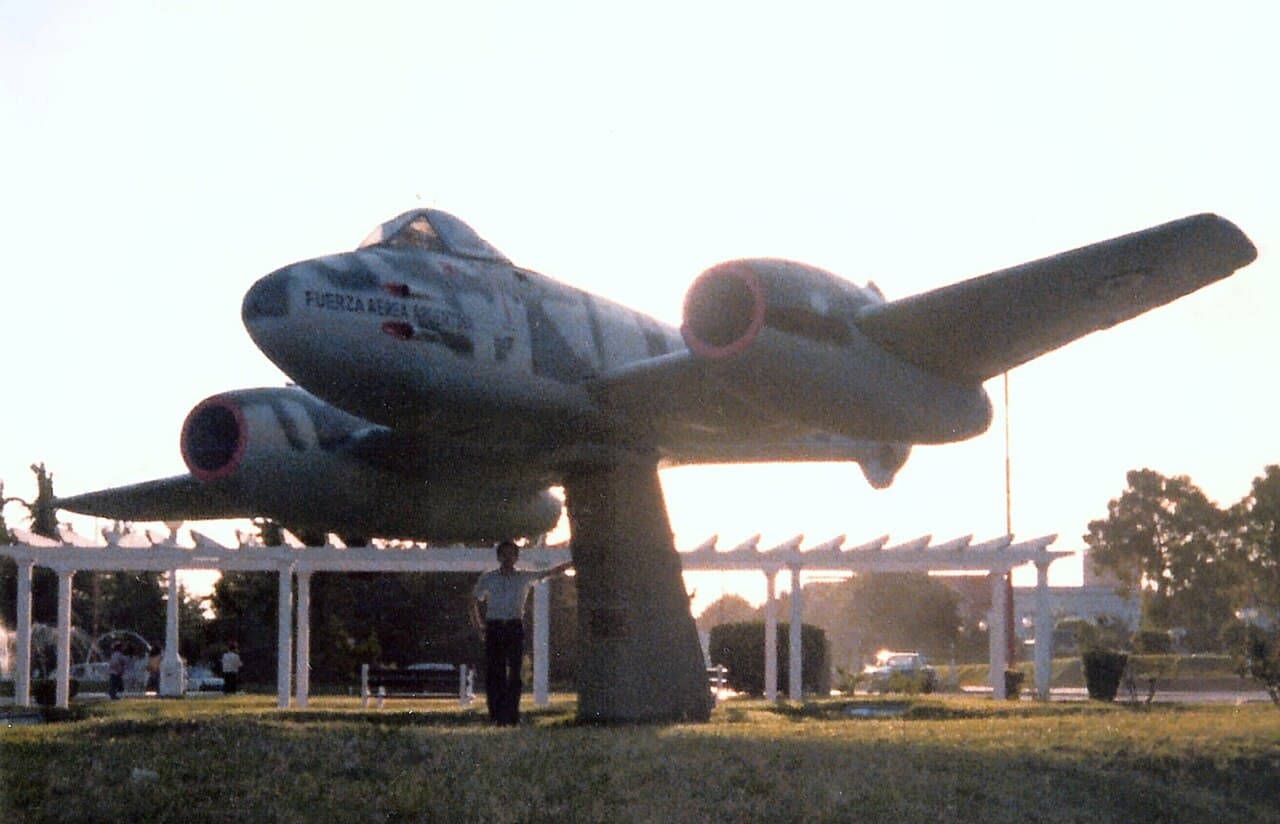
Gloster Meteor F.3
Gloster Aircraft Company
How does the Meteor F.3 stack up?
CompareOverview
The Gloster Meteor F.3 was the first operational jet fighter flown by the Allies and the only Allied jet to see combat during the Second World War. While it never engaged an Me 262 in the air-to-air combat that both sides and aviation historians fantasized about, the Meteor represented a revolutionary leap in aviation technology that would define the postwar era.
The F.3 was a significant improvement over the earlier F.1, featuring more powerful Rolls-Royce Derwent I engines, a sliding canopy replacing the original hinged type, and a longer nacelle design that improved airflow and reduced drag. These changes increased maximum speed from 417 mph in the F.1 to 493 mph, making it faster than any piston-engine fighter in the world.
Although the Meteor's wartime combat record was limited to ground-attack sorties over continental Europe in the final months of the war, its significance was immense. It proved that jet propulsion was practical for frontline military use and gave the RAF invaluable operational experience with jet aircraft that paid dividends in the early Cold War.
Performance Profile
Max Speed
493 mph
at 30,000 ft
Range
504 miles
normal
Service Ceiling
44,000 ft
Rate of Climb
7,000 ft/min
Armament
4 guns
4x 20mm Hispano Mk V
Crew
1
Engine
Rolls-Royce Derwent I
2000 hp jet
Development History
The Meteor's origins trace back to 1940, when the Air Ministry issued Specification F.9/40 for a single-seat jet-propelled interceptor. George Carter at Gloster designed the aircraft around the early turbojet engines being developed by Frank Whittle's Power Jets company. The twin-engine layout was chosen because early jets produced insufficient thrust individually to power a fighter.
The first Meteor prototype flew on March 5, 1943, powered by de Havilland Halford H.1 engines (later named Goblin) because the preferred Rover-built W.2B engines were not yet ready. Development was complicated by the difficulty of producing reliable jet engines in wartime Britain, and multiple engine types were tested in the eight prototypes.
The F.1, with Rolls-Royce W.2B/23C Welland engines producing 1,700 lb thrust each, entered service with No. 616 Squadron in July 1944. Its primary initial mission was intercepting V-1 flying bombs, where its speed advantage was useful. However, the F.1 was still relatively slow and was not deployed to the continent for fear of an aircraft being captured and its technology compromised.
The F.3, entering service in January 1945, represented a substantial improvement. The Derwent I engines offered 2,000 lb thrust each, the airframe was cleaned up aerodynamically, and a new sliding canopy improved pilot visibility. The F.3 was finally deployed to No. 616 Squadron on the continent in late January 1945, though strict orders initially kept it away from the front lines to prevent capture.
Combat History
The Meteor's combat debut came with the F.1 in July 1944, when No. 616 Squadron began V-1 flying bomb interception. The first V-1 kill by a Meteor occurred on August 4, 1944, when Flying Officer Dean destroyed one by tipping it with his wingtip after his guns jammed. In total, Meteor F.1s destroyed 14 V-1s during the campaign.
The F.3 moved to the continent with No. 616 Squadron in January 1945, initially based at Melsbroek in Belgium and later at Nijmegen in the Netherlands. To prevent a Meteor from falling into Soviet hands, pilots were initially forbidden from flying over enemy-held territory. This restriction was gradually relaxed as the Allied front advanced into Germany.
From April 1945, Meteor F.3s conducted ground-attack missions over Germany, strafing airfields, transport, and other targets of opportunity. On April 16, 1945, four Meteors attacked Nordholz airfield, destroying several parked aircraft. These were among the few occasions when Allied jets were used offensively. Despite hopes on both sides, no Meteor ever encountered an Me 262 in combat.
The Meteor's greatest wartime contribution was arguably its role as a technology demonstrator and operational testbed. The lessons learned from operating the F.1 and F.3 in squadron service, including jet engine maintenance, fuel consumption patterns, and pilot conversion training, proved invaluable in establishing the postwar RAF as a jet-equipped force, years ahead of most other air forces.
Variants
| Designation | Key Differences | Produced |
|---|---|---|
| F.1 | Initial production variant with Welland I engines (1,700 lb thrust each); hinged canopy; used for V-1 interception. | 20 |
| F.3 | Improved variant with Derwent I engines (2,000 lb thrust each); sliding canopy; longer nacelles; 493 mph top speed. | 210 |
| F.4 | First major postwar variant with Derwent 5 engines (3,500 lb thrust); clipped wings; set world speed record of 616 mph in 1945. | 489 |
| F.8 | Definitive postwar fighter with lengthened fuselage, ejection seat, and tail redesign; widely exported and used in Korean War by RAAF. | 1,183 |
Strengths & Weaknesses
+Strengths
- First operational Allied jet fighter, giving the RAF a decisive technological lead
- Excellent rate of climb of 7,000 ft/min, far superior to any piston-engine fighter
- Four 20mm cannon provided heavy firepower comparable to the best piston-engine fighters
- Twin-engine layout provided redundancy and safety during the unreliable early jet era
-Weaknesses
- Early Derwent engines had very short service life and high fuel consumption, limiting range
- Straight-wing design limited transonic performance compared to the swept-wing Me 262
- Relatively unstable at high Mach numbers due to compressibility effects on the thick straight wing
- Restricted from front-line operations for much of the war due to fear of technology capture
Pilot Voices
“Climbing into a Meteor after years in Spitfires was like stepping from the 19th century into the 21st. The smooth power, the speed, the rate of climb, everything was different.”
“We were desperate to meet the Me 262 in combat, but it never happened. We knew the Meteor could hold its own, and we wanted to prove it.”
Did You Know?
The first Meteor V-1 kill was achieved without firing a shot, Flying Officer Dean tipped the flying bomb with his wingtip after his four cannon all jammed, deflecting it into the ground.
A Meteor F.3 was exchanged with the Americans for a Bell YP-59A Airacomet in a secret technology-sharing arrangement, each nation evaluating the other's jet fighter.
The Meteor F.4 set a world absolute speed record of 616 mph on November 7, 1945, just months after the war ended, demonstrating how rapidly jet technology was advancing.
