
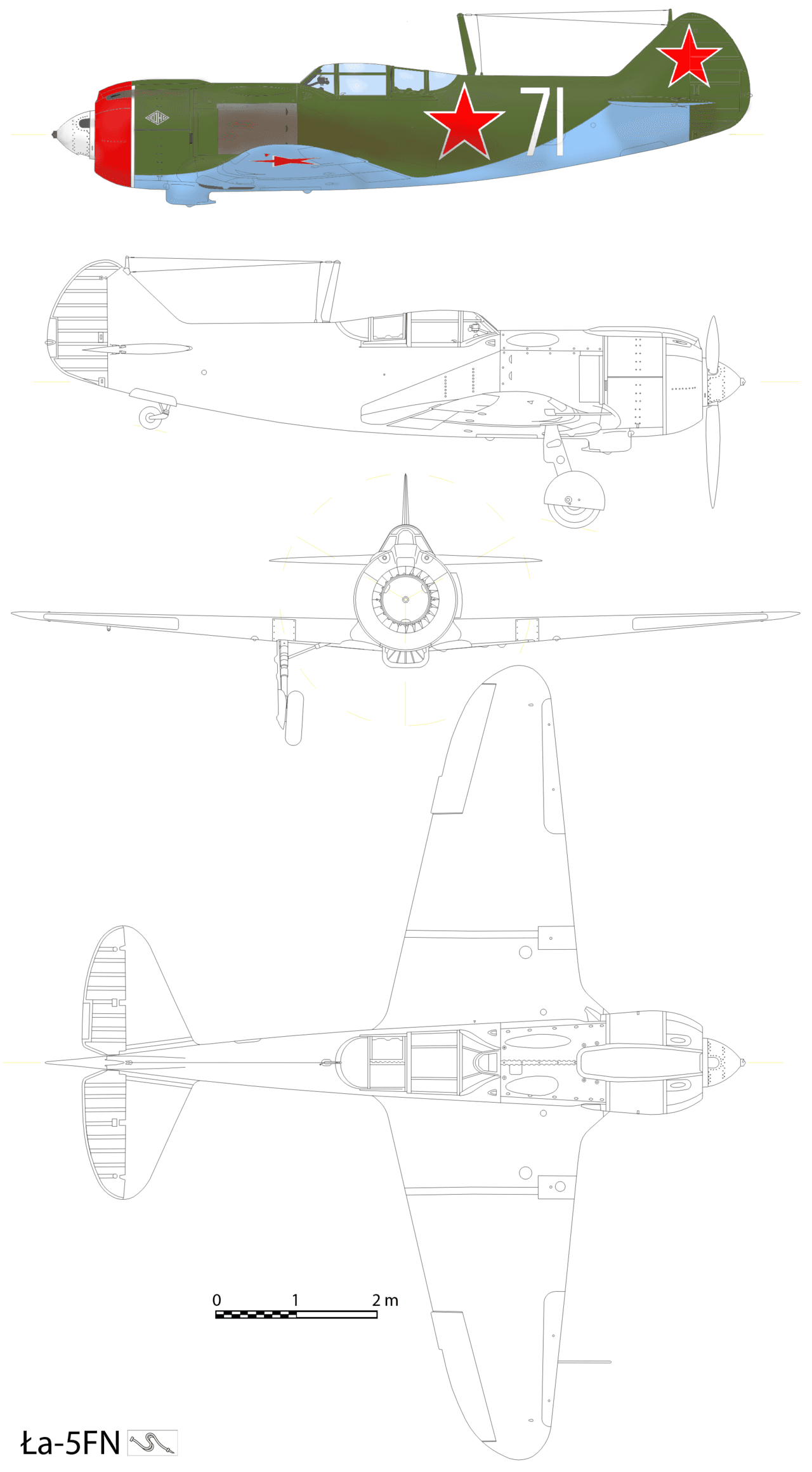
Lavochkin La-5FN
Lavochkin
How does the La-5FN stack up?
CompareOverview
The Lavochkin La-5FN was the aircraft that broke the Luftwaffe's dominance over the Eastern Front. Powered by the fuel-injected Shvetsov ASh-82FN radial engine producing 1,850 horsepower, the La-5FN was the first Soviet fighter that could meet the Bf 109G and Fw 190A on genuinely equal terms at all combat altitudes below 20,000 feet. Its arrival in large numbers at the Battle of Kursk in July 1943 marked the beginning of the end for German air superiority in the East.
The "FN" designation stood for "forsirovannyy neposredstvennogo vpryska", boosted, direct injection. This direct fuel injection gave the ASh-82FN engine a critical advantage over carbureted powerplants: it maintained full power in negative-G maneuvers and inverted flight, a capability that carbureted engines like the Merlin and early Klimov variants could not match. This seemingly minor technical detail translated into a significant tactical advantage in the high-G, rapidly changing combat environment of the Eastern Front.
Built around a rugged radial engine with proven combat reliability, the La-5FN combined Soviet engineering pragmatism with genuine high performance. It was heavier and less agile than the Yak-3, but it hit harder with twin 20mm cannons, absorbed more damage thanks to the air-cooled engine, and operated effectively at a wider range of altitudes. Many of the Soviet Union's highest-scoring aces, including Ivan Kozhedub, the top Allied ace with 62 victories, achieved their greatest successes in the La-5FN.
Performance Profile
Max Speed
402 mph
at 16,400 ft
Range
475 miles
normal
Service Ceiling
31,170 ft
Rate of Climb
3,445 ft/min
Armament
2 guns
2x 20mm ShVAK
Crew
1
Engine
Shvetsov ASh-82FN
1850 hp radial
Development History
The La-5FN's story begins with one of the most remarkable engineering rescues of the war. In 1942, Semyon Lavochkin's LaGG-3 fighter, nicknamed the "lacquered guaranteed coffin" by its pilots, was one of the worst Soviet fighters in service. Underpowered, heavy, and sluggish, the LaGG-3 was being slaughtered by Bf 109s. Lavochkin's design bureau faced closure. In a desperate gamble, he replaced the LaGG-3's inline Klimov engine with the available Shvetsov M-82 radial engine, creating the LaG-5 (soon redesignated La-5) almost overnight.
The La-5 was a massive improvement over the LaGG-3, but it still had significant problems. The carbureted M-82A engine was unreliable and difficult to maintain, the cockpit was poorly sealed and leaked exhaust gases that sickened pilots, and the airframe retained many of the LaGG-3's structural weaknesses. Lavochkin systematically attacked each problem. The cockpit was redesigned with improved sealing. The engine cowling was reshaped for better cooling. The canopy was lowered for improved pilot visibility.
The breakthrough came with the ASh-82FN engine, which featured direct fuel injection, a technology that the Soviets had independently developed, paralleling BMW's work on the German radial engines. Direct injection eliminated the engine cut-out during negative-G maneuvers that plagued carbureted engines, increased maximum power by nearly 200 hp over the original M-82A, and improved fuel efficiency. The combination of the FN engine with Lavochkin's refined airframe produced the La-5FN, which entered production in March 1943.
Testing at the Soviet Air Force Research Institute (NII VVS) confirmed that the La-5FN was superior to the Bf 109G-2 in speed below 20,000 feet, in rate of climb below 16,000 feet, and in horizontal maneuverability at all altitudes. For the first time since the German invasion, a Soviet fighter could claim genuine qualitative parity with the best Luftwaffe equipment. The aircraft also proved easier to manufacture than the aluminum-intensive Yakovlev fighters, as its wooden construction utilized materials that were readily available within the Soviet Union.
Combat History
The La-5FN's defining moment came at the Battle of Kursk in July 1943, where it equipped several elite Guards fighter regiments tasked with seizing air superiority over the salient. In the massive air battles over the Kursk bulge, the largest aerial engagements since the Battle of Britain, La-5FN pilots demonstrated for the first time that they could engage Bf 109Gs and Fw 190As with confidence. The aircraft's combination of speed, climb rate, and firepower proved devastating in the hands of experienced pilots, and the psychological impact on both sides was enormous.
Ivan Kozhedub, who would become the highest-scoring Allied ace of the war, scored his first victories flying the La-5FN at Kursk. Over the following two years, Kozhedub would claim 62 kills, including an Me 262 jet on February 19, 1945, almost all in Lavochkin fighters. His combat technique exploited the La-5FN's strengths perfectly: aggressive climbing attacks from below, leveraging the aircraft's superb rate of climb to achieve firing positions that opponents could not escape.
During the massive Soviet offensives of 1944, La-5FN regiments provided the core of Soviet air superiority forces while Yak fighters handled close escort duties for the Il-2 formations. The La-5FN's twin 20mm cannons gave it a significant firepower advantage over the single-cannon Yakovlev fighters, and its radial engine absorbed combat damage that would have disabled an inline-engined fighter. In the battles over Romania, Hungary, and Poland, La-5FN pilots routinely engaged German fighter formations with numerical and qualitative confidence.
By late 1944, the La-5FN was being superseded by the superior La-7 in frontline units, but it continued to equip second-line regiments through the end of the war. Its total combat record reflected a remarkable trajectory: from the disastrous LaGG-3 through the improved La-5 to the genuinely world-class La-5FN, Lavochkin had transformed the worst Soviet fighter of 1942 into one of the best Allied fighters of 1943-44 in barely eighteen months.
Variants
| Designation | Key Differences | Produced |
|---|---|---|
| La-5 | Initial production model with carbureted M-82A engine (1,700 hp). Retained many LaGG-3 structural elements. Poor cockpit sealing caused carbon monoxide poisoning issues. | 1,129 |
| La-5F | Improved variant with M-82F engine, lowered rear fuselage for better visibility, improved cockpit sealing. Transitional model between La-5 and La-5FN. | 3,826 |
| La-5FN | Definitive variant with ASh-82FN fuel-injected engine (1,850 hp). Maximum speed 402 mph. Superior to the Bf 109G-2 in speed and climb below 20,000 feet. | 5,047 |
| La-5FN Type 41 | Late production variant with lightened airframe, metal wing spars replacing wooden ones, and minor aerodynamic refinements. Improved roll rate and overall agility. | - |
| La-5UTI | Two-seat trainer conversion for pilot familiarization. Rear cockpit with duplicate controls replaced the fuselage fuel tank, significantly reducing range. | - |
Strengths & Weaknesses
+Strengths
- Direct fuel injection engine maintained full power during negative-G maneuvers, giving a decisive advantage in dynamic dogfighting
- Air-cooled radial engine was highly resistant to combat damage, no vulnerable coolant system to be punctured by a single bullet
- Twin 20mm ShVAK cannons provided concentrated, hard-hitting firepower superior to the single-cannon Yakovlev fighters
- Wooden construction used domestically available materials, freeing scarce aluminum for other programs
-Weaknesses
- Heavier than Yak fighters, resulting in slightly inferior turn performance and roll rate at low speeds
- Performance above 20,000 feet declined sharply due to the radial engine's lower critical altitude compared to supercharged inline engines
- Wooden construction was more labor-intensive to repair in the field than metal airframes and degraded in humid conditions
- Only two 20mm cannons with limited ammunition, no machine guns for ranging shots, requiring precise marksmanship
Pilot Voices
“I preferred the Lavochkin to the Yak. The Yak was lighter, faster in the turn, but the La-5 had two cannons and that big radial engine. You could take hits and keep flying. In the Yak, one bullet in the coolant and you were walking home.”
“The La-5FN was the first of our fighters that made the Germans nervous. Before that, they would attack us with confidence. After Kursk, we saw them hesitate.”
Did You Know?
Ivan Kozhedub, the top Allied ace of the entire war with 62 victories, scored the majority of his kills in La-5FN and La-7 fighters, never losing a single aircraft to enemy action.
The La-5FN was born from desperation: Lavochkin's LaGG-3 was so bad that pilots called it the "Lakirovanniy Garantirovanniy Grob", the Lacquered Guaranteed Coffin. The La-5 radial engine swap saved both the aircraft line and Lavochkin's career.
The La-5FN's ASh-82FN was one of the first mass-produced fighter engines with direct fuel injection, predating widespread adoption of this technology in Western aviation by several years.
Captured La-5FN aircraft were extensively tested by the Luftwaffe at the Rechlin test center, and German test pilots confirmed it was equal or superior to the Bf 109G at altitudes below 5,000 meters.

