
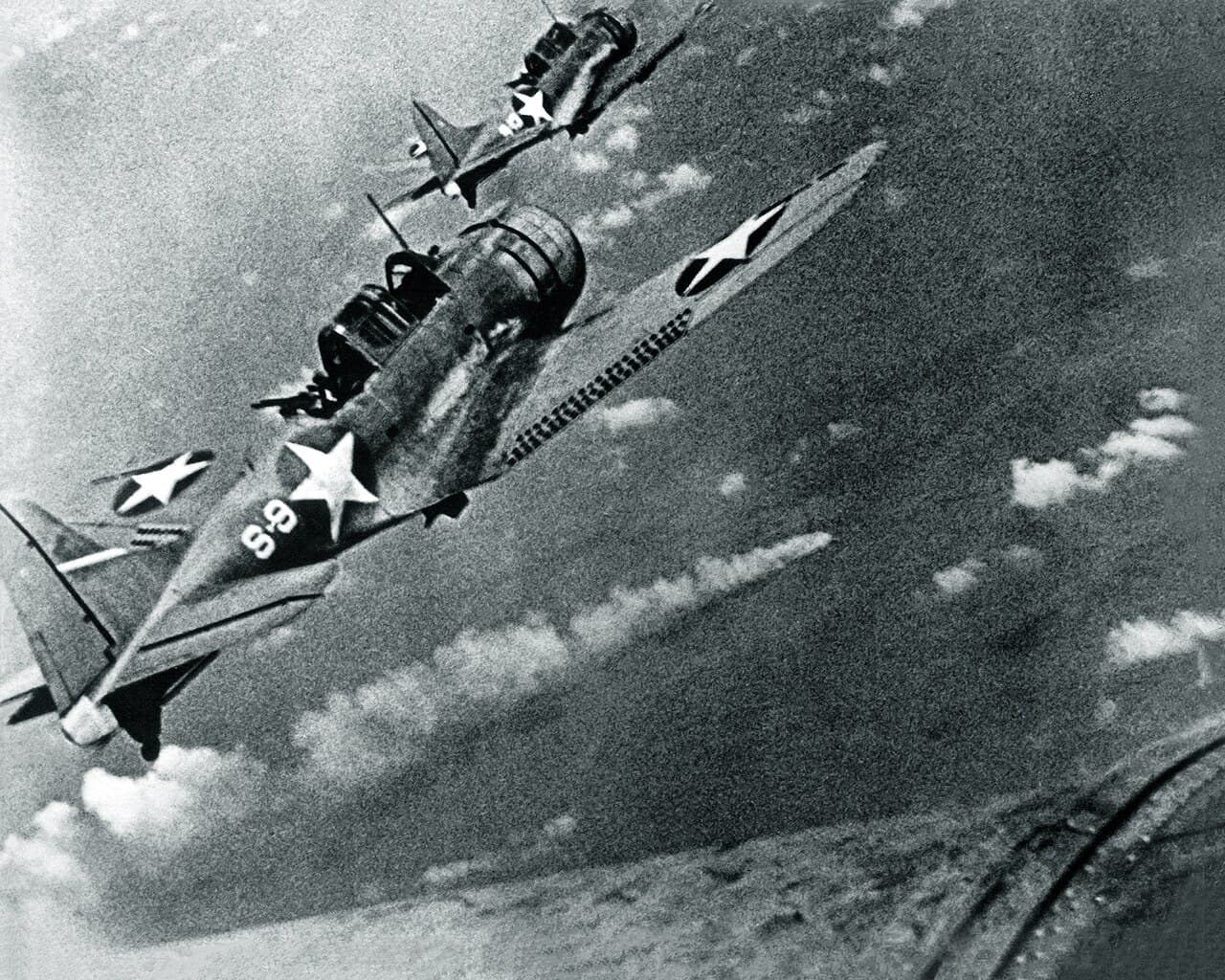
Douglas SBD-5 Dauntless
Douglas Aircraft Company
How does the SBD-5 stack up?
CompareOverview
The Douglas SBD Dauntless was the aircraft that turned the tide of the Pacific war. At the Battle of Midway on June 4, 1942, SBD dive-bombers from the carriers Enterprise, Yorktown, and Hornet sank four Japanese fleet carriers in a matter of minutes, inflicting a defeat from which the Imperial Japanese Navy never recovered. No other single aircraft type had such a decisive impact on the course of a war in such a compressed span of time.
The Dauntless was already considered obsolescent when the war began, slower and less capable than the dive-bombers of other nations on paper. Yet its combat record was staggering: the SBD sank more enemy shipping than any other Allied aircraft type in the Pacific, including six aircraft carriers, fourteen cruisers, and six battleships damaged or sunk. Its crews affectionately called it "Slow But Deadly," a play on the SBD designation that captured both its limitations and its lethal effectiveness.
Designed by Ed Heinemann at Douglas Aircraft, the Dauntless featured perforated split dive flaps that allowed precise, stable dives at steep angles, making it one of the most accurate dive-bombing platforms ever built. In the hands of experienced pilots, the SBD could place a bomb within 50 feet of the target from a release altitude of 2,500 feet, precision that no level bomber could match.
Performance Profile
Max Speed
255 mph
at 14,000 ft
Range
773 miles
normal
Service Ceiling
24,300 ft
Rate of Climb
1,700 ft/min
Armament
4 guns
2x .50 BMG, 2x .30 cal
Crew
2
Engine
Wright R-1820-60 Cyclone
1200 hp radial
Development History
The SBD Dauntless evolved from the Northrop BT-1 dive-bomber, designed by Ed Heinemann when Northrop was a subsidiary of Douglas. When Northrop became independent, the BT-1 design remained with Douglas and was substantially redesigned as the SBD-1. The key innovations were the distinctive perforated dive flaps (split flaps with holes drilled through them to reduce buffeting in a dive), a low-wing monoplane layout with retractable landing gear, and self-sealing fuel tanks.
The SBD-1 and SBD-2 entered Navy and Marine Corps service in 1940-1941, equipping carrier dive-bomber squadrons just in time for the war. These early models were modestly armed with two forward-firing .50-caliber guns and a single rear-firing .30-caliber gun. The SBD-3, which arrived in early 1942, added self-sealing fuel tanks, improved armor, a second rear gun, and the reflector gunsight that would prove critical for bombing accuracy.
The SBD-5, entering production in early 1943, was the most-produced variant. It featured the more powerful 1,200 hp Wright R-1820-60 engine (up from 1,000 hp in the SBD-3), an improved electrical system, and provision for a navigation computer. Despite the improvements, the SBD-5 was still slower than contemporary Japanese fighters by a wide margin, and its survival depended on fighter escort and the courage of its two-man crews.
Douglas produced the SBD at its El Segundo, California plant. The Army Air Forces also operated the aircraft as the A-24 Banshee, though it was less successful in the land-based role without the deck crews and procedures that naval aviators relied on for fast turnarounds.
Combat History
The SBD saw its first combat on February 1, 1942, when Enterprise dive-bombers raided Japanese installations in the Marshall Islands. Through the spring of 1942, SBDs flew strikes against Wake Island, Marcus Island, and targets in New Guinea. But it was at the Battle of the Coral Sea on May 7-8, 1942, that the Dauntless first proved its mettle, sinking the light carrier Shoho and damaging the fleet carrier Shokaku.
The SBD's defining moment came at the Battle of Midway on June 4, 1942. After torpedo bombers from all three American carriers were slaughtered in their low-level attacks, thirty-seven SBDs from Enterprise and Yorktown arrived over the Japanese fleet at precisely the right moment, catching the carriers with fueled and armed aircraft on their flight decks. In five minutes of diving attacks, SBDs sank the carriers Kaga, Akagi, and Soryu. A follow-up strike that afternoon sank the fourth carrier, Hiryu. These five minutes at Midway changed the course of the Pacific war.
Through 1942 and 1943, SBDs continued to play a critical role in the Pacific. At the Battle of the Eastern Solomons, Santa Cruz Islands, and during the grinding Guadalcanal campaign, Dauntless crews attacked Japanese warships, transports, and shore targets. Marine SBDs of VMSB-232 and VMSB-241 flew from Henderson Field on Guadalcanal in some of the most desperate conditions of the war.
By mid-1944, the SBD was being replaced aboard fleet carriers by the faster Curtiss SB2C Helldiver, though many pilots and aircrew preferred the older Dauntless for its reliability and predictable handling. Marine squadrons continued to operate the SBD through the Philippines campaign. The Dauntless was retired from front-line carrier service by mid-1944, but its place in history was already assured.
Variants
| Designation | Key Differences | Produced |
|---|---|---|
| SBD-1/2 | Initial production variants, 1,000 hp R-1820-32, limited armor and self-sealing | 174 |
| SBD-3 | Self-sealing tanks, improved armor, two rear guns, reflector sight, Midway veteran | 584 |
| SBD-4 | Electrical system improvements, radar provision, Hamilton Standard propeller | 780 |
| SBD-5 | 1,200 hp R-1820-60, improved electrical, navigation computer, most-produced variant | 2,965 |
| SBD-6 | Final variant, 1,350 hp R-1820-66, increased fuel capacity | 451 |
| A-24 Banshee | USAAF land-based variant, no arresting hook, limited success | 953 |
Strengths & Weaknesses
+Strengths
- Superb dive-bombing accuracy; perforated dive flaps allowed steep, stable dives with minimal buffet
- Extremely rugged airframe that could absorb significant battle damage and keep flying
- Outstanding combat record: sank more Japanese shipping than any other Allied aircraft type
- Stable and predictable flying characteristics made it accessible to less experienced pilots
- Self-sealing fuel tanks and pilot armor provided good survivability for a dive-bomber
-Weaknesses
- Slow maximum speed of 255 mph made it vulnerable to fighter interception without escort
- Limited range restricted strike radius and loiter time over target areas
- Obsolescent by 1943 standards, unable to outrun or outclimb most Japanese fighters
- Light defensive armament of two .30-caliber rear guns provided minimal protection from stern attacks
Pilot Voices
“I pushed over into my dive and the carrier filled my entire windscreen. At 2,500 feet I released and pulled out. The bomb hit right on the flight deck.”
“The SBD was slow, but it could take a beating. I saw Dauntlesses come back with holes you could put your fist through and the engine still running.”
Did You Know?
At the Battle of Midway, SBD Dauntless dive-bombers sank four Japanese fleet carriers in a single day, changing the course of the Pacific war in five minutes of diving attacks.
The SBD sank more Japanese shipping than any other Allied aircraft type in the Pacific, earning its crews' nickname "Slow But Deadly."
The perforated dive flaps were Ed Heinemann's solution to the violent buffeting that plagued conventional dive brakes, the holes allowed air to pass through, smoothing the airflow.
SBD rear-seat gunners were credited with shooting down numerous Japanese fighters during fleet actions, making the "Slow But Deadly" moniker even more apt.

