
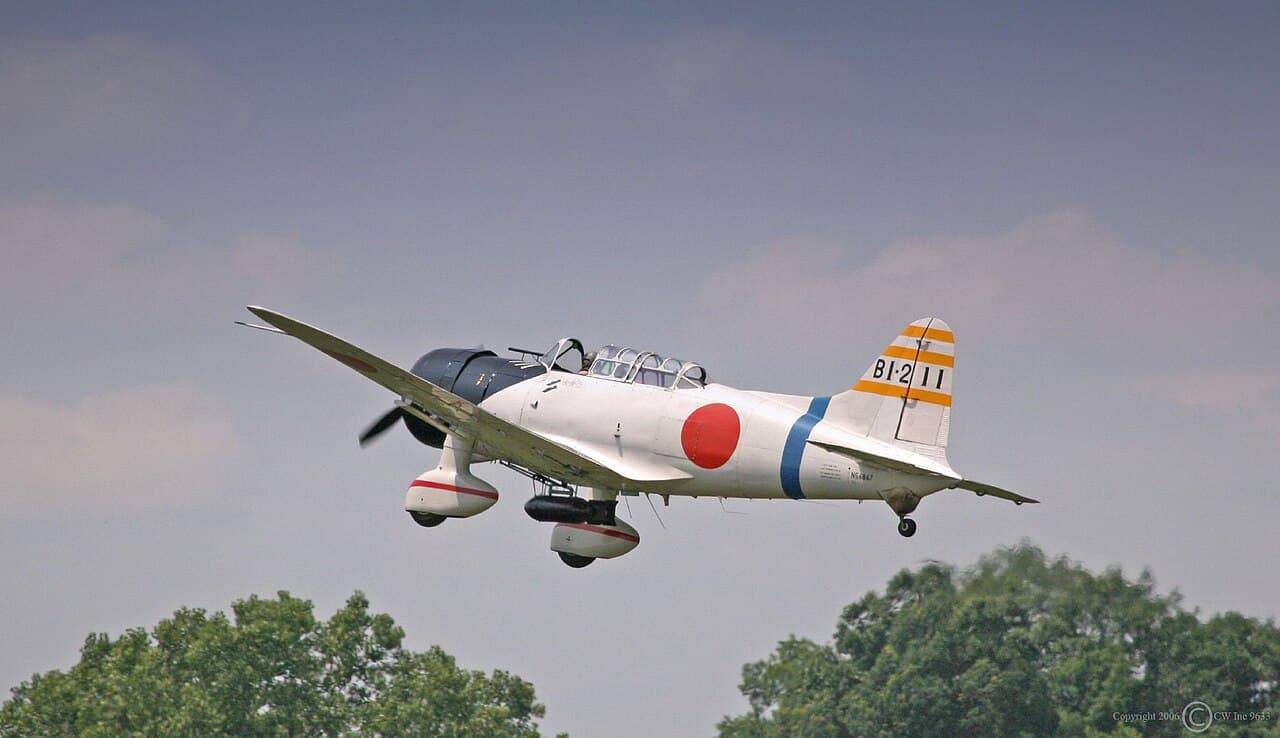
Aichi D3A1 Type 99 Carrier Dive Bomber
Aichi · Allied code name: “Val”
How does the D3A1 stack up?
CompareOverview
The Aichi D3A was the Imperial Japanese Navy's primary carrier-borne dive bomber during the first half of the Pacific War, and in the hands of its highly trained crews, it achieved a higher hit rate than any other dive bomber in the conflict. Allied forces knew it as "Val," and despite its fixed spatted landing gear and seemingly dated appearance, the D3A1 was a devastatingly accurate weapon that sank more Allied warships than any other Axis aircraft type during the first 18 months of the Pacific War.
The D3A1's greatest asset was the extraordinary accuracy of its attacks. Japanese Navy dive bomber pilots trained relentlessly, practicing near-vertical dives from 13,000 feet and releasing their bombs at just 1,500 feet. During the Indian Ocean Raid of April 1942, D3A1 pilots achieved an astonishing 82% hit rate against maneuvering warships, a level of accuracy that no other air force in the world could match. In that single week, Vals sank the British carrier Hermes, the heavy cruisers Cornwall and Dorsetshire, and the destroyer Vampire.
Like the Zero and Kate, the Val represented Japanese prewar aviation at its peak: superb airmanship, meticulous training, and aggressive doctrine masking fundamental equipment limitations. Once the irreplaceable veteran dive bomber crews began to fall in the meat grinder of the Solomons campaign, the D3A's age and vulnerability became glaringly apparent, and it was increasingly relegated to shore-based and kamikaze operations.
Performance Profile
Max Speed
267 mph
at 9,845 ft
Range
915 miles
normal
Service Ceiling
30,050 ft
Rate of Climb
1,480 ft/min
Armament
3 guns
2x 7.7mm, 1x 7.7mm
Crew
2
Engine
Mitsubishi Kinsei 44
1070 hp radial
Development History
Aichi began designing the D3A in response to an 11-Shi (1936) Navy specification for a carrier-based dive bomber to replace the D1A biplane. Chief designer Tokuhichiro Goake drew inspiration from the German Heinkel He 70 mail plane's elliptical wing planform, which offered low drag and good structural properties for the stresses of dive-bombing. The low-wing, all-metal monoplane featured distinctive fixed landing gear with large fairings, a weight-saving decision that also simplified manufacturing and maintenance.
The first prototype flew in January 1938, powered by the Mitsubishi Kinsei 3 engine. Initial flight testing revealed longitudinal instability and poor spin recovery, problems traced to the wing design. Aichi addressed these by reducing the wing span, modifying the dive brakes, and adding a dorsal strake ahead of the vertical tail. The redesigned aircraft handled well in diving attacks, with the fixed gear actually serving as effective air brakes that limited terminal velocity and gave the pilot more time to aim.
The production D3A1, powered by the Kinsei 44 engine producing 1,070 hp, entered service in 1940. It carried a single 551-pound bomb on a centerline crutch that swung the weapon clear of the propeller arc during a dive, plus two 132-pound bombs under the wings. Defensive armament consisted of two fixed forward-firing 7.7mm guns and one flexible rear gun, light by any standard.
The D3A2, which appeared in 1942, installed the more powerful Kinsei 54 engine (1,300 hp) and increased fuel capacity for greater range. However, the additional weight somewhat degraded the already modest performance, and the fundamental limitations of the design, fixed gear, light construction, minimal defensive armament, could not be overcome without a completely new aircraft. The replacement Yokosuka D4Y "Judy" was faster and more modern but encountered its own teething problems, ensuring the Val remained in service far longer than intended.
Combat History
The D3A1's combat debut came with devastating effect at Pearl Harbor on December 7, 1941, when 129 Vals participated in both waves of the attack. First-wave D3A1s targeted airfields at Hickam, Wheeler, and Ford Island, suppressing American air defenses. Second-wave Vals dive-bombed battleships and other targets in the harbor, scoring multiple hits. Though the B5N torpedo planes inflicted the most damage, the Vals' attacks on airfields ensured that American aircraft could not interfere with the torpedo runs.
The next six months were the Val's golden period. During the rampage through Southeast Asia, D3A1s attacked targets from Wake Island to Darwin, Australia. The Indian Ocean Raid in April 1942 was the pinnacle of Japanese dive-bombing accuracy. In attacks on the Royal Navy's Eastern Fleet, D3A1 pilots achieved hit rates of over 80% against the heavy cruisers Cornwall and Dorsetshire, sinking both ships in minutes. The carrier Hermes was sunk with an almost unbelievable accuracy rate, nearly every bomb found its target.
The Coral Sea and Midway battles marked the turning point. At Coral Sea in May 1942, Vals scored three bomb hits on USS Yorktown, but losses among experienced dive bomber crews began to mount. At Midway in June 1942, the surviving D3A1s from the doomed carriers launched a final strike, but by then the elite prewar aircrews were being ground away. The Solomons campaign of 1942-43 accelerated the attrition, as Vals operating from Rabaul were repeatedly intercepted by Marine and Navy fighters during the long approach to Guadalcanal.
By 1944, the D3A was clearly obsolete. During the Battle of the Philippine Sea, the few remaining Vals were slaughtered in the "Great Marianas Turkey Shoot." Surviving aircraft were increasingly used for kamikaze attacks, where their slow speed and light defensive armament no longer mattered. A Val kamikaze actually scored the first successful kamikaze hit of the war, damaging HMAS Australia off Leyte Gulf on October 21, 1944.
Variants
| Designation | Key Differences | Produced |
|---|---|---|
| D3A1 Model 11 | Initial production with Kinsei 44 engine (1,070 hp); the Pearl Harbor and Indian Ocean Raid variant. | 470 |
| D3A1 Model 11 (late) | Minor production improvements including revised propeller spinner and strengthened arresting hook. | 330 |
| D3A2 Model 12 | Kinsei 54 engine (1,300 hp), increased fuel capacity, revised cowling. Heavier but longer-ranged. | 695 |
| D3A2-K | Two-seat trainer variant with dual controls; conversion of operational airframes no longer suitable for combat. | - |
Strengths & Weaknesses
+Strengths
- Achieved the highest bombing accuracy of any dive bomber in the war, with hit rates exceeding 80% in the hands of expert crews
- Stable diving characteristics with fixed gear acting as natural speed brakes, giving pilots extended aiming time
- Elliptical wing provided good low-speed handling for carrier operations and structural strength for high-g dive pullouts
- Reliable and easy to maintain under carrier conditions, with fixed gear eliminating a common source of mechanical failure
-Weaknesses
- Fixed landing gear created significant drag, limiting top speed and making the aircraft an easy target for Allied fighters
- Pathetically weak defensive armament of only 7.7mm machine guns offered no real protection against determined fighter attack
- Light bomb load of 551 pounds on the centerline was less than half what the SBD Dauntless could carry
- No armor or self-sealing fuel tanks made it extremely fragile; accuracy meant nothing if the aircraft could not survive to reach its target
Pilot Voices
“In the dive, the Val was as steady as a rock. You could hold the crosshairs on a moving ship all the way down. I never missed at Pearl Harbor.”
“The Val pilots we faced at Coral Sea were the best dive bomber crews I have ever seen in any navy. Their accuracy was frightening. Fortunately, by the Solomons, those pilots were gone.”
Did You Know?
During the Indian Ocean Raid in April 1942, D3A1 dive bombers achieved an astonishing 82% hit rate against the maneuvering British cruisers Cornwall and Dorsetshire, the highest bombing accuracy against warships ever recorded in combat.
The D3A sank more Allied warship tonnage than any other Axis aircraft type in the first 18 months of the Pacific War, including carriers, battleships, cruisers, and destroyers.
A D3A2 Val scored the first confirmed kamikaze hit of the Philippine campaign, striking HMAS Australia off Leyte Gulf on October 21, 1944.
Despite its seemingly obsolete fixed-gear configuration, the D3A's design was sound enough that Aichi could not produce a significantly better replacement until 1943, and the Yokosuka D4Y "Judy" that followed had its own serious problems.

