
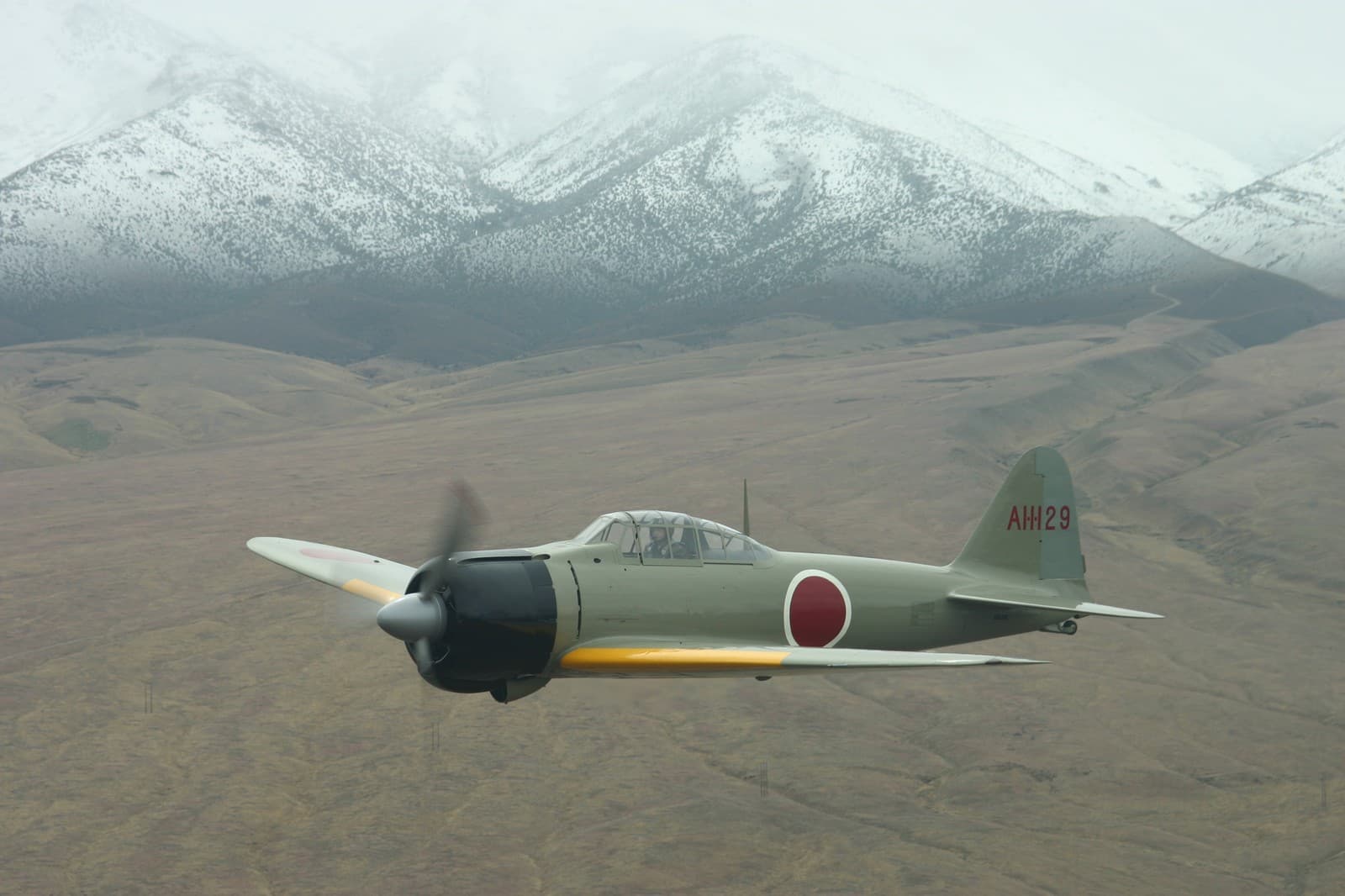
Mitsubishi A6M5 Type 0 Carrier Fighter
Mitsubishi · Allied code name: “Zero/Zeke”
How does the A6M5 stack up?
CompareOverview
The Mitsubishi A6M Zero was the most famous Japanese aircraft of World War II and one of the most iconic fighters in aviation history. When it burst onto the scene over China in 1940 and then swept through the Pacific in the opening months of the war, the Zero shocked Allied air forces with its extraordinary maneuverability, long range, and apparent invincibility. No carrier-based fighter in the world could match it in a dogfight, and for nearly a year after Pearl Harbor, Allied pilots lived in fear of the nimble Japanese fighter.
The Zero achieved its remarkable performance through an extreme design philosophy that sacrificed armor protection, self-sealing fuel tanks, and structural robustness for every possible ounce of range and agility. Designer Jiro Horikoshi created an aircraft of almost poetic lightness, with a wing loading so low that the Zero could out-turn anything in the sky. This approach proved devastatingly effective when flown by the IJN's highly trained prewar pilots against opponents who did not yet understand how to fight it.
Yet the same philosophy that made the Zero supreme in 1941 proved fatal by 1943. As American tactics evolved and heavier, faster fighters like the F6F Hellcat and F4U Corsair arrived in numbers, the Zero's lack of protection turned it into a death trap. Pilots could not dive away from danger because the airframe could not withstand high speeds, and a single hit to the unprotected fuel tanks often meant a fireball. The Zero remained in frontline service until the end of the war, but by 1944 it was hopelessly outclassed, its final role as a kamikaze weapon a grim testament to how far it had fallen.
Performance Profile
Max Speed
351 mph
at 19,685 ft
Range
1,194 miles
normal
Service Ceiling
38,520 ft
Rate of Climb
3,150 ft/min
Armament
4 guns
2x 20mm, 2x 7.7mm
Crew
1
Engine
Nakajima NK1C Sakae 21
1130 hp radial
Development History
The A6M originated from a demanding 1937 Imperial Japanese Navy specification that called for a carrier-based fighter with unprecedented range, maneuverability, and speed. Nakajima declined the specification as impossible, but Mitsubishi's chief designer Jiro Horikoshi accepted the challenge. He realized the only way to meet the contradictory requirements was to build the lightest possible airframe, eliminating every gram of unnecessary weight.
Horikoshi employed a novel extra-super duralumin alloy called Sumitomo Metals' ESD, which was stronger than standard aluminum alloys but also more brittle. The wing was built as a single continuous spar passing through the fuselage, eliminating heavy joint fittings. Armor plating was omitted entirely, and the fuel tanks had no self-sealing protection. The result was an airframe that weighed barely 3,700 pounds empty yet carried two 20mm cannon and two 7.7mm machine guns.
The A6M2 prototype first flew on April 1, 1939, powered by the Mitsubishi Zuisei 13 engine, but production aircraft switched to the more powerful Nakajima Sakae 12. The A6M2 Model 21, which entered service in July 1940, immediately proved devastating in combat over China, where thirteen Zeros destroyed 27 Chinese and Soviet-built fighters without a single loss. This combat debut was largely ignored by Western intelligence, a mistake that would prove costly.
The A6M5 Model 52, which entered service in late 1943, was the most-produced Zero variant. It featured shorter, rounded wingtips for improved roll rate and higher diving speed, an exhaust thrust augmentation system, and the improved Sakae 21 engine. However, the fundamental limitations remained: no armor, no self-sealing tanks, and an airframe that could not be significantly redesigned without starting from scratch. Attempts to install more powerful engines were frustrated by the lightweight airframe's inability to handle the additional torque and vibration.
Combat History
The Zero's combat debut over China in September 1940 was one of the most one-sided air engagements in history. Thirteen A6M2s escorting bombers to Chongqing engaged 27 Chinese fighters and destroyed all of them without losing a single aircraft. Allied intelligence either ignored or disbelieved these reports, and when the Zero appeared over Pearl Harbor, the Philippines, and the Dutch East Indies in December 1941, the shock was profound.
During the first six months of the Pacific War, the Zero swept all opposition from the sky. Over the Philippines, it destroyed most of the USAAF's Far East Air Force. Over the Dutch East Indies, it outfought Dutch Brewster Buffalos and Curtiss Hawks. Over Burma, it bested RAF Hurricanes and P-40s. The Zero's extraordinary range allowed it to escort bombers over distances that Allied planners believed impossible, appearing over targets hundreds of miles from the nearest Japanese base.
The tide began to turn at Midway in June 1942, where the Zero fought well but could not prevent the loss of four carriers. More importantly, the recovery of a largely intact A6M2 from Akutan Island in the Aleutians in July 1942 allowed American engineers to thoroughly test the Zero and develop tactics to exploit its weaknesses. The resulting "Thach Weave" tactic and the dictum to never dogfight a Zero below 300 mph transformed Allied combat effectiveness. New fighters like the F6F Hellcat and F4U Corsair, designed specifically to counter the Zero's strengths, arrived in 1943 and rapidly shifted the balance.
By 1944, the Zero was hopelessly outmatched. At the Battle of the Philippine Sea in June 1944, American pilots shot down over 300 Japanese aircraft, mostly Zeros, in the "Great Marianas Turkey Shoot." The experienced prewar pilots who had made the Zero fearsome were gone, replaced by hastily trained replacements flying an obsolescent aircraft. The Zero's final chapter was as a kamikaze weapon, its light fuel load and the pilot's willingness to die making it effective in a role its designer had never imagined.
Variants
| Designation | Key Differences | Produced |
|---|---|---|
| A6M2 Model 21 | Classic early-war variant with folding wingtips for carrier storage; Sakae 12 engine (940 hp). Pearl Harbor model. | 3,180 |
| A6M3 Model 32 | Sakae 21 engine (1,130 hp), squared-off wingtips for improved roll rate, reduced range due to smaller fuel tanks. | 343 |
| A6M5 Model 52 | Most-produced variant; rounded shorter wingtips, exhaust thrust augmentation, heavier wing skin for higher dive speed. | 4,000 |
| A6M5b Model 52b | One 7.7mm gun replaced by 13.2mm Type 3; CO2 fire extinguisher in wing tanks as a rudimentary self-sealing measure. | 470 |
| A6M5c Model 52c | Added two 13.2mm wing guns; 45mm armor glass windscreen; wing hardpoints for rockets or bombs. | 93 |
| A6M7 Model 63 | Final production variant optimized for dive-bombing and kamikaze role; reinforced fuselage center rack for 500 kg bomb. | 150 |
Strengths & Weaknesses
+Strengths
- Extraordinary maneuverability at low and medium speeds, capable of out-turning every Allied fighter in the early war
- Exceptional range of over 1,100 miles allowed it to escort bombers across vast Pacific distances no other carrier fighter could cover
- Light weight and low wing loading gave superb climb rate and sustained turn performance
- Effective armament of two 20mm cannon gave it hitting power well above most 1940-era fighters
-Weaknesses
- Complete lack of pilot armor and self-sealing fuel tanks made it extremely vulnerable to enemy fire; a single incendiary round could ignite the aircraft
- Structural limitations prevented high-speed dives above approximately 340 mph; the ailerons froze at high speed, making escape from diving attacks impossible
- Low-velocity 20mm cannon had limited ammunition (100 rpg) and poor ballistics at range
- Sakae engine had reached its development limit; no significantly more powerful variant could be fitted without a complete redesign
Pilot Voices
“I saw the Zero for the first time over Clark Field. It climbed faster, turned tighter, and flew farther than anything I had ever seen. We were completely unprepared.”
“The Zero was like a ballet dancer, graceful, light, and beautiful in the air. But one good hit and it burned like paper.”
Did You Know?
An intact A6M2 Zero crash-landed on Akutan Island in the Aleutians on June 4, 1942. Its recovery and testing by American engineers revealed every weakness of the design and directly influenced the development of the F6F Hellcat.
Designer Jiro Horikoshi personally opposed the war and was deeply troubled that his creation became such a potent weapon. After the war, he expressed regret that his engineering brilliance had contributed to so much destruction.
The name "Zero" derives from the Japanese Navy designation "Type 0" because the aircraft was accepted in the Imperial year 2600 (1940). Japanese pilots called it "Reisen" (zero fighter), while the Allies assigned the reporting name "Zeke."
In the first six months of the Pacific War, Zero pilots achieved a kill ratio estimated at better than 12:1 against Allied aircraft, a dominance that evaporated once American tactics and aircraft caught up.


