
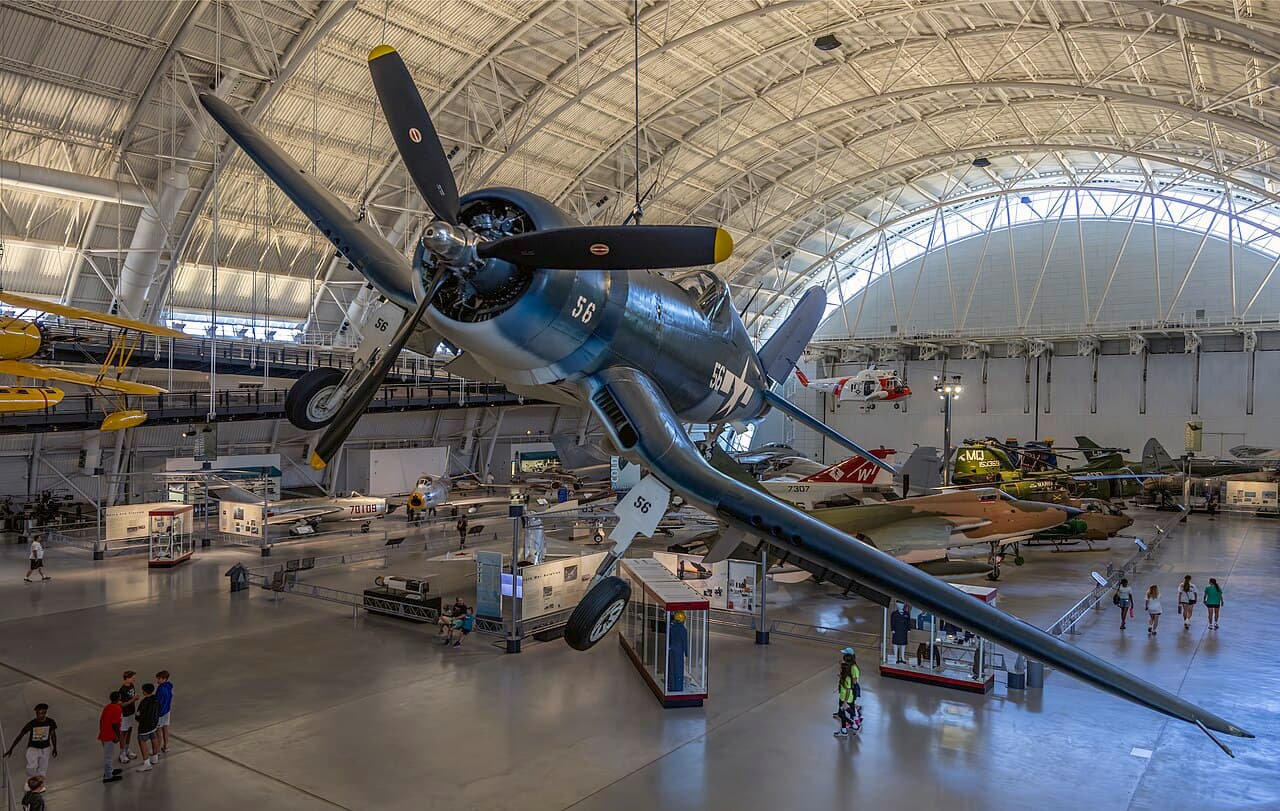
Vought F4U-1D Corsair
Vought
How does the F4U-1D stack up?
CompareOverview
The Vought F4U Corsair was the fastest and most powerful carrier-based fighter of World War II, recognizable by its distinctive inverted gull wing and the whistling sound of air passing through its wing-root oil cooler intakes in a dive. Originally designed as a pure naval fighter, the Corsair's difficult carrier landing characteristics led to its initial deployment with land-based Marine Corps squadrons in the Solomon Islands, where it earned the Japanese nickname "Whistling Death."
The Corsair's combat record speaks for itself: an 11:1 kill ratio across the Pacific war. Marine and Navy pilots flew the big fighter in every major campaign from Guadalcanal to Okinawa, and its combination of speed, range, and bomb-carrying capability made it equally effective as a fighter-bomber. The F4U could carry 2,000 pounds of bombs or eight HVAR rockets, making it a devastating ground-attack platform against Japanese positions.
Remarkably, the Corsair remained in production for over a decade, longer than any other US piston-engine fighter. It flew combat missions in Korea, where it served as a close air support aircraft well into the jet age, and it was the last piston-engine fighter to see combat with the US military. Over 12,500 Corsairs were built by Vought, Goodyear, and Brewster, making it one of the most-produced American fighters of the war.
Performance Profile
Max Speed
425 mph
at 20,000 ft
Range
1,015 miles
normal
Service Ceiling
36,900 ft
Rate of Climb
3,120 ft/min
Armament
6 guns
6x .50 BMG
Crew
1
Engine
Pratt & Whitney R-2800-8W Double Wasp
2000 hp radial
Development History
The F4U Corsair was designed by Vought's chief engineer Rex Beisel to meet a 1938 US Navy requirement for a high-performance carrier fighter. Beisel's team designed the smallest possible airframe around the largest available engine, the 2,000 hp Pratt & Whitney R-2800 Double Wasp, and the biggest propeller that could be fitted to it, the 13-foot-4-inch Hamilton Standard Hydromatic. The inverted gull wing was the solution to keeping the landing gear short enough for carrier operations while providing clearance for that massive propeller.
The XF4U-1 prototype first flew on May 29, 1940, and became the first American fighter to exceed 400 mph in level flight during testing in October 1940. However, converting the hot prototype into a combat-ready carrier aircraft proved far more challenging than expected. The cockpit was moved three feet aft to accommodate a fuselage fuel tank, severely limiting forward visibility. The long nose, high landing speed, and tendency to bounce on landing made it a handful on carrier decks.
The US Navy initially rejected the Corsair for carrier operations, assigning it instead to land-based Marine squadrons. The Marines first took the F4U-1 into combat on February 13, 1943, with VMF-124 at Guadalcanal. Meanwhile, the Royal Navy's Fleet Air Arm, which received Corsairs under Lend-Lease, successfully operated them from carriers by developing approach techniques including a curved final approach to maintain visual contact with the deck.
The F4U-1D variant, entering production in early 1944, incorporated improvements including a new clear-view raised canopy, water injection for emergency power, centerline and wing hardpoints for bombs and rockets, and a frameless windscreen. By April 1944, the US Navy finally cleared the Corsair for carrier operations, and F4U-1Ds deployed aboard fleet carriers for the Marianas, Philippines, Iwo Jima, and Okinawa campaigns.
Combat History
The Corsair's combat debut came on February 13, 1943, when VMF-124 flew an escort mission to Bougainville. Early results were mixed, but the Marines quickly learned to exploit the Corsair's speed advantage. By mid-1943, Marine Corsair squadrons were dominating the skies over the Solomons. VMF-214, the famous "Black Sheep" squadron under Major Gregory "Pappy" Boyington, claimed 94 aerial victories in the Corsair and made Boyington the Marine Corps' leading ace before his capture in January 1944.
As the war progressed, the Corsair increasingly served in the fighter-bomber role. During the Battle of Okinawa in 1945, Marine Corsair squadrons operated from captured airfields delivering devastating close air support to ground troops. They carried napalm, general-purpose bombs, and HVAR rockets against Japanese fortifications, earning the gratitude of infantry Marines who called the Corsair pilots "our angels." Navy Corsair squadrons aboard fleet carriers also played a key role in combating the kamikaze threat.
The Royal Navy operated over 2,000 Corsairs as the "Corsair" Mk I through IV, making it the most numerous Fleet Air Arm fighter of the war. British Corsairs flew strikes against the Tirpitz in Norway, operated extensively in the Indian Ocean, and served with the British Pacific Fleet during the final campaigns against Japan. The RNZAF also operated Corsairs extensively in the South Pacific.
By war's end, F4U pilots had claimed 2,140 aerial victories against just 189 Corsairs lost in air-to-air combat, an 11.3:1 kill ratio. The Corsair went on to serve with distinction in Korea, where it flew more close air support sorties than any other aircraft type, proving the design's extraordinary longevity.
Variants
| Designation | Key Differences | Produced |
|---|---|---|
| F4U-1 (Birdcage) | Initial production, framed "birdcage" canopy, no wing hardpoints | 688 |
| F4U-1A | Raised canopy with semi-bubble hood, improved tail wheel, better stall handling | 2,066 |
| F4U-1D | Water injection, centerline/wing pylons, frameless windscreen, definitive WW2 variant | 1,685 |
| F4U-4 | R-2800-18W (2,100 hp), 4-blade prop, 446 mph, improved climb | 2,357 |
| FG-1D (Goodyear) | Goodyear-built equivalent of F4U-1D, non-folding wings for land-based use | 4,007 |
| F4U-5 | Postwar, R-2800-32W, 462 mph, fully heated cockpit, Korea veteran | 568 |
Strengths & Weaknesses
+Strengths
- Fastest carrier-based fighter of WW2, with a significant speed advantage over Japanese opponents
- Excellent fighter-bomber platform capable of carrying 2,000 lbs of bombs or eight rockets
- Rugged Grumman-style construction with self-sealing tanks and pilot armor
- Superb dive performance and energy retention in boom-and-zoom tactics
- Exceptionally long service life; remained combat-effective through the Korean War
-Weaknesses
- Poor forward visibility over the long nose made carrier landings extremely challenging
- Tendency to stall sharply from the left wing, dangerous during slow carrier approaches
- Initially deemed unsuitable for carrier operations; took two years to resolve deck landing issues
- Oil cooler intakes in wing roots were vulnerable to ground fire in the strafing role
Pilot Voices
“The Corsair was the best fighter I ever flew. It could outrun, outclimb, and outfight anything the Japanese had.”
“When you strapped a Corsair on, you felt like you were riding a thoroughbred racehorse. There was nothing in the Pacific that could touch it.”
Did You Know?
The Japanese nicknamed the F4U "Whistling Death" because of the distinctive sound made by air flowing through its wing-root oil cooler intakes during dives.
The Corsair remained in production for 13 years (1942-1953), longer than any other American piston-engine fighter, with the last F4U-7s built for the French Navy.
The Royal Navy solved the Corsair's carrier landing problem before the US Navy did, using a curved approach technique that allowed pilots to keep the deck in sight around the long nose.
Gregory "Pappy" Boyington's VMF-214 "Black Sheep" squadron scored 94 confirmed kills in just 12 weeks of combat in the Solomons.


