
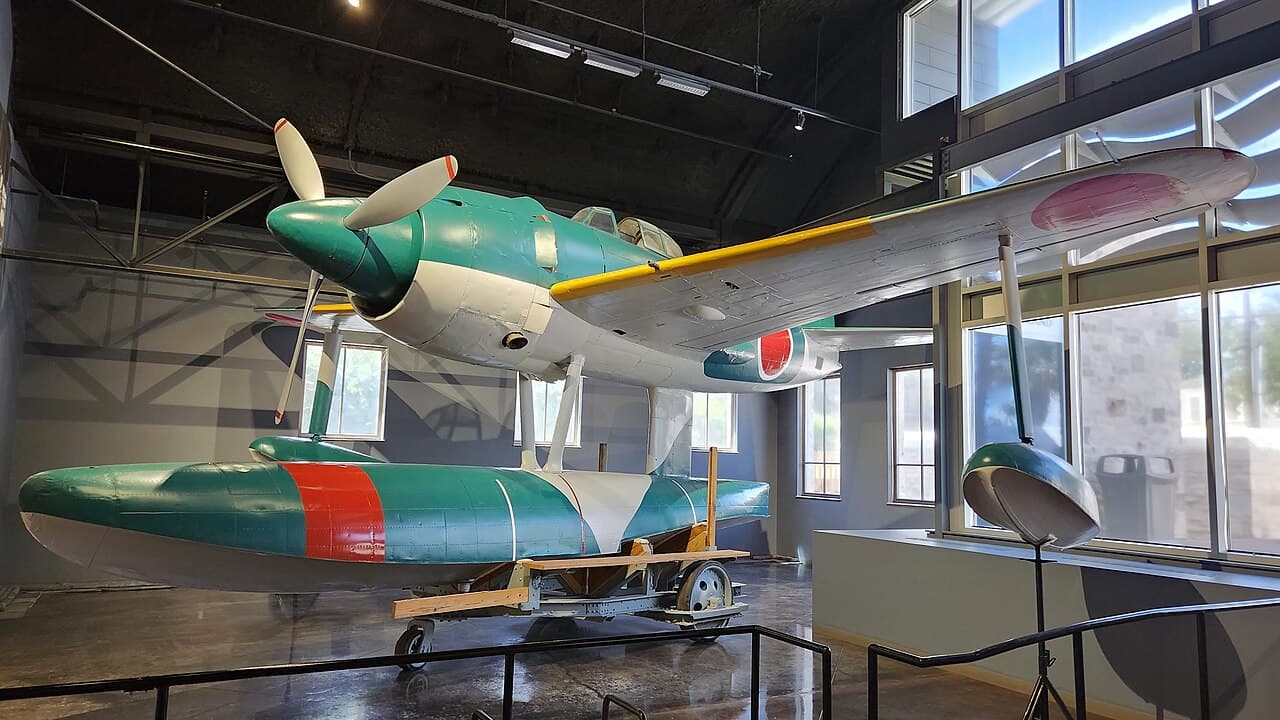
Kawanishi N1K2-J Shiden-Kai (Violet Lightning Improved)
Kawanishi · Allied code name: “George”
How does the N1K2-J stack up?
CompareOverview
The Kawanishi N1K2-J Shiden-Kai was arguably the most formidable Japanese fighter of World War II, a land-based interceptor armed with four 20mm cannon that could challenge any Allied aircraft on equal terms. Developed from an unlikely starting point, a floatplane fighter, the Shiden-Kai combined devastating firepower, good speed, excellent maneuverability, and the pilot protection that earlier Japanese designs had criminally neglected. In the hands of a skilled pilot, it was one of the best fighters produced by any nation during the war.
The aircraft mounted an innovative automatic combat flap system that adjusted flap extension based on g-loading, giving it remarkable maneuverability for its size and weight. Four wing-mounted 20mm cannon provided tremendous hitting power, capable of shredding any Allied fighter or seriously damaging heavy bombers. Self-sealing fuel tanks and pilot armor finally gave Japanese aviators a fighting chance of surviving hits.
The Shiden-Kai's great tragedy was that it arrived far too late and in far too few numbers to affect the outcome of the war. Only 415 were built, hampered by the same engine reliability problems and manufacturing quality issues that plagued other late-war Japanese fighters. Had the N1K2-J been available in 1943 rather than 1944, the Pacific air war might have taken a very different course.
Performance Profile
Max Speed
369 mph
at 18,370 ft
Range
1,066 miles
normal
Service Ceiling
35,400 ft
Rate of Climb
3,300 ft/min
Armament
4 guns
4x 20mm
Crew
1
Engine
Nakajima NK9H Homare 21
1990 hp radial
Development History
The Shiden-Kai had one of the most unusual development paths of any World War II fighter. It began as the N1K1 Kyofu ("Strong Wind"), a floatplane fighter designed by Kawanishi to provide air cover over areas without conventional airfields. When the floatplane version showed promising performance, Kawanishi engineers proposed adapting it as a land-based fighter, creating the N1K1-J Shiden ("Violet Lightning").
The N1K1-J, which first flew in December 1942, was a capable aircraft but suffered from several design compromises inherited from its floatplane origins. The mid-mounted wing, chosen to keep the floats clear of the water, required complex, failure-prone telescoping landing gear legs that were excessively long and weak. The aircraft was also difficult to manufacture, with many complex curves and panels.
Kawanishi's engineers addressed these problems with a comprehensive redesign that produced the N1K2-J Shiden-Kai. The wing was moved from mid to low position, eliminating the troublesome telescoping gear in favor of conventional shorter units. The fuselage was simplified and lengthened, the tail was redesigned, and manufacturing was streamlined with over 1,000 fewer parts than the N1K1-J. The first N1K2-J flew on December 31, 1943, and testing confirmed it was superior to its predecessor in virtually every way.
The Homare 21 engine, like the Ha-45 in the Ki-84, was rated at nearly 2,000 horsepower but suffered from chronic reliability issues. Kawanishi also struggled with production, as American bombing raids repeatedly damaged its factories. The Navy ordered production at multiple plants, but quality varied widely and total output never exceeded a trickle compared to the thousands of American fighters pouring off assembly lines.
Combat History
The N1K2-J Shiden-Kai entered combat in mid-1944 with the 343rd Naval Air Group, an elite unit commanded by Captain Minoru Genda, the tactical architect of the Pearl Harbor attack. Genda hand-picked the best surviving naval aviators for his unit, including aces who had fought since the China campaign. The 343rd was organized as a dedicated interceptor force tasked with defending the Japanese home islands.
The Shiden-Kai's most famous engagement came on March 19, 1945, when the 343rd Kokutai intercepted a massive American carrier strike force attacking the Kure naval base. In a swirling air battle, the Shiden-Kai pilots claimed 52 American aircraft destroyed and 16 probables against their own losses of 16 aircraft, though American records confirm far fewer losses. What is undeniable is that the 343rd gave the attacking Hellcat and Corsair pilots one of their toughest fights of the war.
When flown by experienced pilots, the Shiden-Kai proved it could hold its own against any Allied fighter. Warrant Officer Kaneyoshi Muto of the 343rd (who had transferred from the JAAF Ki-84 units) was credited with shooting down four F6F Hellcats in a single engagement. However, the aircraft's combat record was inevitably limited by its small numbers, only 415 produced total, and the rapidly deteriorating state of Japan's military situation.
The N1K2-J also saw action in the defense of Okinawa, where its pilots tangled with the massed air power of the US Fifth Fleet. By mid-1945, fuel shortages were so severe that even the elite 343rd could barely keep its aircraft in the air. Many surviving Shiden-Kais were hoarded for the expected defense of the home islands against the anticipated American invasion.
Variants
| Designation | Key Differences | Produced |
|---|---|---|
| N1K1-J Shiden (Model 11) | Original land-based conversion with mid-wing, telescoping landing gear, and Homare 11 engine. Complex to build and maintain. | 1,007 |
| N1K2-J Shiden-Kai (Model 21) | Major redesign with low wing, conventional landing gear, simplified construction, and Homare 21 engine. Definitive variant. | 415 |
| N1K2-Ja (Model 21a) | Replaced inboard 20mm cannon with 13.2mm machine guns to reduce weight and improve ammunition supply. | - |
| N1K3-J Shiden-Kai 1 (Model 31) | Proposed high-altitude version with Homare 23 engine and turbocharger; never entered production. | 0 |
| N1K4-J Shiden-Kai 2 (Model 32) | Planned definitive variant with improved Homare 23 engine; two prototypes built before war's end. | 2 |
Strengths & Weaknesses
+Strengths
- Devastating armament of four 20mm cannon provided more firepower than any American single-engine fighter
- Innovative automatic combat flaps gave exceptional maneuverability for a fighter of its weight class
- Meaningful pilot protection with self-sealing fuel tanks and armor plate, a first for many Japanese naval aviators
- Capable of engaging and defeating F6F Hellcats and F4U Corsairs on roughly equal terms when flown by skilled pilots
-Weaknesses
- Homare 21 engine was chronically unreliable, particularly in frontline conditions with poor-quality fuel and rushed maintenance
- Produced in far too few numbers (415 N1K2-J) to have any strategic impact on the air war
- Complex manufacturing requirements were poorly suited to Japan's deteriorating industrial conditions
- High wing loading compared to earlier Japanese fighters made it less forgiving for the poorly trained replacement pilots that filled late-war squadrons
Pilot Voices
“In the Shiden-Kai, I finally felt that I was flying an aircraft that could match the enemy. Four cannon, armor, speed, it had everything the Zero should have had.”
“We encountered a new type over Kure that fought completely differently from the usual Japanese fighters. These pilots did not run and they did not make suicide attacks. They fought like professionals.”
Did You Know?
The Shiden-Kai began life as a floatplane fighter, the only major land-based fighter of the war to be derived from a seaplane design.
Captain Minoru Genda, who planned the Pearl Harbor attack, commanded the 343rd Kokutai that operated the Shiden-Kai. After the war, he became a general in the Japan Air Self-Defense Force and a member of the Japanese parliament.
American test pilots who evaluated captured N1K2-Js after the war rated it as the best Japanese fighter they had flown, praising its maneuverability, firepower, and overall handling qualities.
The automatic combat flap system used mercury switches and a mechanical computer to adjust flap deployment based on g-forces, a remarkably sophisticated system for 1944.


