
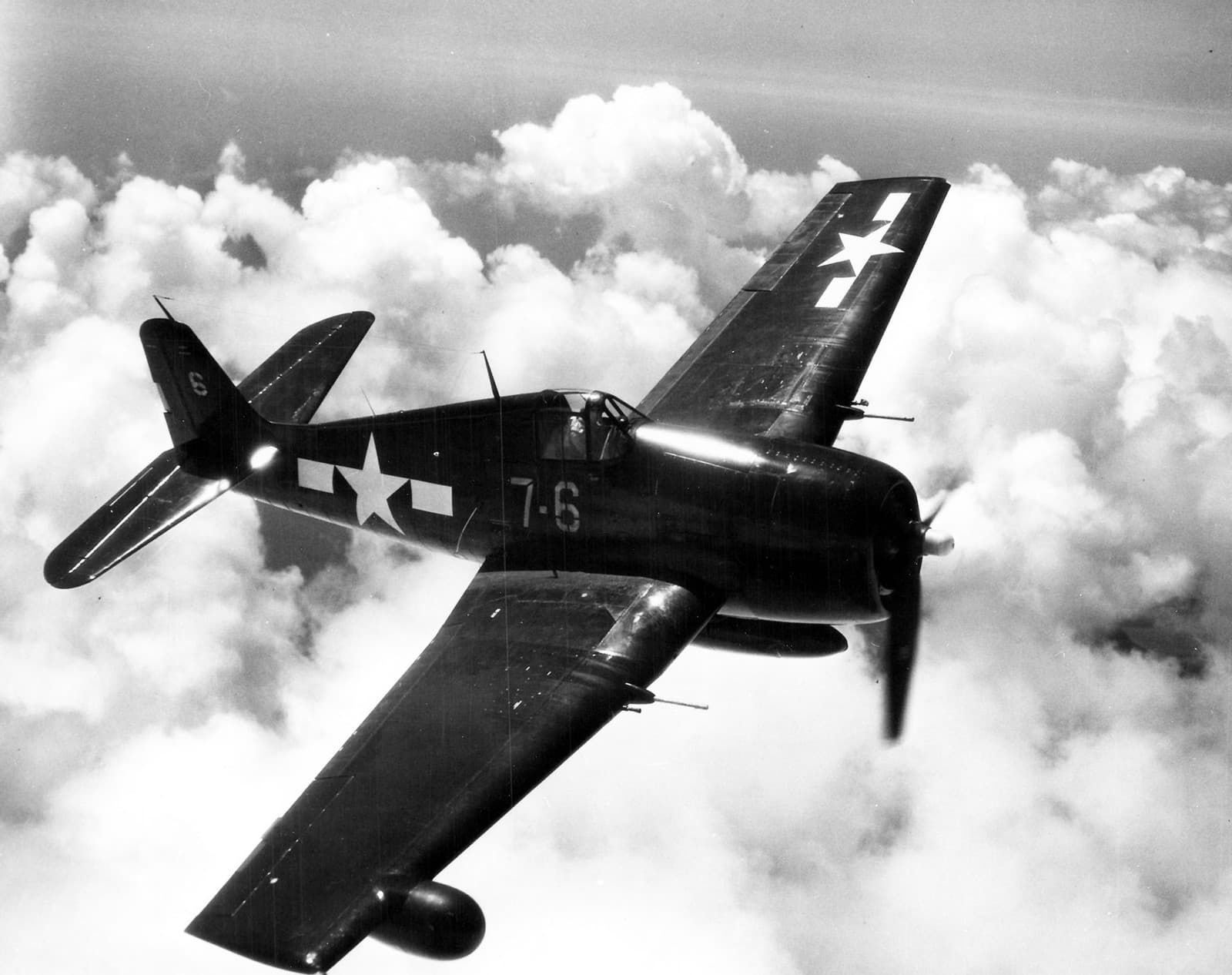
Grumman F6F-5 Hellcat
Grumman
How does the F6F-5 stack up?
CompareOverview
The Grumman F6F Hellcat was the United States Navy's dominant carrier-based fighter of World War II and the aircraft most responsible for breaking Japanese air power in the Pacific. Designed from the outset as the direct counter to the Mitsubishi A6M Zero, the Hellcat married the powerful Pratt & Whitney R-2800 engine to a rugged airframe built to Grumman's legendary standards of toughness. The result was a fighter that traded some agility for speed, firepower, armor, and survivability, exactly what American carrier pilots needed.
The Hellcat's combat record is staggering. F6F pilots claimed 5,163 aerial victories against just 270 Hellcats lost in air-to-air combat, a kill ratio of 19:1. The aircraft accounted for 75% of all US Navy aerial victories in the Pacific war. It achieved its most spectacular success during the Battle of the Philippine Sea in June 1944, the "Great Marianas Turkey Shoot," where Hellcat pilots destroyed over 350 Japanese aircraft in a single day.
Designed, tested, and in mass production in barely eighteen months, the Hellcat was a triumph of pragmatic engineering. Grumman's Bethpage, Long Island factory produced the big fighters at a remarkable rate, delivering over 12,000 aircraft in just three years. The Hellcat was not the fastest, most agile, or most advanced carrier fighter of the war, but it was exactly the right aircraft at exactly the right time.
Performance Profile
Max Speed
380 mph
at 23,400 ft
Range
1,530 miles
normal
Service Ceiling
37,300 ft
Rate of Climb
3,410 ft/min
Armament
6 guns
6x .50 BMG
Crew
1
Engine
Pratt & Whitney R-2800-10W Double Wasp
2000 hp radial
Development History
Grumman began work on the F6F in early 1941, initially as an improved F4F Wildcat with a Wright R-2600 engine. After Pearl Harbor and early combat reports from Wildcat pilots fighting the Zero, Grumman's engineers, led by chief designer William Schwendler, incorporated lessons learned into a substantially redesigned aircraft. The wing was mounted lower on the fuselage, the cockpit was raised for better visibility, and the aircraft was uparmored to protect against the Zero's 20mm cannons.
The critical design decision was the switch from the R-2600 to the more powerful Pratt & Whitney R-2800 Double Wasp after the prototype's first flight. Leroy Grumman personally pushed for the engine change after feedback from Navy combat pilots. The XF6F-3 with the R-2800-10 first flew on July 30, 1942, and the improvement in performance was dramatic, top speed increased by 25 mph and climb rate improved substantially.
The F6F-3 entered service with VF-9 aboard USS Essex in January 1943 and saw its first combat on August 31, 1943, during raids on Marcus Island. The improved F6F-5, which entered production in April 1944, featured a redesigned engine cowling, spring-tab ailerons for improved roll rate, strengthened tail surfaces, and provisions for two 1,000-pound bombs or six HVAR rockets. Night-fighter variants (F6F-3N and F6F-5N) carried AN/APS-6 radar in a wing pod.
Grumman's production efficiency was remarkable. The Bethpage plant manufactured 12,275 Hellcats in just over three years, peaking at 600 aircraft per month. Workers called the factory the "Iron Works" for its relentless output. Unlike many wartime aircraft, the Hellcat had very few production changes, a testament to how well the original design met operational requirements.
Combat History
The Hellcat's combat debut came on August 31, 1943, when F6F-3s from VF-5 aboard USS Yorktown (CV-10) destroyed a Japanese flying boat near Marcus Island. From that point on, the Hellcat rapidly replaced the F4F Wildcat aboard fleet carriers and became the backbone of the fast carrier task forces that drove across the Pacific.
The first major test came during the strikes on Rabaul in November 1943, where Hellcats from multiple carriers engaged large formations of Japanese aircraft and came away with a lopsided victory. The Battle of the Philippine Sea on June 19-20, 1944, was the Hellcat's greatest triumph. In what American pilots dubbed the "Great Marianas Turkey Shoot," F6F pilots shot down over 350 Japanese aircraft while losing just 23 Hellcats in aerial combat. This single battle effectively destroyed Japanese naval aviation as a fighting force.
Hellcats went on to dominate every subsequent engagement: the strikes on Formosa, the Battle of Leyte Gulf (the largest naval battle in history), and the final campaigns against the Japanese home islands. F6F-5N night fighters proved especially valuable in countering Japanese kamikaze attacks during the Okinawa campaign in 1945, patrolling around the clock to intercept incoming suicide aircraft.
The Hellcat also served with distinction in the Royal Navy's Fleet Air Arm, which operated nearly 1,200 aircraft as the "Gannet." British Hellcats participated in strikes against the Tirpitz, operations in the Indian Ocean, and the British Pacific Fleet's attacks on Japan. By war's end, the F6F had participated in virtually every major naval engagement in the Pacific from late 1943 onward.
Variants
| Designation | Key Differences | Produced |
|---|---|---|
| F6F-3 | Initial production variant, R-2800-10, six .50 cal guns | 4,402 |
| F6F-3N | Night fighter with AN/APS-6 radar pod on starboard wing | 205 |
| F6F-5 | Improved cowling, spring-tab ailerons, bomb/rocket provisions, definitive variant | 6,436 |
| F6F-5N | Night fighter variant of F6F-5 with AN/APS-6 radar | 1,189 |
| F6F-5P | Photo-reconnaissance variant with camera installation | 200 |
Strengths & Weaknesses
+Strengths
- Exceptional kill ratio of 19:1 against Japanese aircraft, the best of any American fighter
- Extremely rugged construction in Grumman tradition; could absorb tremendous punishment and return to the carrier
- Excellent visibility from the high-mounted cockpit, critical for carrier operations and dogfighting
- Stable gun platform with six .50-caliber guns providing heavy, accurate firepower
- Good deck handling qualities and docile low-speed characteristics made it forgiving for carrier landings
-Weaknesses
- Slower than most contemporary land-based fighters, both Allied and Axis
- Less maneuverable than the A6M Zero at low speeds; pilots were trained to avoid turning fights
- Heavy and not as responsive in roll as the F4U Corsair
- Large wing area created drag that limited top speed despite the powerful engine
Pilot Voices
“The Hellcat could do everything we asked of it. It was fast enough to catch the enemy, tough enough to take hits, and steady enough to shoot straight.”
“If the Zero pilot tried to run, we'd catch him. If he turned, we didn't follow, we used our speed to set up another pass. The Hellcat gave us the tools to fight smart.”
Did You Know?
The F6F Hellcat accounted for 75% of all US Navy air-to-air victories in the Pacific war, more than any other Allied naval aircraft.
During the "Great Marianas Turkey Shoot" at the Battle of the Philippine Sea, Hellcat pilots destroyed over 350 Japanese aircraft in a single day, the most lopsided aerial victory in naval history.
Grumman designed the Hellcat with 212 pounds of cockpit armor and self-sealing fuel tanks, having studied captured A6M Zeros to understand exactly where the Japanese fighter was vulnerable.
Commander David McCampbell, the Navy's all-time leading ace with 34 victories, shot down nine Japanese aircraft in a single sortie during the Battle of Leyte Gulf while flying an F6F-5.


