
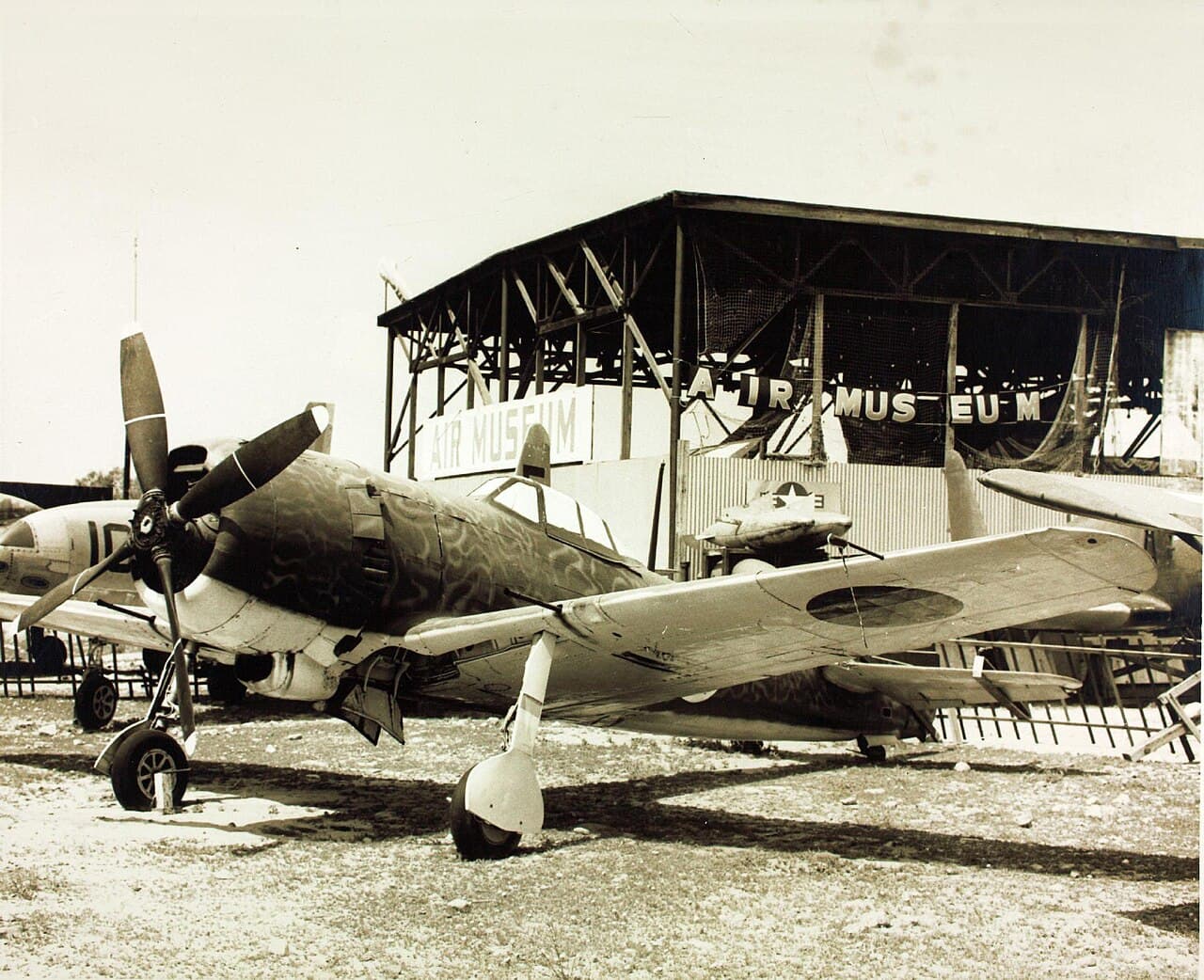
Nakajima Ki-84 Hayate (Gale)
Nakajima · Allied code name: “Frank”
How does the Ki-84 stack up?
CompareOverview
The Nakajima Ki-84 Hayate was the finest fighter produced by Japan during World War II. Known to the Allies as "Frank," the Hayate represented everything the Japanese aviation industry had learned from three years of brutal air combat: it combined the traditional Japanese strengths of maneuverability and climb rate with the armor protection, self-sealing fuel tanks, and heavy armament that earlier designs had fatally lacked. When properly maintained and flown by an experienced pilot, the Ki-84 could meet the P-51 Mustang, P-47 Thunderbolt, and F6F Hellcat on equal or better terms.
The Hayate was the first Japanese fighter designed from the outset with pilot survivability as a priority. It carried 65mm armor glass, a 13mm steel plate behind the pilot's head, and self-sealing fuel tanks, features that had been absent from the Zero and Ki-43. Its armament of two 20mm cannon and two 12.7mm machine guns was more than adequate for any opponent, and it could carry over 1,000 pounds of bombs in the fighter-bomber role.
Tragically for Japan, the Ki-84's effectiveness was undermined by factors beyond its design. The Ha-45 engine was unreliable when built by wartime Japan's deteriorating industrial base, quality control of the airframes declined as factories were bombed, and the replacement pilots assigned to fly it lacked the training to exploit its potential. The Hayate that came off the assembly line in 1945 was often a shadow of the superlative aircraft that had first flown in 1943.
Performance Profile
Max Speed
392 mph
at 20,080 ft
Range
1,053 miles
normal
Service Ceiling
34,450 ft
Rate of Climb
3,790 ft/min
Armament
4 guns
2x 20mm, 2x 12.7mm
Crew
1
Engine
Nakajima Ha-45 (Army Type 4)
1990 hp radial
Development History
Nakajima began designing the Ki-84 in early 1942, drawing on combat reports from China, Southeast Asia, and the Pacific that made clear the next generation of JAAF fighters needed to be faster, better armed, and better protected than the Ki-43. Chief designer Yasushi Koyama created a clean, compact airframe around the new Nakajima Ha-45 18-cylinder radial engine, which promised nearly 2,000 horsepower, almost double the power of the Ki-43's engine.
The first prototype flew in March 1943, and test pilots were immediately enthusiastic. The Ki-84 demonstrated a maximum speed of 392 mph, a climb rate of 3,790 feet per minute, and maneuverability that, while not quite matching the featherweight Ki-43, was still superior to most Allied fighters. Crucially, it achieved this performance while carrying proper armor protection and self-sealing tanks, proving that the "light and unprotected" Japanese design philosophy was not the only path to a competitive fighter.
The Army was so impressed that it placed orders for mass production before testing was complete. Nakajima tooled up at its Ota factory, and deliveries began in April 1944. However, problems quickly emerged with the Ha-45 engine. The complex 18-cylinder powerplant required precision manufacturing that Japan's increasingly strained factories could not consistently deliver. Engine failures, particularly of the reduction gear and crankshaft, plagued operational units.
Late-war variants attempted to address the declining quality of Japanese industry. The Ki-84-Ib replaced the 12.7mm guns with additional 20mm cannon, while the Ki-84-Ic mounted devastating 30mm Ho-155 cannon for use against B-29 Superfortresses. Nakajima also developed the Ki-116, which replaced the temperamental Ha-45 with the lighter, more reliable Ha-112-II engine from the Ki-61, accepting slightly reduced performance for far better reliability. A version with a wooden rear fuselage and wingtips, the Ki-106, was designed to conserve strategic metals, but neither variant entered significant production before the war ended.
Combat History
The Ki-84 first entered combat with the 22nd Sentai in China in August 1944, where it immediately demonstrated its superiority over the P-40s and P-51As of the Chinese-American Composite Wing. Its speed, climb rate, and firepower impressed both Japanese and Allied pilots. From China, Ki-84 units deployed to the Philippines in October 1944, where they would face their most severe test.
During the Philippines campaign, Ki-84s of the 1st, 11th, 22nd, 51st, and 52nd Sentai engaged every type of American fighter in the theater. At their best, Hayate pilots scored impressive victories against P-38s, P-47s, and P-51s. The 22nd Sentai's Captain Kaneyoshi Muto became one of the most successful Frank pilots, demonstrating that the aircraft could outperform its American opponents when engine reliability cooperated. American intelligence reports from the Philippines noted the Ki-84 as the most dangerous Japanese fighter yet encountered.
However, the Philippines campaign also exposed the Ki-84's Achilles heel: the unreliable Ha-45 engine. Serviceability rates were often below 50%, with aircraft grounded for engine failures, oil leaks, and propeller problems. In the Battle of Leyte, many Ki-84s were destroyed on the ground because they could not be maintained in operational condition under American air attack. The combination of engine unreliability, deteriorating fuel quality, and poorly trained replacement pilots meant that the Ki-84 rarely achieved its full potential in combat.
In the final months of the war, Ki-84s were heavily committed to the defense of the home islands, intercepting B-29 Superfortress raids and opposing the expected Allied invasion. The 47th Sentai and other elite units achieved some success against the heavy bombers, though the Ki-84's service ceiling was marginal for high-altitude interception. Some Hayates were also used in kamikaze attacks, a tragic waste of Japan's best fighter.
Variants
| Designation | Key Differences | Produced |
|---|---|---|
| Ki-84-Ia | Standard production model with two 20mm Ho-5 cannon and two 12.7mm Ho-103 machine guns; self-sealing tanks and armor. | 3,100 |
| Ki-84-Ib | Four 20mm Ho-5 cannon replacing the 12.7mm guns for increased firepower against heavy bombers. | 300 |
| Ki-84-Ic | Two 30mm Ho-155 cannon replacing the wing 20mm guns; designed specifically to destroy B-29s. | 60 |
| Ki-116 | Re-engined with lighter Mitsubishi Ha-112-II (1,500 hp); improved handling and reliability but lower top speed. | 3 |
| Ki-106 | All-wood construction to conserve strategic metals; built by Ohji Paper Company. Slightly heavier with reduced performance. | 3 |
Strengths & Weaknesses
+Strengths
- Outstanding overall performance, competitive with the best Allied fighters in speed, climb, maneuverability, and dive
- First Japanese fighter with meaningful pilot protection: 13mm head armor, 65mm armor glass, and self-sealing fuel tanks
- Powerful mixed armament of two 20mm cannon and two 12.7mm guns effective against all targets
- Excellent versatility as both an air superiority fighter and fighter-bomber carrying over 1,000 lbs of bombs
-Weaknesses
- Chronically unreliable Ha-45 engine suffered frequent failures of the reduction gear, crankshaft, and accessories, especially with low-quality wartime manufacturing
- Manufacturing quality declined severely as Japan's factories were bombed and raw materials became scarce, resulting in wide variation between individual aircraft
- Fuel quality issues with low-octane gasoline prevented the engine from reaching its rated power output
- Service ceiling of 34,450 feet was insufficient for high-altitude B-29 interception
Pilot Voices
“When the engine ran properly, the Hayate was the finest aircraft I ever flew. It could do everything, climb, turn, dive, fight. The tragedy was that the engine so rarely ran properly.”
“Frank was the best Japanese fighter we met. When they came at us with altitude and speed, they were very hard to handle. Fortunately, half of them seemed to have engine trouble.”
Did You Know?
Postwar American testing of a captured Ki-84 in optimal condition revealed it could outclimb the P-51D Mustang and P-47N Thunderbolt at all altitudes, and outrun the P-51D below 20,000 feet, confirming that the aircraft's design was superb when the engine actually worked.
The Ki-84's Ha-45 engine was so unreliable in service that the JAAF established special engine overhaul depots near frontline units, something unprecedented for Japanese aviation.
A Ki-106 prototype was built almost entirely of wood by the Ohji Paper Company, one of several Japanese attempts to conserve aluminum as American bombing destroyed the Empire's light metals industry.
Despite its problems, the Ki-84 was produced faster than any other late-war Japanese fighter, with Nakajima delivering over 3,500 aircraft in just 18 months.


