
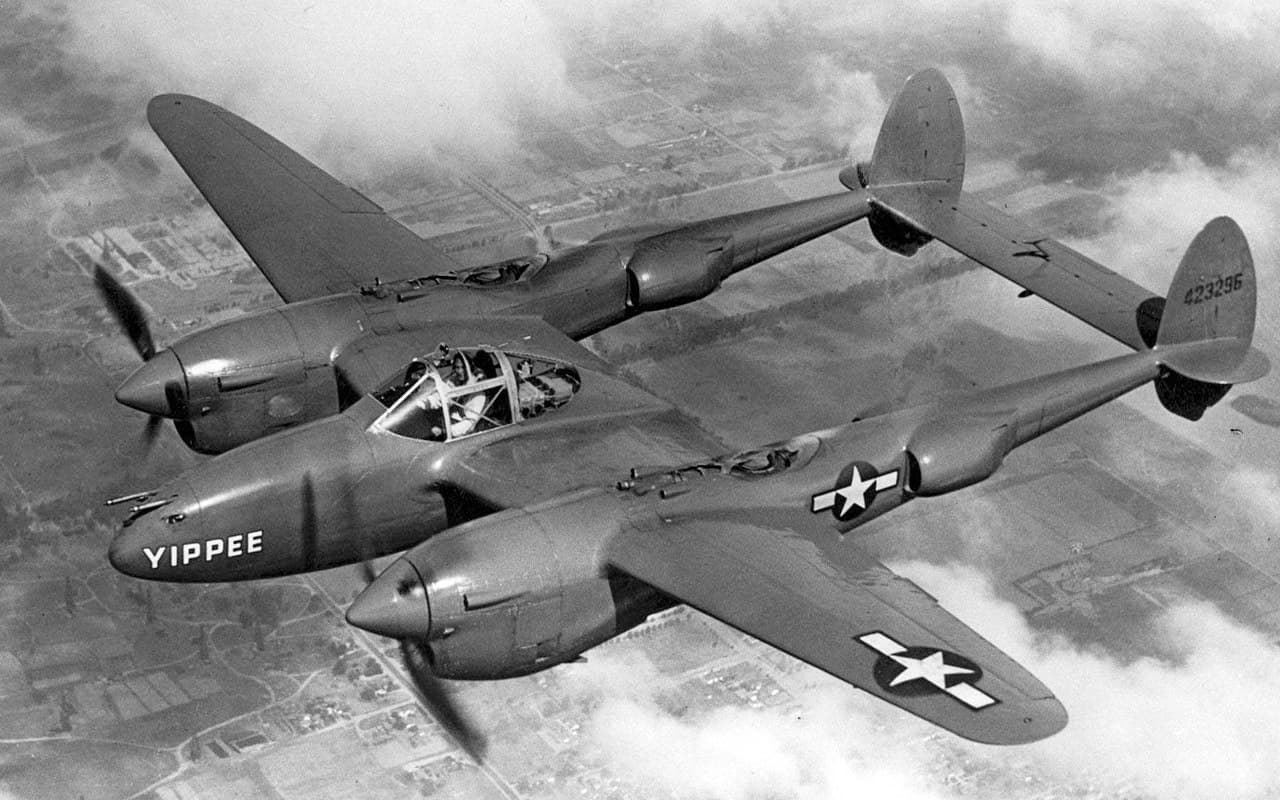
Lockheed P-38J Lightning
Lockheed
How does the P-38J stack up?
CompareOverview
The Lockheed P-38 Lightning was the most distinctive American fighter of World War II, instantly recognizable by its twin-boom configuration with a central nacelle housing the pilot and concentrated nose armament. It was the only American fighter in production throughout the entire US involvement in the war, from Pearl Harbor to V-J Day, and it served in every theater of operations from the frozen Aleutians to the tropical Pacific.
The P-38 was a true multi-role aircraft decades before the term entered common use. It excelled as a long-range escort fighter, high-altitude interceptor, ground-attack platform, and photo-reconnaissance aircraft. The concentrated nose armament of one 20mm cannon and four .50-caliber machine guns gave it a lethal convergent fire pattern at any range, unlike wing-mounted guns that required careful harmonization. Its twin engines provided a safety margin over water that single-engine pilots envied.
America's two top aces, Richard Bong (40 kills) and Thomas McGuire (38 kills), both flew the P-38 in the Pacific theater. The Lightning also carried out one of the most famous missions of the war: the long-range interception and killing of Admiral Isoroku Yamamoto over Bougainville on April 18, 1943.
Performance Profile
Max Speed
414 mph
at 25,000 ft
Range
2,600 miles
ferry
Service Ceiling
44,000 ft
Rate of Climb
4,750 ft/min
Armament
5 guns
1x 20mm, 4x .50 BMG
Crew
1
Engine
Allison V-1710-89/91
1425 hp inline
Development History
The P-38 originated from a 1937 Army Air Corps specification calling for a high-altitude interceptor capable of 360 mph at 20,000 feet. Lockheed's brilliant designer, Clarence "Kelly" Johnson, realized that no single engine then available could meet the requirements, so he proposed the radical twin-boom layout with counter-rotating propellers to eliminate torque effects. The XP-38 prototype first flew on January 27, 1939, and demonstrated exceptional performance, but was destroyed in a crash landing at Mitchell Field after an attempted transcontinental speed record flight.
Early P-38 models (D, E, F) suffered from a dangerous phenomenon called "compressibility" in high-speed dives, where the aircraft would tuck under and the pilot could not pull out. This killed several pilots, including the USAAF's first ace, Richard Bong's 5th Air Force commander. The problem was eventually solved in the J model with the addition of electrically operated dive flaps on the lower wing surface, designed by Lockheed engineers working with NACA researchers.
The P-38J represented the mature Lightning. It incorporated the crucial dive flaps, relocated intercoolers from the wing leading edge to chin-mounted scoops under the engines (improving aerodynamics and cooling), increased fuel capacity with leading-edge fuel tanks, and a flat bulletproof windscreen. The -J model also featured improved Allison V-1710-89/91 engines with better high-altitude performance.
The final combat variant, the P-38L, added even more powerful engines and could carry an impressive ordnance load of 4,000 pounds of bombs plus ten HVAR rockets, making it a formidable fighter-bomber. A night-fighter variant, the P-38M, was developed with a radar operator in a raised rear seat and AN/APS-6 radar pod.
Combat History
The P-38 first saw combat during Operation Torch in November 1942, escorting Allied shipping and flying ground-attack missions over North Africa. In the Mediterranean theater, the Lightning established air superiority over Tunisia, Sicily, and Italy. However, its early reputation in Europe was mixed. The Eighth Air Force's P-38 groups struggled over Northern Europe, where extremely cold temperatures at high altitude caused engine failures and the turbocharger intercooler system malfunctioned, leaving pilots without full power when they needed it most.
It was in the Pacific that the P-38 truly shone. The Fifth and Thirteenth Air Forces made the Lightning their primary fighter, and it dominated Japanese opposition from 1943 onward. Its twin-engine reliability over vast ocean distances, long range, and heavy firepower made it the ideal Pacific fighter. The most famous P-38 mission was Operation Vengeance on April 18, 1943, when sixteen P-38Gs flew over 400 miles from Henderson Field on Guadalcanal to intercept and shoot down the transport aircraft carrying Admiral Yamamoto.
Richard Bong, flying P-38s with the 49th Fighter Group in the Southwest Pacific, became America's all-time leading ace with 40 confirmed victories. Thomas McGuire of the 475th Fighter Group accumulated 38 victories before being killed in action in January 1945. The 475th "Satan's Angels" Fighter Group became the top-scoring P-38 unit with over 500 aerial victories.
The F-5 photo-reconnaissance variant of the P-38 was arguably the most important Allied recon platform, flying mapping and damage assessment missions over every theater. Antoine de Saint-Exupery, the famous French author of "The Little Prince," disappeared while flying an F-5 Lightning on a reconnaissance mission over southern France on July 31, 1944.
Variants
| Designation | Key Differences | Produced |
|---|---|---|
| P-38F | First combat-ready variant, V-1710-49/53, rack for drop tanks/bombs | 527 |
| P-38G | Improved V-1710-51/55, better radio, used in Yamamoto mission | 1,082 |
| P-38H | V-1710-89/91, automatic oil cooler flaps, improved B-33 turbo | 601 |
| P-38J | Chin intercoolers, dive flaps, leading-edge fuel tanks, definitive variant | 2,970 |
| P-38L | V-1710-111/113 (1,475 hp), hydraulically boosted ailerons, rocket pylons | 3,923 |
| F-5 (various) | Photo-reconnaissance variants with cameras replacing guns, multiple sub-variants | 1,400 |
Strengths & Weaknesses
+Strengths
- Twin engines provided safety over water and remote areas, critical advantage in the Pacific
- Concentrated nose armament gave convergent fire at all ranges without harmonization concerns
- Exceptional climb rate and high-altitude capability
- Long range with drop tanks, suitable for Pacific distances
- Counter-rotating propellers eliminated torque, making it easy to handle on takeoff and in combat
-Weaknesses
- Suffered compressibility issues in high-speed dives until dive flaps were added in the J model
- Poor roll rate at high speed compared to single-engine fighters, limiting ability to evade in a dive
- Complex twin-engine systems required more maintenance and experienced ground crews
- Allison engines underperformed at high altitude in cold European conditions, limiting its effectiveness in the ETO
- Large size made it less maneuverable than single-engine opponents in close-in dogfighting
Pilot Voices
“The P-38 was the sweetest-flying plane in the sky. She was forgiving and graceful and beautiful.”
“You fell in love with the Lightning. Two engines, great range, and that firepower concentrated in the nose, it was like pointing a garden hose.”
Did You Know?
The P-38 was the only American fighter in continuous production from before Pearl Harbor through to V-J Day.
America's top two aces of all time, Richard Bong (40 kills) and Thomas McGuire (38 kills), both scored all their victories in the P-38.
Antoine de Saint-Exupery, author of "The Little Prince," was lost while flying an F-5 Lightning reconnaissance mission over southern France on July 31, 1944.
The Germans nicknamed the P-38 "der Gabelschwanz-Teufel" (the Fork-Tailed Devil).


