
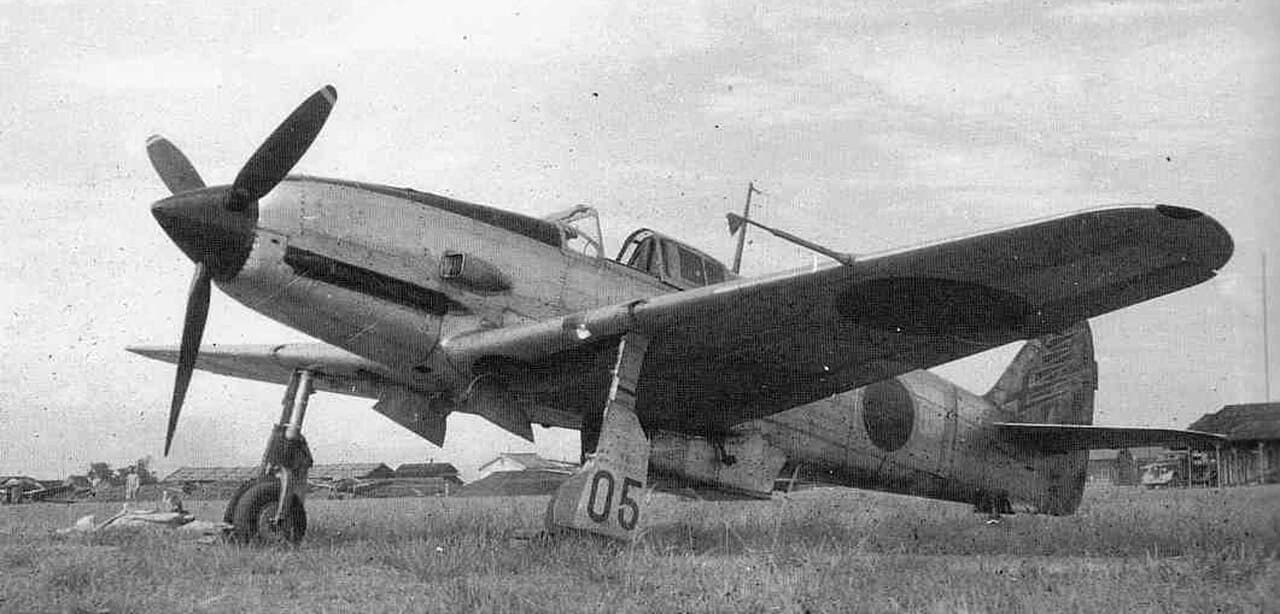
Kawasaki Ki-61-I Hien (Swallow)
Kawasaki · Allied code name: “Tony”
How does the Ki-61-I stack up?
CompareOverview
The Kawasaki Ki-61 Hien was a fighter unlike any other in the Japanese inventory, a sleek, inline-engined interceptor that looked more like a German Bf 109 than any product of Japanese aviation. Allied pilots encountering it for the first time over New Guinea in 1943 initially reported it as an "Italian fighter" or a German aircraft operated by Japan, leading to the reporting name "Tony" (after the Italian stereotype). In reality, the Ki-61 was an entirely Japanese design built around a license-produced Daimler-Benz DB 601 engine, giving it characteristics fundamentally different from every other Japanese fighter.
The Hien's inline engine gave it a slender, streamlined fuselage that provided excellent speed in a dive and good high-altitude performance, areas where radial-engined Japanese fighters typically struggled. It was also the first Japanese fighter to enter service with self-sealing fuel tanks and pilot armor as standard equipment. In the hands of an experienced pilot, the Ki-61 was a balanced, versatile fighter capable of both the traditional Japanese turning fight and the high-speed slashing attacks favored by Allied pilots.
The Hien's great weakness was the very engine that defined it. The Ha-40 was a licensed copy of an already-temperamental German powerplant, and Japanese industry struggled to manufacture it to the required tolerances. Engine failures plagued operational units, with some reporting that more Ki-61s were lost to mechanical problems than to enemy action. Despite this, the Hien served with distinction over New Guinea, the Philippines, and the Japanese home islands, where it was one of the few fighters that could effectively intercept high-flying B-29 Superfortresses.
Performance Profile
Max Speed
368 mph
at 15,945 ft
Range
684 miles
normal
Service Ceiling
37,730 ft
Rate of Climb
2,990 ft/min
Armament
4 guns
2x 20mm, 2x 12.7mm
Crew
1
Engine
Kawasaki Ha-40 (licensed Daimler-Benz DB 601A)
1175 hp inline
Development History
The story of the Ki-61 begins in the late 1930s, when Kawasaki acquired a license to produce the Daimler-Benz DB 601A liquid-cooled inline engine. While every other Japanese manufacturer focused on air-cooled radials, Kawasaki's chief designer Takeo Doi saw the advantages of the streamlined inline configuration: lower drag, better high-altitude performance, and compatibility with a hub-mounted cannon. The resulting Ki-61 was designed from the outset around the Japanese-built Ha-40 engine.
The first prototype flew in December 1941, just days after Pearl Harbor. Flight testing revealed an aircraft with excellent speed and dive characteristics but disappointing maneuverability compared to the lightweight Ki-43. Army test pilots, conditioned by years of flying ultra-agile radial-engined fighters, initially disliked the Ki-61's heavier handling. However, combat pilots who had faced the faster, heavier Allied fighters appreciated the Hien's ability to dive, zoom, and fight at higher speeds.
Production of the Ki-61-I began in late 1942 at Kawasaki's Kagamigahara plant. The initial Ki-61-Ia carried two 12.7mm and two 7.7mm guns, but combat in New Guinea quickly proved this inadequate. The Ki-61-Ib replaced the 7.7mm guns with 12.7mm weapons, and the Ki-61-I-KAIc mounted two 20mm Ho-5 cannon in the wings alongside the fuselage-mounted 12.7mm guns. The 20mm-armed variant became the preferred configuration.
The Ki-61-II, designed around the more powerful Ha-140 engine (a derivative of the DB 605), promised to solve the aircraft's power deficiency. However, the Ha-140 proved even more unreliable than the Ha-40, and bombing of the Akashi engine plant in early 1945 destroyed most of the Ha-140 production line. The approximately 275 Ki-61-II airframes left without engines were re-engined with the reliable Mitsubishi Ha-112-II radial, creating the Ki-100, which ironically became one of the best Japanese fighters of the war.
Combat History
The Ki-61 first entered combat in April 1943 over New Guinea with the 68th and 78th Sentai. Its appearance caused confusion among Allied pilots, who had never seen an inline-engined Japanese fighter and could not identify it. Early reports described encounters with "Bf 109s" or "Italian Macchi fighters" over the Pacific. The Ki-61 proved effective over New Guinea, particularly in the high-speed diving attacks that favored its aerodynamic advantages.
However, the tropical conditions of New Guinea were brutal on the temperamental Ha-40 engine. Heat, humidity, dust, and the lack of proper maintenance facilities caused catastrophic failure rates. The 68th Sentai, one of the first Ki-61 units, lost more aircraft to engine failures and accidents than to enemy action during its initial deployment. Pilots developed a fatalistic attitude about the engine, knowing that a long overwater flight could end with a dead engine and a ditching.
Despite the engine problems, the Ki-61 saw extensive combat across the Pacific. Over Rabaul, it fought against P-38s and Marine F4U Corsairs. During the defense of the Philippines in 1944-45, Ki-61 units engaged P-38 Lightnings, P-51 Mustangs, and P-47 Thunderbolts. The 244th Sentai, based near Tokyo, became one of the most effective B-29 interceptor units, exploiting the Ki-61's relatively good high-altitude performance to reach the Superfortresses at 30,000 feet. On one memorable occasion, a Ki-61 pilot rammed a B-29 over Tokyo, survived, landed safely, and then took off again to ram a second B-29.
The Ki-61's final combat chapter was written by the Ki-100, created when engineless Ki-61-II airframes received the Mitsubishi Ha-112-II radial engine. The Ki-100 proved outstanding, combining the Ki-61's clean airframe with a reliable engine, and fought with distinction in the final defense of Japan against both B-29s and carrier aircraft.
Variants
| Designation | Key Differences | Produced |
|---|---|---|
| Ki-61-Ia | Initial production with two 12.7mm Ho-103 and two 7.7mm Type 89 guns; Ha-40 engine (1,175 hp). | 1,380 |
| Ki-61-Ib | Replaced 7.7mm guns with 12.7mm Ho-103, giving four 12.7mm total. Improved pilot armor. | 1,274 |
| Ki-61-I-KAIc | Wing-mounted 20mm Ho-5 cannon replaced two of the 12.7mm guns; preferred armament configuration. | 388 |
| Ki-61-II | Larger wing, Ha-140 engine (1,500 hp); most airframes re-engined as Ki-100 due to engine failures. | 275 |
| Ki-100 (derivative) | Ki-61-II airframes with Mitsubishi Ha-112-II radial (1,500 hp); excellent performance and reliability. | 395 |
Strengths & Weaknesses
+Strengths
- Excellent dive speed and acceleration in a dive, allowing effective boom-and-zoom tactics uncommon in Japanese fighters
- First Japanese fighter with self-sealing fuel tanks and pilot armor as standard equipment
- Good high-altitude performance thanks to the inline engine, making it one of the few Japanese fighters effective as a B-29 interceptor
- Versatile armament options, with 20mm-armed variants effective against both fighters and bombers
-Weaknesses
- Chronically unreliable Ha-40 engine caused more losses to mechanical failure than enemy action in some units
- Japanese industry could not consistently manufacture the precision liquid-cooled engine to required tolerances
- Liquid-cooled engine was more vulnerable to combat damage than air-cooled radials; a single coolant line hit was fatal
- Maneuverability inferior to the Zero and Ki-43, requiring pilots to adopt unfamiliar energy-fighting tactics
Pilot Voices
“The Hien was fast in a dive and could take hits that would have destroyed a Zero. But every time I took off, I wondered if the engine would hold together long enough to bring me home.”
“We were puzzled when we first met the Tony. It looked German, flew like a European fighter, and for a Japanese plane, it was remarkably sturdy. It was a different kind of fight.”
Did You Know?
Allied pilots who first encountered the Ki-61 over New Guinea initially reported fighting Italian or German aircraft, unable to believe Japan had produced an inline-engined fighter. The reporting name "Tony" was chosen with a deliberate Italian connotation.
Sergeant Chuichi Ichikawa of the 244th Sentai rammed a B-29 Superfortress over Tokyo, survived the collision, bailed out, returned to base, took off in another Ki-61, and rammed a second B-29, surviving again.
The Ki-100, created from engineless Ki-61-II airframes married to a radial engine, proved so successful that pilots preferred it to the far more sophisticated Ki-84 Hayate.
The Ha-40 engine was so problematic that Kawasaki established an entire factory dedicated solely to rebuilding failed engines recovered from crashed Ki-61s.


