
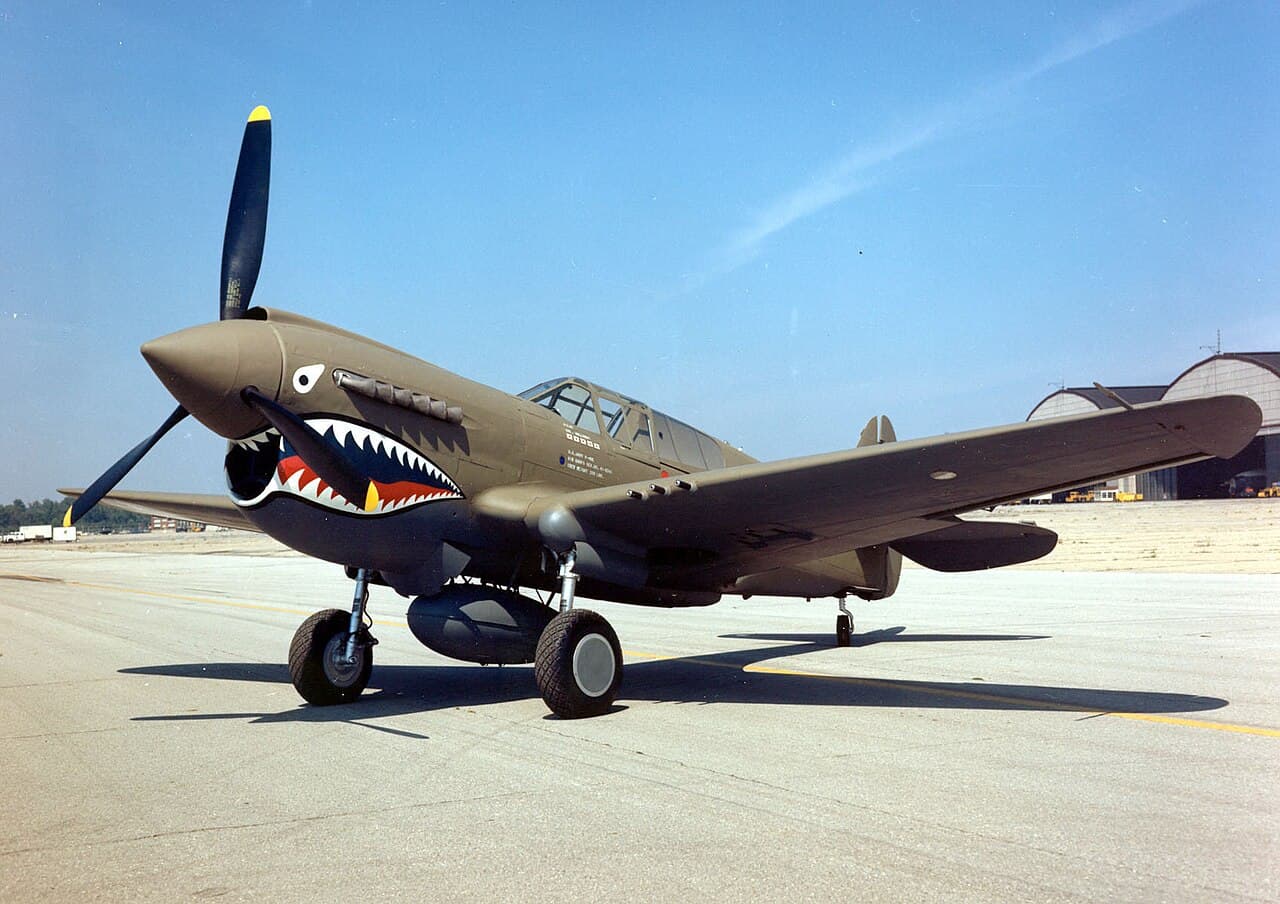
Curtiss P-40E Warhawk
Curtiss-Wright
How does the P-40E stack up?
CompareOverview
The Curtiss P-40 Warhawk was the fighter that held the line for the Allies during the darkest days of World War II. While never the fastest, highest-climbing, or most maneuverable fighter in any theater, the P-40 was available in quantity when nothing else was, and in the hands of skilled pilots it proved a capable and deadly combat aircraft. Its distinctive shark-mouth nose art, made famous by the Flying Tigers in China, became one of the most iconic images of the war.
The P-40 served on every front where the Western Allies fought, from the deserts of North Africa to the jungles of New Guinea, from the skies over Pearl Harbor to the mountains of China and Burma. It was the principal American fighter during the first two years of the war, and RAF Kittyhawks and Tomahawks were instrumental in the North African campaign. Over 13,700 P-40s were built, making it the third most-produced American fighter of the war.
Though outclassed by later designs, the P-40 earned the respect of those who flew it. Its rugged construction, reliable Allison engine, and heavy armament of six .50-caliber machine guns made it effective in the hands of pilots who understood its limitations and exploited its strengths: excellent dive speed, good medium-altitude performance, and the ability to take punishment and keep flying.
Performance Profile
Max Speed
362 mph
at 15,000 ft
Range
850 miles
normal
Service Ceiling
29,000 ft
Rate of Climb
2,100 ft/min
Armament
6 guns
6x .50 BMG
Crew
1
Engine
Allison V-1710-39
1150 hp inline
Development History
The P-40 evolved from the earlier Curtiss P-36 Hawk, one of the first modern monoplane fighters adopted by the Army Air Corps. In 1937, Curtiss engineer Donovan Berlin replaced the P-36's radial engine with the new liquid-cooled Allison V-1710, creating the XP-40 prototype. The conversion was straightforward, and the resulting aircraft won the 1939 fighter competition against Bell, Lockheed, and Seversky designs, largely because it could be put into production immediately.
The early P-40B/C (RAF Tomahawk) carried two .50-caliber nose guns and four .30-caliber wing guns. The P-40D redesigned the nose to accommodate the improved Allison V-1710-39 with an external spur gear reduction, eliminating the nose guns. The P-40E (RAF Kittyhawk I) was the first major production variant with the standard armament of six wing-mounted .50-caliber M2 Brownings, and it became the most widely used early-war P-40 variant.
Curtiss continuously improved the P-40 throughout the war. The P-40F and L models used the Packard-built Merlin engine for improved altitude performance, primarily seeing service in North Africa. The P-40K through N reverted to the Allison engine with progressive improvements in power and performance. The final production variant, the P-40N, was the lightest and fastest of the line at 378 mph, but by 1944 it was thoroughly outclassed by the P-51 and P-47.
Despite its limitations, the P-40's greatest asset was that it was available. When the war began, it was the only modern American fighter in quantity production. Curtiss factories turned out P-40s at rates that filled the immediate need while Republic and North American ramped up production of their superior designs.
Combat History
The P-40's combat career began at Pearl Harbor on December 7, 1941, when Lieutenants George Welch and Kenneth Taylor of the 47th Pursuit Squadron managed to get airborne in their P-40Bs and shoot down several Japanese aircraft. The P-40 became the backbone of the American Volunteer Group (AVG), the "Flying Tigers," who flew P-40Bs and Cs against the Japanese over Burma and China from December 1941 to July 1942, claiming 297 enemy aircraft destroyed.
In North Africa, P-40 Warhawks and RAF Kittyhawks fought through the entire campaign from the Western Desert to Tunisia. The aircraft proved effective in the desert at low and medium altitudes, where its performance was competitive with the Bf 109E/F. Australian P-40s of No. 3 Squadron RAAF scored one of the war's most notable aerial victories when Pilot Officer Andrew Barr shot down the legendary German ace Hans-Joachim Marseille's wingman. The P-40 continued to serve in the Mediterranean through the Italian campaign.
In the Pacific, P-40Es were the primary USAAF fighter in the desperate early battles over the Philippines, Dutch East Indies, and New Guinea. The 49th Fighter Group flew P-40s in some of the most intense air combat of the Pacific war over Port Moresby. Though outmaneuvered by the Zero at altitude, P-40 pilots developed tactics that exploited their aircraft's superior dive speed and ruggedness to achieve respectable kill ratios.
The Soviet Union received over 2,000 P-40s under Lend-Lease, and Soviet pilots flew them effectively on the Eastern Front. The P-40 gradually retired from front-line service in 1943-1944 as P-47s and P-51s became available, but it continued in the training and ground-attack roles until the end of the war.
Variants
| Designation | Key Differences | Produced |
|---|---|---|
| P-40B/C (Tomahawk) | Two .50 cal nose + four .30 cal wing guns, self-sealing tanks, pilot armor | 999 |
| P-40E (Kittyhawk I) | Six .50 cal wing guns, V-1710-39, underwing rack for 500 lb bomb | 2,320 |
| P-40F (Kittyhawk II) | Packard Merlin V-1650-1, improved altitude performance, lengthened fuselage | 1,311 |
| P-40K | V-1710-73, 1,325 hp, improved performance over P-40E | 1,300 |
| P-40N | Lightened structure, V-1710-81, 378 mph, final and most-produced variant | 5,219 |
Strengths & Weaknesses
+Strengths
- Available in large numbers when more advanced fighters were not yet in production
- Excellent dive speed and energy retention, allowing effective boom-and-zoom tactics
- Rugged airframe and reliable Allison engine could absorb significant battle damage
- Six .50-caliber machine guns provided heavy firepower for its class
- Good low and medium altitude performance where much of the fighting occurred
-Weaknesses
- Poor high-altitude performance due to single-stage supercharged Allison engine
- Inferior rate of climb to most contemporary fighters, both Allied and Axis
- Outmaneuvered by the A6M Zero and most Axis fighters in turning combat
- Became obsolete by 1943-1944 but remained in production due to tooling investment
Pilot Voices
“The P-40 is not a bad aircraft, but you have to know how to use it. Never try to dogfight a Zero, dive on him, shoot, and keep going.”
“The shark mouth was good for morale. When those Japs saw those teeth coming at them, it had to give them a fright.”
Did You Know?
The famous shark-mouth nose art of the Flying Tigers was actually inspired by RAF No. 112 Squadron Tomahawks in North Africa, which had copied it from a German Bf 110 unit.
The P-40 was the first American fighter to shoot down an enemy aircraft in World War II, when Lieutenants Welch and Taylor engaged Japanese planes at Pearl Harbor.
Over 2,000 P-40s were sent to the Soviet Union under Lend-Lease, where they served in the defense of Moscow, Leningrad, and the Kuban air battles.
Despite its reputation as outclassed, P-40 pilots of the AVG "Flying Tigers" achieved a kill ratio of approximately 9:1 against Japanese aircraft over Burma and China.


