
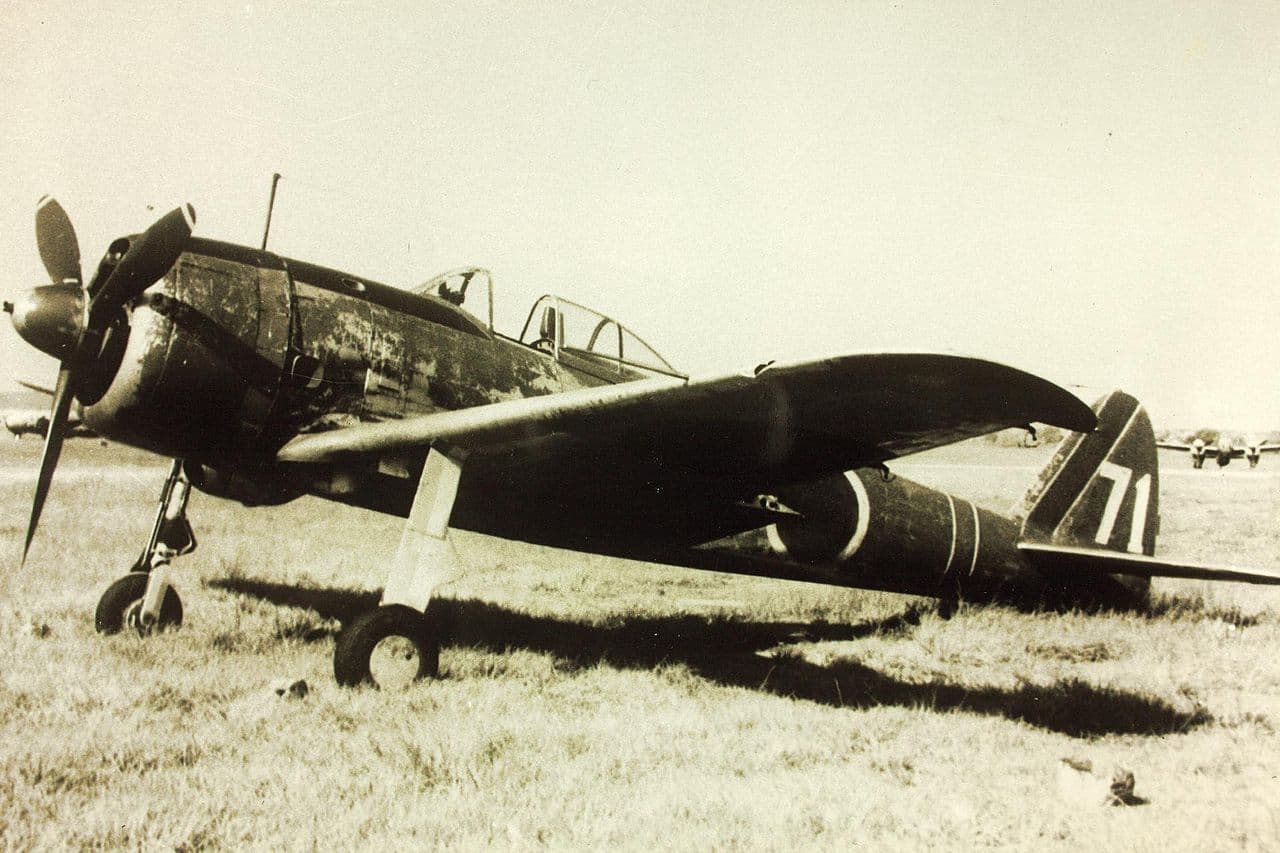
Nakajima Ki-43-II Hayabusa (Peregrine Falcon)
Nakajima · Allied code name: “Oscar”
How does the Ki-43-II stack up?
CompareOverview
The Nakajima Ki-43 Hayabusa was the Imperial Japanese Army Air Force's most important fighter of World War II, serving from the opening day of the conflict through the final surrender. If the Zero was the weapon of the IJN, the Hayabusa, meaning "Peregrine Falcon", was its army counterpart, sharing a similar design philosophy of extreme lightness and agility at the cost of protection and firepower. It was the most numerous JAAF fighter of the war, and more Japanese Army aces scored their victories in the Ki-43 than in any other type.
Allied pilots knew it as "Oscar" and frequently confused it with the Zero, since both were lightweight, highly maneuverable fighters with fixed-pitch propellers and clean, low-wing designs. The Ki-43 was actually even lighter than the Zero, and many experienced pilots considered it the most agile fighter aircraft ever built. Its extraordinary turning ability came from unique "butterfly" combat flaps that could be deployed in dogfights to tighten the turning radius even further.
However, the Hayabusa's Achilles heel was its armament. The Ki-43-I carried only two rifle-caliber 7.7mm machine guns, utterly inadequate for shooting down the rugged Allied bombers and heavily armored fighters it increasingly faced. Even the Ki-43-II's upgrade to twin 12.7mm guns was marginal. Combined with zero armor protection and no self-sealing tanks, the Oscar became increasingly vulnerable as the war progressed, though its pilots fought with tenacious skill to the very end.
Performance Profile
Max Speed
333 mph
at 13,125 ft
Range
1,006 miles
normal
Service Ceiling
36,750 ft
Rate of Climb
3,215 ft/min
Armament
2 guns
2x 12.7mm
Crew
1
Engine
Nakajima Ha-115 (Army Type 1)
1150 hp radial
Development History
Nakajima began designing the Ki-43 in December 1937 to replace the fixed-gear Ki-27 as the JAAF's primary fighter. Chief designer Hideo Itokawa (who would later become known as the father of Japanese rocketry) initially produced a conventional low-wing monoplane with retractable undercarriage, but early flight tests in January 1939 revealed disappointing maneuverability. Army test pilots, accustomed to the Ki-27's extraordinary agility, rejected the prototype as too heavy and unresponsive.
Itokawa went back to the drawing board and radically lightened the airframe, stripping away structural weight and incorporating innovative "butterfly" combat flaps, large slotted flaps that could be partially deployed during combat maneuvering to dramatically reduce the turning radius. The revised Ki-43-I was dramatically more agile, and after extensive testing through 1940, the Army accepted the type for production in January 1941.
The Ki-43-I entered service just months before the Pacific War began, armed with only two 7.7mm machine guns. Pilots quickly demanded heavier armament, and the Ki-43-II, which entered production in late 1942, addressed this with two 12.7mm Ho-103 machine guns (copies of the Browning M2), the more powerful Ha-115 engine with a two-speed supercharger, and a three-blade propeller replacing the original two-blade unit. The wing was slightly reduced in span and strengthened for higher diving speeds.
The Ki-43-III, the final production variant, appeared in mid-1944 with the Ha-112 engine producing 1,230 hp, but it arrived in limited numbers and could not overcome the fundamental limitations of the lightweight airframe. Throughout the war, proposals to add armor and self-sealing tanks were resisted because the resulting weight gain would have destroyed the agility that made the aircraft effective.
Combat History
The Ki-43 saw its combat debut on December 8, 1941, when Hayabusas of the 59th and 64th Sentai swept over Malaya and Burma alongside the broader Japanese offensive. Over Malaya, Ki-43s made short work of RAF Brewster Buffalos and outdated Hawker Hurricanes, establishing complete air superiority that enabled the rapid Japanese advance down the peninsula. Over Burma, Oscar pilots clashed with the American Volunteer Group's P-40s, and the two sides developed a healthy mutual respect, the AVG learned to use dive-and-zoom tactics to counter the Ki-43's turning advantage.
Through 1942 and into 1943, the Ki-43 was the dominant JAAF fighter across Southeast Asia, China, and the Southwest Pacific. In Burma, it fought against RAF Hurricanes, Spitfires, and American P-40s. In New Guinea, it tangled with P-38s, P-39s, and P-40s of the Fifth Air Force. Japanese Army aces like Satoshi Anabuki, who scored 51 victories, built their tallies primarily in the Hayabusa.
As newer Allied fighters arrived in 1943-44, the Ki-43's limitations became painfully apparent. The twin 12.7mm armament could not reliably bring down B-24 Liberators or B-25 Mitchells, and the lack of armor meant that a single burst from an American fighter's six .50-caliber guns was usually lethal. Over Burma in 1944, Spitfire Mk VIIIs and P-47 Thunderbolts outperformed the Oscar in every metric except turning radius.
Despite its obsolescence, the Ki-43 remained the JAAF's most numerous fighter until the end of the war. In the final months, many were used in kamikaze attacks and air defense missions over the home islands. The 64th Sentai, Japan's most famous army fighter unit, flew Hayabusas from the first day of the war to the last.
Variants
| Designation | Key Differences | Produced |
|---|---|---|
| Ki-43-Ia | Initial production; two 7.7mm Type 89 machine guns, Sakae Ha-25 engine (975 hp), two-blade propeller. | 716 |
| Ki-43-Ib | One 7.7mm replaced with 12.7mm Ho-103; otherwise identical to Ia. Field conversion common. | - |
| Ki-43-IIa | Ha-115 engine (1,150 hp), two 12.7mm guns, three-blade prop, reduced wingspan, ejector exhaust stacks. | 2,630 |
| Ki-43-IIb | Simplified production version of IIa with non-adjustable tabs and minor manufacturing shortcuts. | 1,000 |
| Ki-43-III | Ha-112 engine (1,230 hp), individual exhaust stacks for thrust augmentation, further strengthened wing. | 560 |
Strengths & Weaknesses
+Strengths
- Possibly the most maneuverable monoplane fighter of the war; the "butterfly" combat flaps gave it a turning advantage over virtually any opponent
- Extremely light weight provided excellent climb rate and acceleration at low and medium altitudes
- Long range on internal fuel made it effective across the vast distances of the Pacific and Southeast Asian theaters
-Weaknesses
- Woefully inadequate armament of only two 12.7mm machine guns could not reliably destroy Allied bombers or heavily armored fighters
- Total absence of pilot armor and self-sealing fuel tanks made it fatally vulnerable to even light damage
- Low structural strength limited diving speed and high-speed maneuvering, making it unable to escape diving attacks
- Sakae/Ha-115 engine was at its developmental limit, with no path to significantly more power
Pilot Voices
“The Hayabusa responded to the lightest touch. She danced in the air like nothing else I have ever flown. But her guns were like throwing pebbles at a fortress.”
“Never try to turn with an Oscar. He will be on your tail before you complete the first quarter of the turn. Hit him from above and keep your speed.”
Did You Know?
Allied pilots frequently mistook the Ki-43 Oscar for the A6M Zero, since both were lightweight, maneuverable fighters with similar silhouettes. Many "Zero" encounters reported by Army Air Force pilots over Burma and New Guinea were actually against Oscars.
Chief designer Hideo Itokawa later became known as the "father of Japanese rocketry" for his pioneering work in solid-fuel rockets during the postwar era.
The Ki-43's butterfly combat flaps were a unique innovation that no other fighter employed. When deployed in a turn, they could reduce the turning radius by up to 20%, making the Hayabusa essentially impossible to out-turn.
With 5,919 produced, the Ki-43 was the most-built fighter of the Imperial Japanese Army, outnumbering the Ki-84 Hayate by more than a 2:1 margin.


