
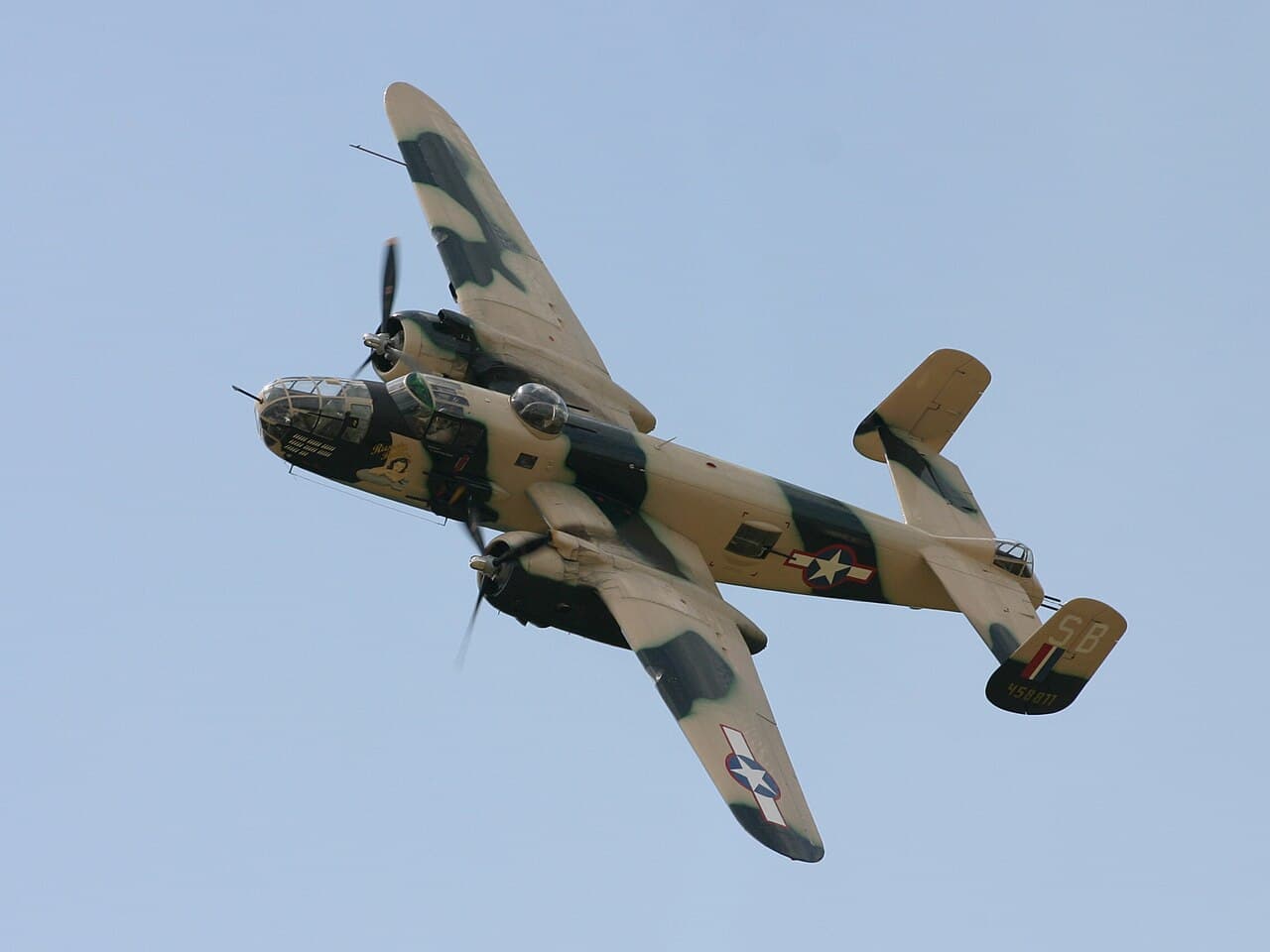
North American B-25J Mitchell
North American Aviation
How does the B-25J stack up?
CompareOverview
The North American B-25 Mitchell was the most versatile and widely used American medium bomber of World War II, named after General Billy Mitchell, the early advocate of air power. The B-25 is best remembered for the Doolittle Raid of April 18, 1942, when sixteen B-25Bs launched from the aircraft carrier USS Hornet to bomb Tokyo in the first American strike against the Japanese homeland, a feat of audacity that electrified a nation still reeling from Pearl Harbor.
Beyond its famous carrier launch, the B-25 served with distinction in every theater of the war. It was equally effective as a level bomber, skip-bomber, strafer, and ship-killer. In the Pacific, B-25s armed with up to fourteen forward-firing .50-caliber machine guns and a 75mm cannon devastated Japanese shipping and airfields in devastating low-level strafing runs. In the Mediterranean and European theaters, B-25s provided the backbone of tactical air support.
With nearly 10,000 built, the Mitchell was one of the most-produced American medium bombers. It served with air forces around the world and continued in military service into the 1960s with several Latin American air forces. Its ruggedness, versatility, and the dash of the Doolittle Raid made it one of the most beloved aircraft of the war.
Performance Profile
Max Speed
272 mph
at 13,000 ft
Range
1,350 miles
normal
Service Ceiling
24,200 ft
Rate of Climb
1,100 ft/min
Armament
12 guns
12x .50 BMG
Crew
6
Engine
Wright R-2600-92 Cyclone 14
1700 hp radial
Development History
The B-25 evolved from North American Aviation's NA-40 design, a twin-engine attack bomber that competed in a 1938 Army Air Corps competition. After the prototype crashed, North American redesigned it as the NA-62, widening the fuselage, adding a bomb bay, and installing more powerful Wright R-2600 engines. The resulting aircraft, designated B-25, first flew on August 19, 1940. Initial deliveries to the Army Air Corps began in February 1941.
The early B-25 and B-25A models were conventional medium bombers, but the B-25B introduced a dorsal and ventral turret. It was the B-25B that was modified for the Doolittle Raid, with extra fuel tanks, reduced armament, and stripped-down weight to enable the unprecedented takeoff from a carrier deck. The B-25C and D were the first major production variants, adding autopilot, de-icing equipment, and external bomb racks.
The most dramatic evolution came in the Pacific theater, where field modifications transformed the B-25 into a devastating low-level strafer. Colonel Paul "Pappy" Gunn of the Fifth Air Force led the effort to install packages of four or more forward-firing .50-caliber guns in the nose and fuselage sides. North American incorporated these modifications into the B-25G and H, which factory-installed a 75mm M4 cannon in the nose, the heaviest weapon ever carried by a standard production medium bomber.
The B-25J, the final and most-produced variant, could be configured as either a glazed-nose bomber or solid-nose strafer. The strafer version carried up to eighteen .50-caliber machine guns, eight in the nose, four in cheek blisters, two in the dorsal turret, two in the waist, and two in the tail, making it the most heavily armed aircraft of the war per pound of airframe.
Combat History
The B-25 first saw combat in the Pacific in early 1942, flying bombing missions from Australia against Japanese positions in New Guinea and the Dutch East Indies. But it was the Doolittle Raid on April 18, 1942, that made the Mitchell famous. Eighty volunteer crews under Lieutenant Colonel James Doolittle launched sixteen B-25Bs from the USS Hornet, 650 miles from Japan, bombing targets in Tokyo, Yokohama, Nagoya, Osaka, and Kobe. The physical damage was minimal, but the psychological impact was enormous, boosting American morale and forcing Japan to divert resources to home defense.
In the Southwest Pacific, the B-25 became the primary ship-killing weapon. During the Battle of the Bismarck Sea in March 1943, B-25s using skip-bombing techniques sank or damaged all eight Japanese transport ships and four of eight escorting destroyers, one of the most one-sided air-sea engagements of the war. Fifth Air Force B-25 crews perfected the art of low-level strafing attacks, coming in at mast height with guns blazing and dropping parafrag bombs on shipping and airfields.
In the Mediterranean, the 12th Air Force operated B-25s extensively in North Africa, Sicily, and Italy. Mitchell groups bombed bridges, rail yards, and troop concentrations in support of the ground campaign. In the CBI theater, B-25s flew missions over Burma and China, supporting the Allied effort to reopen supply routes. The RAF also operated the Mitchell II and III in tactical bombing operations over Europe.
The US Marine Corps operated the B-25 as the PBJ-1, using it in the Philippines and in Marine observation and attack squadrons. By war's end, the B-25 had seen more continuous combat than any other American bomber, serving from the earliest days of the war to the final surrender.
Variants
| Designation | Key Differences | Produced |
|---|---|---|
| B-25B | Dorsal and ventral turrets, tailcone gun position, Doolittle Raid aircraft | 120 |
| B-25C/D | Autopilot, de-icing, external racks, first major production variants (identical, different plants) | 3,915 |
| B-25G | Factory-installed 75mm M4 cannon in solid nose, two .50 cal nose guns | 405 |
| B-25H | Lighter 75mm T13E1 cannon, eight .50 cal nose guns, improved strafer | 1,000 |
| B-25J | Glazed or solid nose, most versatile variant, up to 18 guns in strafer config | 4,318 |
| PBJ-1 (Navy/Marines) | Navy/Marine designation, search radar, torpedo capability | 706 |
Strengths & Weaknesses
+Strengths
- Exceptionally versatile; effective as level bomber, skip-bomber, strafer, and anti-shipping weapon
- Rugged airframe that could absorb significant battle damage, especially in low-level operations
- Devastating forward firepower in strafer configuration, up to 18 .50-caliber machine guns
- Easy to fly and forgiving of pilot errors, making it accessible to less experienced crews
- Adapted well to field modifications, allowing rapid evolution to meet combat needs
-Weaknesses
- Moderate bomb load of 3,000 lbs limited its effectiveness as a strategic bomber
- Relatively short range without external tanks compared to the B-26 Marauder
- The 75mm cannon variants had a low rate of fire and significant recoil that slowed the aircraft
- Vulnerable to fighters when operating alone without escort at medium altitudes
Pilot Voices
“The B-25 was a pilot's airplane. It was honest. It told you when it was about to stall, it didn't surprise you, and it brought you home.”
“We'd come in at mast height with everything firing. It was like flying through a typhoon of our own making.”
Did You Know?
The sixteen B-25Bs that launched from the USS Hornet for the Doolittle Raid could not return to the carrier, all crews either crash-landed in China, bailed out, or were captured by the Japanese.
In the strafer configuration, a B-25J could fire all eighteen .50-caliber machine guns simultaneously, putting out a wall of lead equivalent to 144 rounds per second.
The B-25 was named after General William "Billy" Mitchell, the controversial advocate of air power who was court-martialed in 1925 for insubordination after criticizing military leaders for neglecting aviation.
Colonel Paul "Pappy" Gunn's field modifications of B-25s in the Pacific, adding extra guns and developing skip-bombing techniques, transformed the aircraft from a conventional bomber into the most feared ship-killer in the theater.


